
NEW
Font size
 Worksheets
Unit 8 Ecosystems Test Review
Total questions: 47
Worksheet time: 39mins
List the levels of ecological organization from broadest to smallest.
Biosphere, biome, ecosystem, community, population, organism.
Ecosystem, biosphere, organism, community, population, biome.
Biome, biosphere, community, ecosystem, organism, population.
Population, community, ecosystem, biome, organism, biosphere.
What are biotic factors and give three examples
Any living or once living thing, ex: grass, trees, deer.
Non-living environmental elements such as soil, water, and sunlight.
Chemical properties like pH levels and nutrient content in the environment.
Abiotic elements including minerals and rocks found in nature.
What are abiotic factors and give three examples
Any nonliving part of an ecosystem, ex: sunlight, temperature, dirt.
Any living organism in an ecosystem that interacts with nonliving components.
Only the animals in an ecosystem that feed on plants.
The relationships among organisms in an ecosystem.
What are producers and another name for them
Organisms that make their own food with energy from the sun, autotrophs.
Organisms that obtain energy by consuming other organisms, heterotrophs.
Organisms that decompose dead material to obtain energy, decomposers.
Organisms that rely on relationships with other organisms for energy, symbionts.
What are consumers and another name for them
Organisms that must eat other organisms in order to gain energy, heterotrophs.
Organisms that produce their own food through photosynthesis, autotrophs.
Organisms that break down dead organic matter for nutrients, saprotrophs.
Organisms that absorb sunlight directly and use it for energy, phototrophs.
List what each type of organism consumes.
Herbivore: Eat plants or consume producers. Omnivore: Eats both plants and animals, can be a primary or secondary consumer. Carnivore: Eats only animals, can be a secondary or tertiary consumer.
Herbivore: Eats animals while omnivore consumes only plants, and carnivore eats both plants and animals.
Herbivore: Consumes producers and decomposers, omnivore eats only meat, and carnivore only eats insects.
Herbivore: Eats only meat, omnivore consumes both plants and insects, and carnivore eats only plants.
What kind of organism is at the base of energy pyramids, food chains, and food webs?
Producers (plants).
Consumers (animals).
Decomposers (microbes).
Herbivores (plant-eaters).
Primary consumers consume?
Primary consumers consume (eat) the producers.
Primary consumers consume (eat) the secondary consumers.
Primary consumers consume (eat) the omnivores.
Primary consumers consume (eat) the tertiary consumers.
Secondary consumers consume?
Secondary consumers consume and get energy from primary consumers.
Secondary consumers consume and get energy from producers.
Secondary consumers consume and get energy from decomposers.
Secondary consumers consume and get energy from tertiary consumers.
Tertiary consumers consume?
Tertiary consumer consume and get energy from secondary consumers.
Tertiary consumers obtain energy directly from producers.
Tertiary consumers primarily consume primary consumers.
Tertiary consumers live on decaying organic matter.
What way do arrows point in food chains and food webs?
Arrows point in the direction that the energy is flowing.
Arrows point in the direction that the energy is produced.
Arrows point in the opposite direction of energy flow.
Arrows randomly point in different directions.
What happens to organisms that consume a population that is declining or decreasing?
That population of organisms will also slowly decrease as well.
Organisms will immediately increase in number.
Organisms will remain stable regardless of the population change.
Organisms will migrate to another population.
How does energy move in an energy pyramid?
Energy is transferred from organisms to one trophic level directly above them.
Energy is recycled efficiently among trophic levels.
Energy is constantly reused within each trophic level.
Energy continuously moves from top predators down to the producers.
How much energy transfers to each trophic level?
Only 10% of the energy is transferred, the other 90% is released as heat.
Only 20% of the energy is transferred, the other 80% is released as heat.
Only 5% of the energy is transferred, the other 95% is released as heat.
Only 15% of the energy is transferred, the other 85% is released as heat.
How do invasive species harm native species?
They outcompete the native species for resources, causing the population of the native species to decrease.
They are beneficial because they improve soil quality in native habitats.
They increase biodiversity by adding a new species to the ecosystem.
They enhance native species growth by providing additional food sources.
If you have a large growth of algae in a pond that uses up the oxygen from the water, what happens to the population of the organisms that live in the water?
They are going to die and decrease the populations, since there is no oxygen in the water.
They flourish because they get additional nutrients from the algae.
Their population remains largely unchanged, as they find alternative ways to obtain oxygen.
They migrate to other bodies of water in search of oxygen.
Do you want an ecosystem to have more or less biodiversity?
You want more biodiversity.
You want less biodiversity.
You are indifferent to biodiversity.
Biodiversity doesn't impact ecosystems.
If an ecosystem is sustainable does it have more or less biodiversity? Why?
It has more biodiversity. The more species an ecosystem has the better they are to withstand environmental changes.
It has less biodiversity. A sustainable ecosystem typically supports only the best-adapted species.
It has less biodiversity. Lower biodiversity can minimize resource competition in a mature ecosystem.
It has more biodiversity. However, having too many species could disrupt a balanced ecosystem.
How does human activity, such as overfishing, disrupt an ecosystem?
It causes disruptions by disrupting the energy flow in food chains. It decreases the stability of the ecosystem.
It contributes to a balanced ecosystem by favoring the growth of certain species.
It has no significant impact on the energy flow or the overall stability of the ecosystem.
It benefits the ecosystem by promoting genetic diversity among the remaining species.
Select the correct classification of the 3 types of symbiotic relationships along with their descriptions as given below: - Mutualism: a relationship between two different organisms of different species in which BOTH individuals benefit. - Commensalism: a relationship between two different organisms of different species in which one individual benefits and the other is unaffected. - Parasitism: a relationship between two different organisms of different species in which one individual causes harm to another.
Mutualism: both benefit; Commensalism: one benefits, the other is unaffected; Parasitism: one causes harm to the other.
Mutualism: one benefits, the other is harmed; Commensalism: both benefit; Parasitism: one benefits, the other is unaffected.
Mutualism: both benefit; Commensalism: one is harmed, the other benefits; Parasitism: both are harmed.
Mutualism: one benefits, the other is unaffected; Commensalism: both are harmed; Parasitism: both benefit.
What are the two types of ecological succession?
Primary and secondary succession.
Autogenic and Allogenic succession.
Climax and Non-Climax succession.
Desert and Rainforest succession.
How does ecological succession play a role in an ecosystem’s biodiversity?
As ecological succession occurs, it eventually reaches the climax community where you have the greatest number and diversity of species in an area.
It leads to a uniform distribution of species right from the start, without any changes over time.
It causes a rapid decline in species diversity as dominant species quickly take over the area.
It disrupts the ecosystem balance by hindering the growth of new species throughout the succession process.
Primary succession is characterized by taking a long time, beginning with bare rock, and having pioneer species like lichens and moss to break the rock down, while secondary succession takes a shorter amount of time.
True
False
Make their own food for energy
producers
herbivores
omnivores
carnivores

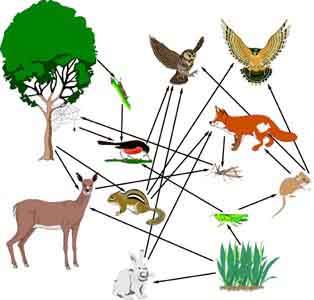
Grasses directly pass energy to...
grasshopper, frog, bird
mouse, rabbit, grasshopper
rabbit, fox, snake
frog, owl, mouse

How many producers are on this food web? Primary consumers (herbivores)?
2, 3
4, 3
3, 3
4, 2

A food pyramid represent the relative amount of energy in trophic levels. Which of the following correctly shows a food pyramid?
A
B
C
D

Which trophic level has the least amount of energy? 1-producers, 2-primary consumers, 3-secondary consumers, 4-tertiary consumers
1
2
3
4

What would happen to the blue whale population if the krill population went extinct?
the blue whale population eats other things in the food web
the blue whale population would increase
The blue whale population would remain the same.
the blue whale population would also decrease

What type of consumer is the shrew?
secondary consumer
primary consumer
tertiary consumer
Answer choices A&B
What is NOT one of the impacts of invasive species?
increases the stability of the ecosystem
depletes native populations
causes increased competition in the ecosystem
interrupts natural biological processes.


Which trophic level has the least amount of energy?
1
2
3
4


Another name for an organism that can produce its own food.
Herbivore
Omnivore
Autotroph
Heterotroph

What will most likely happen to the hawks and rodents if the insects were removed?
There will be more hawks and rodents
The rodents will eat more hawks
There will be fewer rodents and hawks
The hawks will eat more rodents


