Wayground logo

Free Printable Worksheets

Font size

S
M
L
XL
Worksheets

Wave Basics

Total questions: 41

Worksheet time: 2hrs 19mins

Name
Class
Date
1.

this wave moves perpendicular (at a right angle) to the direction the wave is moving

a)

Transverse

b)

Longitudinal

2.

This kind of wave does NOT always need a medium to travel​

a)

Longitudinal

b)

Transverse

3.

These types of waves can be either transverse or longitudinal in nature​

a)

Mechanical Waves

b)

Electromagnetic Waves

c)

Seismic Waves

4.

What do all waves transfer?

a)

Matter

b)

Heat

c)

Electricity

d)

Energy

5.

What are the two types of waves?

a)

longitudinal and transverse

b)

sound and light

6.

What is the number of complete waves passing a fixed point in a given amount of time?

a)

Amplitude

b)

Intensity

c)

Wavelength

d)

Frequency

7.

What is the frequency of this wave? You must count the number of complete waves.

a)

1 Hz

b)

5 Hz

c)

10 Hz

8.

What is frequency measured in?

a)

Milliseconds

b)

Miles

c)

Hertz

d)

Kilograms

9.

What is the distance between the calm sea and the highest wave called?

a)

Wave

b)

Frequency

c)

Amplitude

d)

Magnitude

10.

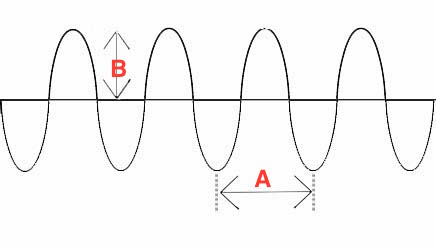
What does #1 represent?

a)

Period

b)

Frequency

c)

Wavelength

d)

Amplitude

11.

What does #2 represent?

a)

Period

b)

Frequency

c)

Wavelength

d)

Amplitude

12.

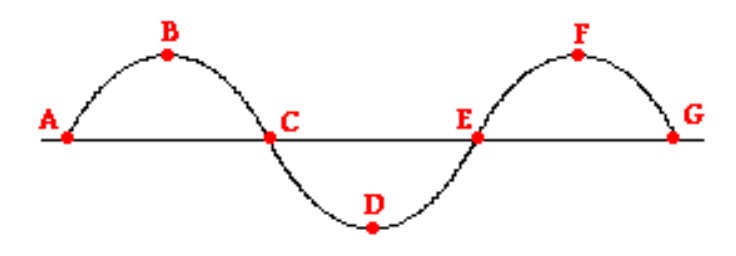
Which letter(s) represent the trough of the wave?

a)

A

b)

B & D

c)

D

d)

C & G

13.
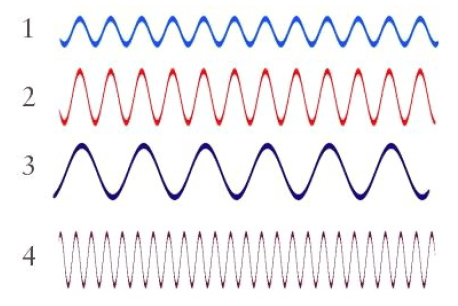
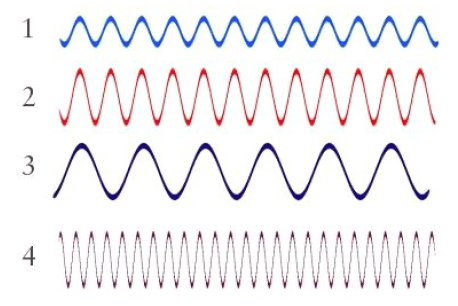
Which wave in the diagram has the greatest frequency?
a)
1
b)
2
c)
3
d)
4
14.

What property of the wave is represented by the letter "A"?

a)

amplitude

b)

crest

c)

trough

d)

wavelength

15.

The highest point on a wave is:

a)

the crest

b)

the trough

c)

the top

d)

the coast

16.
Which wave has a greater frequency?
a)
A
b)
B
17.
How would a person measure the wavelength on this sound wave?
a)
dense to less dense
b)
trough to crest
c)
compression to compression
d)
beginning of illustration to the end
18.

Which wave in the diagram has the greatest wavelength?

a)

1

b)

2

c)

3

d)

4

19.
High Amplitude =__________________
a)
Louder sounds
b)
Quieter Sounds
20.
In General Sound waves travel the fastest in __________
a)
solid
b)
liquid
c)
Gas
d)
plasma
21.
Longitudinal waves are ______.
a)
Parallel
b)
Perpendicular
c)
Crazy
22.
Transverse waves are ___.
a)
Parallel
b)
Perpendicular
c)
Weird
23.
What is the amplitude?
a)
length
b)
height
c)
# of waves
24.
The loudness of the sound depends on
a)
wavelength
b)
amplitude
c)
frequency
25.
What is frequency?
a)
waves
b)
distance between equilibrium to crest
c)
hand motion
d)
The number of wave cycles completed in one second
26.
Compression means.....
a)
Far apart
b)
Close together
c)
Complicated
d)
Stretch
27.
Low Amplitude = ______________
a)
Quieter Sounds
b)
Louder sounds
28.

What is the amplitude of this wave?

a)

4

b)

8

c)

2

d)

6.3

29.

What type of wave move in a back and forth motion?

a)

Compression wave

b)

Light wave

c)

Transverse wave

d)

Hicks-Riddick Wave

30.
What type of wave is this?
a)
Transverse
b)
Longitudinal
31.
What type of wave is this?
a)
Transverse
b)
Longitudinal
32.
Distance from 'y' to 'y' is a _______
a)
Wavelength
b)
Amplitude
c)
Compression
d)
Rarefaction
33.
What is represented by the  letter 'y'?
a)
Compression
b)
Rarefaction
c)
Wavelength
d)
Amplitude
34.
What is represented by the letter 'x'?
a)
Crest
b)
Compression
c)
Rarefaction
d)
Wavelength
35.
Which answer best explains what causes a wave?
a)
Shaking
b)
Potential energy
c)
Light
d)
Vibrations
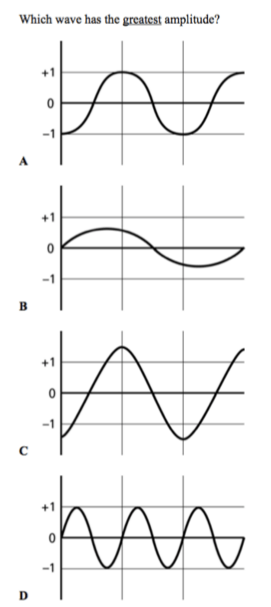
36.
Which wave has the greatest amplitude?
a)
A
b)
B
c)
C
d)
D
37.

In the diagram of a compressional wave, A is showing a ___ while B is showing a ___.

a)

compression, rarefaction

b)

trough, crest

c)

rarefaction, compression

d)

crest, trough

38.

Waves DO NOT transfer ______?

a)

Matter

b)

Energy

39.

When energy increases, amplitude _______?

a)

increases

b)

decreases

c)

stays the same

40.
The material through which a wave travel 
a)
trough
b)
medium
c)
crest
d)
vibration
41.
A disturbance that transfers energy from place to place
a)
Energy
b)
Wave
c)
Force
d)
Motion