Wayground logo

Free Printable Worksheets

Font size

S
M
L
XL
Worksheets

Midterm Biology Review (Spring 2025)

Total questions: 100

Worksheet time: 1hrs 13mins

Name
Class
Date
1.
Which kingdoms are prokaryotic?
a)
Archaebacteria and Animalia
b)
Eubacteria and Archaebacteria
c)
Fungi and Protista
d)
Plantae and Eubacteria
2.
This domain is characterized by bacteria that can live in extreme environments, such as hot springs.
a)
Archaea
b)
Bacteria
c)
Eukarya
d)
Prokarya
3.
 You would find mushrooms and molds in which kingdom?
a)
Plantae
b)
Protists
c)
Fungi
d)
Animalia
4.
In which kingdom do I belong if I am unicellular, autotrophic, and eukaryotic?
a)
Archaebacteria
b)
Protista
c)
Animalia
d)
Plantae
5.
What is the difference between Archaebacteria and Eubacteria?
a)
Eubacteria are eukaryotic.
b)
Archaebacteria are multicellular.
c)
Archaebacteria can live in extreme environments.
d)
Archaebacteria are found everywhere.
6.
All of the following have a nucleus except...
a)
bacteria
b)
animals
c)
plants
d)
protists
7.

The Domain Eukarya contains the kingdom(s):

a)

Archaea

b)

Eubacteria

c)

Plants, Animals, Fungi, Protists

8.

Are Plants unicellular or multicellular?

a)

Unicellular

b)

Multicellular

c)

May be unicellular or multicellular

9.

Are Animals unicellular or multicellular?

a)

Unicellular

b)

Multicellular

c)

May be unicellular or multicellular

10.

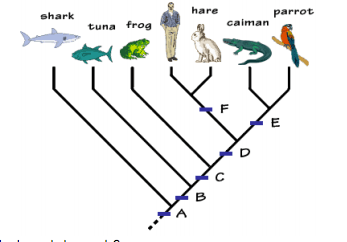
On the cladogram, which organism is the closest relative of the parrot?

a)

Frog

b)

Hare

c)

Caiman

d)

Parrot

11.
Why are advantageous traits more likely to be passed onto offspring?
a)
Because they are more likely to survive and reproduce.
b)
Because they come from dominant alleles.
c)
Because they come from recessive alleles.
d)
Because the trait is an acquired phenotype.
12.

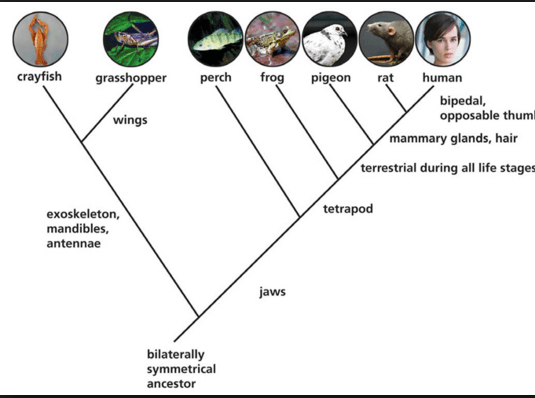
According to the cladogram, which organism is most distantly related to the human?

a)

crayfish

b)

grasshopper

c)

perch

d)

frog

13.

The lizard has all these derived characteristics EXCEPT

a)

Jaws

b)

Lungs

c)

Bipedal

14.

A virus is

a)

living

b)

non living

c)

dead

15.

Viruses need a ____________ in order to make copies of themselves.

a)

bacterial cell

b)

host cell

c)

capsid

d)

vaccine

16.

Has membrane bound organelles

a)

Prokaryote

b)

Eukaryote

c)

Both

17.

What is the chemical equation for photosynthesis?

a)

A. CO2 + H2O -> C6H12O6 + O2

b)

B. C6H12O6 + O2 -> CO2 + H2O

c)

C. C6H12O6 + CO2 -> H2O + O2

d)

D. H2O + O2 -> CO2 + C6H12O6

18.

Where does photosynthesis primarily occur in plants?

a)

A. Stomata

b)

B. Roots

c)

C. Leaves

d)

D. Flowers

19.

Autotrophs (producers) can perform photosynthesis because they have -

a)

Mitochondria

b)

Ribosomes

c)

A Nucleus

d)

Chloroplasts

20.
What are the products of photosynthesis?
a)
water and carbon dioxide
b)
oxygen and glucose
c)
oxygen and carbon dioxide
d)
oxygen and water
21.
What is Anaerobic Respiration?
a)
process of producing energy without oxygen.
b)
process of producing energy with oxygen.
22.
The mitochondria is responsible for ...
a)
photosynthesis
b)
anaerobic respiration
c)
aerobic respiration
d)
fermentation
23.
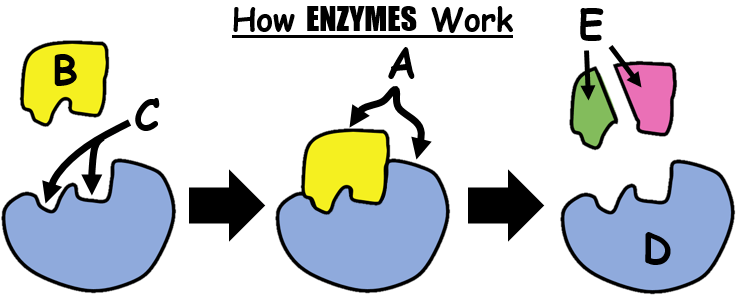
What is being represented by the letter A in the image?
a)
Substrate
b)
Enzyme
c)
Product
d)
Complex
24.
What is being represented by the letter B in the image?
a)
Substrate
b)
Enzyme
c)
Substrate
d)
Product
25.

Identify what is labeled with the letter D

a)

active site

b)

enzyme

c)

substrate

d)

products

26.
Enzymes have an area where reactants called substrates can be brought together in an enzyme-catalyzed reaction. This area on the enzyme is called the
a)
enzyme substrate complex.
b)
reaction site.
c)
active site.
d)
lock and key.
27.
What makes an enzyme specific?
a)
Size
b)
Shape
c)
Name
d)
Location it is found in
28.
Enzymes need certain environmental conditions in order to function properly.  What happens when enzymes are heated to a high temperature?
a)
they die
b)
they denature
c)
they change their amino acid sequence
d)
they work better
29.
Based on their role in the cell, enzymes can also be classified as –
a)
inhibitors
b)
catalysts
c)
sources of energy
d)
vitamins
30.
Enzymes are composed of which of the following monomers? 
a)
amino acids
b)
proteins
c)
nucleotides
d)
monosaccharides
31.
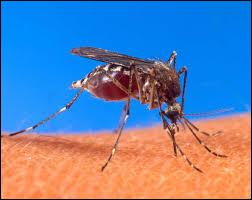
Mosquito  belongs to what kingdom?
a)
Animal Kingdom
b)
Plant Kingdom
c)
Fungi Kingdom
d)
Protista Kingdom
32.

The scientific name for an organism is made from the:

a)

class and family name

b)

genus and species name

c)

domain and kingdom name

d)

kingdom and phylum name

33.

An example of an unicellular organism would be:

a)

monkey

b)

bacteria

c)

spider

d)

human

34.
Binomial nomenclature is the ____________ system for naming organisms.
a)
Numerical
b)
Symbolical
c)
two word
d)
alphabetical
35.

What do plants need for photosynthesis?

a)

Sunlight and C02

b)

Oxygen and fertilizer

36.

What are the reactants in cell respiration?

a)

water, carbon dioxide, light

b)

oxygen, sugar

c)

sugar, water, carbon dioxide

37.

What are the products of cell respiration?

a)

water, light, and sugar

b)

water, carbon dioxide, ATP

c)

oxygen, water, sugar

38.

Plants can only go through photosynthesis not respiration.

a)

True

b)

False

39.
When a specific population grows past the ecosystem's carrying capacity, what happens to the population?
a)
Density Independent limiting factors start to occur resulting in the population going farther above carrying capacity.
b)
Density Dependent limiting factors start to occur resulting in the population going back below carrying capacity.
c)
The population will go extinct due to lack of resources
d)
The population grows then finds a new carrying capacity
40.
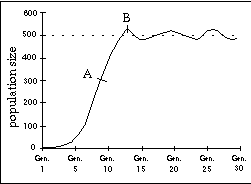
What is the carrying capacity of the graph?
a)
around 500
b)
more than 500
c)
less than 500
d)
around 600
41.

The total number of individuals that can survive in an habitat over time with the resources it has available.

a)
Carrying capacity
b)
Limiting factors
c)
Resources
d)
Population
42.
If the amount of food or resources available increases, the carrying capacity for an animal:
a)
Stays the same
b)
Increases
c)
Decreases
d)
Fluctuates
43.
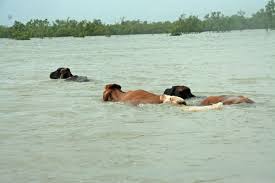
Excessive amounts of rain caused a flood in the southwest United States that resulted in substantial amounts of deaths in the rabbit population? This situation is an example of a density _____________ limiting factor.
a)
density-independent
b)
density-dependent
c)
density- too high
d)
density- too low
44.

Natural disasters can be considered limiting factors.

a)

true: density independent limiting factors

b)

false; natural disasters are not limiting factors

c)

true: density dependent limiting factors

d)

false: because Mrs. Burroughs said so

45.

A lion and a cheetah attempt to occupy the same niche. The more aggressive lion survives; the cheetah does not.

a)

Density-Dependent: Competition

b)

Density-Independent: Competition

c)

Density-Dependent: Predator-Prey

d)

Density-Independent: Predator-Prey

46.

Coyotes cross the winter pack ice and enter Newfoundland. The moose population starts to decline.

a)

Density-Dependent: Competition

b)

Density-Independent: Competition

c)

Density-Dependent: Predator-Prey

d)

Density-Independent: Predator-Prey

47.

Due to severe overcrowding in an Asian village, many children do not survive to reach adulthood.

a)

Density-Dependent: Disease

b)

Density-Independent: Disease

48.

A severe flood in the Red River Valley causes a decline in the deer population.

a)

Density-Dependent

b)

Density-Independent

49.

The number of pythons found throughout Everglades National Park has increased in recent years. These huge snakes are not native to Florida and are believed to have been released into the wild by pet owners. Wildlife biologists have initiated attempts to capture and remove these pythons. Which statement best explains the biologists’ reason for removing these pythons from the Everglades?

a)

The pythons could upset the territorial boundaries of native organisms.


b)

The pythons could adapt to overcome diseases common to native snakes.

c)

The pythons could prey on native organisms and cause native populations to decline.

d)

The pythons could begin to interbreed with native snakes and produce a more successful species.

50.

In the ocean nitrogen is often the limiting nutrient. What does this term mean?

a)

An unlimited amount of nitrogen is in the ecosystem

b)

Nitrogen is scarce or cycles very slowly through the ecosystem.

c)

The presence of nitrogen limits the availability of other nutrients

d)

Nitrogen is overabundant or cycles very quickly through the ecosystem

51.

Each step in a food chain is called a trophic level. What percentage of energy available at one trophic level is transferred to organisms at the next level?

a)

about 2 percent

b)

about 10 percent

c)

about 25 percent

d)

about 50 percent

52.
What growth pattern describes a population whose growth rate slows or stops following a period of exponential growth?
a)
logistic growth
b)
population growth
c)
exponential growth
d)
predator-prey cycle
53.
As you move upward, from level to level, in an energy pyramid, energy _____.
a)
increases
b)
decreases
c)
stays the same
d)
increases exponentially
54.
The living portions of the ecosystem.
a)
Biotic factors
b)
Abiotic factors
55.
The nonliving aspects of an ecosystem.
a)
Abiotic factors
b)
Biotic factors
56.
What is the term for each step in the transfer of energy and matter within a biological community?
a)
energy path
b)
food web
c)
trophic level
d)
food pyramid
57.
The rabbit in this food web would be considered a:
a)
Decomposer
b)
Producer
c)
Secondary Consumer
d)
Primary Consumer
58.
Barnacles grow on whales.  Whales give the barnacles a place to live but the barnacles do not help or harm the whale.  Which type of relationship is this?
a)
commensalism
b)
mutualism
c)
parasitiesm
59.
In which type of relationship do both species benefit?
a)
parasitism
b)
mutualism
c)
commensalism
60.
Which is an example of a parasitic relationship?
a)
a bee pollinates a flower
b)
a tapeworm takes nutrients from a dog
c)
an orchid lives in a tree but does not harm the tree
61.
Which is an example of a parasitic relationship?
a)
a bee pollinates a flower
b)
a tapeworm takes nutrients from a dog
c)
an orchid lives in a tree but does not harm the tree
62.
What would most likely happen if the rabbit population was removed from the food chain grass —› rabbit —› fox?
a)
their would be more grass
b)
there would be less rabbits
c)
there would be more fox
63.

Predator population lags behind prey population because......

a)

Increase in predators leads to decrease in prey

b)

Increase in predators leads to increase in prey

c)

Increase in predators leads to decrease in producers

d)

Increase in producers leads to increase in prey

64.

Which of the following is evaporation of water from plants?

a)

Precipitation

b)

Nitrification

c)

Transpiration

d)

upllift

65.

The Phosphorus cycle is important because phosphorus is contained in

a)

sugars

b)

DNA

c)

proteins

d)

starches

66.

Animals get the carbon they need by

a)

Nitrogen fixation

b)

photosynthesis

c)

cellular respiration

d)

ingestion of plants and animals

67.

In the carbon cycle, the only process that removes CO2 from the atmosphere is

a)

combustion

b)

cellular respiration

c)

decomposition

d)

photosynthesis

68.

The main way nitrogen is removed from the atmosphere and changed into a form plants can use is

a)

Nitrogen Fixation

b)

Nitrification

c)

Ammonification

d)

Denitrification

69.

Each process in the nitrogen cycle is carried out by

a)

bacteria

b)

mice

c)

cows

d)

plants

70.

Decomposers include which of the following?

a)

plants

b)

fungi

c)

bacteria

d)

algae

71.

Denitrification is the process by which bacteria

a)

Make ammonium

NH4+

b)

Create Nitrate

NO3-

c)

Create Nitrite

NO2-

d)

Return nitrogen gas to the air

N2

72.

Legumes are plants like beans, clover, and alfalfa that have bacteria living in nodules on their roots. These bacteria fix nitrogen into a form the plant can use and in return the bacteria get nutrients from the plant as well as a place to live.

This relationship can be best described as ____.

a)

Competition

b)

parasitism

c)

mutualism

d)

commensalism

73.

Which of the following are true of biogeochemical cycles?

a)

They ensure that nutrients are used only once by organisms.

b)

The create new materials to replace lost ones.

c)

They increase the total amount of matter over time.

d)

They can be affected by human activity.

74.

Which of the following is an example of how biogeochemical cycles are important in sustaining life?

a)

The atoms of water molecules are destroyed during a drought.

b)

Oxygen atoms are converted into carbon during cellular respiration.

c)

Nitrogen in wastes are converted into useable nutrients for other organisms.

d)

New carbon atoms are created during the carbon cycle.

75.

Decomposition is part of all cycles except _______

a)

the carbon cycle

b)

the nitrogen cycle

c)

the water cycle

d)

the phosphorus cycle

76.
A particular golf course is using large amounts of nitrogen fertilizer. What process could move this nitrogen into a local stream?
a)
volatilization
b)
nitrogen fixation
c)
runoff
d)
ammonification
77.
What is the process of water droplets or ice crystals falling from the sky?
a)
evaporating
b)
condensing
c)
precipitating
d)
runoff
78.
What cycle is demonstrated in the diagram?
a)
The Carbon cycle
b)
The Water cycle
c)
The Nitrogen cycle
d)
The Life cycle
79.
What is this a picture of?
a)
Nitrogen cycle
b)
carbon cycle
c)
water cycle
d)
plant cycle
80.
Organisms use nitrogen to form
a)
carbohydrates and lipids
b)
proteins and lipids
c)
lipids and nucleic acids
d)
proteins and nucleic acids
81.

The end result of ecological succession is usually a(n)

a)

A.land biome.

b)

B.aquatic biome.

c)

C.unstable community.

d)

D.climax community.

82.

Which of the following is not a possible cause of ecological succession?

a)

A. fire

b)

B. flood

c)

C. earthquake

d)

D. change of season

83.

. Which of the following is an example of primary succession?

a)

A.lichens growing on rocks following a volcanic eruption

b)

B.grasses growing after a forest fire

c)

C.oak trees replacing pine trees in a forest

d)

D. non-native species introduced into a climax community

84.

How is primary succession different from secondary succession?

a)

Primary succession starts with soil.

b)

Secondary succession start with bare rock.

c)

Primary succession starts with bare rock, with lichens and moss.

d)

Fire is an example of primary succession.

85.

Examples of Abiotic Factors include:

a)

Weather, birds, plants, and animals

b)

Rocks, reptiles, shrubs, trees, and grasses

c)

Weather, wind, rain, sunlight, and rocks

d)

Birds, plants, animals, reptiles, shrubs, trees, and grasses

86.

Which of the following best

describes biodiversity

a)

A. a diverse Biology class

b)

B. variety of all life on earth

c)

C. a variety of plants

d)

D. a variety of animals

87.

Abandoned railroad tracks are overgrown with weeds. Ten years later there are small aspen trees growing in the middle of the tracks. This change is an example of:

a)

Primary succession

b)

Biological evolution

c)

Secondary succession

d)

Heterotrophic nutrition

88.
What is a consequence of negative human interactions with the environment?
a)
degradation of soils
b)
destruction of animal habitats
c)
depleted population of certain fish
d)
all of the above
89.
What is the best description of the idea of environmental conservation and sustainability?
a)
Innovating new ways in which humans can store nuclear waste above ground
b)
Innovating new ways in which humans can use and consume more fossil fuels
c)
   Careful and controlled use of renewable and non-renewable resources
d)
Careful and controlled use of renewable resources only
90.
The Eastern United States is dominated by temperate forests, which of the following abiotic factors would have a lasting negative impact on biodiversity in the temperate forest?
a)
clear-cutting
b)
 A reduction in the use of fertilizers
c)
selective cutting
d)
an increase in plant poplulations
91.
what is the leading cause of deforestation?
a)
Diseases 
b)
Housing market
c)
Agriculture and Farming
d)
Paper mill
92.
Which of the following is a fossil fuel?
a)
Wind
b)
Coal
c)
Solar
d)
Biomass
93.
Wind, geothermal, and solar energy are all what type of energy resources?
a)
cheap
b)
potential
c)
renewable
d)
chemical 
94.
What is a second way you could save energy?
a)
Charge your phone as much as you can
b)
Always turn off the lights when you leave you house
c)
Always keep your computer or other electronics on
d)
Buy lots of things on line
95.
What is global warming?
a)
the steady rise of earth's daily temperature
b)
the rapid rise of Earth's average temperature
c)
the steady rise of the United States' daily temperature
d)
the rapid rise of the United States' average temperature
96.
How does global warming affect polar bears?
a)
It could drive polar bears to warmer climates
b)
It could cause wildfires in polar bears' habitats
c)
It could cause severe weather patterns in the Arctic
d)
It could melt the sea ice which would impact their food supply
97.
What absorbs ultraviolet rays in the atmosphere?
a)
troposphere
b)
stratosphere
c)
ozone layer
d)
greenhouse gases
98.
What does this diagram illustrate?
a)
Ozone Layer
b)
The Greenhouse Effect
c)
Ultraviolet Radiation
d)
Layers of the atmosphere
99.
The ozone layer is damaged by
a)
CFCs
b)
Increase in greenhouse gases
c)
Increased global temperatures
d)
Sulfuric and nitric acids
100.

What is an invasive species?

a)

A native (naturally found) species which are added to an area

b)

An organism that is new to an environment and has a negative effect on that environment.

c)

A keystone species in an environment

d)

none of the above