wayground logo

Free Printable Worksheets

Font size

S
M
L
XL
Worksheets

Spring MAP Activity

Total questions: 93

Worksheet time: 1hrs 10mins

Name
Class
Date
1.

Which of the following is an element?

a)

potassium chloride (KCl)

b)

water (H2O)

c)

carbon (C)

d)

calcium carbonate (CaCO3)

2.
Which is an example of a physical change?
a)
Burning wood
b)
Freezing water
c)
Rust on a car
d)
Cooking food
3.

Changing the state of water from ice melting into water is a

a)

catalyst

b)

physical change

c)

chemical change

d)

Precipitate

4.

The substances at the end of a chemical reaction

a)

product

b)

reactant

c)

change

d)

precipitate

5.
If you start a chemical reaction with 5 atoms of helium, how many atoms will you have after?
a)
4 atoms
b)
10 atoms
c)
1 atom
d)
5 atoms
6.

Which of the following is a compound?

a)

zinc (Zn)

b)

magnesium (Mg)

c)

sodium chloride (NaCl)

d)

potassium (K)

7.
In this image, what are the information to the right of the arrow (in black) is called the_______.
a)
Product
b)
Reactant
c)
Chemical Subscript
8.
Is TNT exploding a physical or chemical change?
a)
Physical
b)
Chemical
c)
Both physical and chemical
d)
Neither physical nor chemical
9.

How many atoms of O in CO2

a)

2

b)

1

c)

0

d)

3

10.

The number of substances at the beginning of a reaction

a)

Molecules

b)

Reactants

c)

products

d)

catalysts

11.

How many hydrogen atoms are in 2H2+O2?2H_2+O_2?  

a)

2

b)

4

c)

6

d)

1

12.

Determine whether the following equation is balanced or unbalanced. H2 + Br2 ---> 2HBr

a)

Balanced

b)

Unbalanced

13.

The number written next to an element in the bottom corner

a)

subscript

b)

catalyst

c)

chemical change

d)

temperature

14.

The number of substances at the beginning of a reaction

a)

Molecules

b)

Reactants

c)

products

d)

catalysts

15.
Which is an example of a chemical change?
a)
Burning wood
b)
Rust on a car
c)
Cooking food
d)
All of the above
16.
Which observation(s) might be used as evidence that a chemical reaction occurred?
a)
Color change
b)
Odor change
c)
Properties change
d)
All of the above
17.
________ result(s) in no new substances.
a)
A physical change
b)
A chemical change
c)
Physical and chemical changes
d)
None of the above
18.

The change of a substance into a completely new substance

a)

catalyst

b)

chemical change

c)

physical change

d)

surface area

19.

Determined whether the following equation is balanced or unbalanced. Ag + O2 ---> 2Ag2O

a)

Balanced

b)

Unbalanced

20.

Determine whether the following equations is balanced or unbalanced. H4 + O2 ---> 2H2O

a)

Balanced

b)

Unbalanced

21.

Is a copper penny turning greenish after a few years a chemical or physical change?

a)

Chemical Change

b)

Physical Change

22.

In order for an equation to be balanced, there must be ...

a)

an equal amount of atoms on both sides

b)

a greater mass on the product side

c)

a greater mass on the reactant side

d)

elements with the same atomic # on both sides

23.

How many total atoms are in this compound? Al2O3

a)

2

b)

5

c)

6

d)

3

24.
What is a molecule?
a)
Two or more atoms bonded together
b)
One element
c)
One atom
d)
Solid, Liquid, Gas
25.

Which of the following is a mixture?

a)

Saltwater

b)

Carbon dioxide (CO2)

c)

Iron (Fe)

d)

Glucose (C6H12O6)

26.

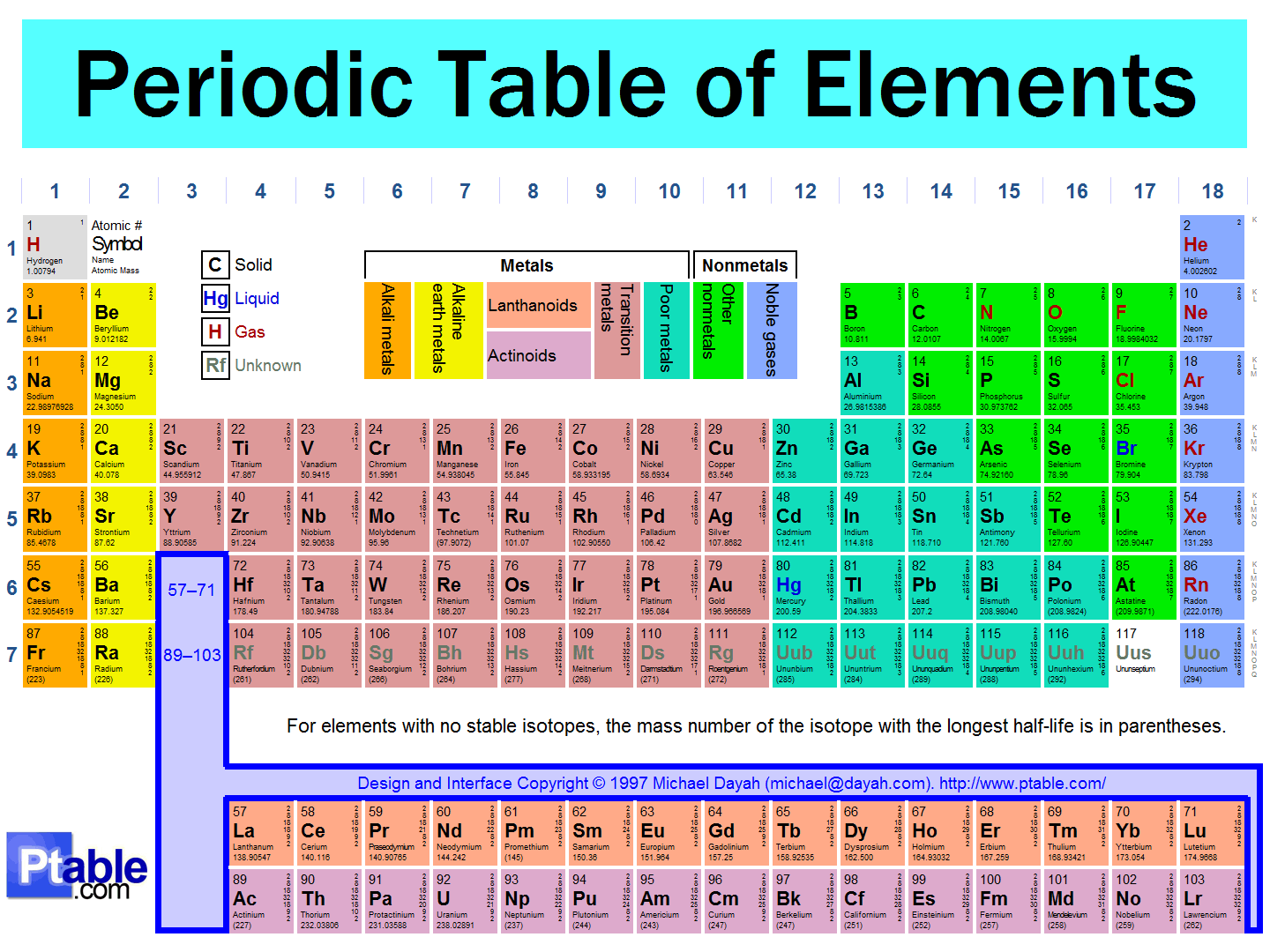
The vertical (up and down) columns in the Periodic Table are called

a)

groups

b)

towers

c)

periods

d)

atomic numbers

27.

The vertical (up and down) columns in the Periodic Table are called

a)

groups

b)

towers

c)

periods

d)

atomic numbers

28.
The atoms along the staircase are called 
a)
metals
b)
nonmetals
c)
metalloids
d)
noble gases
29.

Helium

a)

He

b)

H

c)

El

d)

Li

30.

He

a)

Helium

b)

Hydrogen

c)

Hermium

d)

Help me! pls?

31.

Boron

a)

B

b)

Bo

c)

Br

d)

Be

32.

Phosphorus

a)

P

b)

Pt

c)

Ph

d)

Po

33.

Br

a)

Bromeme

b)

Baron

c)

Bromine

d)

Bismuth

34.

Zn

a)

Zinc

b)

Sink

c)

Bismuth

d)

Zoinks

35.

Cs

a)

Cesium

b)

Chlorine

c)

Carbon

d)

Bismuth

36.

Bi

a)

Bismuth

b)

Boron

c)

Barium

d)

Bimath

37.

Rn

a)

Radon

b)

Radium

c)

Rhodium

d)

Bismuth

38.

Ra

a)

Radium

b)

Radon

c)

Rhodium

d)

Bismuth

39.

C

a)

Carbon

b)

Chlorine

c)

Copper

d)

Calcium

40.

F

a)

Flourine

b)

Bismuth

c)

Flerovium

d)

Francium

41.

Ar

a)

Argon

b)

Aluminum

c)

Arsenic

d)

Bismuth

42.

Krypton

a)

K

b)

Ky

c)

Kp

d)

Kr

43.

Barium

a)

Ba

b)

Bi

c)

B

d)

Br

44.

Uranium

a)

U

b)

Ue

c)

Ur

d)

Ua

45.

H

a)

Hydrogen

b)

Helium

c)

Bismuth

d)

Hassium

46.

Neon

a)

Ne

b)

No

c)

N

d)

Nn

47.

Aluminium

a)

Al

b)

A

c)

Au

d)

Am

48.

Magnesium

a)

Mg

b)

Ma

c)

M

d)

Mn

49.

Chromium

a)

Cr

b)

Cd

c)

C

d)

Co

50.

Ti

a)

Titanium

b)

Tungsten

c)

Bismuth

51.

Na

a)

Sodium

b)

Magnesium

c)

Nitrogen

d)

Bismuth

52.

Calcium

a)

Ca

b)

C

c)

Cl

d)

Cc

53.

Iron

a)

Fe

b)

K

c)

Ir

d)

Xe

54.

Copper

a)

C

b)

Cu

c)

Co

d)

Cp

55.

Pb

a)

Lead

b)

Peanut Butter

c)

Phosphorous

d)

Bismuth

56.

Gold

a)

Au

b)

Ag

c)

G

d)

Bi

57.

Silver

a)

Ag

b)

Au

c)

Si

d)

Sl

58.

Mercury

a)

Hg

b)

Me

c)

M

d)

Sn

59.
What indicates a chemical reaction occurred?
a)

change of odor

b)
gas (bubbles) produced
c)
color change
d)
all of the above
e)

precipitate formation

60.

What is a chemical equation?

a)

Describes the number of elements in a compound.

b)

One or two letters that represent the elements on the periodic table.

c)

The number to the lower right of an element that shows the number of atoms bonded.

d)

A written description of a chemical reaction.

61.

Identify the number in blue.

a)

Product

b)

Reactant

c)

Coefficient

d)

Subscript

62.

A_________is an expression that uses symbols to show the relationship between the starting substances and the substances that are produced by a chemical reaction.

a)

Chemical formula

b)

chemical change

c)

chemical reaction

d)

chemical equation

63.
Matter can not be created nor destroyed: it can only be
a)
Destroyed a little bit
b)
Invisible
c)
Transformed, changed
d)
None of the above
64.

Evidence of a chemical change

a)

A color change

b)

A change in odor

c)

Precipitate formation

d)

Gas bubbles

e)

transformation

65.

When writing a chemical equation:

a)

You must be sure that the reactants and products contain different number of atoms of each element.

b)

You must be sure that the reactants and products contain the same number of atoms of each element.

66.

Which formulas below have coefficients of 4? Check all that apply.

a)

4CO24CO_2

b)

4CH44CH_4

c)

4H2O24H_2O_2

d)

4Br34Br_3

67.

3H2O3H_2O  

Which image below matches this chemical formula?

a)
b)
c)
d)
68.

In ENDOTHERMIC reactions, energy is _____ by the reaction system from the surroundings.

a)

Absorbed

b)

Released

c)

Eliminated

d)

Obliterated

69.

In EXOTHERMIC reactions, energy is _____ from the reaction to the surroundings.

a)

Absorbed

b)

Released

c)

Eliminated

d)

Evaporated

70.

Temperature usually _____ in EXOthermic reactions.

a)

Stays the same

b)

Increases

c)

Decreases

71.

Cooking and baking are _____ reactions.

a)

EXOthermic

b)

ENDOthermic

72.

The starting temperature of a reaction was 21 degrees Celsius and the ending temperature was 44 degrees Celsius. What type of reaction occurred?

a)

EXOthermic

b)

ENDOthermic

73.

Which of the following is a common sign that a chemical change has occurred?

a)

A chemical has turned a different color, bubbled, and/or changed temperature.

b)

A chemical has changed to a different state of matter, such as a liquid to a solid.

c)

A chemical has changed size.

d)

A chemical has become a different shape.

74.
Grinding a seltzer tablet into powder increases the rate of reaction due to increased
a)
concentration
b)
surface area
c)
temperature
d)
reactants
75.
Which factors increase the rate of a reaction.
a)
increasing temperature
b)
increasing concentration
c)
increasing surface area
d)
all of these
76.
A ______________ is a substance that increases the rate of a reaction without being used up during the reaction. 
a)
catalyst
b)
product
c)
reactant
d)
solute
77.

When we investigate the rate of reaction we are looking at the...

a)

amount of product formed

b)

speed of reaction

c)

concentration of reacting particles

d)

combining reactants with products

78.

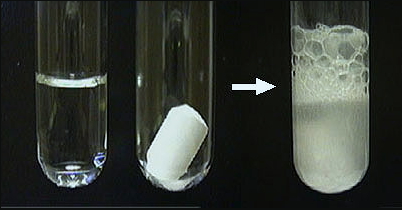
How could we make this reaction happen more quickly?

a)

Decrease the concentration of the acid

b)

crush the chalk to increase the surface area

c)

Put the test tube in an ice bath

79.
To slow down a chemical reaction you will do one of the following:
a)
Place the reactants in hot water
b)
Place the products in ice bath
c)
Place the reactants in a ice bath
d)
Keep stirring the reactants with a stirring rod
80.
The amount of a substance in a given volume.
a)
concentration
b)
temperature
c)
surface area
d)
catalyst
81.
Increasing the concentration increases the speed of reaction by
a)
lowering activation energy
b)
increasing collisions
c)
speeding up the reactants
d)
exposing more reactant
82.

As the frequency of ______________ increases, the rate of reaction increases.

a)

Time

b)

Reactions

c)

Collisions

d)

Reactants

83.

Icing sugar has a greater ______ _____ than a solid cube of

sugar.

a)

Surface Area

b)

Catalyst

c)

Temperature

84.
Organic compounds are in all?
a)

animals

b)

plants

c)
living organisms
d)

trees

e)

all of the above

85.
The basic unit of a chemical element. 
a)
Atoms
b)
Element 
c)
Compounds
d)
Pure Substance 
86.
Represents the name of an element and is written as a capital or a capital letter followed by a lowercase letter.
a)
Atomic Number 
b)
Atomic Mass
c)
Chemical Symbol 
d)
Groups
87.
The number of protons and neutrons in the atom; the average mass of atoms of an element.  
a)
Chemical Symbol 
b)
Atomic Number
c)
Atoms 
d)
Atomic Mass
88.
A substance in which there is only one type of particle that has a specific composition and specific properties.  
a)
Atoms
b)
Elements 
c)
Compounds 
d)
Pure Substance 
89.
A horizontal row of elements numbered 1 through 7.    
a)
Groups 
b)
Element 
c)
Periods 
d)
Chemical Symbols 
90.
A column, or vertical line, left to right of elements numbered 1 to 18. 
a)
Groups 
b)
Periods 
c)
Element 
d)
Atom 
91.
A change in matter that involves a substance going from one state to another without alteration of the chemical composition.   
a)
Chemical Change 
b)
Physical Change 
92.
A pure substance made by chemically combining two or more elements.  
a)
Compounds 
b)
Element 
c)
Atoms 
d)
Subscript 
93.
The number written to the right and slightly below an element in a chemical formula; represents the number of atoms of the element directly in front of it.
a)
Coefficient 
b)
Atom 
c)
Subscript 
d)
Atomic Mass