
Font size
 Worksheets
Energy Transfer and Atmosphere Layers
Total questions: 71
Worksheet time: 37mins
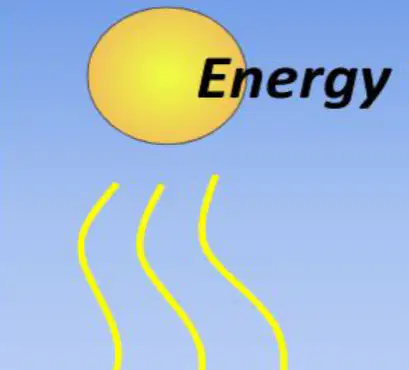
What type of energy transfer occurs when the sun heats up Earth's surface?
Conduction
Convection
Radiation
Reflection
Which process occurs when warm air rises in Earth's atmosphere?
Conduction
Convection
Radiation
Evaporation
What is the process called when the Earth's surface heats up the air?
Conduction
Convection
Radiation
Insulation
How does energy from the Sun travel to Earth's surface?
Through sound waves
Through electromagnetic waves
Through water currents
Through air pressure
What does the warmer object do in heat transfer?
Absorbs heat from the cooler object
Transfers heat to the cooler object
Reflects heat away
Retains all its heat
Which of the following is NOT a process of heat transfer?
Radiation
Conduction
Convection
Reflection
What is the process called when heat is transferred through electromagnetic waves?
Conduction
Convection
Radiation
Insulation
Which process involves heat transfer through direct contact?
Radiation
Conduction
Convection
Evaporation
What is the process of heat transfer through fluid movement?
Radiation
Conduction
Convection
Reflection
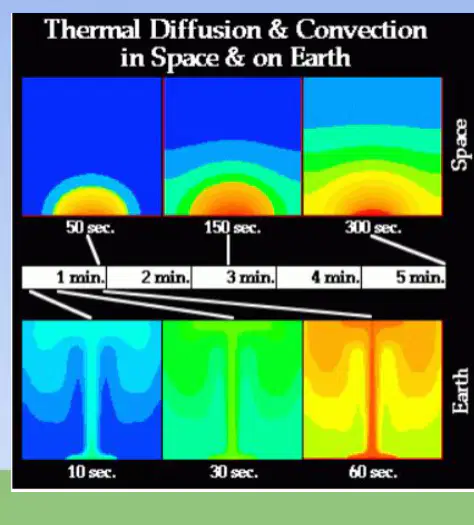
Diagram showing thermal diffusion and convection in space and on Earth over time.
Thermal diffusion and convection occur only on Earth.
Thermal diffusion and convection occur only in space.
Thermal diffusion and convection occur both in space and on Earth.
Thermal diffusion and convection do not occur in space or on Earth.
How does the sun warm the Earth?
Through radiation
Through conduction
Through convection
Through evaporation
What happens when you feel heat without touching the source?
You are experiencing radiation
You are experiencing conduction
You are experiencing convection
You are experiencing insulation
What happens when a pot of water is placed on a stove burner?
Heat is transferred from the burner to the pot and then to the water.
The pot cools down the burner.
The water evaporates immediately.
The burner stops working.
What is an example of conduction mentioned in the text?
Earth’s surface heating the air.
Sunlight traveling through space.
Water freezing in a freezer.
Wind blowing across a field.
What is a real-life example of convection mentioned in the text?
Melting ice in a glass.
Boiling water in a pot.
Heating a metal rod.
Sunlight warming the ground.
What causes warm air to rise in Earth's atmosphere?
It becomes more dense than the surrounding air.
It becomes less dense than the surrounding air.
It becomes heavier than the surrounding air.
It becomes colder than the surrounding air.
What is Earth's Energy Budget?
The balance between incoming and outgoing energy from Earth's atmosphere.
The total amount of energy produced by the sun.
The energy used by humans on Earth.
The energy stored in Earth's core.
When does Earth's Energy Balance occur?
When incoming energy is greater than outgoing energy.
When incoming energy is less than outgoing energy.
When incoming energy plus outgoing energy equals zero.
When there is no incoming energy.
What happens if more energy is going out than is coming in?
The Earth will heat up.
The Earth will cool down.
The Earth will remain the same.
The Earth will gain energy.
What is the equation for Earth's Energy Balance?
Incoming Energy - Outgoing Energy = 0
Incoming Energy + Outgoing Energy = 0
Incoming Energy x Outgoing Energy = 0
Incoming Energy / Outgoing Energy = 0
What is another term for solar radiation from the Sun?
Longwave radiation
Shortwave radiation
Mediumwave radiation
Ultraviolet radiation
What percentage of solar radiation is absorbed by land and oceans?
10%
25%
50%
75%
Why do dark colors absorb more heat than lighter ones?
They reflect more light energy
They absorb more light energy
They are denser
They are cooler
Which regions absorb a lot of the Sun's radiation?
Deserts
Polar regions
Oceans and rainforests
Mountains

What is longwave radiation?
Energy from the sun
Heat converted at Earth's surface
Light from the moon
Sound waves in the atmosphere
What effect is created when some radiation is trapped by the atmosphere?
Greenhouse effect
Solar effect
Lunar effect
Oceanic effect
What are greenhouse gases?
Gases that cool the Earth
Gases that trap heat near Earth's surface
Gases that are only found in space
Gases that cause rain
Which of the following is a greenhouse gas?
Oxygen
Nitrogen
Carbon dioxide
Helium
Why are greenhouse gases important?
They make the Earth colder
They keep the planet at a suitable temperature for life
They cause the Earth to spin faster
They block sunlight completely

What would be the effect on the particles in the animation if more heat is supplied to the system?
They would slow down.
They would stop moving completely.
They would speed up.
There would be no effect.

What Layer do Plants and Animals live in?
Thermosphere
Troposphere
Exosphere
Stratosphere
Mesosphere

What layer houses the International Space Station
Exosphere
Mesosphere
Thermosphere
Troposphere

What layer do Thunderstorms take place in?
Troposphere
Mesosphere
Stratosphere
Thermosphere

This layer houses the coldest place on earth
Thermosphere
Mesosphere
Troposphere
Exosphere

The Mesosphere has all of the following (mark all)
Cold Temperatures
Sprites from Thunderstorms
Iron and other metals
a lot of water vapor

This layer has 99% of the Atmospheric Water Vapor
Mesosphere
Stratosphere
Thermosphere
Troposphere

What contains 5 layers of air that separates Earth from Outer Space?
Water
Atmosphere
Gasses
CO2

The outermost layer of the Atmosphere that is sometimes considered to just be outer space
Troposphere
Thermosphere
Exosphere
Stratosphere
The energy from the absorbed radiation heats the gases in the air and the gases hold the heat in the Earth’s atmosphere. This process is called the
Electromagnetic Waves
Greenhouse Effect
Heat Transfer
El Niño
Which are considered Greenhouse Gasses?
Sodium Chloride, Sodium dioxide, methanicane, and other gases in the air are considered Greenhouse Gases
Sodium Choride and smoky gasses
Water vapor, carbon dioxide, methane, and other gases in the air
Oxygen and Triglyceride
Infrared radiation from Greenhouse Gases is absorbed by which one of the following gasses? Choose the one that has all gasses.
Sodium Chloride, methane, Chloroform
Water Vapor, Methane, Carbon Dioxide.
the Ozone Layer
How are humans contributing to the Greenhouse Effect
By increasing the rate of chemical and mechanical weathering
By shopping too much
By watching Netflix on the weekends and eating strawberry popcorn all day
By increasing Carbon Dioxide (CO2)
The greenhouse effect.....
Protects the ocean from excessive evaporation rates
Is a place where people grow plants because the temperature is regulated
Keeps Earth’s atmosphere at a temperature that is comfortable for most living things
What would happen if the Ozone layer did not exist in the Stratosphere?
Temperatures in the troposphere would decrease
People would experience high temperatures
Greenhouse gasses would increase
nothing at all.
Infrared Radiation that is not absorbed by Greenhouse Gases is reflected back ....
to the Earth
to space
to the toposphere
to the ocean
Increased carbon dioxide may cause global warming by
reducing the amount of oxygen in the air.
allowing more sunlight into the atmosphere.
trapping more heat in the atmosphere.
reflecting more sunlight from clouds.
Gas in Earth's atmosphere that absorbs most of the damaging high-energy UV radiation from the Sun is known as
atmosphere
climate
ozone
air pressure

How are a greenhouse and Earth's atmosphere most alike?
Both prevent harmful radiation from reaching Earth.
Both trap heat inside and prevent it from escaping.
Both lower the temperature to be suitable for life
Both contain large amounts of carbon dioxide
Which of the following greenhouse gases enters our atmosphere through evaporation?
water
carbon dioxide
methane
ozone

Which property of light is being demonstrated in this image?
absorption
diffraction
reflection
bending

Which color of light has the longest wavelength?
violet
green
blue
red

If greenhouse gases increase and build up in our atmosphere, what happens?
They trap more heat and global temperatures rise.
They trap more heat and global temperatures decrease.
They trap less heat and global temperatures rise.
They trap less heat and global temperatures decrease.

What percentage of the Sun's energy is reflected back into space?
100%
About 50%
About 30%
It depends on the weather.

The energy coming in to from the sun minus the energy being radiated out is known as
the greenhouse effect
global warming
Earth's energy budget
the electromagnetic spectrum

Which wavelength is longest?
A
B
C
D

Which of the following is NOT a greenhouse gas?
H2O
CH4
CO2
O2
When solar energy hits the earth
it can be reflected by light colored surfaces like ice
it can be absorbed by light colored surfaces by ice
it can be reflected by dark colored surfaces like asphalt
it cannot affect processes that occur on earth
Heat is radiated back to space from earth as
visible light
ultraviolet radiation
gamma radiation
infrared radiation
The wavelengths of electromagnetic energy that can be seen by humans is known as
ultrared radiation
visible light
ultraviolet radiation
infrared radiation

According to the diagram, what can happen when solar energy hits clouds in Earth's atmosphere?
it can be reflected or absorbed
it can only be absorbed
it can only be reflected
it is neither reflected nor absorbed

The range of wavelengths of radiation(including infrared, visible light, and ultraviolet) is known as
Earth's energy budget
solar flares
the greenhouse effect
the electromagnetic spectrum
Why does visible light appear white?
it is made of ultraviolet radiation
it is made of only white wavelengths of light
it is a combination of all of the different wavelengths of light
Which type of solar energy has the longest wavelength?
ultraviolet radiation
they all have the same wavelengths
visible light
infrared radiation
Carbon dioxide enters our atmosphere through
the burning of fossil fuels
evaporation
the electromagnetic spectrum
the process of photosynthesis



