wayground logo

Free Printable Worksheets

NEW

Font size

S
M
L
XL
Worksheets

Unit 4 Review: Earth's Cycles

Total questions: 72

Worksheet time: 1hrs 15mins
Name
Class
Date
1.
During which stage do clouds form?
a)
condensation
b)
evaporation
c)
precipitation
2.
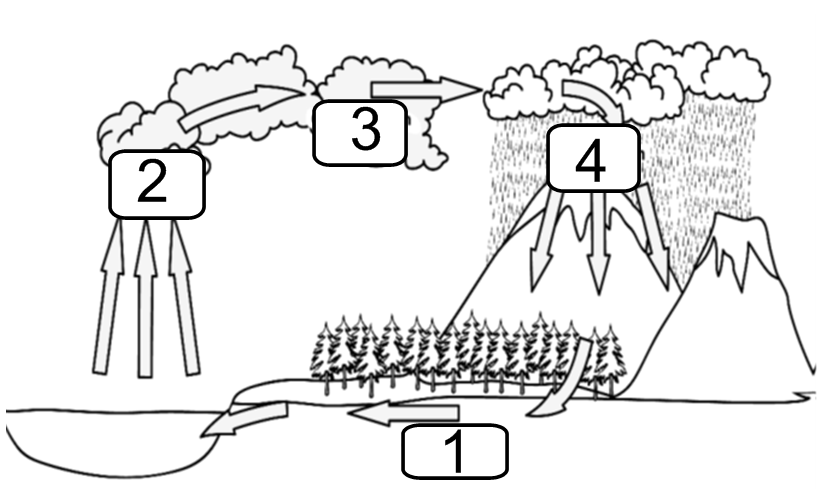
Which stage does the #2 show in the diagram?
a)
condensation
b)
evaporation
c)
precipitation
d)
run off
3.
Which stage does the #3 show in the diagram?
a)
condensation
b)
evaporation
c)
precipitation
d)
run off
4.
what does the #4 show in the diagram?
a)
condensation
b)
evaporation
c)
precipitation
d)
run off
5.
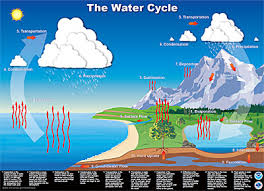
What part of the water cycle does this picture show?
a)
condensation
b)
precipitation
c)
evaporation
6.
Which of these is an example of precipitation?
a)
snow
b)
air
c)
clouds
d)
vapor
7.
Which is the opposite of condensation?
a)
runoff
b)
evaporation
c)
precipitation
d)
transpiration
8.
Which best explains why runoff is important?
a)
It returns water to other locations on Earth
b)
It increases the chance of flooding
c)
It makes evaporation occur faster
d)
It increases condensation
9.
Snow, sleet, hail, and rain are all examples of  ________________. 
a)
evaporation
b)
condensation
c)
accumulation
d)
precipitation
10.

What is it called when WATER is FORMED from an LIQUID to a WATER VAPOR or a [GAS]?

a)

EVAPORATION

b)

PRECIPITATION

c)

TRANSPIRATION

11.
What does groundwater do?
a)
It sends water to our buildings, houses, and water transplant places
b)
to the sky
c)
to the sun
d)
To the Earth's surfaces
12.
What is it called when plants give off water vapor as a waste product?
a)
condensation
b)
evaporation
c)
sublimation
d)
transpiration
13.
When water _________, dew forms.
a)
Melts
b)
Evaporates
c)
Condenses
d)
Precipitates
14.
What is the water cycle?
a)
the 3 forms of water
b)
the movement of water on, above, or below the surface of the Earth
c)
when water melts
d)
when clouds form
15.
Precipitation occurs because 
a)
the droplets evaporate in the air
b)
the droplets are too light for the air to hold
c)
the droplets are too heavy for the air to hold
16.
The ________ is the driving force of the earth's surface.
a)
sun
b)
moon 
c)
stars
17.
Any type of liquid or solid water that falls to earth's surface
a)
evaporation
b)
condensation
c)
precipitation
d)
runoff 
18.
The first step in the water cycle 
a)
evaporation
b)
condensation 
c)
precipitation
d)
there is no first step 
19.
What is the process during which water cools and turns from a gas to a liquid?
a)
Codensation
b)
Runoff
c)
Precipitation
d)
Evaporation
20.
The water cycle is also known as ..........
a)
Hypertonic Solution
b)
Hydrological Cycle
c)
Hyperlogical Cycle
d)
None of these
21.
What is a man-made hole drilled below water table?
a)
natural spring
b)
lake
c)
wetlands
d)
well
22.
Water flows through permeable materials ____________________ than impermeable materials.
a)
slower
b)
faster
23.

97% of the Earth's water is located in....

a)

ground water

b)

the ocean

c)

lakes, rivers, and streams

d)

glaciers

24.
Which of the following has the lowest porosity?
a)
Clay
b)
Silt
c)
Gravel
d)
Sand
25.
Impermeable materials...
a)
have an abundance of pores.
b)
let water in.
c)
have little to no pores.
26.
What is a layer of rock or sediment that holds water?
a)
glacier
b)
well
c)
aquifer
d)
natural spring
27.
An example of BIOsphere connecting to ATMOsphere
a)
plants produce oxygen
b)
animals eat plants
c)
animals live in caves
d)
animals drink water
28.
A sponge has high porosity.  A rock can have it too.  Porosity is...
a)
the inability to hold water
b)
the ability to hold water
c)
allowing water to pass through
29.
If porosity is low then permeability is ______________.
a)
low
b)
high
30.
Poorly sorted soil...
a)
has low porosity
b)
has high porosity
c)
has high pore space
d)
means water will move through quickly
31.
Well sorted soil...
a)
has low porosity
b)
has low pore space
c)
has high porosity
d)
means water will move through slowly
32.
All of the living organisms on earth, including all plants and animals.
a)
geosphere
b)
biosphere
c)
hydrosphere
d)
atmosphere
33.
All of the rocks, minerals, and ground that are found on and in Earth
a)
geosphere
b)
biosphere
c)
hydrosphere
d)
atmosphere
34.
All the water on Earth. This includes all of the rivers, lakes, streams, oceans, groundwater, polar ice caps and glaciers.
a)
geosphere
b)
biosphere
c)
hydrosphere
d)
atmosphere
35.
The outer layer of earth, contains all of the gases on earth
a)
geosphere
b)
biosphere
c)
hydrosphere
d)
atmosphere
36.
 When a volcanic eruption spews gases and ash into the air, which two spheres are interacting? 
a)
a.  Hydrosphere and geosphere
b)
a.  Biosphere and geosphere
c)
a.  Geosphere and atmosphere
d)
a.  Biosphere and atmosphere
37.
The Four Spheres of Earth
a)
are all connected
b)
have nothing to do with one another
c)
exist on Venus and Mars
d)
don't affect human life
38.
 Which sphere does rain belong to?
a)
a.  The atmosphere
b)
a.  The hydrosphere
c)
a.  The geosphere
d)
a.  The biosphere
39.

________________________ is the movement of water through the atmosphere, specifically from over the oceans to over land. Some of the earth's moisture transport is visible as clouds, which themselves consist of ice crystals and/or tiny water droplets.

a)

Transportation

b)

Precipitation

c)

Deposition

d)

Surface runoff

40.

____________________ is the process by which water on the ground surface enters the soil. ________________ rate in soil science is a measure of the rate at which soil is able to absorb rainfall or irrigation.

a)

Infiltration

b)

Percolation

c)

Deposition

d)

Condensation

41.

_____________________ is the conversion between the solid and the gaseous phases of matter, with no intermediate liquid stage. For those of us interested in the water cycle, _____________ is most often used to describe the process of snow and ice changing into water vapor in the air without first melting into water.

a)

Transpiration

b)

Evaporation

c)

Snowmelt runoff

d)

Sublimation

42.

________________ is movement of water past the soil going deep into the groundwater.

a)

Evaporation

b)

Transpiration

c)

Percolation

d)

Sublimation

43.

Water that flows across the land and enters rivers and streams. It eventually flows into lakes and the ocean.

a)

Snowmelt runoff

b)

Surface Runoff

c)

Deposition

d)

Precipitation

44.

Who is the main cause of water pollution ?

a)

Animals

b)

Humans

c)

Both

45.

Water Pollution Effects:

a)

Humans

b)

Animals and their ecosystems

c)

Food Sources

d)

Medical Supplies

e)

All of the above

46.
What type of winds blow constantly, predictably, and over long distances?
a)
land breezes
b)
mountain breezes
c)
global winds
d)
land breezes
47.

Which statement correctly defines wind?

a)

The movement of air from areas of low pressure to areas of high pressure

b)

The movement of air to a colder area in the atmosphere.

c)

The movement of air from areas of high pressure to areas of low pressure.

d)

The movement of air pushed around and bouncing off Earth's surface.

48.

The Coriolis effect causes ___________.

a)

the Earth to rotate on its axis

b)

earthquakes

c)

global winds to move in a curved path instead of a straight line

d)

the Earth to revolve around the sun

49.
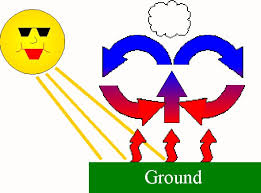
Which diagram shows the formation of a land breeze?
a)
diagram Y
b)
diagram X
c)
neither 
d)
both
50.
Which diagram shows the formation of a sea breeze?
a)
diagram Y
b)
diagram X
c)
neither
d)
both
51.
Which statement correctly describes the properties of cold air?
a)
less dense and less pressure than warm air
b)
more dense and more pressure than warm air
c)
more dense and less pressure than warm air
d)
less dense and more pressure than warm air
52.
Near the top of the troposphere is a narrow band of high speed winds called the______.
a)
westerlies
b)
jet stream
c)
trade winds
d)
local winds
53.
Which global winds are found at the poles? 
a)
Polar Westerlies
b)
Prevailing Easterlies
c)
Polar Easterlies
d)
Trade Winds
54.
Warm, rising air at the Equator forms a calm, weak wind called the:
a)
Doldrums
b)
Trade Winds
c)
Polar Easterlies
d)
Westerlies
55.
Cool, sinking air at 30 degrees North create a pressure belt known as the:
a)
Trade Winds
b)
Doldrums
c)
Horse Latitudes
d)
Westerlies
56.

Winds that blow from 300 latitude to the equator are called...

a)

westerlies

b)

polar easterlies

c)

trade winds

d)

horse latitudes

57.

Winds that blow from 300 latitude to 600 latitude are called...

a)

polar easterlies

b)

westerlies

c)

trade winds

d)

doldrums

58.
Two types of ocean currents are
a)
local and global
b)
sea and land
c)
surface and deep
d)
warm and cold
59.
Due to the Coriolis Effect, water in the northern hemisphere moves
a)
clockwise
b)
counter clockwise
c)
both
d)
neither
60.
Due to the Coriolis Effect, water in the southern hemisphere moves
a)
clockwise
b)
counter-clockwise
c)
both
d)
neither
61.
Warm ocean currents generally come from
a)
The North Pole
b)
The South Pole
c)
The Equator
d)
Both A and B
62.
The Gulf stream carries _____________ water from the east coast of The United States to the West coast of Europe.
a)
Cold
b)
Warm 
c)
Freezing
d)
Fresh
63.

Which layer of the atmosphere has meteors?

a)

troposphere

b)

stratosphere

c)

mesosphere

d)

thermosphere

64.

Which layer of the atmosphere has weather?

a)

troposphere

b)

stratosphere

c)

mesosphere

d)

thermosphere

65.

Which layer of the atmosphere contains the ozone?

a)

troposphere

b)

stratosphere

c)

mesosphere

d)

thermosphere

66.

Temperature increases with height in the ______ due to the ozone trapping heat.

a)

troposphere

b)

stratosphere

c)

mesosphere

d)

thermosphere

67.

Conduction is how heat passes through objects by...

a)

Fluids

b)

Direct Contact

c)

Empty Space

68.

What is the circular motion of hot air rising and cold air sinking?

a)

Radiation

b)

Convection Currents

c)

Electromagnetic Waves

d)

Conduction

69.
What is the transfer of heat by movement of liquids or gases?
a)
Radiation
b)
Convection
c)
Conduction
d)
Heat
70.
Heat transfers from an area of ________temperature to an area of ______ temperature.
a)
high to low
b)
low to high
c)
high to high
71.
Warm water from the ocean moves to the north while cool waters moves to the south. This is an example of.. 
a)
Conduction
b)
Convection
c)
Radiation
72.
Warm air rises and the cool air sinks. This is...
a)
conduction
b)
convection
c)
radiation