

wayground logo

Free Printable Worksheets

Font size

S
M
L
XL
Worksheets

Photosynthesis and Cellular Respiration

Total questions: 53

Worksheet time: 1hrs 27mins

Name
Class
Date
1.

Which of the following best describes the transformation of energy during photosynthesis?

a)

Chemical energy to light energy

b)

Light energy to chemical energy

c)

Thermal energy to chemical energy

d)

Mechanical energy to light energy

2.

What are the inputs required for the process of photosynthesis?

a)

Glucose and Oxygen

b)

Carbon Dioxide and Water

c)

Nitrogen and Water

d)

Oxygen and Water

3.

Which of the following is a product of photosynthesis?

a)

Oxygen

b)

Carbon Dioxide

c)

Nitrogen

d)

Sulfur

4.

Which factor does NOT affect the rate of photosynthesis?

a)

Light intensity

b)

Carbon dioxide concentration

c)

Oxygen concentration

d)

Temperature

5.

What is the role of chlorophyll in photosynthesis?

a)

To absorb water

b)

To absorb light energy

c)

To release oxygen

d)

To store glucose

6.

What is the chemical equation for photosynthesis?

a)

6CO2+6H2OC6H12O6+6O26CO_2 + 6H_2O \rightarrow C_6H_{12}O_6 + 6O_2

b)

C6H12O6+6O26CO2+6H2OC_6H_{12}O_6 + 6O_2 \rightarrow 6CO_2 + 6H_2O

c)

6CO2+6O2C6H12O6+6H2O6CO_2 + 6O_2 \rightarrow C_6H_{12}O_6 + 6H_2O

d)

C6H12O6+6H2O6CO2+6O2C_6H_{12}O_6 + 6H_2O \rightarrow 6CO_2 + 6O_2

7.

Where does photosynthesis occur?

a)

Ribosome

b)

Mitochondria

c)

Chloroplast

d)

Cytoplasm

8.

Which term describes organisms capable of producing their own food?

a)

Consumers

b)

Heterotrophs

c)

Scavengers

d)

Autotrophs

9.

The main function of stomata is to

a)

capture sunlight

b)

protect leaves from insects

c)

allow gases to move rapidly in/out of leaves

d)

release sugars into the atmosphere

10.

A stoma is

a)

an opening

b)

a clot

c)

a cell that captures light energy

d)

a water tube

11.

What is the function of GUARD cells in plants?

a)

Allow gas exchange

b)

Control the opening & closing of the stomata

c)

Contain DNA

d)

Nucleus

12.

What happens to the guard cells when water is not available within a plant?

a)

The guard cells close.

b)

The guard cells open.

c)

The guard cells become double.

d)

The guard cells increase.

13.

Plants use water for photosynthesis. How does that water get into the plant?

a)

through the roots

b)

from rain on the leaves going into the stomata

c)

from moisture in the air going through pores in the leaf

d)

through the leaves

14.

What is the major difference between xylem and phloem?

a)

Xylem transports sugars and organic compounds, while phloem transports water and minerals.

b)

Xylem and phloem have the same function of transporting sugars and organic compounds.

c)

Xylem transports water and minerals, while phloem transports sugars and organic compounds.

d)

Xylem and phloem both transport water and minerals.

15.
What is transpiration?
a)

Excess water being released from the leaf

b)

Excess sugar being released from the leaf
c)
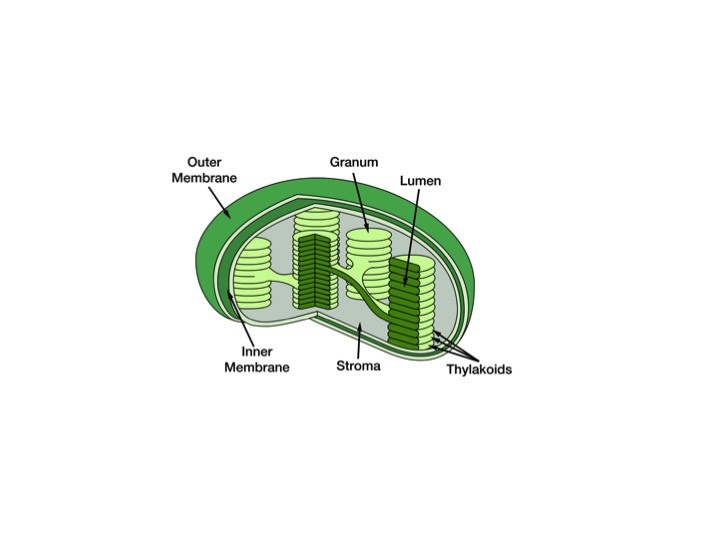
The way a plant makes its food
d)
When the plant uses sugar for energy
16.
Chloroplasts are...
a)
Structures of animal cells to produce ATP
b)
Organelles where lipids are elaborated
c)
Specialized structures of plants where food is made
d)
Waste organelle of plants
17.
Leaves look green because.....
a)
they eat their vegetables
b)
to blend into their environment
c)
they contain a molecule named chlorophyll
d)
they are sick
18.
According to this absorption spectrum, what color is not used by the chlorophyll pigments?
a)
green
b)
blue
c)
yellow
d)
red
19.

According to this absorption spectrum, what color is absorbed most by the chlorophyll pigments? SELECT ALL

a)
green
b)
blue
c)
yellow
d)
red
20.
What is photosynthesis?
a)
The process plants use to turn carbon dioxide and water into food.
b)
The process plants use to chlorophyll and sunlight into air. 
c)
The process plants use to turn sunlight and chlorophyll into soil.
d)
The process plants use to turn chocolate and milk into chocolate milk.
21.
Where does a plant get carbon dioxide from?
a)
A plant gets carbon dioxide from the soil.
b)
A plant gets carbon dioxide from the air.
c)
A plant gets carbon dioxide from the water.
d)
A plant gets carbon dioxide at the Shell gas station.
22.
What is the chemical formula for glucose?
a)
C6H12O6
b)
C6H6O12
c)
C12H6O12
d)
C6O2H6
23.
Which of these conditions would decrease the rate of photosynthesis in a plant?
a)
Above average precipitation
b)
Changing the daylight hours from 14 hrs to 10 hrs
c)
Changing the CO2 concentration from 380 ppm to 410 ppm
d)
All of these choices
24.
A student is collecting the gas given off from a plant in bright sunlight at a temperature of 27°C. The gas being collected is probably ________.
a)
oxygen
b)
carbon dioxide
c)
ATP
d)
glucose
25.
If carbon dioxide is completely removed from a plant’s environment, what would you expect to happen to the plant’s production of high-energy sugars (rate of photosynthesis)?
a)
Sugar production will likely increase.
b)

Sugars will not be present in the plant at all.

c)
The rate of sugar production will decrease .
d)
Fewer sugars will be produced at first, but then the plant will recover.
26.
How would light intensity generally affect the rate of photosynthesis?
a)
Increases the rate, up to a point
b)
Increases the rate
c)
Decreases the rate
d)
No relationship to the rate
27.
How would the concentration of CO2 in water affect photosynthesis?
a)
The higher the CO2, the greater the rate
b)
The higher the CO2, the lower the rate
c)
CO2 concentration doesn't affect photosynthesis
d)
a greater rate of photosynthesis causes higher CO2 concentrations 
28.

Why does the rate of photosynthesis decrease at high temperatures?

a)

Enzymes are denatured

b)

Enzymes do not have enough kinetic energy

29.
What is the ultimate source of energy for life on Earth?
a)
glucose
b)
sunlight
c)
ATP
d)
H2O
30.

In which part of the plant does photosynthesis primarily occur?

a)

Roots

b)

Stem

c)

Leaves

d)

Flowers

31.

What is the process in which plants capture the energy in sunlight and use it to make food? (a)  

Choose from the below words
cellular respiration
carbon dioxide
glucose
photosynthesis
32.
Which gas is removed from the atmosphere during photosynthesis?
a)
hydrogen
b)
oxygen
c)
nitrogen
d)
carbon dioxide
33.
How are photosynthesis and cellular respiration related?
a)
They have opposite equations
b)
they have the same equation
c)
they both produce carbon dioxide
d)
they both produce oxygen
34.
What are the products in cellular respiration?
a)
water and carbon dioxide
b)
water and glucose
c)
carbon dioxide and oxygen
d)
glucose and oxygen
35.

In what part of the plant does photosynthesis occur?

a)

Xylem

b)

Root

c)

Stem

d)

Leaf

36.
What is the energy molecule?
a)
DNA
b)
ATP
c)
RNA
d)
AAA
37.
The waste gas given off by cellular respiration is?
a)
oxygen
b)
carbon dioxide
c)
nitrogen
d)
methane
38.
What is the correct equation for cellular respiration?
a)
6O2 + C6H12O6 -> 6CO2 + 6H2O + Energy
b)
6O2 + C6H12O6 + Energy -> 6CO2 + 6H2O
c)
6CO2 + 6H2O -> 6O2 + C6H12O6 + Energy
d)
6CO2 + 6H2O + Energy -> 6O2 + C6H12O6
39.
What is cellular respiration?
a)
the breakdown of glucose  to release ATP
b)
the breakdown of glucose to release NADH
c)
the breakdown of glucose to release FADH
d)
the breakdown of glucose to release carbon
40.

Which of the following is a reactant of cellular respiration

a)

Carbon Dioxide

b)

Water

c)

Oxygen

d)

ATP

41.

Which of the following is a reactant of cellular respiration?

a)

Glucose

b)

Carbon Dioxide

c)

Water

d)

ATP

42.

A decrease in the amount of oxygen available will....

a)

not have an effect on the amount of energy produced during cellular respiration

b)

decrease the amount of glucose produced during cellular respiration

c)

cause the amount of water produced during cellular respiration to increase

d)

decrease the amount of energy produced during cellular respiration

43.

What type of respiration requires oxygen?

a)

Aerobic

b)

Anaerobic

44.

Which organism go through cellular respiration?

a)

animals

b)

plants

c)

both animals and plants

d)

none

45.

Cellular Respiration occurs in what cell organelle?

a)

chloroplast

b)

cytoplasm

c)

mitochondria

d)

animal

46.

Anaerobic respiration yields about ______ ATP per glucose whereas aerobic respiration yields about _______ ATP per glucose.

a)

38, 2

b)

2, 38

c)

2, 18

d)

18, 2

47.
The main source of energy for all life comes from ____.
a)
the Earth
b)
the moon
c)
the sun
d)
the food we eat/make
48.
What process is shown in the diagram? 
a)
aerobic respiration 
b)
anaerobic respiration 
c)
 fermentation 
d)
photosynthesis 
49.
What is a disadvantage of fermentation as a process? 
a)
It produces too much ATP
b)
It only produces 2 ATP
c)
It occurs in the absence of oxygen
d)
It is only for quick bursts of energy
50.
Lactic acid fermentation occurs in your muscles after a workout because your cells are struggling to get
a)
Glucose
b)
Sunlight
c)
Oxygen
d)
Water
51.
After intense activity, your muscles feel sore because of 
a)
the accumulation of NAD+
b)
the accumulation of lactic acid 
c)
the accumulation of ATP
d)
the accumulation of carbon dioxide
52.
Fermentation is:
a)
Cellular Respiration 
b)
Photosynthesis
c)
Aerobic
d)
Anaerobic
53.
When respiration occurs with oxygen, it is called _______
a)
anaerobic
b)
aerobic
c)
light-dependent
d)
fermentation
