
 Worksheets
Unit 5: Ecology Review
Total questions: 81
Worksheet time: 1hrs 21mins
The non-living parts of an ecosystem (e.g. soil, water, weather).
abiotic factors
biotic factors
oxygen
soil
When a plant is eaten by a grasshopper, the grasshopper is called:
Producer
Primary consumer
Secondary consumer
Tertiary consumer
When a plant is eaten by a caterpillar and the caterpillar is eaten by a frog, the frog belongs to:
Producer
Primary consumer
Secondary consumer
Tertiary consumer
When a plant is eaten by a caterpillar and the caterpillar is eaten by a frog, and the frog is eaten by a snake, the snake belongs to:
Producer
Primary consumer
Secondary consumer
Tertiary consumer
Communities are a set of populations of different species that interact and share a common point in space that is called _____________________.
biome
biomass
eutrophication
habitat
Very large ecological areas with fauna and flora adapted to their environment. They're classified into the desert, aquatic, forest, grassland, and tundra.
biome
biomass
biosphere
troposphere

A linear depiction of energy flow, which an organism feeding on and deriving energy from the preceding organism.
food chain
food web

A complex model of interconnected food chains in which there are multiple links among species.
Food web
Trophic chain

Which type of succession would occur here?
Primary
Secondary
Both

Which term refers to all the biotic and abiotic factors that interact in a habitat?
population
ecosystem
community
organism

Which term describes "living" things in an ecosystem?
biotic
biosphere
abiotic
prokaryotic

Which term refers to the non-living parts of the ecosystem?
biosphere
abiotic
prokaryotic
biotic

Which term describes a single living thing?
ecosystem
population
organism
community

A collection of the same type of living things is defined as a(n)...
ecosystem
organism
community
population

Which vocabulary term best describes all the different types of living things in a habitat?
population
community
ecosystem
abiotic
Which of these is best described as an organism?


Which picture is best described as a population?


Which of these pictures best illustrates a community?


Which of these is abiotic?


The following image is an example of a(n) _____________.
organism
population
community
ecosystem

The following image is an example of a(n) ____________.
organism
population
community
ecosystem

What are the abiotic factors in this image?
water, sunlight, dirt, air
birds and plants
water, plants, and birds
What is ecology?
the study of rocks
the study of relationships between organisms and their environments
the study of the ocean
the study of animals and plants
What is the definition of a population?
all individuals of one kind living in one area
one single organism
any living thing
many different organisms living in one area


Which would result in primary succession?
volcano destroying habitat leaving only soil and ash
Tornado destroying a crop leaving very little soil
Glacier retreating exposing bare rock
limiting factors
. Which of the following is an example of primary succession?
A.lichens growing on rocks following a volcanic eruption
B.grasses growing after a forest fire
C.oak trees replacing pine trees in a forest
D. non-native species introduced into a climax community
How has the invasion of pythons effected the everglades ecosystem in terms of species numbers?
The pythons could upset the territorial boundaries of native organisms.
The pythons could adapt to overcome diseases common to native snakes.
The pythons could prey on native organisms and cause native populations to decline.
The pythons could begin to interbreed with native snakes and produce a more successful species.
What is the starting source of energy for all food chains?
grass
sun
bug
mushrooms
An animal that ONLY eats plants is called a
Herbivore
Carnivore
Omnivore
Plantivore
An animal that ONLY eats other animals is called a
Carnivore
Omnivore
Herbivore
Consumer

Which of the following supply energy TO the bear?
Beaver
Parasol Fungus
Swallowtail Caterpillar
Persimmon Tree

In this food web, the gray fox is a...
Primary Consumer
Secondary Consumer
Both a Primary Consumer and a Secondary Consumer
Producer

If only 10% of the energy in the pyramid is available as you move from one trophic level to the next, what happens to the other 90%?
Passed on to decomposers
Metabolized and "lost" as heat energy and waste
Assembled into tissues of producers permanently
False statement - 100% of the energy is available

If you constructed a food chain, what role does the heron (bird) play?
Producer
Primary Consumer
Secondary Consumer
Tertiary Consumer
Quaternary Consumer (Top Predator)

Which of the following is true?
Level A contains the most producers
Organisms in level B get food directly from level A
Level C contains the largest group of consumers
Level D contains the most heterotrophs
Which is a possible food chain from this energy pyramid?
sunfish -> Algae -> great blue heron -> crustaceans
great blue heron -> crustaceans -> sunfish -> algae
algae -> crustaceans -> sunfish -> great blue heron
crustaceans -> great blue heron -> algae -> sunfish

Which food chain sequence can be found in this meadow?
fruit -> toad -> snake -> mouse
snake -> grasshopper -> deer -> wolf
mouse -> raccoon -> snake -> toad
grass -> grasshopper -> raccoon -> wolf
Each level in an energy pyramid is called
feeding level
energy level
trophic level

The frog in this food web could be considered a second-level and third-level consumer
true
false

Which organism DOES NOT pass energy directly to the eagle?
rat
thrush
frog
dragonfly

If the number of births in a population is the same as the number of deaths in a population, what will happen to the growth of the population?
It will increase
It will decrease
It will stay the same
It will fluctuate

What is the carrying capacity for this sheep population?
1.9 million
1.6 million
1.25 million
1.0 million
The largest number of individuals of a population that the environment can support is the...
carrying capacity
population crash
lag phase
mutualism

When a population grows past the ecosystem's carrying capacity, what happens to the population?
The population continues to grow
The population will go extinct due to limited resources
The population starts to die off to return to carrying capacity
The population grows, then finds a new carrying capacity
Food, water, sunlight, shelter, and space are that keep populations from growing exponentially are called...
food chains
ecosystems
communities
limiting factors

Which of the following are examples of density-dependent limiting factors in a rabbit population? (Check all that apply)
increase in predators
climate
disease
amount of sunlight
competition for food

Which statement sounds accurate based on the graph data?
The zebra and lions do not affect each other.
When lion population increases, so does the zebra population.
When the zebra population increases, it causes the lion population to also increase.
When zebra populations increase, the lion population decreases.
A j-shaped curve is a representative model of what type of growth?
exponential growth
logistic growth
minimal growth
linear growth

What point on the graph represents the carrying capacity?
A
B
C
D

This graph best represents which of the following?
exponential growth
logistic growth

The common brushtail possum is a marsupial native to Australia. This possum was introduced to New Zealand where it had no natural predators and had an abundant food supply. Which of these likely occurred a few years after the introduction of this possum to New Zealand?
The possums became extinct.
The possum population competed for food and resources
The possum population grew exponentially
The possum population reached its carrying capacity
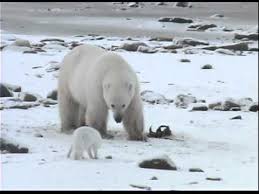
Two arctic foxes are fighting with a polar bear for a dead sea lion. One fox distracts the bear while the other eats. What type of limiting factor is the polar bear?
Predator-Prey Relationships
Competition
Cooperation
Parasitism

What effect will a decrease in the frog population most likely have on the other trophic levels?
The slug population will decrease, and the heron population will increase.
The slug population will increase, and the heron population will decrease.
The slug and heron populations will increase, and the plant population will decrease.
The slug and heron populations will decrease, and the plant population will increase.
How would the carrying capacity of an ecosystem be affected if there were a decrease in the number of decomposers?
It would increase as a result of more available space.
It would increase due to less competition occurring among organisms.
It would remain the same regardless of the decomposer population.
It would decrease due to a low amount of available nutrients for plants.

The graph below shows the change in the total ecosystem biomass over time.
This overall system change was most likely caused by a rapid decline in the populations at which trophic level?
decomposer
primary consumer
tertiary consumer
producer

The graph below represents the fluctuations for a predator and prey population based on the carrying capacity of that particular ecosystem.
Based on the data in the graph, which statement is a valid conclusion?
The increase in prey population is a result of an increased predator population.
The increase in predator population is a result of an increased prey population.
The predator and prey populations increase and decrease at the exact same time.
The predator and prey populations have no effect on each other's population size.
Symbiosis means:
relationship
sharing
helping
harming
Commensalism means:
Living on or in another organism at that organisms expense
consuming another organism
getting a benefit from another organism without harming or helping it
getting a benefit from another organism while helping it
belonging in the same niche with limited resources
Parasitism means:
Living on or in another organism at that organisms expense
consuming another organism
getting a benefit from another organism without harming or helping it
getting a benefit from another organism while helping it
belonging in the same niche with limited resources
mutualism means:
Living on or in another organism at that organisms expense
consuming another organism
getting a benefit from another organism without harming or helping it
getting a benefit from another organism while helping it
belonging in the same niche with limited resources



