
 Worksheets
5th Grade Benchmark 3 Review
Total questions: 57
Worksheet time: 41mins
What is the process called when water vapor cools and changes back into liquid droplets?
Condensation
Precipitation
Collection
Evaporation
Which of the following is a primary consumer in a food web?
Eagle
Grass
Rabbit
Wolf
What percentage of Earth's water is freshwater?
About 10%
About 70%
About 50%
About 3%
Which of the following is a solution to reduce pollution?
Deforestation
Improving waste management
Overfishing
Increasing chemical use
What is the term for areas in oceans with low oxygen levels due to pollution?
Wetlands
Estuaries
Dead Zones
Coral Reefs
Which stage of the water cycle involves water turning into vapor?
Evaporation
Collection
Condensation
Precipitation
What is the role of producers in an ecosystem?
They compete with consumers for food
They decompose organic matter
They consume other organisms
They create energy through photosynthesis
Which natural process can lead to habitat loss?
Pollination
Photosynthesis
Glacier melting
Seed dispersal
A harmful substance that contaminates a
natural environment
Deforestation
Environmental Impact
Overexploitation
Pollution
Imagine Grandpa owns a large piece of land. He decides to clear the entire area of trees to make space for a new farm. What is the likely impact of this action on climate change?
It decreases the amount of carbon dioxide in the atmosphere
It increases the Earth's albedo
It increases the amount of carbon dioxide in the atmosphere
It has no significant impact on climate change
What is the main source of energy for producers in an ecosystem?
Sunlight
Water
Soil
Wind
Which of the following is a consequence of deforestation?
Increased biodiversity
Decreased carbon dioxide levels
Improved air quality
Loss of habitat for many species
What is the term for the process by which plants release water vapor into the atmosphere?
Evaporation
Transpiration
Condensation
Precipitation
What is the primary role of decomposers in an ecosystem?
They produce energy through photosynthesis
They break down dead organisms and recycle nutrients
They provide shelter for other organisms
They compete with primary consumers for food
What is the process by which plants convert sunlight into chemical energy?
Photosynthesis
Fermentation
Respiration
Transpiration
A process in which substances change into different substances is a/an _______________.
chemical reaction
physical reaction
chemical
wastewater treatment
Which of the following options is NOT a sign of a chemical change?
light is made
taste change
electricity is made
melting
In a chemical reaction, substances are mixed and at least one _____ substance with different properties is formed.
similar
new

Which cycle is illustrated in this image?
the water cycle
the carbon cycle
the phosphorus cycle
the rock cycle
Which two systems interact when a river causes erosion?
the biosphere and the atmosphere
the biosphere and the geosphere
the hydrosphere and the biosphere
the hydrosphere and the geosphere
A biosphere is the part of Earth that supports _______.
water
life
minerals
air
Water returns to the atmosphere by the process of __________.
condensation
evaporation
radiation
precipitation
Surface processes that work to break down rock are called__________.
weathering
subduction
compaction
cementation

According to this graph, most (96.5%) of the water on Earth is what type of water?
freshwater
saltwater

Most of the freshwater on Earth is in ___________ and _____________.
(a)

The majority of surface freshwater is found in (a) .
Animals grow by eating food molecules and turning them into body molecules, so their bodies have more _______________.
waste
energy
matter
molecules
People who study the different types of ecosystems are called
economies
economics
ecologist
environmentalist
Matter that is not used is called
water
waste
recyled
garbage
Food molecules in an ecosystem can be traced back to __________.
plants
the sun
the ground
none of these
__________are where plants and animals live together in their environment.
America
Swamps
ecosystems
geosphere
A _________________________ is a set of actions that are meant to help an ecosystem recover from damage.
construction plan
subdivision plan
deconstruction plan
restoration plan
Everything is connected in an ecosystem from what it______.
lives with
talks to
eats
cooks
Molecules can be passed from one organism to another through the food______
web
chain
store
processor

a diagram that shows what eats what in an ecosystem
ecosystem
food web
environment
organism
Food molecules in an ecosystem can always be traced back to _________.
plants
matter
predators
organisms
What is the source of all energy?
the sun
plants
producers
molecules
What is the difference between a food web and a food chain?
A food web shows numerous paths plants and animals are connected.
A food chain shows the many different paths plants and animals are connected.
A food web only follows just one path as animals find food.
A food chain only follows just one path as animals find food.
What is made of matter?
everything
molecules
atoms
organisms
What is matter made out of?
molecules
organisms
plants
animals
Animals grow by ________
changing food molecules into body molecules that can build their bodies
changing body molecules into food molecules that can build their bodies
getting lots of sleep
changing atoms into molecules
What happens to food molecules in an animal's body?
Some are used to make body molecules, AND some are released as energy that helps the animal move and grow.
To make body molecules
To release energy that helps them move and grow
They disappear
How do animals get their energy?
From eating plants and other animals to get food molecules.
From the sun and air.
Their body gives them endless energy.
They do not receive energy.

What is the producer in this food web?
Rabbit
Mouse
Grasshopper
Grasses
Which are consumers in this food web? Select all that apply
Rabbit
Mouse
Grasshopper
Grasses
When plants use carbon dioxide, water, and sunlight to make food it is called?
organism
photosynthesis
consumer
environment
Where does the fox get the food molecules it needs to survive?
Rabbit
Mouse
rabbit and mouse
Grasses
What will happen to the bird if the grasshoppers decrease?
the birds will decrase
the birds will increase
nothing will happen to the birds
In a food chain, When a rabbit eats hay, the hay is the rabbits source of _____.
energy
water
sunlight
carbon dioxide
How does energy enter an ecosystem?
sunlight
soil
animals
invasive species
Use sunlight to make food
Gain energy from eating other organisms
Keep other species from overpopulating
Breaking down dead stuff
Plants do not need food.
True
False
Which statement best describes how the matter is transferred between decomposers and plants?
Decomposers are the top of the food chain. Matter and energy from decomposers are released into the ecosystem.
Decomposers break down organisms and return nutrients to the soil. Plants need those nutrients to survive.
Decomposers transfer matter from the air to the soil. The plants consume that matter for energy
Plants are producers. They use energy from the sun to grow.
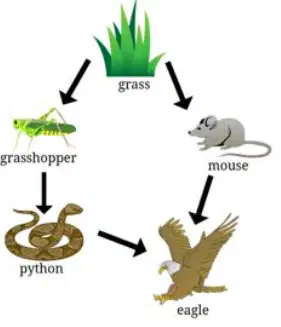
Walter researches a forest ecosystem for his science fair project. He made a model of a forest food web to explain how matter moves among organisms in the ecosystem. He studied his model and realized he could make an improvement.
How could Walter improve his forest food web model to best explain how matter cycles among organisms and the environment?
He should add the right climate to explain how the plants and animals survive in their environment.
He should add decomposers to explain how they break down dead organisms and restore some materials to the soil.
He should add a rabbit to the food chain to include more forest animals and explain how animals compete for grass.
He should add air to explain how the different organisms in the forest use the gases in the air to survive.

