
Font size
 Worksheets
Inv. 9 . Exp.1
Total questions: 31
Worksheet time: 23mins
Think about what chemical reactions are required to launch the rocket. There is no right or wrong answer, respond what you think for this phenomemon video.

The energy released when kerosene and oxygen molecules react to form carbon dioxide and water comes from:
The breaking of chemical bonds in kerosene and oxygen
The formation of chemical bonds in carbon dioxide and water
The increase in temperature during the reaction
The movement of molecules
What are the substances present before a chemical reaction called?
Products
Reactants
Equations
Compounds

In the word equation 'Iron + Oxygen → Iron(III) oxide', what is the product?
Iron(III) oxide.
Iron(II) oxide.
Iron(IV) oxide.
Iron oxide.

How are word and skeleton equations used to represent chemical reactions?
Word equations use words to describe the reactants and products, while skeleton equations use chemical formulas.
Word equations use chemical formulas, while skeleton equations use words to describe the reactants and products.
Both word and skeleton equations use chemical formulas to describe the reactants and products.
Neither word nor skeleton equations are used to represent chemical reactions.
Write the skeleton equation for the iron and diatomic oxygen gas reaction to form iron(III) oxide (Fe2O3). Sketch a molecular model of the reactants and products in the reaction.
Fe + O2 -> Fe2O3
Write the skeleton equation for the reaction of iron and diatomic oxygen gas to form iron(III) oxide (Fe2O3).
Fe + O2 → Fe2O3
4Fe + 3O2 → 2Fe2O3
2Fe + O2 → Fe2O3
3Fe + 2O2 → Fe2O3

What does the symbol '+' represent in chemical equations?
Separates two reactants or two products
Indicates heat is supplied
Designates an aqueous solution

What does the symbol '→' mean in a chemical equation?
A) Shows that the reaction is reversible
B) 'Yields'; separates reactants from products
C) Designates a reactant in the solid state.

Fill in the blank: The symbol '⇌' shows that the reaction is ______ and can go in either direction.
reversible.
irreversible.
unidirectional.
static.

What do the symbols (s), (l), (g) designate in a chemical equation?
Aqueous solution
Solid, liquid, gaseous state
Catalyst

Fill in the blank: The symbol (aq) designates an ______ solution; the substance is dissolved in water.
aqueous.
gaseous.
solid.
liquid.

What does the symbol 'Δ' or 'heat' indicate in a chemical equation?
A) Reaction is reversible
B) Heat is supplied to the reaction
C) Aqueous solution
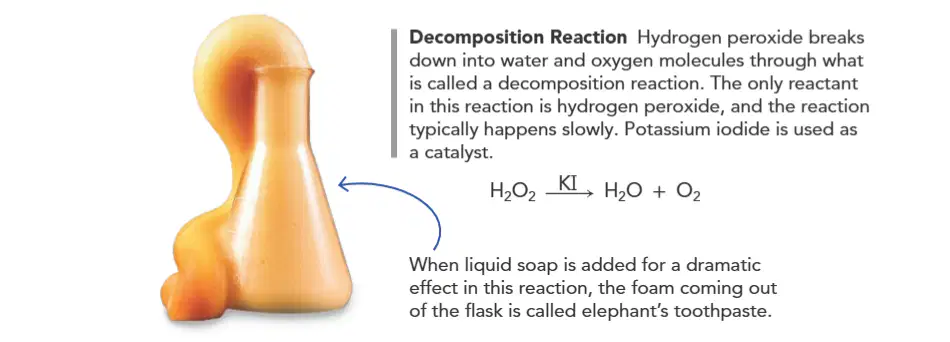
Explain the decomposition reaction of hydrogen peroxide as described in the image. Include the role of potassium iodide.
The decomposition of hydrogen peroxide is a redox reaction where potassium iodide acts as a catalyst.
The decomposition of hydrogen peroxide is an acid-base reaction where potassium iodide acts as a reactant.
The decomposition of hydrogen peroxide is a precipitation reaction where potassium iodide acts as a product.
The decomposition of hydrogen peroxide is a synthesis reaction where potassium iodide acts as a solvent.
Research and communicate information about why manganese(IV) oxide is used as a catalyst in the decomposition of hydrogen peroxide and why it isn’t considered a reactant.
Manganese(IV) oxide speeds up the reaction without being consumed.
Manganese(IV) oxide is a reactant that gets consumed.
Manganese(IV) oxide changes the products of the reaction.
Manganese(IV) oxide is not involved in the reaction.
Write the correct formula for each substance in the reaction. Indicate the state of each substance. Separate the reactants from the products with an arrow. Use plus signs to separate the two reactants and each of the three products.
Reactants: sodium hydrogen carbonate (solid), hydrochloric acid (aqueous).
Products: sodium chloride (aqueous), water (liquid), carbon dioxide (gas).
NaHCO3 (s) + HCl (aq) → NaCl (aq) + H2O (l) + CO2 (g)
NaHCO3 (aq) + HCl (s) → NaCl (s) + H2O (g) + CO2 (l)
NaHCO3 (s) + HCl (aq) → NaCl (s) + H2O (l) + CO2 (g)
NaHCO3 (s) + HCl (aq) → NaCl (aq) + H2O (g) + CO2 (s)
Sulfur burns in oxygen to form sulfur dioxide. What is the skeleton equation for this chemical reaction?
S(s) + O2(g) -> SO2(g)
2S + O2 -> 2SO2
S + O -> SO
2S + 3O2 -> 2SO3

The law of conservation of mass states that in a chemical reaction, the mass of the reactants is equal to the mass of the products.
True
False

Fill in the blank: Numbers that are added in front of terms to balance equations are called ________.
coefficients.
exponents.
subscripts.
variables.

A common mistake when balancing equations is to change the subscripts instead of the coefficients. For example, a person might try to balance the reaction H₂ + O₂ ⟶ H₂O by changing one subscript in the products: H₂ + O₂ ⟶ H₂O₂. How does changing the subscript make the equation incorrect?
You canot change the subscripts on the product, as the products H2O and H2O2 represent different compounds. The structures of H2O and H2O2 different ;therefore, they have diffrent properties.
It balances the equation correctly.
It has no effect on the equation.
It makes the equation more complex.
21.
Answer the questions below after watching the video
Balance AgNO3(Aq)+Cu(s)→Cu(NO3)2(aq)+ Ag(s)
Write the balanced chemical equation for the reaction of solid carbon with oxygen gas to form carbon monoxide gas.
C(s) + O2(g) → CO(g)
2C(s) + O2(g) → 2CO(g)
C(s) + O2(g) → CO2(g)
2C(s) + O2(g) → CO2(g)
Write the balanced chemical equation for the reaction of glucose (C₆H₁₂O₆) with oxygen gas to produce carbon dioxide gas and water vapor.
C₆H₁₂O₆ + 6O₂ → 6CO₂ + 6H₂O
C₆H₁₂O₆ + O₂ → CO₂ + H₂O
C₆H₁₂O₆ + 3O₂ → 3CO₂ + 3H₂O
C₆H₁₂O₆ + 12O₂ → 12CO₂ + 6H₂O

What is the energy stored in the chemical bonds of a substance called?
Chemical potential energy
Kinetic energy
Thermal energy
Electrical energy

Fill in the blank: The law of conservation of energy states that in any chemical reaction, energy is neither created nor ________.
destroyed.
transformed.
lost.
converted.

Using the table of average bond energies, estimate the energy needed to break the bonds of the reactants and the energy released when the products form for the reaction N2 + O2 → 2NO. Note: N2 has a triple bond and O2 and NO have double bonds.
Energy required to break bonds = 100 kJ/mol
Energy released when product form = 2 (607 kJ/mol) = 1214 kJ/mol
Energy required to break bonds = 151kJ/mol
Energy released when product form = 2 (607 kJ/mol) = 1214 kJ/mol
Energy required to break bonds = 1443 kJ/mol
Energy released when product form = 2 (607 kJ/mol) = 1214 kJ/mol
Energy required to break bonds = 503 kJ/mol
Energy released when product form = (607 kJ/mol) = 607 kJ/mol

Define endothermic and exothermic.
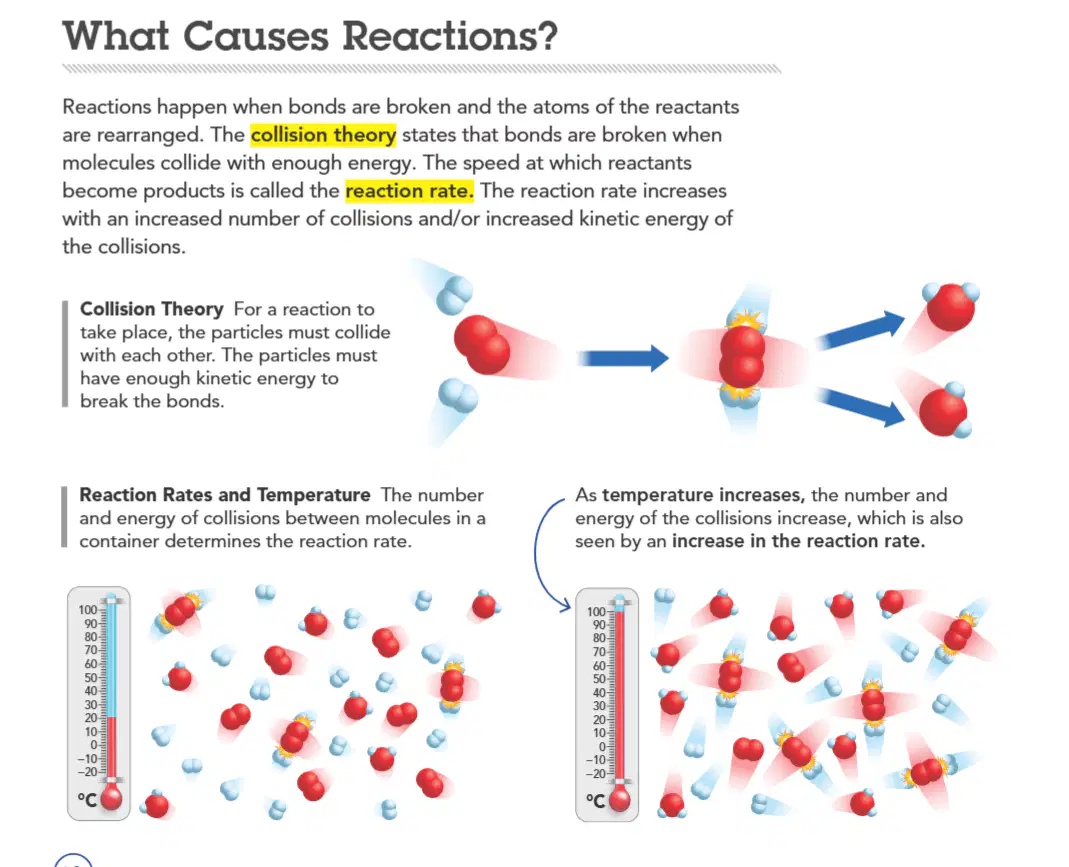
What does the collision theory state about how reactions occur?
Reactions occur when particles collide with sufficient energy and proper orientation.
Reactions occur spontaneously without any external influence.
Reactions occur only at high temperatures.
Reactions occur only in the presence of a catalyst.

How does temperature affect the reaction rate according to the diagram?
Temperature increases the reaction rate.
Temperature decreases the reaction rate.
Temperature has no effect on the reaction rate.
Temperature first increases then decreases the reaction rate.

Analyze the table showing the reaction rate of NO2 with temperature. Describe the pattern in the data (increasing/decreasing, linear/exponential, etc.).
The reaction rate of NO2 increases linearly with temperature.
The reaction rate of NO2 decreases linearly with temperature.
The reaction rate of NO2 increases exponentially with temperature.
The reaction rate of NO2 decreases exponentially with temperature.
13.SEP Develop a Model: Generating energy requires exothermic reactions. Which of the following best describes the energy generation from the reaction of hydrogen and oxygen?
The energy comes from the breaking of bonds in hydrogen and oxygen.
The energy is absorbed during the formation of water.
The energy is released during the formation of water from hydrogen and oxygen.
The energy is generated by the splitting of water into hydrogen and oxygen.

