
 Worksheets
Chapter 6 review
Total questions: 61
Worksheet time: 1hrs 24mins

The picture below shows an enzyme unwinding and unzipping DNA.
What is the name of this enzyme?
DNA Helicase
DNA Ligase
DNA polyermase
RNA Polymerase
Which of the following DNA nucleotides are paired with the correct corresponding DNA nucleotide? (mark all that apply)
Adenine with Thymine
Guanine with Cytosine
Thymine with Cytosine
Adenine with Uracil.
Uracil with Thymine
You are given the DNA strand 5'ATGCTCAGCTGA3'. What is the corresponding DNA strand?
5'UACGAGUCGACU3'
5'TACGAGTCGACT3'
3'UACGAGUCGACU5'
3'TACGAGTCGACT5'

Which letter in the picture below depicts the leading strand in DNA replication?
A
C
B
None of the above
Which letter in the picture below depicts the lagging strand in DNA replication?
Letter A since it is copied from 5' to 3'
Letter A since it is copied from 3' to 5'
Letter B since it is copied from 3' to 5
Letter B since it is copied from 5' to 3'


CAA
TGGCAAGTACGT
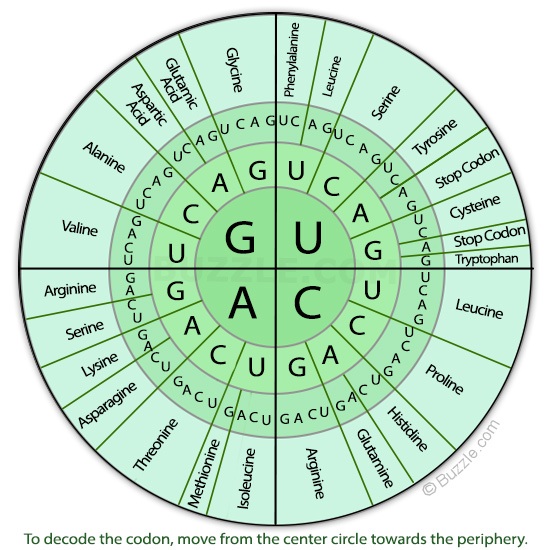
A sequence of a DNA template strand is shown.
3' TCC AAT GGC TTA TTT 5'
Which of these is the correct amino acid chain produced from the DNA template strand?
Arginine, Leucine, Proline, Asparagine
Tryptophan, Phenylalanine, Leucine
Serince, Leucine, Proline, Asparagine
Tryptophan, Phenylalanine, Leucine, Glycine
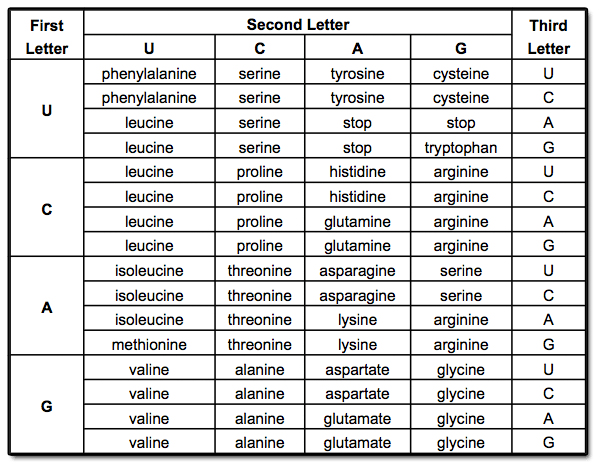
A sequence of a DNA template strand is shown.
3' TCC AAT GGC TTA TTT 5'
Which of these is the correct amino acid chain produced from the DNA template strand?
Arginine, Leucine, Proline, Asparagine
Tryptophan, Phenylalanine, Leucine
Serince, Leucine, Proline, Asparagine
Tryptophan, Phenylalanine, Leucine, Glycine
If a strand of DNA had bases in the following order - ATCCGTC, what would be the transcribed mRNA sequence?
TAGGCAG
UAGGCAG
TUGGCUG
None of the above are correct
A protein is built during this process
translation
transcription
At the end of this process the RNA molecule leaves the nucleus
translation
transcription
What does tRNA do during translation?
it brings a specific segment of DNA to the ribosome for transcription
it brings any amino acid to the ribosome
it brings a specific amino acid (decided by the DNA) to the ribosome for translation
it brings a specific amino acid (decided by the codon) to the ribosome for translation
What are 2 differences between DNA and RNA?
(a)

A codon is a group of (a) RNA bases

The ribosome is mainly made up of ..?
tRNA
mRNA
rRNA
DNA

DNA is found in the ...?
Ribosome
Nucleus
Cytoplasm
Chromosomes
Where is RNA made into protein?
Cytoplasm
Nucleus
Ribosome
Cell Membrane
Is this a strand of DNA or RNA?
TACGGACTA
DNA
RNA
Impossible to tell
Anti-codons are located on...
DNA
mRNA
tRNA
rRNA
Codons are located on....
DNA
mRNA
tRNA
rRNA
During transcription, adenine pairs up with _________, and guanine pairs up with _____________.
(a)
What is made during transcription?
DNA
RNA
Proteins
Amino Acids
Where does transcription take place?
cell membrane
nucleus
cytoplasm
ribosome

What is a GMO?
An organism that has had its DNA modified by humans
An organism missing a chromosome
Epigenetics
A genetically identical organism


What mutation has occurred here?
T-G-A-C-C-A
T-G-A-G-C-A
Substitution
Deletion
Insertion
Frameshift
Which of the following would result in a frameshift mutation?
Insertions only
Substitution only
Deletion only
Insertions and Deletions
DNA molecule segment is : TTACGCAAG
The mutated DNA segment is TTCGCAAG. This is an example of ___ mutation.
Substitution
Deletion
Insertion
Inversion
A mutation is defined as:
A change in the cell's structure
Anything that changes in an embryo
Any change in the physical features of a human
A change in the DNA sequence
ATTTGAGCC- Original
ATTGAGCC - Mutated
The example above is an example of a
Insertion- Frameshift
Deletion- Substitution
Deletion -Frameshift
All of the above
What mutation has occurred here?
T-G-A-C-C-A
T-G-A-G-C-A
Substitution
Deletion
Insertion
Frameshift
Why are insertion and deletion (frameshift) mutations so harmful?
They change all of the codons from the mutation on down the line, which changes the amino acid sequence
They insert things that an organism doesn't need.
They often delete things that organisms need.
Insertion and deletions are not any more harmful than substitution mutations.
Identify the DELETION mutation form the following:
ATG CCA AAT
ATG TCA AAT
ATG CCT AAA T
ATC CA AT
ATG CCA AAT

Which mutation will cause translation to stop?
Mutations 1 and 3 only
Mutation 1 only
Mutation 2 only
Muations 1, 2, 3

Which type of mutation does the model demonstrate?
Deletion
Substitution
Insertion
Translocation
What does RNA Stand for
Ribcnucleic acid
Ribonucleic acid
Ribonucloic acid
Ribonocleic acid
What does DNA Stand for
deoxyribcnucleic acid
deaxyribonucleic acid
deoxyribonucleic acid
deoxyribonuoleic acid
What does Chargaff's Rule describe?
The double-stranded nature of DNA
The anti-parallel nature of DNA
The equal numbers of A-T and G-C bases
What is the name of the twisting shape of the DNA molecule?
Deep Nitrogen Atom
Turning Ladder
Twisted Strands of Life
Double Helix
The discovery of the structure of DNA was important to what field of science?
Physics
Robotics
Genetics
Astronomy


What are the proper complementary base-pairs?
A--T and G--C
A--G and C--T
G--T and A--C
A--C and T--G
How many nucleotide bases are there?
1
2
3
4
How many DNA molecules does replication start with, and end with?
2 --> 1
1 --> 2
2 --> 4
10 --> 20

