
 Worksheets
Molecular Exam Review
Total questions: 80
Worksheet time: 52mins

The picture below shows the steps of DNA replication beginning with step one and ending with step three.
Because you are reusing the old, or parent, DNA strand DNA replication is said to be
Semi- Conservative
Semi-discontinuous
Continuous
Fully-Conserveative

The picture below shows an enzyme unwinding and unzipping DNA.
What is the name of this enzyme?
DNA Helicase
DNA Ligase
DNA polyermase
RNA Polymerase
Match he nucleotide with its complementary nucleotide. (DNA to DNA).
Cytosine-
Thymine
Guanine
Adenine
Which enzyme is responsible for adding the free nucleotides to the replicating DNA?
DNA Helicase
DNA Ligase
DNA polyermase
RNA Polymerase
Which is the second step?
DNA Helicase unwinds original DNA strand
RNA Primase lays down RNA primer for new nucleotide bases.
DNA polymerase builds new strands by bring in new nucleotide bases.
Ligase knits together fragments on lagging strand
Which is the fourth step?
DNA Helicase unwinds original DNA strand
RNA Primase lays down RNA primer for new nucleotide bases.
DNA polymerase builds new strands by bring in new nucleotide bases.
Ligase knits together fragments on lagging strand
Which is the third step?
DNA Helicase unwinds original DNA strand
RNA Primase lays down RNA primer for new nucleotide bases.
DNA polymerase builds new strands by bring in new nucleotide bases.
Ligase knits together fragments on lagging strand

Which letter in the picture below depicts the leading strand in DNA replication?
A
C
B
None of the above
DNA replication runs from ______' to _____' and is said to be ______________________
5, 3, antiparallel
3, 5, antiparallel
5, 3, parallel
3, 5, parallel
Okazaki fragments appear on which strand of DNA during DNA replication?
lagging
leading

What is this structure called
Double Helix
Double Felix
Two Cats
Single Strand
What are the differences between DNA and RNA?
RNA is single stranded; DNA is double stranded
RNA has the base U; DNA has the base T
Both
Neither
mRNA:
Sends text messages
Is at the ribosome
Is the messenger RNA

Name this structure.
Base
Nucleotide
Sugar
DNA

This process is called:
Translation
Transcription
DNA Replication
Transcription goes from:
DNA to DNA
DNA to Protein
DNA to RNA
None of the above
Name the bases of DNA.
Guanine and Cytosine
Adenine
Adenine, Thymine, Guanine, Cytosine
Adenine, Uracil, Guanine, Cytosine
Name the bases of RNA.
Guanine and Cytosine
Adenine
Adenine, Thymine, Guanine, Cytosine
Adenine, Uracil, Guanine, Cytosine
Replicate the DNA:
A T C - G A G - C T G
T A G - C T C - G A C
A T C - G A G - C T G
U A G - C U C - G A C
Transcribe the DNA to RNA:
G A C - C T A - A G T
G A C - C T A - A G T
C U G - G A U - U C A
C T G - G A T- T C A

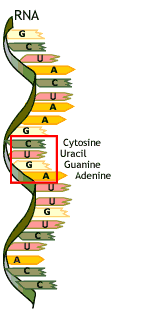
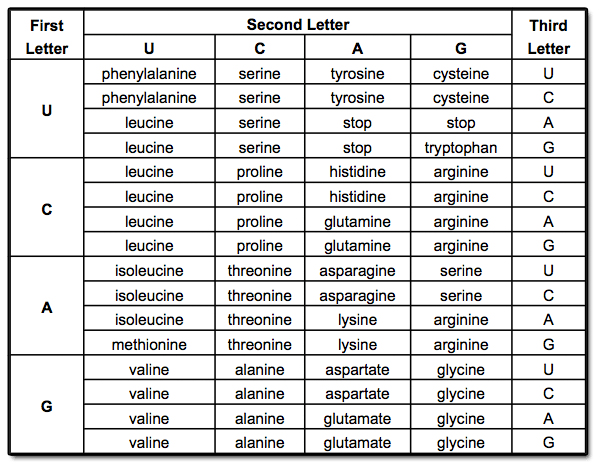
What protein is UCC
Ser
STOP
Thr
Tyr
What protein is AAC
Ser
STOP
Asn
Lys
Transcribe the DNA to RNA:
A A G - C T G - T A G
A A G - C T G - T A G
A A G - C T G - T A G
U U C - G A C - A U C
What is the first step of DNA replication?
Transcription
Translation
Helix unwinding
RNA processing
During transcription, which molecule is synthesized from the DNA template?
Protein
mRNA
tRNA
DNA
What is the role of mRNA in the process of translation?
It carries amino acids to the ribosome.
It replicates the DNA.
It provides the template for protein synthesis.
It adds nucleotides to the new DNA strand.
Which of the following is not a component of the genetic code?
Codons
Anticodons
Ribosomes
Nucleotides
What is the significance of the genetic code being described as 'universal'?
It is the same in all organisms.
It only applies to humans.
It varies greatly between different organisms.
It changes every generation.
Which enzyme is primarily responsible for DNA replication?
RNA polymerase
Helicase
DNA polymerase
Ligase
What is the function of tRNA during translation?
To replicate DNA
To carry amino acids to the ribosome
To transcribe mRNA
To unwind the DNA helix
In RNA processing, what is added to the 5' end of the pre-mRNA?
Poly-A tail
Amino acid
5' cap
Introns
Which of the following is a correct base pairing in DNA?
Adenine with Guanine
Cytosine with Adenine
Thymine with Adenine
Uracil with Thymine
How many nucleotides make up a codon?
2
3
4
5
What process removes introns from pre-mRNA to produce mature mRNA?
Translation
DNA replication
RNA splicing
Transcription
Which molecule is responsible for bringing the correct amino acid to the ribosome based on the codon sequence of the mRNA?
rRNA
mRNA
tRNA
DNA
What is the role of ribosomes in protein synthesis?
They replicate DNA.
They synthesize mRNA.
They join amino acids to form a polypeptide chain.
They modify mRNA after transcription.
Which of the following is not directly involved in the process of transcription?
DNA
RNA polymerase
Ribosomes
Nucleotides
What is the main purpose of DNA replication?
To produce different types of RNA
To create amino acids
To ensure each new cell has a complete set of DNA
To synthesize proteins
In what process is mRNA synthesized?
Transcription
Translation
DNA Replication
Mitosis
Where does TRANSCRIPTION occur?
Nucleus
Ribosome
Cytoplasm
Mitochondria
Why must transcription occur where DNA can be found?
because DNA can't leave
because ribosomes are in the nucleus
because DNA polymerase is found there
because helicase unzips the DNA
How many nucleotides equal 1 amino acid?
1
2
3
4

A polypeptide is a sequence of ____________________ held together by a ______________ bond.
amino acids; peptide
fatty acids; ionic
proteins; hydrogen
fatty acids; covalent
TRANSCRIBE this DNA sequence: TACGTTACT
AUGCAAUGA
ATGCAATGA
AUGGATUGA
TACGTTACT
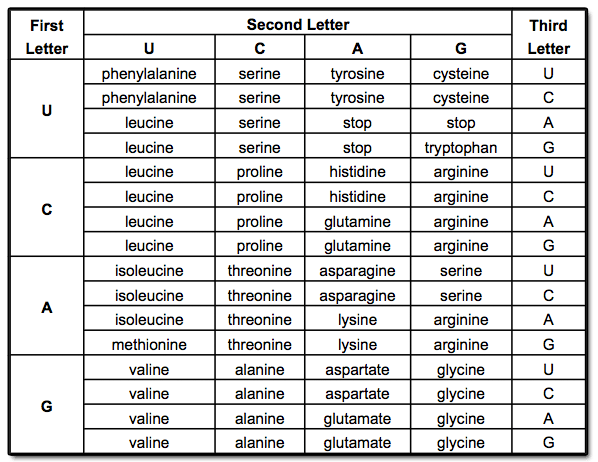
TRANSLATE this RNA sequence: AUGCAAUGA
Met-Glu-Stop
Met-His-Stop
Thr-Glu-Stop
Thr-Pro-Stop
GTAGTCA
TGGCAAGTACGT
Given the template strand, what is the mRNA strand?
5'- GATGAAC -3'
5'- GUUCAUC -3'
5'- CUACUUG -3'
5'- GAACUAC -3'
5'- GTTCATC -3'
In splicing, _________ are removed and __________ are connected.
Introns; exons
Caps; tails
Exons; introns
Sigma factors; nucleotides
Transcription occurs in the _______ of prokaryotes, and in the _________ of eukaryotes.
Cytoplasm ; cytoplasm
Nucleus ; ribosome
Nucleolus ; nucleus
Cytoplasm ; nucleus
Nucleoid ; cytoplasm
What is the central dogma?
DNA --> mRNA --> tRNA --> rRNA
Template strand --> coding strand --> mRNA
Nucleus --> cytoplasm --> ribosome
DNA --> mRNA --> protein
Given the coding strand, what is the template strand?
5'- AGCTTA -3'
5'- ATTCGA -3'
5'- UCGAAU -3'
5'- TAAGCT -3'
5'- TCGAAT -3'
What is the function of RNA polymerase?
To recognize the promotor region
To recognize the transcribed region
To synthesize RNA
To hydrolyze RNA
To "read" the coding strand
Which of the following is complementary and antiparallel to the template strand? Select all that apply!
The non-coding strand
The coding strand
The polypeptide
The tRNA
The mRNA
Which of the following components is involved in the initiation of transcription?
Start codon
Origin
Promoter
Primer


On which end of the RNA molecule (5' or 3') can additional bases be added to?
5'
3'
new bases can be added on both the 5' and the 3' ends
it depends on the gene
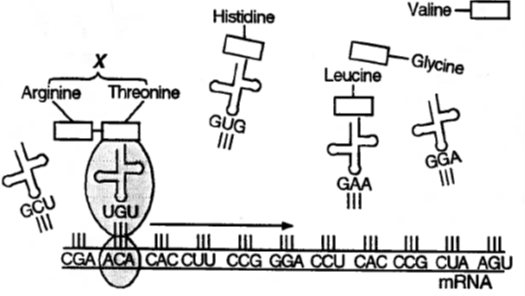
ATG GGA ACT CCA
how are nucleotides held together in DNA
hydrogen bonds
covalent bonds
ionic bonds
oxygen bonds
How many nucleotides equal 1 amino acid?
1
2
3
4
When these bond together, they form a protein
Amino Acids
Peptide Bonds
Ribose
Nucleotides
Which of the following statements correctly describes the relationship between a codon and anticodon?
The codon on mRNA is identical to the anticodon on tRNA
The codon on mRNA is complementary to the anticodon on tRNA
The codon on tRNA is complementary to the anticodon on mRNA
The codon on tRNA is identical to the anticodon on mRNA

•What amino acid is coded for by the codon CCC?
Pro
leu
gly
Phe


