
 Worksheets
Ecology Unit test review MIXED
Total questions: 96
Worksheet time: 3hrs 39mins
Please match
heterotroph
must consume other things for energy
herbivore
Consumer that eats plants
producer
Makes it's own food via photosynthesis
Omnivore
Consumer that eats plants and meat
Carnivore
Consumer that eats meat
Please match the term with its definition
Ecosystem
community (considers living &non things)
Community
groups of diff. species live same area
Biosphere
all ecosystems/ life on Earth
Population
Members of a species in a defined area
Organism
An individual living thing
Organisms that relies on other organisms for food; consumer
herbivore
decomposer
heterotroph
species
A large geographic area characterized by specific climate conditions, plant communities, and animal species, essentially a major type of ecological community.
ecosystem
biome
community
population
biosphere
What do fungi do to dead plants and animals?
Leave them there
Decompose them
Wait for other animals to eat them
Move away

What may happen if the snowshoe hare was removed from the food web pictured?
The insects in the habitat would increase.
The shrew population would decrease due to being the only hawk food source.
The willow tree population would decrease.
Foxes would die due to no food source.

In the energy pyramid shown here, how much of the energy in the producers is passed to the herbivores?
10%
20%
80%
90%
Nitrogen fixation processes nitrogen from which of the following sources?
lightning
fertilizers
dead plants
atmosphere

In the food web shown, the snail would be considered a...
primary consumer
secondary consumer
tertiary consumer
producer
Which graph depicts exponential growth in a population?


In population ecology, one of the factors studied is a density-dependent factor. Density-dependent factors have the greatest effect on dense populations and little to no effect on very sparse populations. Which of the following would NOT be an example of a density-dependent factor?
Parasitism
Predation
Communicable disease
The average rainfall of a region
A lion and a cheetah attempt to occupy the same niche. The more aggressive lion survives; the cheetah does not.
Density-Dependent: Competition
Density-Independent: Competition
Density-Dependent: Predator-Prey
Density-Independent: Predator-Prey
2 factors which increase population size
Birth Rate, Immigration
Death Rate, Immigration
Birth Rate, Emigration
Death Rate, Emigration
A scientist was studying a population of fish in a pond over a period of 10 years. He observed that the population increased each year for 3 years, and then remained nearly constant for the rest of the study. The best explanation for this observation is that the population had
stopped reproducing
reached carrying capacity
mutated into a different species
run out of food and all died

Predation

Commensalism
(+/0 )

Parasitism
(+/-)

Mutualism
(+/+)
When the birth rate is high and the death rate is low, what happens to the population?
The population increases.
The population decreases.
The population stays the same.
All of these.
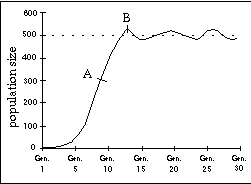
What is the carrying capacity shown in the graph?
around 500
more than 800
less than 300
around 700
An S-shaped curve is known as:
Exponential graph
Logistic graph
Survivorship curves
Graphs
Emigration is
the movement out of an area
the movement into an area
movement in and out of an area
migration
Why don't populations grow indefinitely?
limiting factors
only biotic factors
only abiotic factors
none of the above

The penguins are spread out evenly. This is an example of:
uniform dispersion
random dispersion
clumped dispersion
unknown

These animals are scattered in this area in no particular order. This is an example of:
random dispersion
uniform dispersion
clumped dispersion
unknown
Trophic levels are represented by
squares
circles
pyramids
lines
What source provides the energy to feed most food chains?
producers
sun
consumer
decomposers

Which of the following is a herbivore?
cricket
frog
hawk
shrew

An organism that gets energy from breaking down dead organisms, non-living material, or waste is a(an) ___________.
producer
consumer
decomposer
autotroph
An organism that uses an outside source of energy, like the sun, to create energy-rich food molecules.
Consumer
Producer
Decomposer
Parasite
The reason that the biomass pyramid and the energy pyramid look so similar is that...
biomass carries energy
energy carries biomass
no reason - coincidence!
only plants have biomass
Correctly label each trophic level

Use the image to answer the question:
How much energy does the apex predator receive?
10,000 kcal
1,000 kcal
100 kcal
10 kcal
Which is a secondary consumer?
Which image below shows uniform dispersion?


Which image below shows clumped dispersion?

Plant life starting to grow on a volcano.
primary succession
secondary succession
tertiary succession
variable succession

A pioneer species is...
a large organism
the first organisms to adapt to a new environment
the best organism
abiotic organisms

The process by which a new community forms where no community lived before
resource
invasive (non-native) species
primary succession
competition
Which is the correct order in primary succession?
Rocks, Lichens & Mosses, Bushes & Shrubs, Trees
Lichens & Mosses, Rocks, Trees, Bushes & Shrubs
Trees, Bushes and Shrubs, Lichens & Mosses, Lichens & Mosses
Rocks, Grass, Trees, Bushes & Shrubs
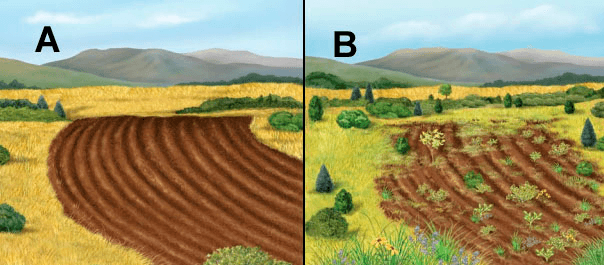
What type of succession is shown going from Figure A to Figure B?
primary succession
ecological succession
secondary succession
intermediate
Natural disasters such as flooding and tornadoes are linked to ________________.
primary
secondary
old field
ecosystem
What is an ecosystem?
All life, including vegetation and bacteria, in a given area
Members of the same species that live together
All living and non-living things in a given area
All ecosystems that are in some way connected to each other
_______ is when 2 or more species live in close association.
Predation
Competition
Symbiosis
Food web
Name the species interaction: A decorator crab camouflages itself with sponges. Sponges are unaffected.
competition
predation
commensalism
mutualism
The outcome of competition often leads to the extinction of one of the competing species.
Character Displacement
Competitive Exclusion
Resource Partitioning
Brood Parasitism
Competition among members of the same species.
intraspecific competition
interspecific competition
Competition between members of different species.
intraspecific competition
interspecific competition
Commensalism is represented by which of the following symbols?
( - / - )
( + / - )
( + / + )
( + / 0 )

Is this an example of a population or a community?
Population
Community
Reorder the following from least to greatest (from left to right).
organism
population
community
ecosystem
biome
A certain plant needs moisture, carbon dioxide, oxygen, light, and minerals to survive. This scenario shows that this particular living organism depends on .
Biotic Factors
Abiotic Factors
Which of the following lists has ONLY Biotic factors?
snail, algae, guppy, sunlight
temperature, Daphnia (water flea), snail, guppy (fish)
snail, guppy (fish), Daphnia (water flea), algae
temperature, pH, conductivity, nitrite concentration

What is the process of water falling out of the atmosphere?
Groundwater flow
Precipitation
Water collection
Cloud formation

What is the process by which plants release water vapor into the atmosphere?
Precipitation
Condensation
Transpiration
Evaporation
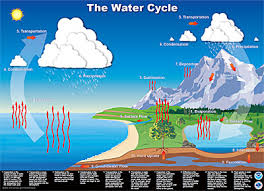
Which stages does liquid water from the ocean turn into water vapor?
condesantion
evaporation
precipitation
run off
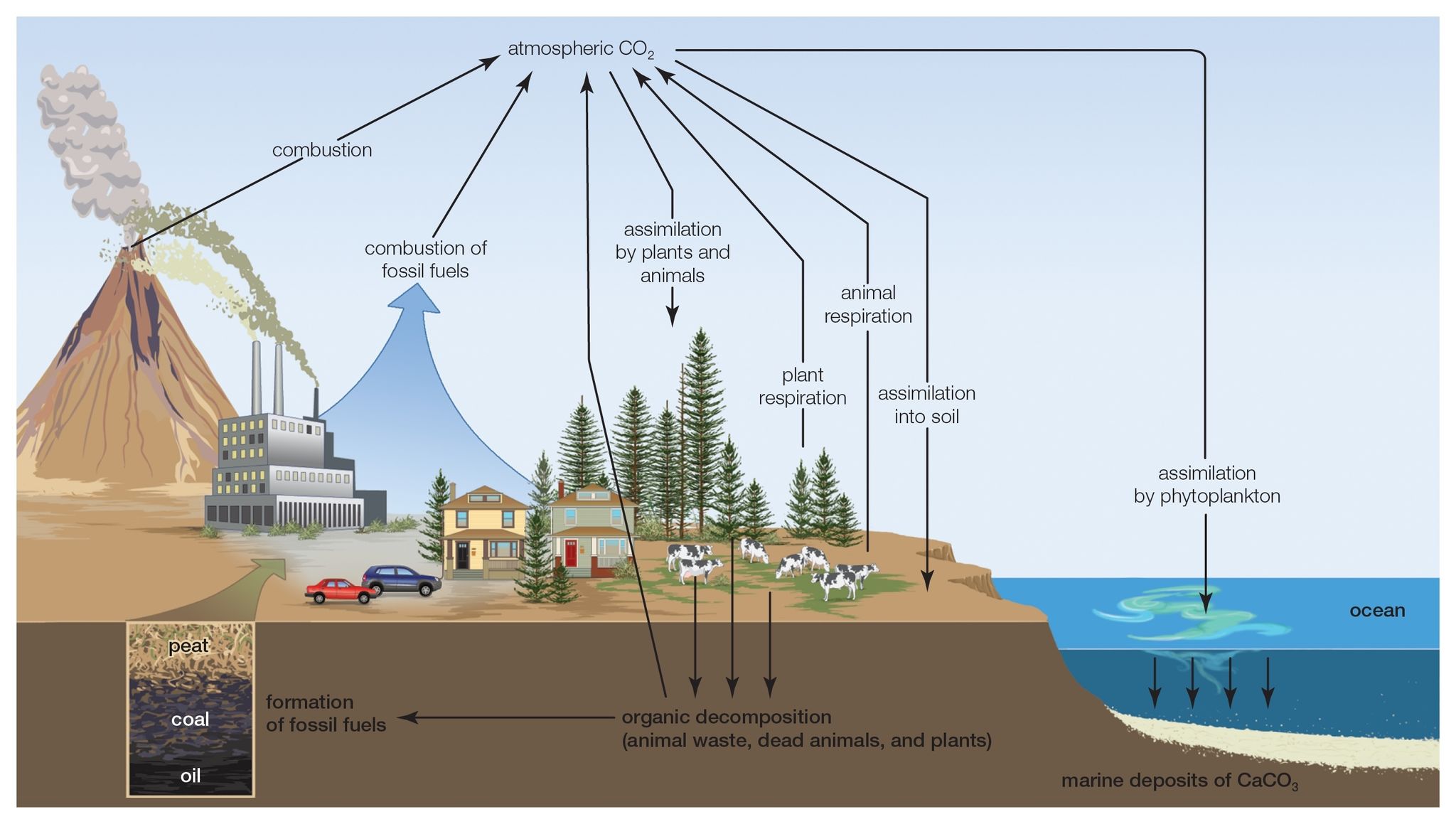
Which of the following add carbon dioxide to the atmosphere?
volcanoes
combustion of fossil fuels
animal and plant respiration
all of these
Which process removes carbon dioxide from the atmosphere?
deforestation
photosynthesis
burning fossil fuels
cellular respiration
human waster

Which cycle is shown in this diagram?
Nitrogen
Carbon
Phosphorus
Water
Oxygen
Process by which water runs down the side of land or soil and is deposited into a body of water.
Weathering
Run-Off
Combustion
Nitrogen-fixing
Precipitation
An organism that feeds on dead or decaying plant or animal remains.
omnivore
herbivore
carnivore
detrivore
A family of plants including beans, alfalfa, and peas, most of which harbor symbiotic, nitrogen-fixing bacteria in nodules in their roots.
producers
legumes
prokaryotes
tubers
Bacterial action that results in the combination of atmospheric nitrogen with other elements; making nitrogen available for use by plants.
ammonificaiton
denitrification
nitrification
nitrogen fixation
During which process do legumes and/or bacteria in the soil convert nitrogen gas from the atmosphere into ammonia and/or ammonium?
nitrification
denitrifcation
nitrogen fixation
assimilation
A gradual process of change and replacement of the types of species in a community.
ecological succession
secondary succession
primary succession
algal bloom
Every food web begins with what abiotic factor?
grass
sun
clouds
rain

Which organism receives the least amount of energy?
birds of prey
snakes
small mammals
insects
If there are 10 sharks in one area, but only 1 fish. What behavior will occur between the sharks?
commensalism
competition
parasitism
A habitat is ___________________.
the place or kind of place in which an animal or plant naturally lives.
is how plants produce their own food.
is an animal that only eats meat.
the place where only one animal lives.
A squirrels niche would be _________________.
hunting prey and providing meat for other squirrels.
searching for fish to eat in the ocean.
staying busy storing nuts and seeds for winter.
help decompose other animals and plants.
Due to RUNOFF Too many nutrients washing into waterways can cause what effect in ponds or rivers (bodies of water)
limestone to disappear
oxygen levels to increase
poisonous algae bloom to grow more rapidly
erosion to increase

When too much algae grows it is called an algal bloom. Why do algal blooms happen?
there are too many nutrients in the water due to RUNOFF
there are too many fish in the water
there is not enough sediment in the water
there is oil in the water

Algal blooms can cause which of the following? PICK 2
low oxygen levels in the water
an increase in fish numbers
fish die offs
high oxygen levels in the water


Match the sphere to its definition.
Atmo
Air
Bio
Life
Geo
Rock
Hydro
Water

Some organisms in an ecosystem are represented in
the pyramid below. In the pyramid, the arrows
labeled X represent
the loss of organisms due to predation
a decrease in photosynthetic organisms
the loss of energy in the form of heat
a decrease in available oxygen

The diagram represents an biomass pyramid.
If 500 kg of organisms were present in trophic level "A", what would be the biomass of trophic level "B"?
500 kg
5,000 kg
50 kg
5 kg
pioneer species
Competition between members of the same species is known as INTERspecific competition
True
False, INTRAspecific
The competitive exclusion principle states that no two organisms can occupy exactly the same niche in exactly the same habitat at exactly the same time
True
False, species

This pyramid is known as a ...
An ecological pyramid
A pyramid of energy
A pyramid of biomass
A pyramid of numbers
Deep sea vent bacteria get their energy from
eating other bacteria.
releasing sulfur.
photosynthesis.
chemosynthesis.
The model of the energy available at each level that ALWAYS gets smaller as you go up is the
energy pyramid.
numbers pyramid.
biomass pyramid.
food web.

Lakes, rivers, streams, underground aquifers, and dew all belong to this part of the global system:
Atmosphere
Biosphere
Geosphere
Hydrosphere
Grass, trees, insects, bacteria, elephants, and humans belong to this part of the global system.
Atmosphere
Biosphere
Geosphere
Hydrosphere
Oxygen, Hydrogen, Nitrogen, and other greenhouse gases belong to this part of the global system.
Atmosphere
Biosphere
Geosphere
Hydrosphere
Rocks, lava, fault lines, concrete, and the ocean floor all belong to this part of the global system.
Atmosphere
Biosphere
Geosphere
Hydrosphere
The study of the complex system of interactions that sustain life on the planet is called
Zoology
Ecology
Chemistry
Economics
Non-living factors in the environment that impact an organisms survival are called
Abiotic
Biotic
Bacteria
Plankton
A group of the SAME species that live together in an ecosystem is called
Community
Cluster
Population
Organism
A group of different species that live together in an ecosystem is called a
Community
Cluster
Population
Organism
What is the correct order of the ecological levels of organization?
Organism, Biosphere, Population, Community, Ecosystem, Biome
Organism, Population, Community, Ecosystem, Biome, Biosphere
Organism, Community, Ecosystem, Population, Biome, Biosphere
Population, Community, Biome, Ecosystem, Biosphere, Organism
Wind, rain, temperature, and sunlight are all examples of which?
Biotic factors
Abiotic factors
What are biotic factors in a pond ecosystem?
fish, water lilies, frogs
pond water and rain that falls on the pond
air above the pond and pond water
the sunlight that shines on the pond

