
 Worksheets
UTS Mata Kuliah Pemasaran Bisnis
Total questions: 100
Worksheet time: 2hrs 40mins
STP in Markering stands for ...
Situation, Targeting, Positioning
Selling, Targeting, Positioning
Segmentation, Targeting, Positioning
Segmenting, Targeting, Positioning
Segmentation is
Grouping consumers based on their preferences
The process of identifying groups of consumers who have the same interest
The process of identifying groups of consumers who have similarities based on certain criteria
Group consumers based on their demographic profile
The targeting criteria......
Market Size, Market Growth, Competitive Advantage, Competition
Market Size, Market Growth, Consumer Type, Competition
Competitive Strategy, Market Growth, Competitive Advantage, Competition
Market Size, Market Share, Competitive Advantage, Competition
The following is a factor that can be used to do the segmentation:
Social
Economic
Behavioural
Politic
The following is a part of the demographic characteristic:
Idealism
Achievement
Household Pattern
All are right
A business will offer the same products to all consumers and promote them in almost the same way. This refers to>>>>.
mass Marketing
niche marketing
concentrated marketing

Geographical segmentation is dividing a market into different units such as ____________.
age, gender and income
race, religion and family status
states, regions and cities
user status, usage rate and loyalty status.
What is the primary goal of targeting in marketing?
To increase the company's market share across all segments
To reduce the cost of production
To focus on the product
To identify and serve the most appropriate segments
According to the text, differentiated targeting strategy is...
A strategy through which a firm targets several market segments with a similar offering for each
A strategy through which a firm targets one market segment with multiple different offerings
A strategy through which a firm targets several market segments with a different offering for each
A strategy through which a firm targets one market segment
What is the third step in the STP process?
Establish strategy or objectives
Evaluate segment attractiveness
Use segmentation methods
Identify positioning strategy
In targeting, what is 'positioning' mainly concerned with?
Deciding which segments to ignore
Determining the location of retail outlets
Creating a specific image of the product in the mind of the consumer
Setting prices lower than competitors
A shoe manufacturing company uses ads featuring the members of a country music band with the hope that the band's fans will see them wearing the company's shoes and hence purchase the same brand of shoes. The shoe company believes that the band portrays the image of a ________ to the band's fans.
membership group
reference group
status symbol
lifestyle
A buyer's decisions are influenced by ________ such as the buyer's age and life-cycle stage, occupation, economic situation, lifestyle, personality, and self-concept.
personal characteristics
perceptions
attitudes
psychographics
The buyer decision process consists of five stages. Which of the following is NOT one of these stages?
need recognition
information search
conspicuous consumption
purchase decision
The buying decision process starts with ________, in which the buyer spots a problem.
need recognition
information search
impulse purchases
alternative evaluation
Donna wants to buy a new coat. During the ________ stage of the buyer decision process she will ask her friends to recommend stores that sell good quality winterwear clothing. She will also go through newspapers and magazines to look out for offers and sales on coats.
product evaluation
alternative evaluation
need recognition
information search
A particular automobile company works to keep its customers happy after each sale, aiming to delight each one of them in order to increase their customer lifetime value. Which of the following steps of the buyer decision process does the company exemplify?
need recognition
information search
purchase decision
postpurchase behavior
There are 5 Consumer Behavior influence factors except ...
Personal Factors
Social Factors
Cultural Factors
Physical Factors
Here is the Consumer Decision Making Process ....
Need Recognition
Information Search
Evaluation of alternatives
All answers are correct
Which of the following is NOT a stage in the consumer buying process?
Need recognition
Information search
Post-purchase evaluation
Product disposal
Which of the following factors is NOT considered a psychological factor influencing consumer behavior?
Learning
Perception
Motivation
Social status
The Buying Decision Process
Information Search
Problem Recognition
Purchase Decision
Postpurchase Decision
Evaluation of Alternatives
Information Search
Problem Recognition
Purchase Decision
Evaluation of Alternatives
Postpurchase Decision
Postpurchase Decision
Purchase Decision
Evaluation of Alternatives
Information Search
Problem Recognition
Problem Recognition
Information Search
Evaluation of Alternatives
Purchase Decision
Postpurchase Decision
Person buying product or service is:
Customer
Consumer
Client
Producer
Person using or consuming goods and/or services is:
Customer
Consumer
Proffesional
Producer
A company can obtain new products through new product development. Which of the following defines new products?
Original product
product improvement
Product modification
All of the above
New product development starts with _____________.
Idea generation
Idea screening
Concept development
Concept testing
This stage in the PLC is characterized by rapid market acceptance, increasing sales, and increasing profits. What is it?
Introduction
Maturity
Growth
Decline
Sales decline in the stage of the PLc because of technological advances, increased competition, and _____ .
Shifts in the economy
Shifts in unemployment
Shifts in consumer tastes and preferences
Foreign import
In which stage of New product development it is decided whether the product idea compatible with company objectives, strategies, and resources?
Idea screening
Concept development and testing
Idea generation
Product development
A detailed version of the new product idea started in meaningful consumer form is known as
___________________.
Idea Generation
Product Concept
Concept testing
Strategy Development
A combination of factors that businesses use to promote and sell their products
Opportunity
Marketing mix
Brand
Recession
Marketing Mix (the 4 Ps) includes:
Payment, Patents, Partnership, Product
Profit, product, partnership, pricing
Product, place, price, promotion
Promotion, publicity, psychology, profit
Involves cultural trends and observing customer behaviors.
introducing the product
evaluating acceptance
testing the product
generating ideas
Eliminating possibilities until one or two ideas are selected for development.
generating ideas
screening ideas
introducing the product
evaluating customer acceptance
A model of a new product.
protagonist
prototype
proton
production
Which of the following phase involve selecting the best idea and dropping poor ideas?
Idea generation
Business Analysis
Market strategy development
Idea screening
The ideas generation can come from
employees
customers
competitors
ghost
This stage is also called "commercialization". New products are advertised to introduce benefits to consumers.
Developing the product
Testing the product
Developing a proposal
Introducing the product
What is the final stage in the product life cycle?
Growth
Maturity
Decline
Introduction
What is a key characteristic of the introduction stage in the product life cycle?
Rapid market acceptance
Low sales growth
High profits
Many competitors
Which of the following is a reason for the decline in sales during the decline stage?
Technological advances
High promotion expenses
Low customer satisfaction
Increased market acceptance
What does a systematic new product development process ensure?
Faster time to market
Consistency in idea generation
Avoidance of haphazard decision-making
Increased sales during the growth stage

Which of the following is the first step in the New Product Development process?
Screening
Research
Idea Generation
Testing
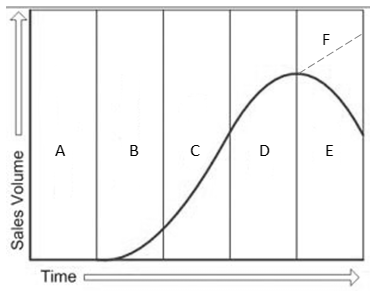

What is the 4th/final stage of the product life cycle?
Growth - product sales increase
Introduction - new product release
Decline - product sales decrease
Maturity - product sales start to slow down

Which stage has lots of competitors?
growth
maturity
introduction
decline
Which statement best describes "Price"?
The cost of producing items
The amount customers are charged for items
The profit earned from selling items
A movie theater sells its tickets at lower prices to students and seniors. This is an example of:
Prompt payment
Price discrimination
Price skimming
Stability pricing
Fast food restaurants such as McDonalds use this pricing strategy for selling combos of burgers, fries and a beverage at a lower price than the total price of the items sold individually. This is an example of:
Discounts
Stability pricing
Price discrimination
Product-bundle pricing
Which pricing strategy uses the
buyers’ perceptions of value rather than seller’s cost?
Customer Value-Based Pricing
Competition-Based Pricing
Cost-Based Pricing
Dynamic Pricing
“The costs of production (raw and processed materials, and labor) that are tied to and vary, depending on the number of units produced” is an explanation of …
Fixed Cost
Total Cost
Average Fixed Cost
Variable Cost
The following are NOT included in pricing tactics are ...
discounting for channel members
distribution-based pricing
price leadership
price bundling
A pricing strategy used by luxury goods, marketers in which they keep the price artificially high to maintain a favorable image of the product, is an explanation of..
Prestige Pricing
Freemium Pricing
Loss-Leader Pricing
Predatory Pricing
What is the primary motive of all firms when it comes to pricing?
To reduce production costs
To increase market share
To attract more customers
To maximize profit
What is the importance of price in building the image of a product?
Consumers believe high priced products are of high value
Price has no impact on product image
Consumers do not consider price when evaluating product value
Consumers believe low priced products are of high value
What is the role of price in targeting a particular segment of customers ?
Price is used to target a particular segment of customers
Price is not used to target specific customer segments
Price is used to discourage customer segmentation
Price is used to target all customer segments equally
What is the importance of understanding customer needs in relation to pricing?
Understanding customer needs has no impact on pricing
Understanding customer needs can help identify opportunities to raise prices
Understanding customer needs is only important for product development
Understanding customer needs is irrelevant in pricing decisions
What is the role of price in influencing consumer perception?
Consumers do not consider price when evaluating product value
Consumers believe low priced products are of high value
Price has no impact on product image
Consumers believe high priced products are of high value
The market’s responsiveness to a price change is often referred to as the ______ of the market.
price sensitivity
price elasticity
price change
Geographical pricing can involve charging different prices in different regions for the same product.
TRUE
FALSE
Discount pricing involves offering a reduced price for a product for a limited time to stimulate sales.
TRUE
FALSE
Seasonal discounts are price reductions given to customers buying out-of-season merchandise.
TRUE
FALSE
Segmented pricing strategy involves setting a single price for all customers regardless of their characteristics or buying behavior
TRUE
FALSE
What statement best describes the term 'upstream partners'?
Upstream partners are organizations that collaborate on marketing and promotional strategies for the company's products.
Upstream partners refer to competitors in the market who influence the supply chain indirectly through competition.
Upstream partners are the customers and retailers who distribute the company's products to the end users.
Upstream partners involve suppliers to the company (manufacturers).
What statement best describes the term 'downstream partners'?
Downstream partners are the marketing channels or distribution channels that look toward the customer, including retailers and wholesalers.
Downstream partners include logistics firms responsible for transporting raw materials to manufacturing facilities.
Downstream partners are suppliers that provide raw materials and components to the company for production.
Downstream partners are organizations involved in post-purchase services, such as customer support and product maintenance.
Which of the following is not an advantage of having a distributor?
A manufacturer has to interact with millions of customers if there were no intermediaries and/or distributors.
Retailers get the product to the customer and the manufacturer advertises for it.
Distributors limit the control manufacturers have over pricing and promotional strategies, making it harder for manufacturers to maintain brand consistency.
It is simpler for customers to go to one retailer for all of their products rather than going to each and every manufacturer.
Which of the following is incorrect regarding direct marketing channels?
A direct marketing channel is most effective for mass-market products that require broad reach and high-volume distribution.
A direct marketing channel is a marketing channel that has no intermediary levels.
A direct marketing channel involves the company selling directly to the customer.
A benefit to direct marketing channels include customizing the product to customer needs.
Which of the following is incorrect regarding indirect marketing channels?
An indirect marketing channel is a marketing channel containing one or more intermediary levels.
An indirect marketing channel involves the company selling to intermediaries (wholesalers/retailers), who then sell the product to the customer.
An indirect marketing channel is most effective for niche products that require highly specialized customization for individual customers.
A drawback to indirect marketing channels include retailers may push competitors’ products over the firm’s products.
Which statement best explains the term 'channel conflict'?
Channel conflict refers to issues arising from miscommunication between suppliers and end customers.
Channel conflict refers to disagreement among channel members over goals, roles, and rewards.
Channel conflict occurs when competitors in the same market disagree on pricing strategies.
Channel conflict refers to disputes between marketing and sales teams over revenue allocation.
Which statement best explains to when a vertical channel conflict may occur?
A vertical channel conflict occurs when there is a disagreement between the company and the intermediaries, such as price issues.
A vertical channel conflict occurs when two competitors collaborate on a marketing campaign but fail to align strategies.
A vertical channel conflict happens only when a retailer promotes products that are not aligned with the manufacturer’s interests.
A vertical channel conflict occurs due to the inability of different manufacturers to cooperate on shared supply chains.
Which statement best explains to when a horizontal channel conflict may occur?
A horizontal channel conflict occurs when a retailer disputes with a manufacturer about promotional activities.
A horizontal channel conflict happens when companies in different markets fail to align their distribution strategies.
A horizontal channel conflict occurs due to inefficiencies in the vertical supply chain structure.
A horizontal channel conflict occurs when there is a disagreement between two companies at the same level, such as competitors that are working side by side.
Which statement best describes the term 'disintermediation'?
Disintermediation involves technology reducing the need for traditional supply chains as it is now easier for companies to access consumers through online and social media.
Disintermediation refers to the process of streamlining supply chains by automating intermediary operations without removing them entirely.
Disintermediation occurs when manufacturers bypass their distributors to sell directly to wholesalers or retailers.
Disintermediation is the practice of outsourcing logistics and distribution to third-party service providers to reduce internal costs.
A firm is choosing between which channel distributions to pick, what are the 3 marketing distribution strategies that it can use?
Intensive distribution, which is used for widely available products in massive amounts, such as groceries.
Exclusive distribution, which is used for speciality and luxury products that are narrowly available.
Selective distribution, which is in between intensive and exclusive, such as shoes and clothes.
All of the above are strategies that it can use, but it mainly depends on the product that they are selling.
When determining the number of channel members to use at each level, three strategies are available: intensive, exclusive, and _____.
multichannel
direct
extensive
selective
1. Sometimes a producer chooses only a few dealers in a market area to distribute its products or services. Generally these dealers are given a right to _____.
exclusive distribution
selective distribution
intensive distribution
corporate distribution
_____ represent buyers or sellers on a more permanent basis. Another name for them is manufacturers’ representatives.
brokers
agents
Retailers
Customers
What does supply chain refer to?
The stages goods and services go through from their source to the end consumer
The process of transporting a product from one location to another
The process of getting a good or service from a warehouse to the end customer
From the economic system’s point of view, the role of marketing intermediaries is to transform the assortments of products made by __________ into the assortment wanted by consumers.
producers
suppliers
marketers
distributors
Producers benefit from using intermediaries because they ________.
offer greater efficiency in making goods available to target markets
bring a fresh point of view to strategy development
eliminate risk
are generally backlogged with orders
refuse to store products for longer than a few days
Which of the following is NOT a key function that intermediaries play in completing transactions?
promotion
information
negotiation
financing
matching
An advantage of a vertical marketing system (VMS) over a conventional distribution channel is that it acts as a ________ system.
unified
democratic
socially responsible
customer-driven
task-driven
Sometimes a producer chooses only a few dealers in a territory to distribute its products or services. Generally these dealers are given a right to ________ distribution.
exclusive
selected
intensive
administered
corporate
A firm that uses direct marketing would most likely sell its products through ________.
one marketing intermediary
big box retailers
large wholesalers
multiple intermediaries
the company Web site
A paid non-personal message communicated to a select audience through a mass medium is refers to?
Advertising
Personal selling
Sales promotion
Public relations
Which of the following is the advertising media used in advertising?
Newspaper
Yellow page
Social media
All of the above
The process of communicating with a potential buyer face-to-face with the purpose of selling a product or service is refers to?
Advertising
Personal selling
Sales promotion
Public relations

The image above refers to?
Rebate
Coupon
Frequent user incentives
Point of purchase display
A free product given to customers to encourage trial and purchase refers to?
Rebate
Sample
Frequent user incentives
Point of purchase display
The temporary price reduction to resellers for purchasing specified quantity of product refers to?
Trade shows
Buying allowance
Frequent user incentives
Cooperative advertising
Communication activities in creating and maintaining favorable relationship between organization and various public groups are refers to?
Advertising
Personal selling
Sales promotion
Public relations
Brochures, company annual reports and magazines are the example of which public relations tool?
Written communication
Event sponsorship
Publicity
Spoken communication
News release, featured article, captioned photograph ad press conference are the example of which public relations tool?
Written and spoken communication
Event sponsorship
Publicity
Corporate identity materials
___ is a printed report containing news or activity of business that is sent by mail
Propoganda
Newsletter
Budget
Blog
__ is one of the activities associated with PR
Publicity
Trade
Social Media
Advising
The use of short-term incentives to encourage the purchase or sale of a product is called
Advertising
Personal selling
Public relations
Sales promotion
Which tool is also known as "event" marketing (when a company provides money or resources for an event or team in exchange for benefits like advertising its logo at an event)?
sponsorship
direct marketing
advertising
sales promotion
An
appropriate _____ mix must be created in order to meet the marketing
objectives.
promotional
social
resource
organisation
What is relationship marketing?
Marketing that builds an emotional connection with the customer
Marketing to families
Marketing that focuses on using minimal money

