
 Worksheets
Kinetic Molecular Theory, and Temperature Practice Quiz
Total questions: 124
Worksheet time: 2hrs 16mins
According to the Kinetic Molecular Theory a liquid's (SELECT ALL THAT APPLY)
particles are held close together by intermolecular forces
particles are in constant motion
particles are vibrating in place and closely packed
particles are not moving

The properties of liquids include (SELECT ALL THAT APPLY)
definite volume
take the shape of the container
can flow
are relatively incompressible
can diffuse and have surfacre tension
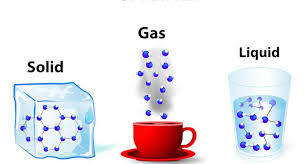
Which of the following is an assumption of the kinetic-molecular theory of gases?
Collisions between gas particles are inelastic.
Gases consist of closely spaced particles.
Gas particles move around in an orderly manner.
The temperature of a gas depends on the average kinetic energy of the gas particles.
Which of the following is an assumption of the kinetic-molecular theory of gases?
Collisions between gas particles are inelastic.
Gases consist of closely spaced particles.
Gas particles move around in an orderly manner.
The temperature of a gas depends on the average kinetic energy of the gas particles.
Which states of matter are fluid?
gases and liquids
liquids and solids
gases only
liquids only

1. Kinetic refers to _______________
Force
Energy
Motion
Acceleration

What are the three states of matter?
Solid
Pretzel
Phone
Liquid
Gas

What is the process that turns a gas into a liquid?
melting
freezing
evaporation
condensation

What is the process that turns a liquid into a gas?
melting
freezing
evaporation
condensation

What is the process that turns a liquid into a solid?
melting
freezing
evaporation
condensation

In which state of matter are the particles the moving the fastest?
solid
liquid
gas

Put each state in order from particles closest together to particles farthest apart.
Solid
Liquid
Gas

Solids have ...
Definite shape and a definite volume.
Definite volume and takes the shape of the container,
No definite shape and no definite volume.

Gases have ...
Definite shape and definite volume.
No definite shape and no definite volume.
Definite volume but no definite shape.

A solid substance turning into a liquid is called ...
evaporation
freezing
melting
evaporation
A solid substance turning into a liquid is called ...
evaporation
freezing
melting
evaporation
When a gas is cooled to make a solid.
deposition
sublimation
condensation
none
When a solid turns directly to a gas.
condensation
clouds
sublimation
evaporation

Dry ice in a glass is an example of...
Deposition
Evaporation
Precipitate
Sublimation

In three days you go back and this puddle is gone. This is an example of...
Condensation
Sublimation
Deposition
None of the answers

Scraping ice from a windshield is the result of...
Sublimation
Deposition
Evaporation
Condensation

A ______ change occurs when matter moves from one phase/state to another
physical
chemical
matter
melting

When heat is removed -- gas changes into a solid -- such as water vapor changing into frost. The liquid phase is skipped.
evaporation
freezing
deposition
condensation
The change of one state of matter to another is called
Osmosis
Phase Change
Matter
Energy
A phase change is a chemical or physical change?
Physical
Chemical
Transition from a solid to a liquid
Condensation
Melting
Freezing
Evaporation
Transition from a liquid to a gas
Condensation
Freezing
Evaporation
Melting
Transition from a liquid to a solid
Freezing
Sublimation
Melting
Evaporation
Gas condenses to a liquid
Evaporation
Melting
Freezing
Condensation
Change of a solid directly into a gas
Deposition
Melting
Sublimation
Freezing
Change of a gas directly into a solid
Sublimation
Condensation
Evaporation
Deposition
When an object undergoes phase change, its mass
increases
stays the same
decreases

This is an example of
Freezing
Melting
Condensation
Sublimation

This is an example of
Melting
Condensation
Freezing
Evaporation

This is an example of
Condensation
Evaporation
Sublimation
Melting

This is an example of
Deposition
Condensation
Melting
Evaporation

This is an example of
(Hint: Dry Ice)
Deposition
Sublimation
Freezing
Melting

This is an example of
Melting
Sublimation
Deposition
Condensation

The temperature at which a liquid evaporates to a gas is called
freezing point
boiling point
melting point
condensation point
The temperature at which a liquid freezes to a solid is called
Freezing Point
Melting Point
Boiling Point
Condensation Point
The temperature at which a solid melts to a liquid is called
Boiling Point
Freezing Point
Condensation Point
Melting Point
The temperature at which a gas condenses to a liquid is called
boiling point
condensation point
melting point
freezing point
Solid --> Liquid
Fusion
Liquid --> Gas
Vaporization
Solid --> Gas
Gas --> Liquid
Liquid --> Solid
Gas --> Solid
Decide if each phase change is Endothermic or Exothermic.
Melting/Fusion
Vaporization/Boiling
Sublimation
Condensation
Freezing
Deposition
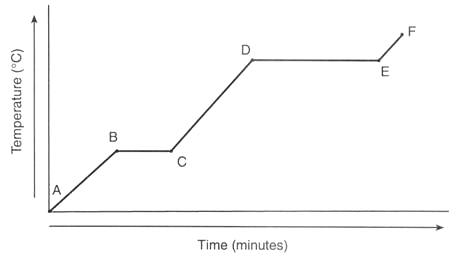
Is the substance gaining or losing energy?
Gaining
Losing
Are the particles moving faster or slower as time goes on?
Faster
Slower
What state/phase is the object likely from points A to B?
Solid
Liquid
Gas
Plasma
What is happening to the particles in the substance between points A and B?
Melting
Freezing
Speeding Up
Slowing Down
What is happening to the particles in the substance between points D and E?
Melting
Freezing
Vaporizing
Sublimating

Is the substance gaining or losing energy?
Gaining
Losing

Where on the graph are phase changes taking place?
1
2
3
4
5


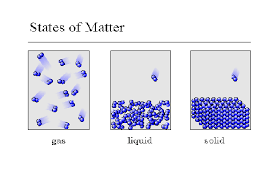


Temperature is the measure of _______________ energy.
potential
kinetic
thermal
mechanical
Heat and termperature are the same.
True
False
Temperature is the measure of _______________ energy.
potential
kinetic
thermal
mechanical
As thermal energy increases, the temperature -
increases
decreases
stays the same
Water boils at -
212 0F
0 0F
373 0F
98.6 0F
Absolute zero happens when particles -
move very fast
move very slowly
stop moving
melt
As the temperature of a substance increases, the movement of the particles -
stop
decrease
increase
Particles of a substance are in a constant motion.
True
False
The greater the heat, the __________________ the movement of the particles.
lower
greater
____ is a measure of the average kinetic energy among the particles of a substance.
heat
specific heat
temperature
thermal energy
Which of these samples of water will have greater average kinetic energy among its particles?
20 oC
40 oC
They will be equal.
Which of these samples of water will have faster average velocity among its particles?
20 oC
40 oC
They will be equal.
Match the following temperature scales with the correct descriptions.
Fahrenheit
everyday measurements in U.S.
Celsius
everyday measurements outside of U.S.
Kelvin
based on absolute zero
Which of these would be the coldest possible temperature?
0 oF
0 oC
0 K
What tool is used to measure temperature?
calorimeter
thermometer
ruler
balance
The theoretical temperature at which all particle motion stops is called __.
boiling point
freezing point
absolute zero
Which of these represents a higher temperature?


They are equal.
Water boils at 100 __ and freezes at 0 __.
oF
oC
K
Water boils at 373 __ and freezes at 273 __.
oF
oC
K
Water boils at 212 __ and freezes at 32 __.
oF
oC
K
The highest temperature ever recorded on Earth was 134 oF at Death Valley, California. What is this temperature in oC?
273.2
56.6
407
-139
The coldest temperature ever recorded on Earth was -89.2 oC in Antarctica. What is this temperature in oF?
-129.6
-67.3
183.8
-362.2
At night, the temperature on the moon can get as cold as -130 oC. What is this in kelvin?
-202
-90
143
-403
(Kelvin = C + 273)
Convert: 0 K to °C
-273 °C
-273 K
273 °C
273 K
100 °C = _____ K
173 K
373K
273 K
0 K
100 °C = _____ K
173 K
373K
273 K
0 K
Convert: 0 K to °C
-273 °C
-273 K
273 °C
273 K

What would be the effect on the particles if more heat is supplied to the system? (a)


Thermal energy
Temperature
Heat
Convection
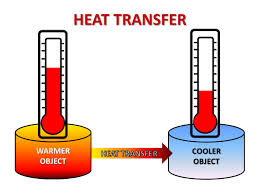
Heat flows from an area of (a) temperature to an area of (b) temperature.
Car A has their AC set to 72oF. Car B has their AC set to 67oF. If it is 98oF outside, which car will heat flow into faster?
Car A
Car B
Heat will flow into the cars at the same rate.
__________is the form of energy that is transferred between objects that are different temperatures.
Heat or Temperature
Heat
Temperature
The measure of hotness or coldness is (a) .
temperature or heat

