
 Worksheets
Chapter 12 Review
Total questions: 37
Worksheet time: 19mins
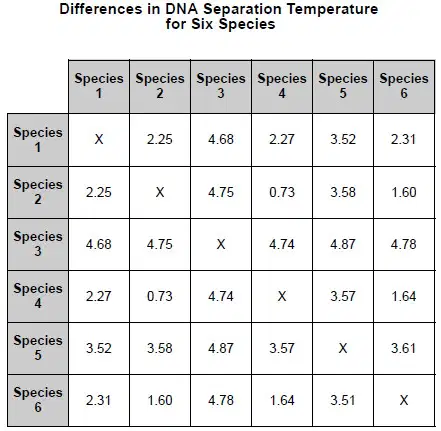
DNA-DNA hybridization is a technique used to determine the relatedness among different species. During hybridization, scientists combine a single strand of DNA from two different species. They heat these combined strands in small increments, and observe the temperatures at which most of the strands in the sample separate. Scientists compare the differences in separation temperatures from single-species DNA strands to hybridized DNA strands, since a greater difference in separation temperature indicates fewer base pair similarities between each organism. The table shows data for six species.
Which pair of species is the most closely related?
species 4 and species 5
species 5 and species 6
species 2 and species 4
species 2 and species 6
DNA-DNA hybridization is a technique used to determine the relatedness among different species. During hybridization, scientists combine a single strand of DNA from two different species. They heat these combined strands in small increments, and observe the temperatures at which most of the strands in the sample separate. Scientists compare the differences in separation temperatures from single-species DNA strands to hybridized DNA strands, since a greater difference in separation temperature indicates fewer base pair similarities between each organism. The table shows data for six species.
Select the two statements that describe evidence to support the determination of the most closely related pair of species.
Hybrid DNA will separate easily when two species share more common ancestors.
Similar temperatures are needed to separate DNA from species that share more genetic similarities.
Higher temperatures are needed to separate hybrid DNA from two species with greater differences in genomes.
Species that have diverged from a common ancestor more recently will also share more complementary base pairs.
The European corn borer is a pest whose larvae cause damage to corn crops in the United States. Pesticides can be used to control the larvae. As an alternative, scientists have developed a genetically engineered form of corn called the Bt strain. It produces a toxin in its cells called Bt, which is poisonous to the corn borer larvae. Farmers who plant fields of Bt corn are required by law to plant fields of non-Bt corn nearby as well.
Which statement explains why farmers would be required to plant non-Bt corn near Bt corn?
To provide controls for Bt toxin experiments with corn borers
To keep corn borers from cross-pollinating Bt and non-Bt corn
To slow reproductive selection for a Bt toxin-resistant corn borer
To prevent movement of corn borers from Bt to non-Bt corn fields
A biologist conducting a long-term field study noticed there were two types of mice in a valley. One type of mouse had webbed toes, and one type of mouse lacked webbed toes. A dam was built in the valley turning the land into a wetland. As the years passed,all mice living in the valley were found to have webbed toes. No mice were found with non-webbed toes.
Which statement best explains the observed change in the mouse population?
Webbed-toed mice survived better and reproduced more than mice without webbed toes.
The increased water levels in the valley increased the mutation rate in the mouse population.
The mice grew webbing to move more efficiently in the new environment.
Webbed toes in mice are controlled by the environment

