Wayground logo

Free Printable Worksheets

Font size

S
M
L
XL
Worksheets

Unit 10 Review

Total questions: 34

Worksheet time: 2hrs 41mins

Name
Class
Date
1.

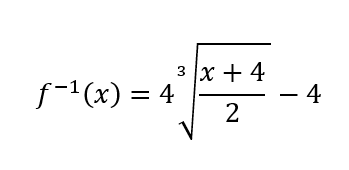
Determine which function is one-to-one?

a)
b)
c)
2.

The relation in the graph is..

a)

a function but not a one-to-one function.

b)

a one-to-one function.

c)

not a function

3.

The relation in the graph is..

a)

a function but not a one-to-one function.

b)

a one-to-one function.

c)

not a function

4.

x−7+10=1\sqrt{x-7}+10=1   Only type the number answer

(a)  

5.

(x+2)12+3=7\left(x+2\right)^{\frac{1}{2}}+3=7  

a)

14

b)

-14

c)

98

d)

0

6.

Solve the cube root equation

a)

27

b)

20

c)

3

d)

30

e)

None

7.

What is the value of x in the equation (2x + 1)1/3 + 3 = 6

a)

1

b)

13

c)

4

d)

16

e)

None

8.

∛(x−5)=∛(5x−11)∛\left(x-5\right)=∛\left(5x-11\right)  

a)

x=23x=\frac{2}{3}  

b)

x=32x=\frac{3}{2}  

c)

x=4x=4  

d)

x=−4x=-4  

e)

None

9.

Which graph represents the function?

a)
b)
c)
d)
10.
What transformations have occurred to get the graph of g(x) from the graph of f(x)?
a)
reflection over the x-axis,vertical compress by a factor of 5
b)
reflection over the y-axis,vertical compress by a factor of 5
c)
reflection over the x-axis,vertical stretch by a factor of 5
d)
reflection over the y-axis,vertical stretch by a factor of 5
11.
If f(x) = x3 is changed to f(x) = - (x + 3)3 + 2, how is the graph transformed?
a)
3 units right, 2 units up, reflected across the y-axis
b)
3 units right, 2 units up, reflected across the x-axis
c)
3 units left, 2 units up, reflected across the y-axis
d)
3 units left, 2 units up, reflected across the x-axis
12.

To find the inverse of a function, you must.......?

a)

Swap x and y, solve for x.

b)

Swap and x and y, solve for y.

13.

If f(x)=x2+2, x≥0f\left(x\right)=x^2+2,\ x\ge0 , find f−1(x)f^{-1}\left(x\right) and restrict the domain if necessary.

a)

f−1(x)=x−2f^{-1}\left(x\right)=\sqrt[]{x-2}

b)

f−1(x)=− x−2f^{-1}\left(x\right)=-\ \sqrt[]{x-2}

c)

f−1(x)=x+2f^{-1}\left(x\right)=\sqrt[]{x}+2

d)

f−1(x)=− x+2f^{-1}\left(x\right)=-\ \sqrt[]{x}+2

14.

If f(x)=5xf\left(x\right)=\sqrt[]{5x} , find f−1(x)f^{-1}\left(x\right) and restrict the domain if necessary.

a)

f−1(x)=15x2, x≥0f^{-1}\left(x\right)=\frac{1}{5}x^2,\ x\ge0

b)

f−1(x)=15x2, x≤0f^{-1}\left(x\right)=\frac{1}{5}x^2,\ x\le0

c)

f−1(x)=x2−5, x≥0f^{-1}\left(x\right)=x^2-5,\ x\ge0

d)

f−1(x)=x2−5, x≤0f^{-1}\left(x\right)=x^2-5,\ x\le0

15.

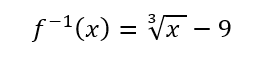
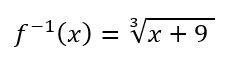
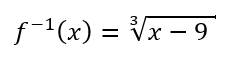
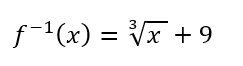
What is the inverse of f(x) = (x-9)3? Remember that the x and y switch.
a)
b)
c)
d)
16.

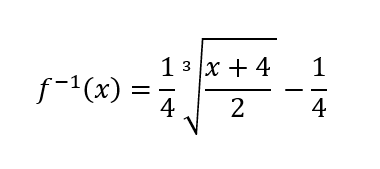
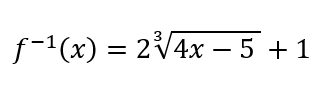
What is the inverse of the function

ƒ(x) = 2(4x + 1)³ − 4
a)
b)
c)
17.
What are the transformations of this functions compared to the parent function?
a)
Shifted right 5, shifted down 2, and reflected over the x-axis
b)
Reflected over the x-axis, vertical stretch, and shifted right 5
c)
Reflected over the x-axis, vertical stretch, and shifted left 5
d)
Shifted right 5, shifted down 2
18.
Describe the transformations.
a)
Translate Right 2, Down 4
b)
Translate Left 2, Down 4
c)
Translate Left 2, Up 4
d)
Translate Right 2, Up 4
19.

What do we call the point (-2, 4) in the function graphed?

a)

vertex

b)

relative (or local) minimum

c)

relative (or local) maximum

d)

absolute maximum

e)

absolute minimum

20.
If f(x) = (x - 1)3 + 4 is shifted up 3 and left 2, what is the new domain?
a)
(-∞, ∞)
b)
[-1, 7]
c)
[-1, ∞)
d)
(-∞, 7]
21.
If f(x) = x3 is changed to f(x) = - (x + 3)3 + 2, how is the graph transformed?
a)
3 units right, 2 units up, reflected across the y-axis
b)
3 units right, 2 units up, reflected across the x-axis
c)
3 units left, 2 units up, reflected across the y-axis
d)
3 units left, 2 units up, reflected across the x-axis
22.

What is the y-intercept of f(x) = (x + 2)3 - 6? { Hint: the y-intercept is the same thing as f(0). }

a)

(2, 0)

b)

(-0.5, 0)

c)

(0, 2)

d)

(0, -0.5)

23.

What is the Domain of ALL Cube Root Functions in interval notation?

a)

(−∞, ∞)

b)

−∞ < x < ∞

c)

(−∞, 0]

d)

All Cube Root Functions are different.

24.
The graph of a function is shown.  What are the domain and range of this function?
a)
Domain: (-∞, ∞)
Range: (-∞, 2]
b)
Domain: [2, ∞)
Range: (-∞, ∞)
c)
Domain: (-∞, ∞)
Range: (-∞, ∞)
d)
Domain: (-∞, 2]
Range: [2, ∞)
25.

What is the range of ALL cubic functions? Select all that apply!

a)

[-∞, ∞]

b)

(-∞, ∞)

c)

-∞ ≤ y ≤ ∞

d)

-∞ < y < ∞

26.
What is the range of this function?
f(x) = √(x-2) + 4
a)
(-∞,4]
b)
(-∞,2]
c)
(∞,4]
d)
[4,∞)
27.
What is the domain of this function?
f(x) = √(x-2) + 4
a)
[2,∞)
b)
(-∞,2]
c)
(∞,2]
d)
[4,∞)
28.

Which function matches the graph?

a)

A

f(x) = − ∛(x + 3) − 1

b)

B

f(x) = − ∛(x - 3) − 1

c)

C

f(x) = ∛(x + 3) − 1

d)

D

f(x) = ∛(x - 1) + 3

29.

Solve the cube root equation

a)

344

b)

21

c)

-344

d)

-21

e)

None

30.

Solve the cube root equation

a)

36

b)

-216

c)

216

d)

-36

e)

None

31.

What is the value of x in the equation (2x + 1)1/3 + 3 = 6

a)

1

b)

13

c)

4

d)

16

e)

None

32.

−5−2(−3−16x)13=−15-5-2\left(-3-16x\right)^{\frac{1}{3}}=-15  

a)

8

b)

50916\frac{509}{16}  

c)

-8

d)

314\frac{31}{4}  

e)

None

33.

The two functions −2x+43\sqrt[3]{-2x+4} and −x+83\sqrt[3]{-x+8} intersect at which point?

a)

(−4,43)\left(-4,\sqrt[3]{4}\right)

b)

(4,−4)\left(4,-4\right)

c)

(−4,4)\left(-4,4\right)

d)

(43, −4)\left(\sqrt[3]{4},\ -4\right)

34.

Solve the radical equation:

2x+3−2=x\sqrt[]{2x+3}-2=x