
 Worksheets
Levels of Organization in Ecology
Total questions: 23
Worksheet time: 15mins
Fill in the blanks with appropriate words. ________ is the study of organisms and their interaction with the surrounding environment.
Ecology
Biology
Geology
Astronomy
Fill in the blanks with appropriate words. An ________ studies the relationship between living organisms and their habitats.
ecologist
biologist
geologist
chemist
How many levels of organization are there in an ecosystem?
Five: organism, population, community, ecosystem, and biosphere
Four: organism, community, ecosystem, and biosphere
Six: cell, organism, population, community, ecosystem, and biosphere
Three: population, community, and ecosystem
Fill in the blanks with appropriate words. A ________ is a group of similar individuals, usually of a given species occupying a particular habitat at a particular time.
population
community
ecosystem
biome
Fill in the blanks with appropriate words. An ________ is a single organism, plant, animal, or microorganism, such as bacteria and fungi, capable of independent existence.
individual
ecosystem
community
population
Fill in the blanks with appropriate words. An ________ is a functional unit of nature consisting of more than a community of living organisms and their abiotic factors.
ecosystem
organism
population
biome
Fill in the blanks with appropriate words. A ________ includes populations of different species living together and sharing the same habitat in a given area.
community
ecosystem
biome
population
Fill in the blanks with appropriate words. A ________ is the total of all the ecosystems on the planet Earth.
biosphere
atmosphere
hydrosphere
lithosphere
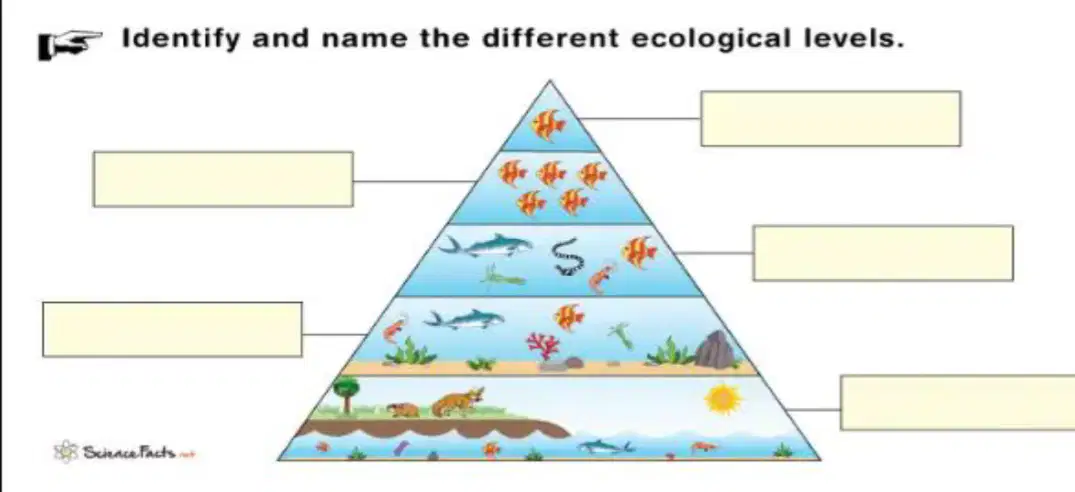
Identify and name the different ecological levels in the diagram.
Organism, Population, Community, Ecosystem, Biome, Biosphere
Cell, Tissue, Organ, Organ System, Organism
Producer, Consumer, Decomposer
Individual, Group, Society, Culture

Identify the different ecological organization levels. Fill in the blanks with the correct levels of ecological organization. Also draw the different organisms in each level.
The different levels of ecological organization are: individual, population, community, ecosystem, biome, and biosphere.
The different levels of ecological organization are: cell, tissue, organ, organ system, organism.
The different levels of ecological organization are: atom, molecule, cell, tissue, organ.
The different levels of ecological organization are: species, genus, family, order, class.
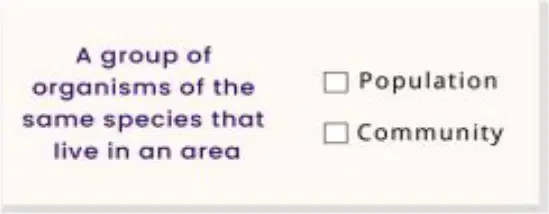
Determine which level of ecological organization the information refers to. A group of organisms of the same species that live in an area.
Population
Community
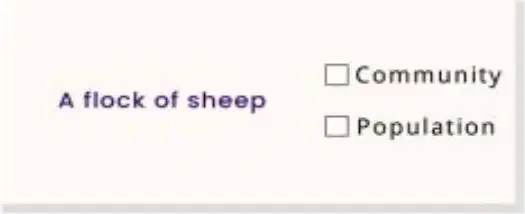
Determine which level of ecological organization the information refers to. A flock of sheep.
Community
Population

Determine which level of ecological organization the information refers to. An interacting group of various species in a common location.
Community
Ecosystem
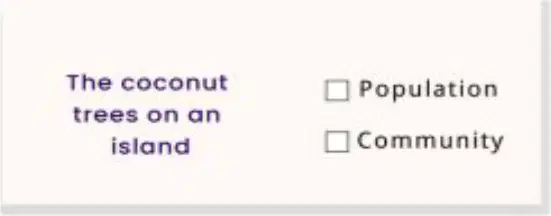
Determine which level of ecological organization the information refers to. The coconut trees on an island.
Population
Community
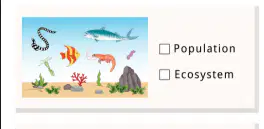
Determine which level of ecological organization the information refers to.
Biosphere
Ecosystem
Population
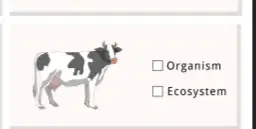
Determine which level of ecological organization the information refers to.
Organism
Ecosystem

1 individual
Organism
a group of the SAME organisms
Population
groups of DIFFERENT organisms
Community
All of the living and non-living things in an area
Ecosystem
a ball of life =
the earth
Biosphere
Label the levels of organization:
Match the following

population

community

organism
Match the following
Biosphere
Where organisms live ocean-to sky
Organism
One living thing
Poplation
2 or more organisms of the same species
Community
Multiple populations
Ecosystem
community & abiotic factors
Which of the following is an example of an abiotic factor in an ecosystem?
Sunlight
Tree
Deer
Fungi
Fill in the blanks with appropriate words. A ________ is a living component that affects the population of another organism, or the environment.
abiotic factor
biotic factor
biosphere
ecosystem
Which of the following best describes the relationship between abiotic and biotic factors in an ecosystem?
Abiotic factors are less important than biotic factors.
Biotic factors control abiotic factors.
Biotic factors depend on abiotic factors for survival.
Abiotic factors are independent of biotic factors.

