
 Worksheets
6.5 Tools and Approaches
Total questions: 105
Worksheet time: 1hrs 3mins
Discuss the use of project management approaches to define projects.
Project management approaches help in defining project scope, objectives, and deliverables.
Project management approaches are only used for scheduling tasks.
Project management approaches are irrelevant in defining projects.
Project management approaches are only used for budgeting.
The structure of projects includes roles and responsibilities, deliverables, and timelines. Which of the following best describes this structure?
A hierarchical organization of tasks and responsibilities with defined deliverables and timelines.
A random assortment of tasks without specific roles or timelines.
A focus solely on deliverables without considering roles or timelines.
An emphasis on timelines without defined roles or deliverables.
Discuss the formats of large and small projects and how they are tracked and reported on.
Large projects are tracked using Gantt charts, while small projects use simple to-do lists.
Both large and small projects use the same tracking methods.
Large projects are not tracked, only small projects are.
Small projects are tracked using Gantt charts, while large projects use simple to-do lists.
Discuss the methods used to measure project indicators.
Methods to measure project indicators include surveys, interviews, and data analysis.
Project indicators are measured by guessing.
Project indicators cannot be measured.
Project indicators are measured by intuition.
Explain the features and benefits of a range of technology-based project management tools.
Technology-based project management tools offer features like task management, collaboration, and reporting, providing benefits such as increased efficiency and better team communication.
Technology-based project management tools are primarily used for entertainment purposes.
Technology-based project management tools are outdated and offer no significant benefits.
Technology-based project management tools are only useful for small teams.
Explain the reporting structures of projects and how they can be presented visually.
Reporting structures of projects can be presented visually using Gantt charts, organizational charts, and flow diagrams.
Reporting structures of projects are only presented in textual reports.
Reporting structures of projects do not require any visual representation.
Reporting structures of projects are presented visually using only pie charts.

Fill in the blank: ________ series of practices are part of project management practices.
Related
Unrelated
Random
Irrelevant

Fill in the blank: Project management involves logical ________-by-step plans.
step
process
method
procedure

Fill in the blank: Project management teaches how to ________ a project.
develop
manage
execute
plan
Fill in the blank: Project management helps to control the ________.
variables
budget
timeline
resources
Fill in the blank: Project management involves implementing the ________.
plan
strategy
budget
timeline

Fill in the blank: Project management aims to deliver ________.
outcomes
results
products
services

Fill in the blank: Project management requires to complete and ________.
terminate
initiate
plan
execute
What does the structure of a project refer to?
The process of how it is organised.
The final outcome of the project.
The budget allocated for the project.
The team members involved in the project.
Which of the following is part of the project organisation structure?
Arrangements for decision making
Marketing strategies
Customer feedback analysis
Product design
How is the project methodology model used in project organisation?
It is part of the project organisation structure.
It is used to define the project budget.
It is a tool for managing project risks.
It is a method for scheduling project tasks.
What is involved in planning how a project will be actioned?
It is part of the project organisation structure.
It involves setting deadlines for tasks.
It includes allocating resources to tasks.
It requires identifying project risks.
What should be allocated in the project organisation structure?
The budget parameters.
The team members.
The project timeline.
The resource allocation.
Which resources are considered in the project organisation structure?
Resources, staff, materials, tools.
Only financial resources.
Only human resources.
Only technological tools.
What needs to be agreed upon in the project organisation structure?
Deliverables and timelines.
Project budget and resources.
Team roles and responsibilities.
Stakeholder communication plan.
Who collaborates to create the project organisation structure?
Clients and specialists from relevant departments working with the project manager.
Only the project manager.
External consultants only.
The finance department alone.
What is the budget range for small projects according to UK government infrastructure project categories?
Less than £100 million
Over £100 million
Over £1 billion
What is the budget range for major projects according to UK government infrastructure project categories?
Less than £100 million
Over £100 million
Over £1 billion
Mega projects have a budget of over ______ according to UK government infrastructure project categories.
£1 billion
£500 million
£2 billion
£750 million

What is the typical timeline for small projects?
hours/weeks/months/one year
days/weeks/decades/centuries
minutes/hours/days/weeks
weeks/months/years/decades

What are the deliverables for large projects?
overall objectives, tracking and reporting
budget allocation and resource management
team meetings and brainstorming sessions
client feedback and revisions

Which of the following is a resource for small projects?
Project manager; team leaders
One person, small teams
Hundreds/thousands of specialists

What is a common cost consideration for both small and large projects?
budget limits, payment schedule
project duration, team size
location, weather conditions
technology stack, innovation

What is a characteristic of the project flow in small projects?
More complex
Several methodologies used
Shorter, simpler, easy to manage
Formal communications processes

What is a characteristic of the rigour in large projects?
Reporting to self/line managers
Match tasks against deliverables
Higher levels of accountability, administration, documentation and red tape
Single methodology
What is the purpose of implementing projects according to the text?
To make a difference.
To increase profits.
To follow a trend.
To satisfy stakeholders.
Which of the following is a key performance indicator (KPI) for measuring projects?
Specific direct impacts
Project duration
Team size
Office location
What should the £ value achieved be in relation to the £ cost according to the KPIs?
Significantly higher than £ cost.
Equal to £ cost.
Lower than £ cost.
Unrelated to £ cost.
What does 'Return on investment' compare in the context of project KPIs?
£ cost of project versus £ impact.
£ revenue versus £ expenses.
£ time spent versus £ time saved.
£ resources used versus £ resources saved.
Which KPI involves comparing planned milestones with actual achievements?
On time.
Budget variance
Quality index
Resource utilization
What does stakeholder engagement measure in project KPIs?
Their perception of value.
The project's budget.
The timeline of the project.
The technical specifications.
What is one method of measuring project progress that involves production units, hours, and repetitive tasks?
Completed units
Estimated hours
Task lists
Milestone reviews
Which measurement method involves budgeting each step based on staff time and percentage of complete process?
Milestones
Time Tracking
Cost Analysis
Resource Allocation
For large projects, what percentage is allocated to milestones/deliverables and measured?
Start/finish
10%
50%
100%
In small/short projects, what percentage is assigned/paid on start and on finish?
50% on start; 50% on finish
40% on start; 60% on finish
60% on start; 40% on finish
30% on start; 70% on finish
What is the cost ratio method of measuring project progress?
Budget allocated divided by staff hours; % value of project completion
Budget allocated divided by total project cost; % value of project completion
Actual cost divided by planned cost; % value of project completion
Total expenses divided by total income; % value of project completion
Which method involves tasks and subtasks with different units of measurement?
Weighted/equivalent units
Simple units method
Task-based method
Subtask division method
What type of measurement method is based on expert views and is considered subjective and unscientific?
Experience/opinion
Statistical analysis
Quantitative measurement
Empirical research
What is a GANTT chart?
A type of bar chart that illustrates a project schedule
A financial statement showing income and expenses
A diagram showing the hierarchy of an organization
A chart used to track stock market trends
Which of the following is a feature of GANTT charts?
Vertical structure for critical path
Set out tasks from start to finish
Monitor progress annually
Assign tasks randomly
What is the structure used in GANTT charts for the critical path?
Vertical
Circular
Horizontal
Diagonal
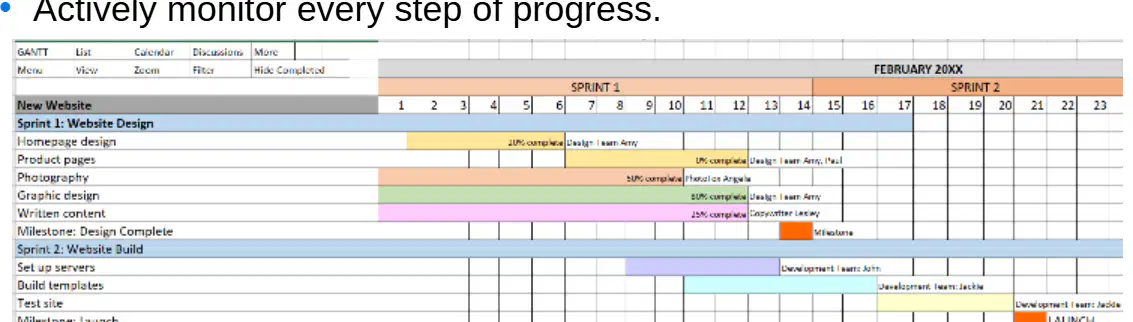
GANTT charts help in project management by:
Providing a visual timeline for tasks and deadlines
Offering detailed financial analysis
Ensuring team communication
Automating project tasks

What is one advantage of GANTT charts?
They are easy to set up
They offer a clear visual representation of project tasks
They do not require updates
They show the number of hours needed by the size of the bar

What is one disadvantage of GANTT charts?
They are easy to set up
They do not require updates
They can be very time consuming to set up at the beginning
They show the number of hours needed by the size of the bar

Which of the following is an advantage of GANTT charts?
A) Can support effective time management schedules
B) Need constant updating to keep information current
C) Not all tasks/resources are available in a single view of chart
D) Not easy to calculate averages or aggregates

Which of the following is a disadvantage of GANTT charts?
Demonstrate resource allocations across the project
Show % completion of each task
Projects with lots of tasks and sub tasks can become complex
Help project managers coordinate with their teams
Match the following advantages and disadvantages of GANTT charts:
Can be very time consuming to set up at the beginning
Offer a clear visual representation of project tasks
Projects with lots of tasks and sub tasks can become complex
Can support effective time management schedules
Need constant updating to keep information current
Demonstrate resource allocations across the project
Can’t tell number of hours needed by the size of the bar
Show % completion of each task
What is an advantage of GANTT charts in project management?
Help order complex projects into manageable chunks
Provide a detailed budget analysis
Ensure team collaboration
Track project milestones effectively
What is a disadvantage of GANTT charts in project management?
What is another name for critical flow analysis?
Critical path analysis (CPA)
Flow network analysis
Bottleneck analysis
Streamline analysis
Which of the following is a function of critical path analysis?
Identifies only critical tasks
Sets minimum and maximum time per task
Ignores task dependencies
Calculates only deadline date
Critical path analysis helps in visualizing the flow and priorities of all tasks in a project.
True
False
Fill in the blank: The CPA process moves a project from chaos to ______, making it easier to visualize the flow and priorities of all the tasks in the project.
clarity
confusion
disorder
complexity
What is the first task in the CPA for building a house?
Dig trenches for utilities/water mains.
Lay the foundation.
Install the roof.
Paint the walls.
What task involves pouring foundations and base in the CPA for building a house?
Dig and pour foundations and base.
Install roofing materials.
Paint the exterior walls.
Lay down the flooring.
Which task in the CPA for building a house involves installing windows and doors?
Build walls/install windows/doors.
Lay the foundation
Install plumbing
Paint the walls
What is the task related to laying pipes and cables in the CPA for building a house?
Lay pipes and cables to the house.
Install windows and doors.
Paint the exterior walls.
Construct the roof.
Which task in the CPA for building a house involves building the roof and insulating the loft?
Build the roof, tiles, insulate loft.
Install windows and doors.
Lay the foundation and build walls.
Paint the interior and exterior.
What task involves installing and connecting the kitchen and bathroom in the CPA for building a house?
Install and connect kitchen/bathroom.
Paint the exterior walls.
Lay the foundation.
Install the roof.
What is the final task in the CPA for building a house before handing over the keys?
Snagging jobs to give high-spec finish.
Painting the exterior walls.
Installing the roof.
Laying the foundation.
The purpose of a CPA network diagram in project management, using the example of building a house, is to:
Visualize the sequence of tasks and their dependencies
Estimate the total cost of the project
Identify the stakeholders involved
Determine the quality standards required
What is one advantage of Critical Path Analysis (CPA)?
It does not schedule the teams to tasks
It sets out critical tasks that depend on each other in a sequence
Timings of tasks are based on best guest estimates
It does not enable allocation of other resources
What is one disadvantage of Critical Path Analysis (CPA)?
It identifies parallel tasks that can run concurrently with each other
It gives a clear picture of how to manage the project efficiently
CPA does not schedule the teams to tasks
It allows team members to clearly see every step in the project

Fill in the blank: Critical Path Analysis (CPA) identifies ______ tasks that can run concurrently with each other.
parallel
sequential
dependent
isolated

Fill in the blank: One disadvantage of Critical Path Analysis (CPA) is that the critical path may not be clear in larger, more ______ projects.
complex
simple
straightforward
easy

What is a benefit of using Critical Path Analysis (CPA) in project management?
It does not show material costs for each task
It gives a calculated estimate of minimum and maximum times for the project duration
It does not enable allocation of other resources
The critical path may not be clear in larger projects

Fill in the blank: Critical Path Analysis (CPA) allows team members to clearly see every ______ in the project.
step
milestone
deadline
resource
What does PERT stand for in project management?
Project Evaluation Review Technique
Program Evaluation and Review Technique
Project Estimation and Resource Tracking
Performance Evaluation and Reporting Tool
Which of the following is a step in PERT planning?
Identify tasks and sequences
Allocate resources
Conduct market analysis
Develop a marketing plan
What is the formula for calculating the expected time in PERT?
(Optimistic + 4 × Most likely + Pessimistic) / 6
(Optimistic + Most likely + Pessimistic) / 3
(Optimistic + Pessimistic) / 2
(Most likely + Pessimistic) / 2
What does ES stand for in PERT planning?
Earliest start time
Estimated start
Event schedule
Execution sequence
What does EF stand for in PERT planning?
Earliest finish time
Estimated finish
Event forecast
End function
What does LS stand for in PERT planning?
Latest start time
Longest sequence
Least slack
Last schedule
What does LF stand for in PERT planning?
Latest finish time
Longest flow
Least factor
Logical function
A flowchart is a:
diagram that represents a process or algorithm
type of chart used to display data
method for solving mathematical equations
tool for creating presentations
Which of the following is a use of flowcharts?
Illustrate the sequence of tasks
Identify potential workflow issues
Discover potential workflow improvements
All of the above
Flowcharts can be created quickly and easily using:
pen and paper
flowchart software
spreadsheets
presentation slides
Flowcharts can present lots of information in a single diagram.
True
False
What can be color-coded in a flowchart?
Shapes
Lines
Text
All of the above
What does the 'Process' symbol represent in a flowchart?
Action or process step; is common to all process flowcharts and workflow maps
Decision point in the process
Start or end of the process
Data input or output
What is the purpose of the 'Flow line' symbol in a flowchart?
Showing the direction the processes and tasks are flowing
Indicating the start of the process
Representing a decision point
Displaying the end of the process
Which symbol is described as 'A parallelogram is the data symbol, showing inputs and outputs of the process'?
Data
Process
Decision
Start/End
What does the 'Document' symbol show in a flowchart?
Shows parts of the process that create or result in a document
Indicates a decision point in the process
Represents the start or end of a process
Displays a manual operation
What is indicated by the 'Multi-documents' symbol in a flowchart?
Showing when multiple documents are produced or used
Indicating a decision point in the process
Representing a start or end point
Showing a process or action step
What does the 'Manual input' symbol indicate in a flowchart?
Showing when users will be required to input information manually
Indicating a decision point in the process
Representing a process or operation
Denoting the start or end of a process
Which of the following is a project management practice?
Randomized planning
Logical step-by-step plans
Unstructured brainstorming
Spontaneous execution
What is the purpose of the project methodology model?
Which of the following is NOT an area of responsibility in a project?
Project leadership
Project board
Project team
Project finance
Which area of responsibility is involved in implementing the project?
Project leadership
Project board
Project team
Project stakeholders
What is the level of the T-Level Technical Qualification in Management and Administration?
Level 1
Level 2
Level 3
Level 4
What is a common timeline consideration for both small and large projects?
No timeline
Timelines are always the same
Timelines vary based on project scale
Timelines are irrelevant
What is the main purpose of implementing projects according to the document?
To make a difference
To increase costs
To reduce stakeholder engagement
To delay milestones
What does the cost ratio method involve?
Dividing budget by staff hours
Allocating budget to milestones
Using expert opinions
Measuring repetitive tasks
Which method involves assigning and paying 50% at the start and finish of a project?
Milestones
Start/finish for small projects
Cost ratio
Weighted/equivalent units
What is the main benefit of the CPA process?
What is the first step in the CPA for building a house?
Dig trenches for utilities/water mains.
Planning permission granted.
Build walls/install windows/doors.
Lay pipes and cables to the house.
Which task involves handing over keys to house owners?
Snagging jobs to give high-spec finish.
Hand over keys to house owners.
Install and connect kitchen/bathroom.
Build the roof, tiles, insulate loft.
What is the main focus of a CPA network diagram when building a house?
Task dependencies and time estimation
Cost estimation
Resource allocation
Design planning
What is the relationship between activities in a CPA network diagram?
Sequential and dependent
Independent and random
Simultaneous and unrelated
Parallel and independent
How does CPA help with non-critical tasks?

