wayground logo

Free Printable Worksheets

Font size

S
M
L
XL
Worksheets

First Semester Review - Biology

Total questions: 100

Worksheet time: 1hrs 12mins

Name
Class
Date
1.

A possible answer to a question that can be tested.

a)

Observation

b)

Hypothesis

c)

Principle

d)

Inference

2.

Defines relationships that are valid everywhere in the universe

a)

Scientific Theory

b)

Principle

c)

Scientific Law

d)

Fact

3.

A conclusion reached on the basis of evidence and reasoning

a)

Observation

b)

Hypothesis

c)

Principle

d)

Inference

4.

Information obtained through the senses.

a)

Observation

b)

Hypothesis

c)

Principle

d)

Inference

5.

A series of steps used to solve a scientific problem

a)

Scientific Theory

b)

Scientific Method

c)

Scientific Law

d)

Scientific Principle

6.

The condition in an experiment that is changed or manipulated.

a)

Dependent Variable

b)

Experimental Group

c)

Independent Variable

d)

Control Group

7.

The condition in an experiment that is observed or measured

a)

Dependent Variable

b)

Experimental Group

c)

Independent Variable

d)

Control Group

8.

In an experiment the group that serves as a standard for comparison and receives no experimental treatment.

a)

Dependent Variable

b)

Experimental Group

c)

Independent Variable

d)

Control Group

9.

The condition that does not change in an experiment.

a)

Data

b)

Inference

c)

Variable

d)

Constant

10.

Data expressed in words.

a)

Qualitative Data

b)

Quantitive Data

11.
An experiment is performed on plants to see how different liquids affect plant growth. Each plant in the experiment is given a different liquid; water, apple juice, or milk. Each plant has the same amount of soil, sunlight, and listens to the same music. In this investigation, the independent variable is ...
a)
The type of plant
b)
The amount of sunlight
c)
The type of music
d)
The type of liquid
12.
Mr. S normally uses praise as a reward to train his dog. He wants to know the best way to train his dog, so he sets up an experiment to find out if there is a better way to get his dog to respond to commands. What is his dependent variable?
a)
Type of reward
b)
Praise
c)
Type of dog
d)
Amount of time the dog follows commands
13.
Enzymes are considered to be 
a)
Lipids
b)
Carbohydrate
c)
Protein
d)
Nucleic Acid
14.
What is the purpose  of an enzyme?
a)
give permission for the reaction
b)
raise activation energy
c)
speed up reactions
d)
control how many reactions occur
15.
How do enzymes increase the speed of chemical reactions?
a)
reducing the number of products   
b)
reducing the activation energy
c)
increasing the temperature of the cell
d)
increasing the concentration of reactants 
16.
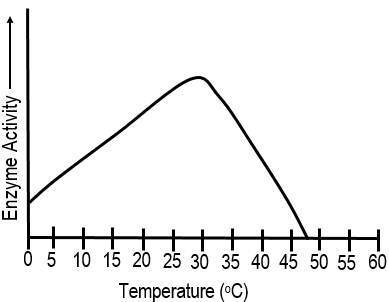
Based on the graph, what temperature does this enzyme work best? 
a)
15 C
b)
40 C
c)
30 C
d)
47 C
17.

What is the chemical symbol of water?

a)

H2O

b)

CO2

c)

O2

d)

N2

18.

What property allows water molecules to stick together and makes water a unique molecule for life?

a)

Hydrogen Bonds

b)

Cohesive behavior

c)

Polarity

d)

Expansion Upon Freezing

19.

What characteristic is shown in the image?

a)

Polarity

b)

Hydrogen Bonds

c)

Cohesion

d)

Adhesion

20.

What property of water allows for water to act as a temperature regulator for the world?

a)

Cohesive Behavior

b)

Expansion Upon Freezing

c)

High Specific Heat

d)

Universal Solvent

21.

What property of water causes these Alka-Seltzer tablets to dissolve?

a)

Universal Solvent

b)

Expansion Upon Freezing

c)

Cohesive Behavior

d)

High Specific Heat

22.

Valence electrons are found

a)

in the innermost energy level of an atom

b)

in the middle energy levels of an atom

c)

in the outermost energy levels of an atom

23.

How do covalent bonds form?

a)

By donating and receiving valence electrons between atoms.

b)

Scientists still aren't sure.

c)

Opposite slight charges attract each atom in the compound.

d)

Sharing valence electrons between atoms

24.
How are ionic bonds formed?
a)
Transfer of electrons
b)
Sharing of electrons
25.
DNA and RNA are examples of ___________.
a)
Carbohydrates
b)
Lipids
c)
Proteins
d)
Nucleic Acids
26.
What is the function of nucleic acids?
a)
Store and transmit genetic information
b)
Store energy (long-term)
c)
Store energy (short-term)
d)
Build skin, hair, nails, and muscles
27.
Examples of which biological macromolecule include glucose, fructose, starch, and glycogen?
a)
Lipids
b)
Carbohydrates
c)
Nucleic Acids
d)
Proteins
28.
What does POLY- mean?
a)
Two
b)
A name for a parrot
c)
Many
d)
One
29.
What are the four types of biological macromolecules?
a)
carbohydrates, nucleotides, lipids, amino acids
b)
carbohydrates, lipids, nucleic acids, proteins
c)
nucleic acids, monosaccharides, proteins, lipids
d)
carbohydrates, amino acids, water, proteins
30.
What are the monomers (building blocks) of CARBOHYDRATES?
a)
Monosaccharides (simple sugars)
b)
Amino Acids
c)
Nucleotides
d)
Glycerol and fatty acids
31.

What are the building blocks (or monomers) of proteins?

a)

Nucleotides

b)

Monosaccharides

c)

Amino Acids

d)

Glycerols

32.
What type of cell has a nucleus? 
a)
eukaryotic
b)
prokaryotic 
33.
Controls what enters/leaves a cell
a)
cell membrane
b)
Nuclear membrane
c)
cell wall
d)
cytoplasm
34.
What am I?
a)
cell wall
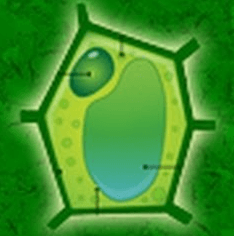
b)
mitochondria
c)
cytoplasm
d)
chloroplast
35.
What can only be found in plant cells?
a)
Cell membrane
b)
Vacuole
c)
Chloroplast
d)
Mitochondrion
36.
Where are proteins made?
a)
Golgi body
b)
Mitoichondrion
c)
Chromosomes
d)
Ribosomes
37.
This organelle takes food and turns it into ENERGY for plant and animal cells.
a)
Chloroplast
b)
Mitochondria
c)
Lysosome
d)
Ribosome
38.
A rigid layer that lies outside the cell's  membrane is...
a)
Cytoskeleton
b)
Cilia
c)
Cell Wall
d)
Flagella
39.
In what organelle is the genetic material found inside?
 
a)
Endoplasmic Reticulum
b)
Golgi Complex
c)
Nucleolus
d)
Nucleus
40.

Maintains the cell's shape and aids in cellular movement

a)

cytoskeleton

b)

centrioles

c)

Golgi apparatus

d)

nucleus

41.

Made of a lipid bilayer, proteins, & carbohydrates

a)

Rough endoplasmic reticulum

b)

nucleus

c)

Cell wall

d)

Cell membrane

42.

Fluid that fills the cell

a)

Cell membrane

b)

Cytoplasm

c)

Choloroplast

d)

Vacuole

43.
Has membrane bound organelles
a)
Prokaryote
b)
Eukaryote
c)
both
44.
One example of a prokaryote is a...
a)
fungus
b)
bacteria
c)
animal
d)
plant
45.
Where is the DNA found in a prokaryotic cell? 
a)
floating around in the cytoplasm 
b)
in the nucleus 
c)
in the ribosomes
d)
attached to the cell membrane
46.
Where is the DNA found in a eukaryotic cell? 
a)
floating around in the cytoplasm 
b)
in the nucleus 
47.

What type of cell is shown?

a)

Plant cell

b)

Prokaryotic cell

c)

Bacteria cell

d)

Eukaryotic cell

48.
What is the energy source for photosynthesis?
a)
Enzymes
b)
Sunlight
c)
Glucose
d)
Carbohydrates
49.
What are the reactants for photosynthesis?
a)
Carbon Dioxide & Oxygen
b)
Oxygen & Water
c)
Water & Glucose
d)
Carbon Dioxide & Water
50.
What type of sugar molecule is produced by plants during photosynthesis?
a)
Oxygen
b)
Starch
c)
Glucose
d)
Water
51.
Organisms that are able to take inorganic raw materials and convert them into organic products to use for food are called
a)
Autotrophs
b)
Heterotrophs
c)
Decomposers
d)
Consumers
52.
What green pigment is used to trap light energy from the Sun to be used for photosynthesis?
a)
Chlorophyll
b)
Xanthophyll
c)
Carotene
d)
Chloroplast
53.
What is the formula for photosynthesis?
a)
Carbon dioxide + Water → Glucose + Oxygen
b)
Glucose + Oxygen
→ Carbon dioxide + Water
c)
Carbon dioxide + Glucose
→ Oxygen + Water
d)
Carbon dioxide + Oxygen
→ Glucose + Water
54.
What are the reactants for aerobic cellular respiration?
a)
Glucose & oxygen
b)
Glucose & carbon dioxide
c)
Oxygen & water
d)
Water & carbon dioxide
55.
What molecules are produced by cellular respiration?
a)
Water & glucose
b)
Water, carbon dioxide & ATP
c)
Glucose, oxygen & ATP
d)
Oxygen & ATP
56.
Inside of which cell organelle does cellular respiration take place?
a)

Ribosome

b)
Cell Membrane
c)
Nucleus
d)
Mitochondria
57.

If oxygen is not present (anaerobic) what process do cells undergo to create ATP?

a)
Fermentation
b)
Breathing
c)
Glycolysis
d)
Synthesis
58.
Which statement BEST compares aerobic and anaerobic respiration?
a)
Less ATP is generated during anaerobic respiration than during aerobic respiration
b)
more water is generated during anaerobic respiration than during aerobic respiration
c)
more oxygen is generated during anaerobic respiration than during aerobic respiration
d)
less lactic acid is generated during anaeobic respiration than during aerobic respiration
59.
What gas is collecting in the yeast and sugar balloon?
a)
oxygen
b)
carbon dioxide
c)
nitrogen
d)
glucose
60.

Osmosis is what type of transport?

a)

Active

b)

Passive

61.

Osmosis is the movement of

a)

water from high concentration to low concentration

b)

water from low concentration to high concentration
c)

sugar from high concentration to low concentration

d)

sugar from low concentration to high concentration

62.
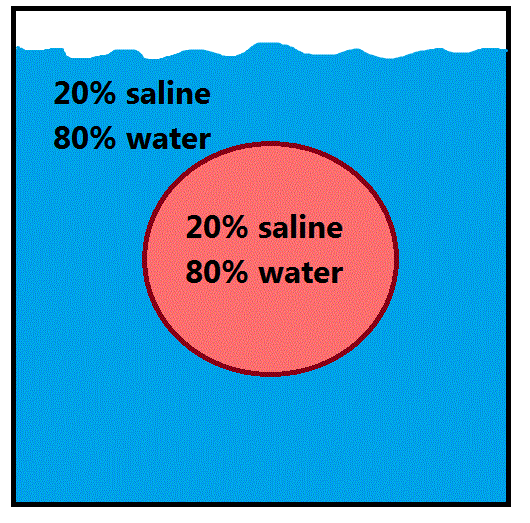
A blood cell is placed into the jar, as seen. Where will the water go?
a)
Into the cell
b)
Out of the cell
c)
Equally in & out - it's isotonic
d)
The water is a lie
63.
Why can't you drink salt water?
a)
It's hypertonic to your cells
b)
It's hypotonic to your cells
c)
It's isotonic to your cells
d)
It's paratonic to your cells
64.
The cell below is in a _________ solution.
a)
Hypotonic
b)
Hypertonic
c)
Isotonic
65.
The cell below is in a _____________ solution.
a)
Hypertonic
b)
Hypotonic
c)
Isotonic
66.

The head of phospholipids are

a)

hypotonic

b)

hydrophbic

c)

hypertonic

d)

hydrophilic

67.

What is the plasma membrane made of?

a)

sugars

b)

phospholipids

c)

nucleic acids

d)

proteins

68.
What type of transport is this?
a)
Endocytosis
b)
Diffusion
c)
Exocytosis
d)
Osmosis
69.
What type of transport is this?
a)
Endocytosis
b)
Facilitated Diffusion
c)
Active Transport Pump
d)
Osmosis
70.
What type of transport is this?
a)
Endocytosis
b)
Exocytosis
c)
Diffusion
d)
Sodium-Potassium Pump
71.
What are 3 types of active transport?
a)
Riding a bike, Running through the mountains, walking on the beach
b)
Osmosis, Diffusion, Facilitated Diffusion
c)
Sodium/potassium Pump, Endocytosis, Exocytosis
d)
Throwing a ball, Playing tennis, driving a car
72.
The maintenance of an organism’s internal environment is called:
a)
compensating
b)
homeostasis
c)
balancing
d)
routine
73.

What is a similarity in chemosynthesis and photosynthesis

a)

they both produce carbon dioxide

b)

they both use light

c)

the both are used by plants

d)

they both produce energy and sugar

74.

Produces 2 daughter cells

a)

Mitosis

b)

Meiosis

c)

Both

75.

Has 2 divisions

a)

Mitosis

b)

Meiosis

c)

Both

76.

Produces body cells

a)

Mitosis

b)

Meiosis

c)

Both

77.

helps with growth

a)

Mitosis

b)

Meiosis

c)

Both

78.

Produces gametes

a)

Mitosis

b)

Meiosis

c)

Both

79.

Helps create genetic variation

a)

Mitosis

b)

Meiosis

c)

Both

80.

The human diploid number is:

a)
92
b)
46
c)
23
d)
2
81.
This diagram below shows:
a)
synthesis 
b)
mitosis
c)
crossing over
d)
cell cycle 
82.
C is pointing to: 
a)
chromatid
b)
chromosome
c)
centromere
d)
centriole
83.
A nucleotide includes...?
a)
pentose sugar
b)
nitrogenous base
c)
phosphate group
d)
all of the above
84.
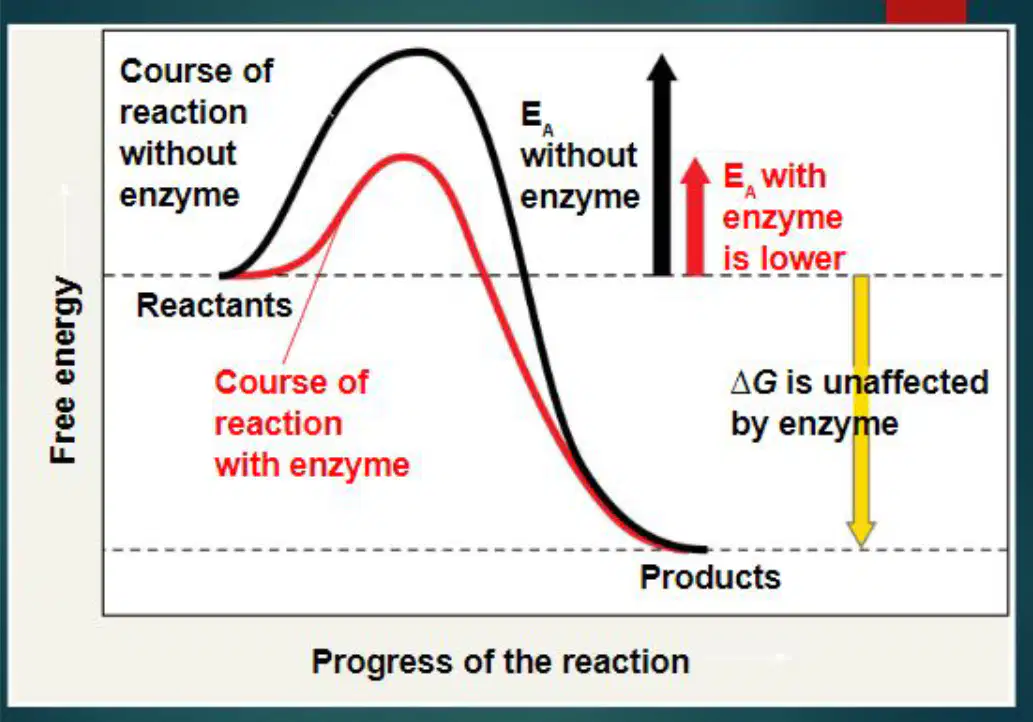
The graph shows how enzymes affect reactions in cells. Which statement best summarizes the information shown in the graph?
a)
Enzymes increase the energy of the reactants.
b)
Enzymes decrease the energy level of the products.
c)
Enzyme decrease the activation energy of the reaction.
d)
Enzymes reverse the direction of the reaction.
85.

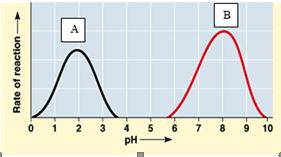
What is the optimal pH of enzyme A?

a)

8

b)

2

c)

5.7-10

d)

10

86.

What does the diagram explain about enzyme activity?

a)

Enzymes increase the activation energy of a reaction.

b)

Enzymes decrease the activation energy of a reaction.

c)

Enzymes have no effect on the activation energy.

d)

Enzymes increase the free energy of the products.

87.

Consider the energy diagram for a chemical reaction. Overall, is energy released or absorbed?

a)

absorbed, because the energy level of the products is greater than that of the reactants

b)

released, because the energy level of the reactants is greater than that of the products

c)

absorbed, because the energy level increases during the reaction

d)

released, because the reaction is initiated by the addition of heat

88.

Which reaction occurred WITH an enzyme?

a)

A

b)

B

89.

Looking at the graph shown, what is the optimum temperature for this particular enzyme to work?

a)

10 degrees

b)

40 degrees

c)

63 degrees

d)

30 degrees

90.

Biology is the study of

a)

minerals

b)

life

c)

genetics

d)

energy

91.
Is this ionic bond drawn correctly?
a)
Yes
b)
No
92.

What is the picture displayed?

a)

atom

b)

molecule

c)

element

d)

compound

93.

Which type of macromolecule stores energy and provides thermal insulation for the body?

a)

lipid

b)

protein

c)

nucleic acid

d)

carbohydrate

94.

Large numbers of ribosomes are present in cells that specialize in producing which of the following molecules?

a)

lipids

b)

carbohydrates

c)

proteins

d)

nucleic acids

95.

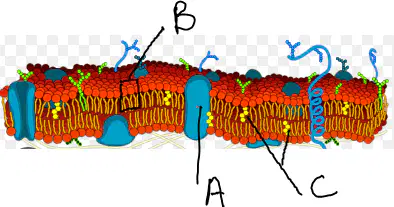
Refer to the picture. Which of the following types of molecules are the major structural components of the cell membrane?

a)

phospholipids and nucleic acids

b)

phospholipids and proteins

c)

nucleic acids and proteins

d)

proteins and carbohydrates

96.

Organisms must be able to adapt to a changing external and internal environment. An organism’s ability to maintain a stable internal environment is known as homeostasis. How does a cell’s membrane help an organism maintain homeostasis?

a)

cell membranes directly control the temperature of the cell

b)

cell membranes protect the cell organelles from large doses of radiation

c)

cell membranes control the substances that enter or leave the cell

d)

cell membranes use a large portion of the cell's energy supply

97.

An organism’s genetic information is stored in which type of macromolecule?

a)

nucleic acid

b)

carbohydrate

c)

lipid

d)

protein

98.

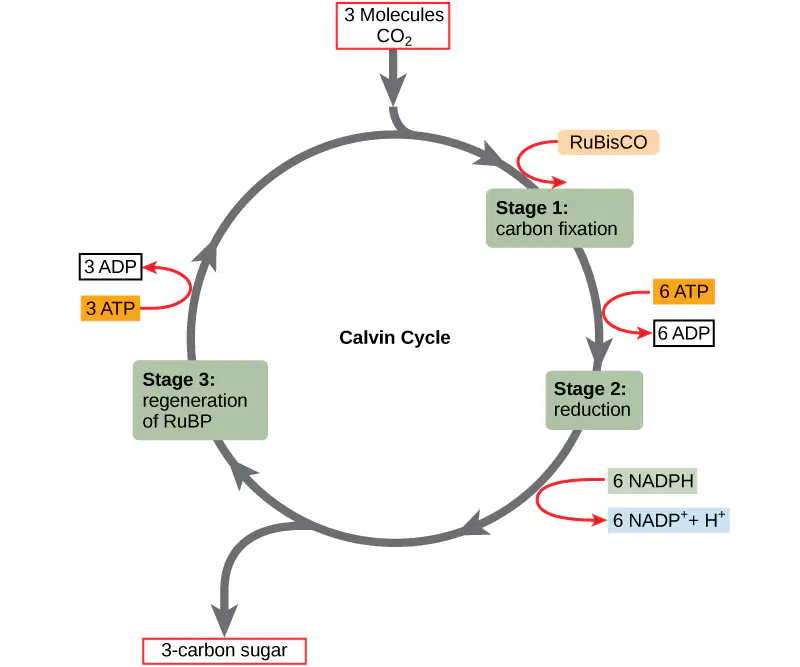
What is the main purpose of the cycle shown in the figure above?

a)

production of ADP

b)

sugar production

c)

destruction of CO2

d)

Production of NADH+

99.

Which cells have a cell membrane? (check all that apply)

a)

plants

b)

animals

c)

bacteria

d)

none of these have cell membrane

100.

The division of the cytoplasm during mitosis is called

a)

interphase

b)

meiosis

c)

binary fission

d)

cytokinesis