Worksheets
Earth's Interior and Crust Characteristics
Total questions: 52
Worksheet time: 2hrs 40mins

The diagram represents a model of Earth’s surface and internal structure. Letters A, B, C, and D represent four different layers. Some depths below Earth’s surface are shown. Which Earth layer is inferred to be composed of solid nickel and iron?
A
B
C
D

The cross-section shows the direction of movement of an oceanic plate over a mantle hot spot, resulting in the formation of a chain of volcanoes labeled A, B, C, and D. The geologic age of volcano C is shown. What are the most likely geologic ages of volcanoes B and D?
B is 5 million years old and D is 12 million years old
B is 12 million years old and D is 6 million years old
B is 9 million years old and D is 9 million years old
B is 10 million years old and D is 4 million years old
In which layer of Earth’s interior is the inferred temperature 6,000º C?
crust
outer core
inner core
mantle

On the map above, line AB is drawn across several of Earth’s tectonic plates in the South Atlantic Ocean. Which cross section best represents the plate boundaries and mantle movement beneath line AB?


Which graph best shows the range of density in each of Earth’s layers?


Contact zones between tectonic plates may produce trenches. One of these trenches is located at the boundary between which plates?
Indian-Australian and Pacific
South American and African
Indian-Australian and Antarctic
North American and Eurasian

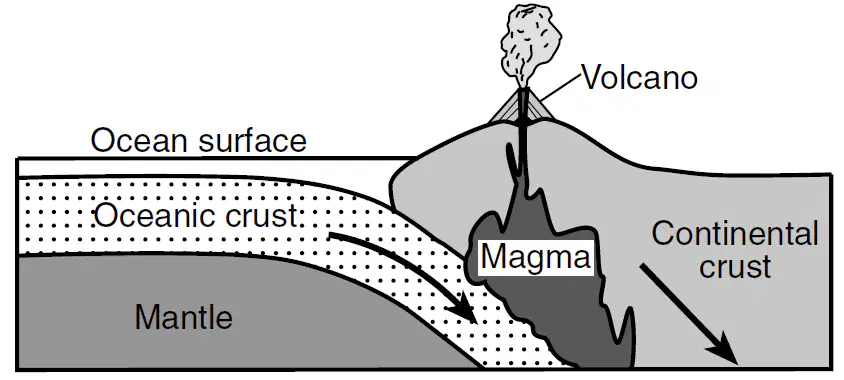
The diagram above shows the collision of an oceanic plate and a continental plate. Collisions between oceanic plates and continental plates are thought to result primarily from
hot liquid magma in the inner core
convection currents in the mantle
volcanic eruptions along coastlines
meteor impacts in the ocean basins
At the Aleutian Trench and the PeruChile Trench, tectonic plates are generally
moving along a transform boundary
moving over a mantle hot spot
diverging
converging
On which plate is the Hawaii Hot Spot located?
South American
Antarctic
Nazca
Pacific
Which of the following is located at a converging plate boundary?
Southwest Indian Ridge
Iceland Hotspot
Marianas Trench
Sandwich Plate
What type of plate boundary exists between the African Plate and the Antartic Plate?
convergent
transform
divergent
complex
The temperature of rock located 1,000 kilometres below the Earth's surface is about
200 Celsius
2,100 Celsius
2,800 Celsius
3,200 Celsius
The diagrams show four major types of fault motion occurring in Earth's Crust. Which type of fault motion matches the general pattern of crustal movement at California's San Andreas fault?


Approximately how far below the surface of the Earth's surface is the interface between the mantle and the outer core?
5 to 30 km
700 to 900 km
2,900 to 3,000 km
5,000 to 5,200 km
Which information indicates that new seafloor rock is forming along a mid-ocean ridge and then moving horizontally away from the ridge?
Most volcanoes are located under water.
Seafloor rock is older than continental rock.
Fossils of marine organisms can be found at high elevations on continents.
The age of seafloor rock increases as the distance from the mid-ocean ridge increases.
Which type of tectonic plate boundary is found between the South American Plate and the Scotia
Plate?
A) transform
B) convergent
C) divergent
D) complex or uncertain
In which layer of Earth's interior is the
inferred temperature 6,000°C?
A) crust
B) mantle
C) outer core
D) inner core

The place where two plates come together is known as a _______
transform boundary.
divergent boundary.
convergent boundary.
rift valley.
Which two mantle hot spots are located at midocean ridges?
Iceland and Yellowstone
Galapagos and Tasman
St. Helena and Hawaii
Easter Island and Bouvet
Crustal formation, which may cause the widening of an ocean, is most likely occurring at the boundary between the
African Plate and the Eurasian Plate
Pacific Plate and the Philippine Plate
Indian-Australian Plate and the Antarctic Plate
South American Plate and the North American Plate
How does the Oceanic crust compare to the Continental crust?
A) The Oceanic crust is more dense
B) The Oceanic crust is less dense
C) The Oceanic crust has the same density as the Continental crust
The theory of continental drift suggests that the
A) continents moved due to Earth's orbit around the sun
B) continents moved due to Earth's rotation
C) the continents are moving toward each other
D) the continents once fit together like puzzle parts

The block diagram below represents the formation of an island arc near a plate boundary.
An island arc is located near the boundary between which two tectonic plates?
Antarctic Plate and Indian–Australian Plate
Philippine Plate and Eurasian Plate
African Plate and North American Plate
Scotia Plate and South American Plate

Which tectonic plate boundary is best represented by this diagram?
Nazca Plate and Pacific Plate boundary
Scotia Plate and South American Plate boundary
Juan de Fuca Plate and North American Plate boundary
Antarctic Plate and Indian-Australian Plate boundary
Which cross section best represents the convection currents in the mantle beneath the Peru-Chile Trench?


The block diagram below shows the boundary between two tectonic plates.
divergent
convergent
complex
transform
At which plate boundary is one lithospheric plate sliding under another?
Nazca Plate and Antarctic Plate
Pacific Plate and Indian-Australian Plate
Indian-Australian Plate and Antarctic Plate
Nazca Plate and Pacific Plate

Early scientist studies the continents an dobserved that South America and Africa fit together like puzzle pieces. Which of the following ideas does this observation support?
The continental shelves of these two continents are made of the same type of rock.
The material that makes up the continental shelves is eroded from the continents.
These continents were joined in the past and have moved apart since that time.
The tectonic plates beneath these continents are roughly the same age.

Mid-ocean ridges are found at one type of tectonic plate boundary. These ridges consist of extensive underwater mountain ranges split by rift valleys. The rift valleys mark places where two crustal plates are pulling apart, widening the ocean basins, and allowing magma from the asthenosphere to move upward. In some cases, mid-ocean ridges have migrated toward nearby mantle hot spots. This explains why mid-ocean ridges and mantle hot spots are found together at several locations.
At which location is the temperature of the ocean floor bedrock most likely highest?
a
b
c
d

The most recently formed bedrock is found at location

Base your answer to the following question on the block diagram and on your knowledge of Earth science. Describe the general relationship between the distance from the ridge center and the age of the seafloor bedrock.
As distance from the ridge center increases, the age of the seafloor remains the same.
As distance from the ridge center increases, the age of the seafloor decreases.
As distance from the ridge center increases, the age of the seafloor increases.

The map below shows the present-day locations of South America and Africa. Remains of Mesosaurus, an extinct freshwater reptile, have been found in similarly aged bedrock formed from lake sediments at locations X and Y. Which statement represents the most logical conclusion to draw from this evidence?
Mesosaurus migrated across the ocean from location X to location Y.
Mesosaurus came into existence on several widely separated continents at different times.
The continents of South America and Africa were joined when Mesosaurus lived.
The present climates at locations X and Y are similar.

Base your answer to the following question on the map of the Mid-Atlantic Ridge shown below. Points A through D are locations on the ocean floor. Line XY connects locations in North America and Africa. In which cross section do the arrows best show the convection occurring within the asthenosphere beneath line XY?


The map below shows some tectonic plate boundaries near South America and Africa. Letters A, B, C, and D represent locations on Earth's surface. Which location most likely has the youngest bedrock?
A
B
C
D
Which mantle hot spot is located closest to a mid-ocean ridge?
Canary Islands
Easter Island
Hawaii
Tasman

State the average density of the continental crust of the North American Plate and the average density of the oceanic crust of the Pacific Plate.
Continental: 2.7 g/cm³, Oceanic: 3.0 g/cm³
Continental: 2.9 g/cm³, Oceanic: 3.3 g/cm³
Continental: 2.5 g/cm³, Oceanic: 2.9 g/cm³
Continental: 2.8 g/cm³, Oceanic: 3.1 g/cm³

The cross section below represents a lithospheric plate boundary. In which diagram do the arrows show the relative directions of plate movement at this type of plate boundary?
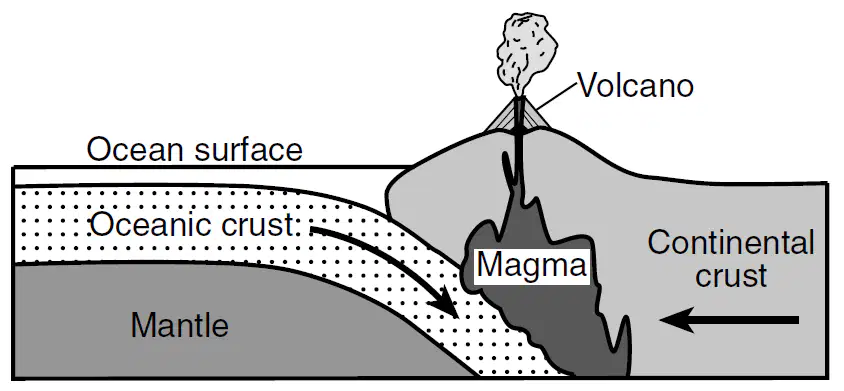
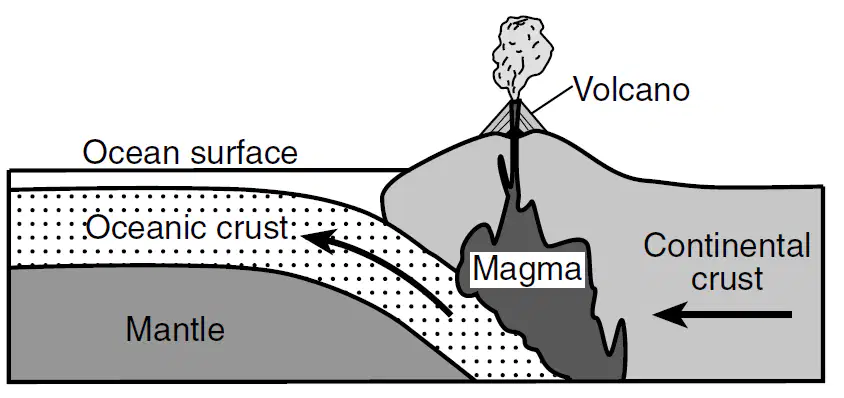
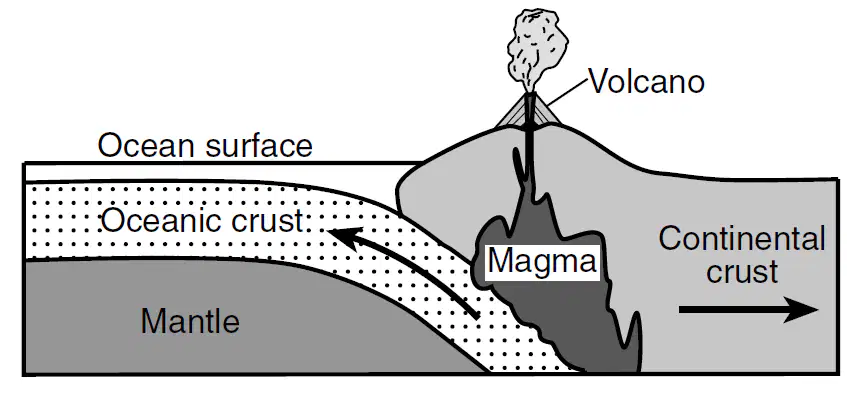

The map shows the location of the epicenter of a major earthquake that occurred about 1700 years ago. Point A represents a location on a tectonic plate boundary. Plates X and Y represent major tectonic plates. The island of Crete; the Anatolian Plate, which is a minor tectonic plate; and the Hellenic Trench have been labeled. Arrows indicate the relative directions of plate motion. What are the names of the major tectonic plates X and Y?
X = Eurasian Plate; Y = African Plate
X = Eurasian Plate; Y = Arabian Plate
X = Indian-Australian Plate; Y = African Plate
X = Indian-Australian Plate; Y = Arabian Plate

On the map below, points A through D represent locations on Earth's surface. Which location is positioned over a mantle hot spot?
A
B
C
D
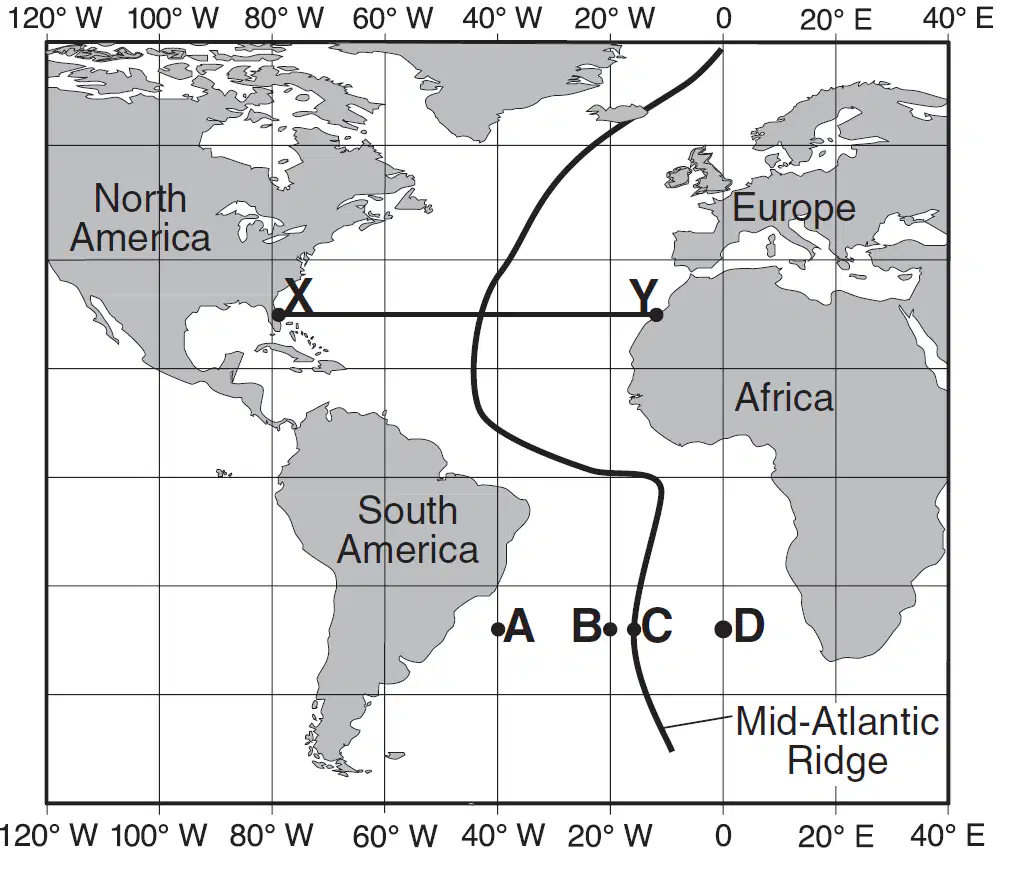
Base your answer on the map of the Mid-Atlantic Ridge shown below. Points A through D are locations on the ocean floor. Line XY connects locations in North America and Africa. In which cross section do the arrows best show the convection occurring within the asthenosphere beneath line XY?
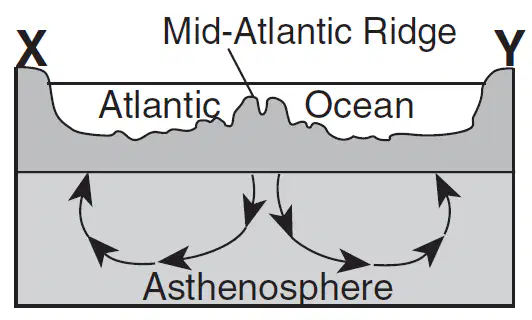
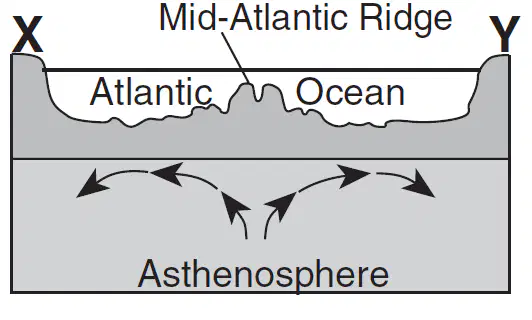
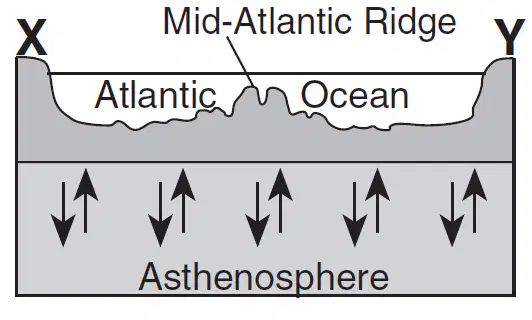
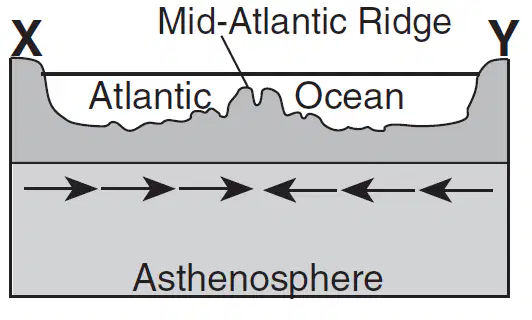
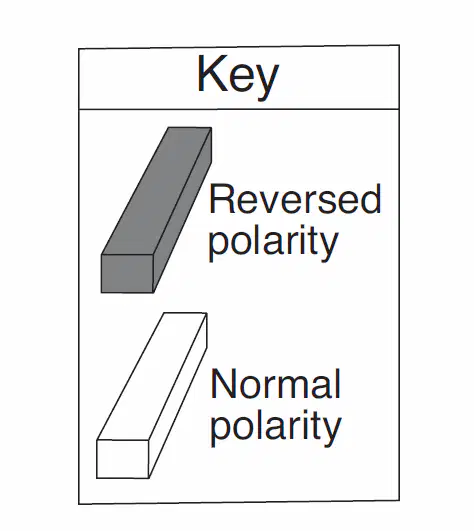
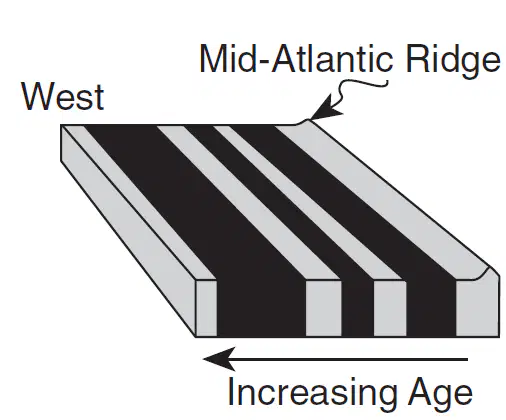
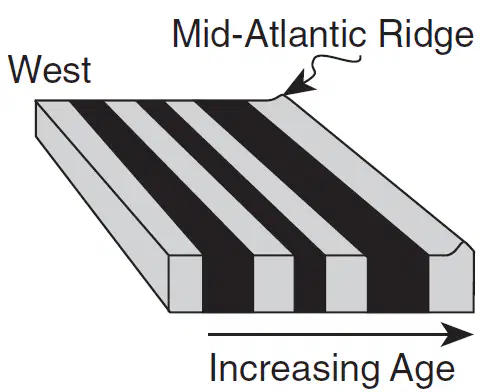
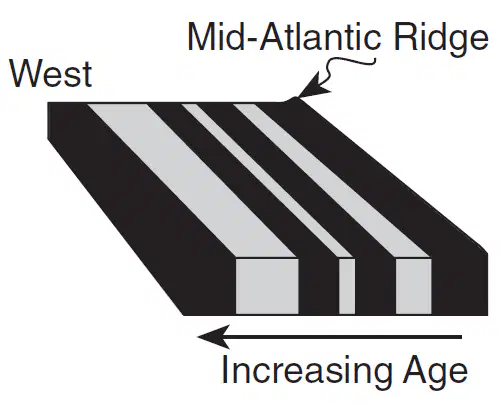
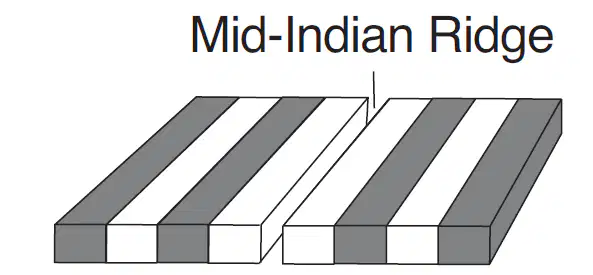
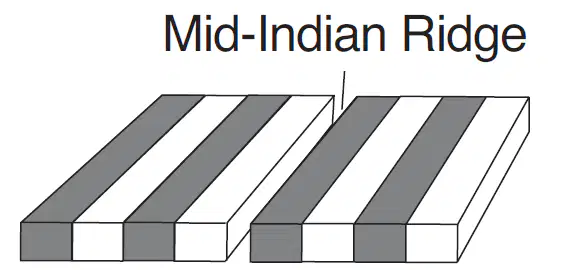
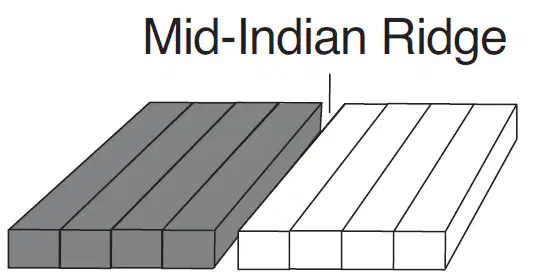
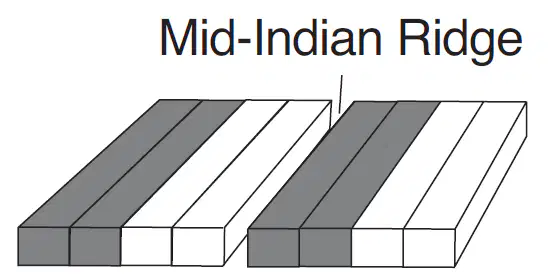
Which diagram best represents the polarity of the magnetic field preserved in the ocean-floor bedrock found on both sides of the Mid-Indian Ridge?
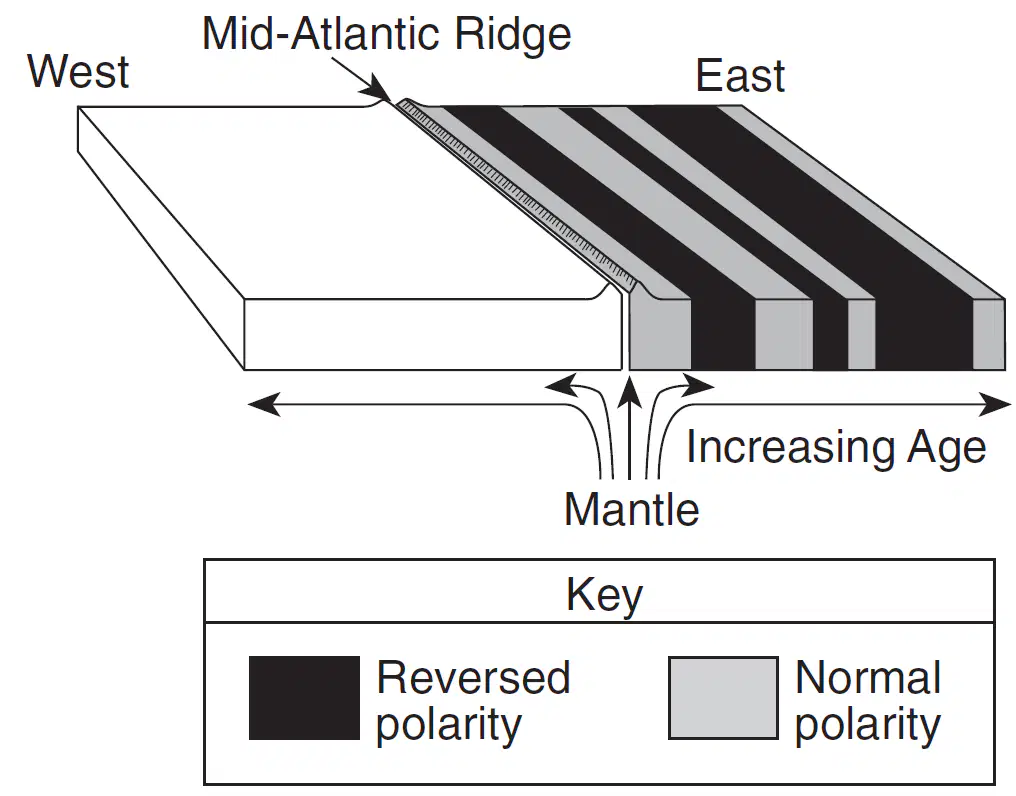
Which diagram best shows the magnetic pattern and relative age of the igneous bedrock on the west side of the ridge?