
 Worksheets
Final Exam Review- Unit 1 & 2
Total questions: 65
Worksheet time: 33mins
Name
Class
Date
1.
Chemistry is
a)
The study of friction and force
b)
The study of solids, liquids and gasses
c)
The study of life and behavior of animals on the planet
d)
The study of matter and the changes that matter undergoes
2.
A solution that has a uniform appearance is a
a)
unsaturated solution
b)
heterogenous solution
c)
homogenous solution
d)
saturated solution
3.
A solution that has a nonuniform appearance is a
a)
unsaturated solution
b)
heterogenous solution
c)
homogenous solution
d)
saturated solution
4.
Pure water freezes at (a) ℃
5.
Pure water freezes at (a) ℉
6.
adding salt to water depresses or lowers the freezing point below zero
a)
depresses or lowers the freezing point below zero Fahrenheit.
b)
elevates or increases the freezing point above zero Celsius.
c)
depresses or lowers the freezing point below zero Celsius.
d)
elevates or increases the freezing point above zero Fahrenheit.
7.
When you remove heat from water (or any substance),
a)
the molecules slow down.
b)
the molecules speed up.
c)
All of the above
d)
None of the above
8.
In a solid, the molecules do not move.
a)
True
b)
False
9.
Blood has lower intermolecular forces acting on it than air
a)
True
b)
False
10.
Which of the following has the strongest intermolecular force?
a)
Carbon Dioxide (CO2)
b)
Water (H20)
11.
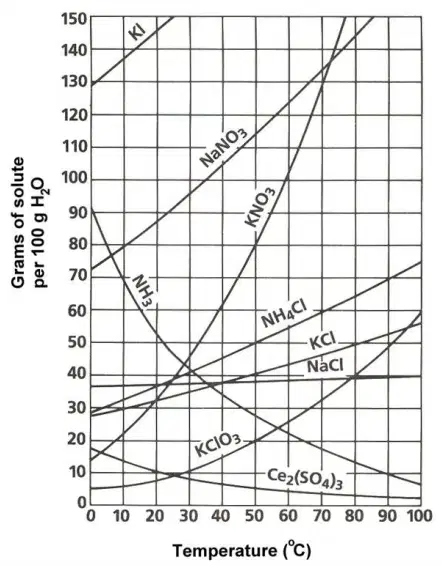
Using the following solubility curve, Which salt is least soluble in water at 20 C
a)
KI
b)
KCl
c)
NH3
d)
KClO3
12.
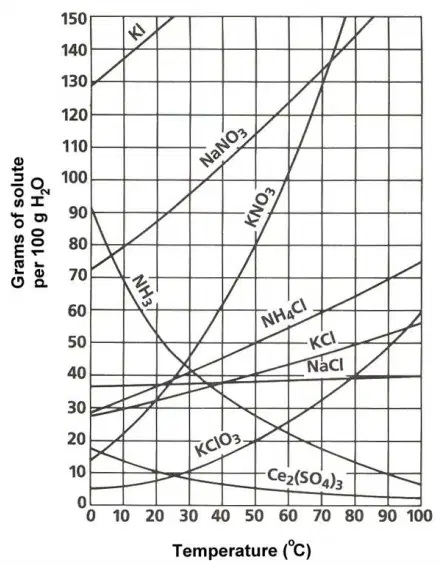
Using the following solubility curve, Which of the following compounds does temperature not increase solubility?
a)
KI
b)
KCl
c)
KClO3
d)
NH3
e)
KNO3
13.
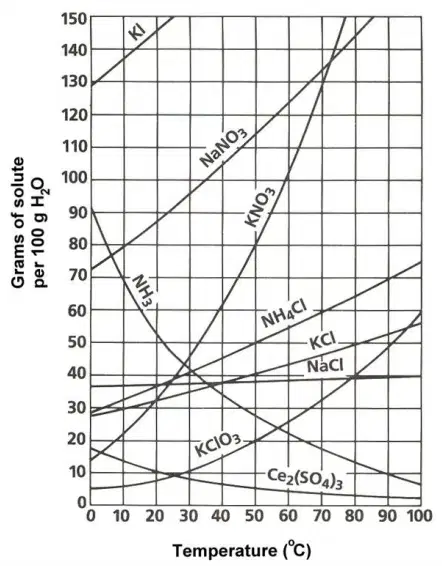
Using the following solubility curve, generally as temperature increases, solubility?
a)
increases
b)
decreases
c)
stays the same
d)
none of the above
14.

Using the following solubility curve, 89g of NaNO3 is prepared at 30 C, Will all the salt dissolve?
a)
Yes
b)
No
15.
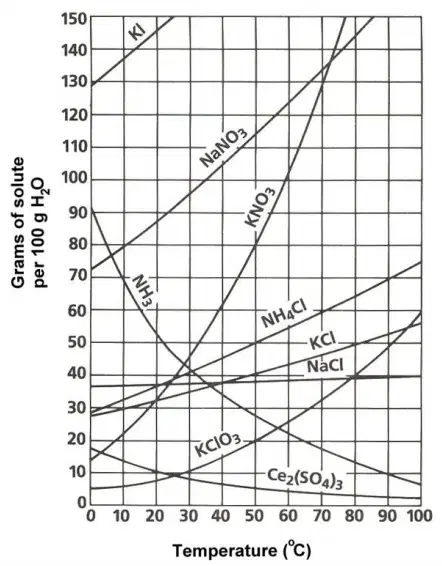
Using the following solubility curve, What mass of NaNO3 will dissolve at 30 C ?
(a)
16.
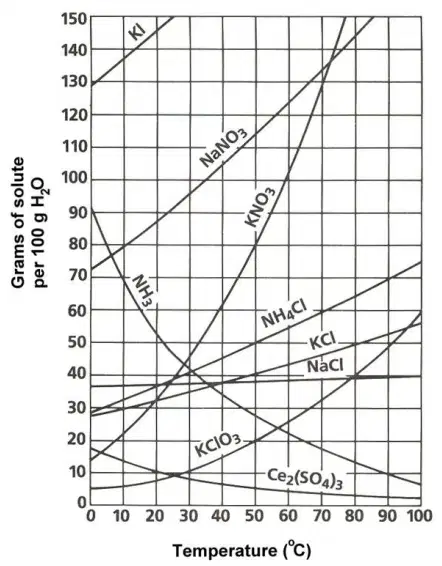
Using the following solubility curve, How many grams of potassium chloride (KCl) can be dissolved in 100g of water at 80 C?
(a)
17.
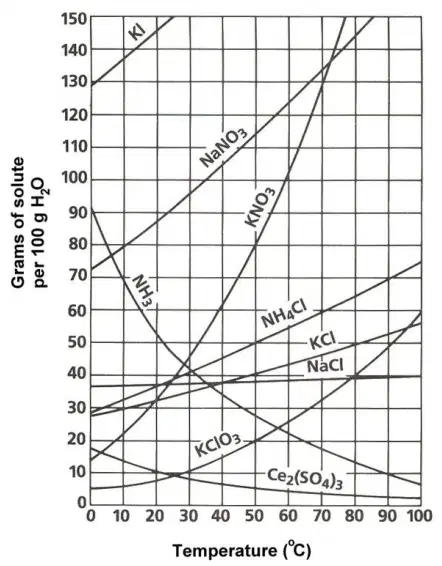
Using the following solubility curve, How many grams of potassium chloride (KCl) can be dissolved in 200g of water at 80 C?
(a)
18.
What is the equation for density?
a)
D = (v)(m)
b)
D = m/v
c)
D = (m)(v)
d)
D = v/m
19.
Intermolecular forces are
a)
forces of attraction between solutions.
b)
chemical bonds
c)
forces of attraction between molecules.
d)
forces between atoms within a molecule.
20.
This type of reaction always produces H2O and CO2
a)
Combustion
b)
Synthesis
c)
Decomposition
d)
Double Replacement Reactions
21.
This type of reaction: A + B = AB
a)
Combustion
b)
Synthesis
c)
Decomposition
d)
Double Replacement Reactions
22.
This type of reaction: AB = A + B
a)
Combustion
b)
Synthesis
c)
Decomposition
d)
Double Replacement Reactions
23.
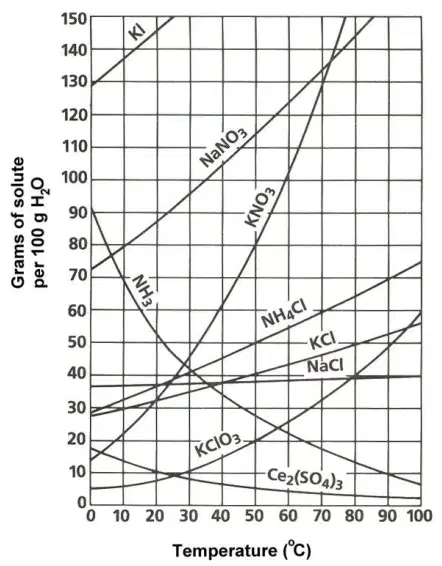
Using the following solubility curve, How many grams of ammonia (NH3) can be dissolved in 100g of water at 50 C?
(a)
24.
What are the customary units of solubility on solubility curves?
a)
Degrees Celsius and grams of solute/ 100g of water
b)
Degrees Fahrenheit and grams of solute/ 100g of water
c)
Degrees Fahrenheit and grams of solute/ 200g of water
d)
Degrees Celsius and grams of solute/ 200g of water
25.
Define solubility
a)
a measure of how much solute can dissolve in a given amount of solvent
b)
a measure of how much solvent can dissolve in a given amount of solute
26.
Approved eye protection devices (such as goggles) are worn in the laboratory
a)
to avoid eye strain.
b)
to improve your vision.
c)
only if you don't have corrective glasses.
d)
anytime chemicals, heat or glassware are used.
27.
Density is the relationship of
a)
matter and volume.
b)
mass and volume
c)
volume and matter
d)
time and speed.
28.
We can think of volume as,
a)
matter
b)
intermolecular force
c)
space
d)
weight
29.
A physical property is a
a)
characteristic of a substance that can be observed without changing the substance into another substance.
b)
Anything with density, and something that emits light while undergoing a reaction.
c)
characteristic of a substance that can be observed by changing the substance into another substance.
d)
anything with mass and volume.
30.
A chemical property is a
a)
Anything with density, and something that emits light while undergoing a reaction.
b)
characteristic of a substance that can be observed without changing the substance into another substance.
c)
characteristic of a substance that can be observed by changing the substance into another substance.
d)
anything with mass and volume.
31.
Intensive physical characteristics would include,
a)
melting point, density and boiling point.
b)
volume, mass.
c)
ability to rust, and tarnish.
d)
ability to turn into another substance.
32.
Extensive physical characteristics would include,
a)
melting point, density and boiling point.
b)
volume, mass.
c)
ability to rust, and tarnish.
d)
ability to turn into another substance.
33.
Burning is an example of
a)
physical change.
b)
chemical change.
c)
All of the above
d)
None of the above.
34.
If two liquids are mixed together and bubbles are created, it is most likely a
a)
physical change.
b)
chemical change.
c)
All of the above
d)
None of the above.
35.
When bonds are broken,
a)
energy is released.
b)
energy is supplied
c)
a phase change is occurring.
d)
a physical change is occurring.
36.
In an exothermic reaction,
a)
more energy is released than supplied
b)
more energy is supplied than released
c)
there is equal amounts of energy supplied and released
d)
Energy is not supplied or released
37.
In an endothermic reaction,
a)
more energy is released than supplied
b)
more energy is supplied than released
c)
there is equal amounts of energy supplied and released
d)
Energy is not supplied or released
38.
An endothermic chemical reaction
a)
is an example of a physical change
b)
feels hot
c)
feels cold
d)
does not involve temperature
39.
An exothermic chemical reaction
a)
is an example of a physical change
b)
feels hot
c)
feels cold
d)
does not involve temperature
40.
In order for a collision to be successful, molecules must hit each other with
a)
a. a force lower than the activation energy.
b)
b. enough energy.
c)
c. proper orientation.
d)
Both “B” & “C"
41.
Water displacement is a method used to determine,
a)
mass
b)
volume
c)
surface area
d)
chemical bonding
42.
Mass is measured with
a)
water displacement
b)
density
c)
a scale
d)
a stopwatch
43.

What is the following piece of equipment called?
a)
Beaker Tongs
b)
Test Tube Tongs
c)
Mortar & Pestle
d)
Scoopula
44.
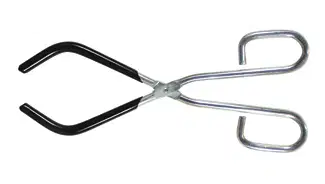
What is the following piece of equipment called?
a)
Beaker Tongs
b)
Test Tube Tongs
c)
Mortar & Pestle
d)
Scoopula
45.
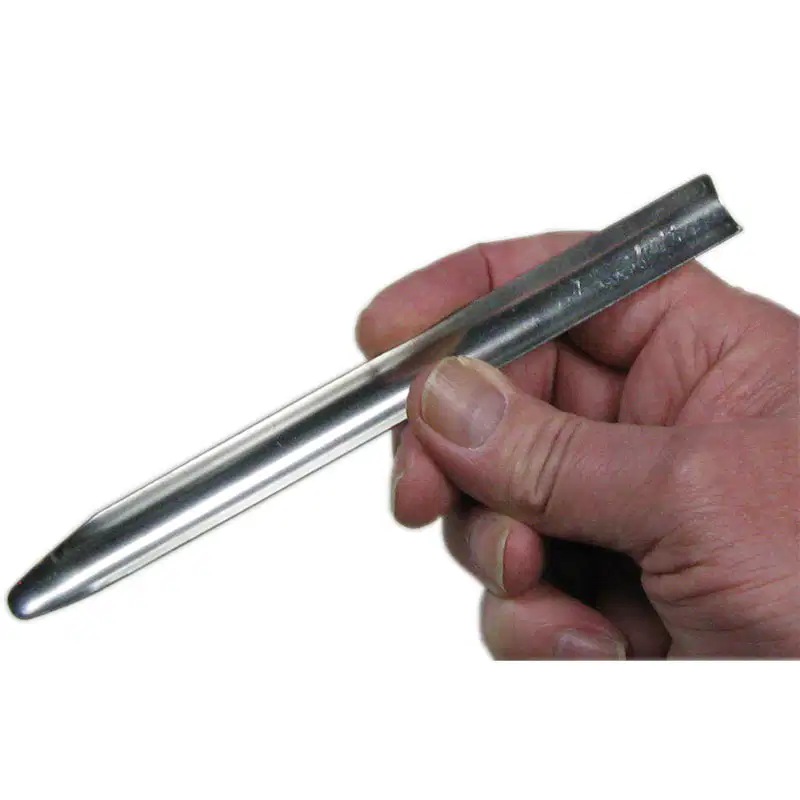
What is the following piece of equipment called?
a)
Beaker Tongs
b)
Test Tube Tongs
c)
Mortar & Pestle
d)
Scoopula
46.

What is the following piece of equipment called?
a)
Beaker Tongs
b)
Test Tube Tongs
c)
Mortar & Pestle
d)
Scoopula
47.
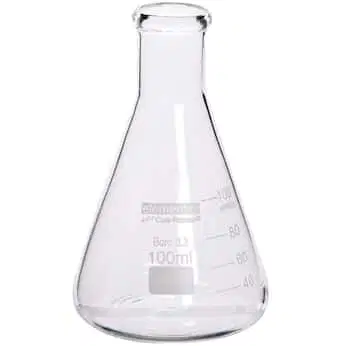
What is the following piece of equipment called?
a)
Beaker
b)
Erlenmeyer Flask
c)
Test Tube
d)
Graduated Cylinder
48.
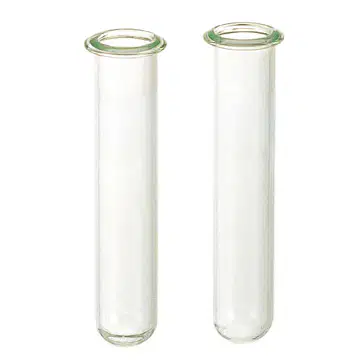
What is the following piece of equipment called?
a)
Beaker
b)
Erlenmeyer Flask
c)
Test Tube
d)
Graduated Cylinder
49.
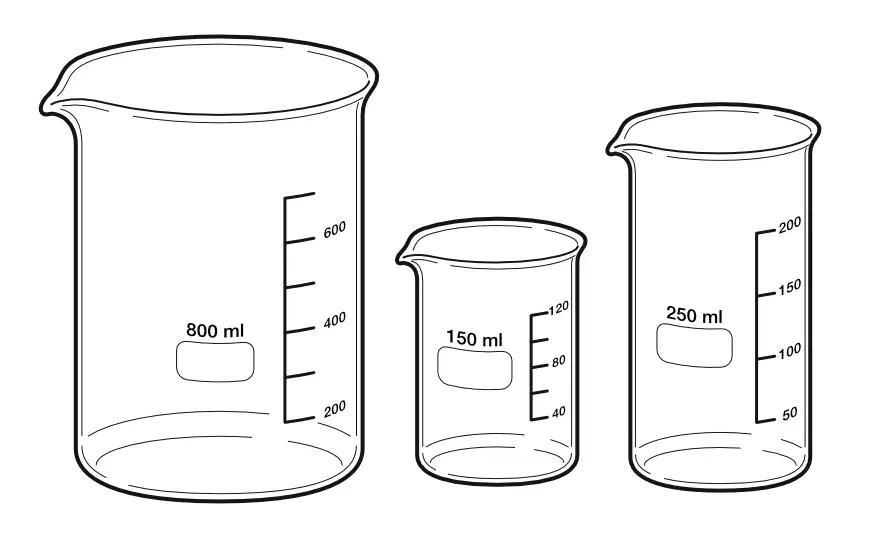
What is the following piece of equipment called?
a)
Beaker
b)
Erlenmeyer Flask
c)
Test Tube
d)
Graduated Cylinder
50.

What is the following piece of equipment called?
a)
Scale
b)
Crucible Tongs
c)
beaker tongs
d)
Hot Plate
51.
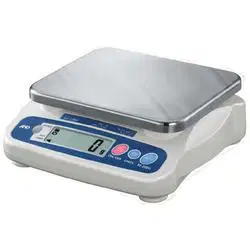
What is the following piece of equipment called?
a)
Scale
b)
Crucible Tongs
c)
beaker tongs
d)
Hot Plate
52.
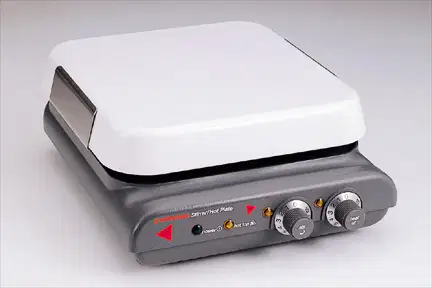
What is the following piece of equipment called?
a)
Scale
b)
Crucible Tongs
c)
beaker tongs
d)
Hot Plate
53.
If I asked you to measure out 5.0 grams of a substance what tool would you use to measure?
a)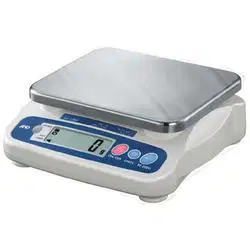
Option 1
b)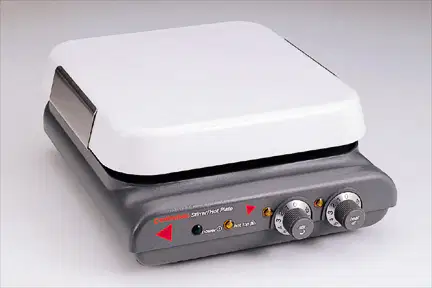
Option 2
c)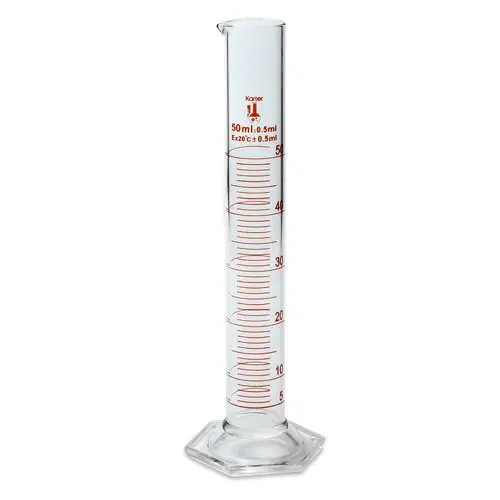
Option 3
54.

What is this piece of glassware called?
a)
Beaker
b)
Erlenmeyer Flask
c)
Mortar & Pestle
d)
Graduated Cylinder
55.
Which of the following is best for measuring volume?
a)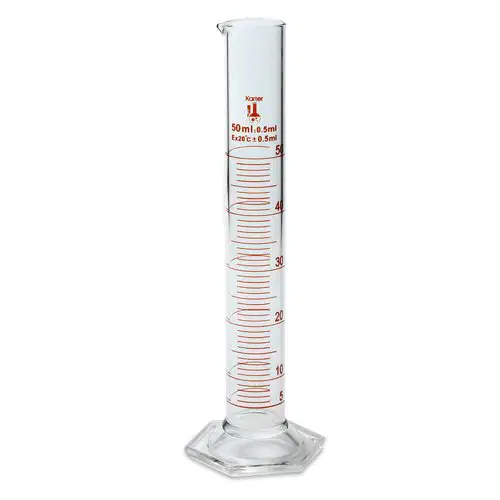
Option 1
b)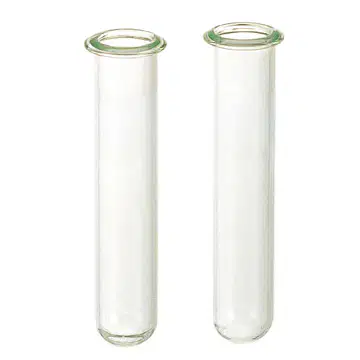
Option 2
c)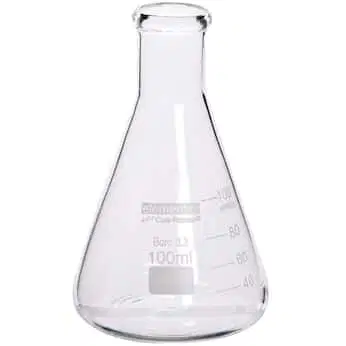
Option 3
d)
Option 4
56.
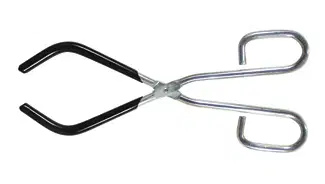
These are best for picking up a
a)
Beaker
b)
Test Tube
c)
Erlenmeyer Flask
d)
Watch Glass
57.
A beaker is best used to
a)
measure temperature
b)
measure energy
c)
measure phase changes
d)
heat/ hold a particular volume of a substance
58.
What tool do we use in Chem A to light the Bunsen burner?
a)
Wire
b)
Match
c)
Flint & Steel
d)
non of the above
59.
Matter is
a)
anything that has mass
b)
anything that takes up space
c)
Both of the above
d)
none of the above
60.
A mixture is
a)
capable of being separated
b)
not capable of being separated
c)
none of the above
61.
ALL matter is made of moving particles.
a)
False
b)
True
62.
Activation energy is...
a)
the energy required to break a chemical bond
b)
the energy required to make a chemical bond
c)
all of the above
d)
none of the above
63.
Increasing temperature increases the rate of the reaction because there are
a)
more collisions
b)
harder collisions
c)
all of the above
d)
none of the above
64.
Generally speaking, as kinetic energy of molecules increase in a system,
a)
pressure increases.
b)
temperature increases.
c)
all of the above.
d)
none of the above.
65.
We can think of density as a measurement of _______________
a)
volume
b)
energy
c)
compactness
d)
mass
100 %

