
 Worksheets
Science STAAR Review
Total questions: 103
Worksheet time: 3hrs 47mins

The diagram shows a model of the water cycle created by a group of science students. What part of the model represents cloud formation in the water cycle?
Tiny drops of water forming at the top of the bottle.
Drops of water running down the side of the bottle.
The lamp shining on the bottle and the water.
Water sitting in the bottom of the bottle.

A mirror can (a) light, but not (b) it. A black hoodie will (c) a lot of the light that hits it.
reflect
refract
absorb
(a) is when rocks are broken down into pieces of sediment.
When water evaporates, it changes from a (a) to a gas.
(a) is short term. (b) is long term.
weather
Climate

Object 1 is (a)
Object 2 is (b)
Object 3 is (c)
same density as water
less dense than water
more dense than water

Evaporation

Transpiration

Runoff

What time is it based on shadow?
8 AM
6 PM
10 AM
12 PM
Label the parts of the water cycle.
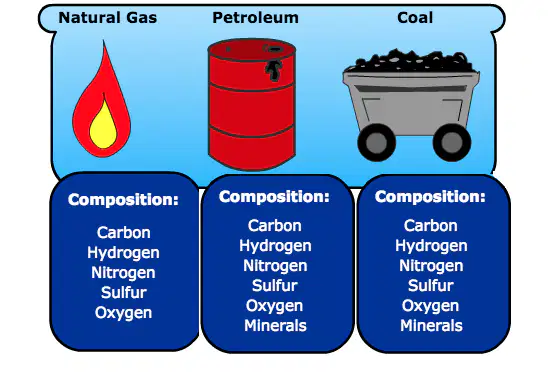
Select all the facts about fossil fuels.
Fossil fuels come from the dead plants and animals.
Fossil fuels are non-renewable.
Coal, oil, and natural gas are fossil fuels.
Fossil fuels are formed in a short time

Plant root grow in a rock and cause it to split is called _____.
weathering
erosion
deposition
compaction
cementation

Refraction

Absorption

Reflection

White light is collection of all colors
Carrying sediment from one place to another (a)
Breaking down of the rock (b)
Leaving sediment in a new place (c)
Which of these devices is the only one NOT designed to produce both sound and light energy?


This valley was most likely formed by —
A a rapid series of earthquakes
B volcanic activity
C a flood with rapidly moving water
D the movement of a glacier

A LEDs 1, 3, and 4 only
B LEDs 1, 2, 3, and 4
C LEDs 3 and 4 only
D LEDs 1, 3, 4, and 5
The Grand Canyon is more than 400 km long and in some places almost 2 km deep. Which model best represents the main process that formed the Grand Canyon?


Crayfish live in water and often hide under rocks or plants. They come out to look for food and will eat both plants and animals. Which of these is a trait that a crayfish most likely inherits from its parents? (5.10B)
The average distance it travels each day
The number of legs it has
The amount of food it eats each day
The type of plants in its habitat
What are structural adaptations (body part to help the organism survive)?

It offers protection from predators.

They will help it breathe underwater.

It can help it hide from predators.

They are light weight in order to fly.

Camouflage is a method when an (a) blends in with its (b) to avoid its (c) .
organism
environment
predator

A food web for some organisms in an African rain forest is shown below. Which organisms in this food web eat only consumers? (5.9B)
okapis
civets
leopards
gorillas

This food web represents organisms in a field. What role do raccoons play in this food web? (5.9B)
prey
producer
decomposer
consumer

The picture show two views of a certain fish. How does the appearance of this fish most likely help it survive?
Predators have little chance of seeing this fish as it approaches head-on.
The head-on view of this fish attracts predators.
The narrow body allows this fish to live in deep water.
Predators have a hard time seeing the side view of this fish.
Which statement correctly describes the Sun's apparent movement across the sky?
As Earth spins on its axis, it makes the Sun appear to move across the sky.
As the Sun spins around Earth, it moves across the sky.
Earth rotates around the Sun every 24 hours, making the Sun appear to move across the sky.
The Sun rotates around Earth every 12 hours, making the Sun appear to move across the sky.
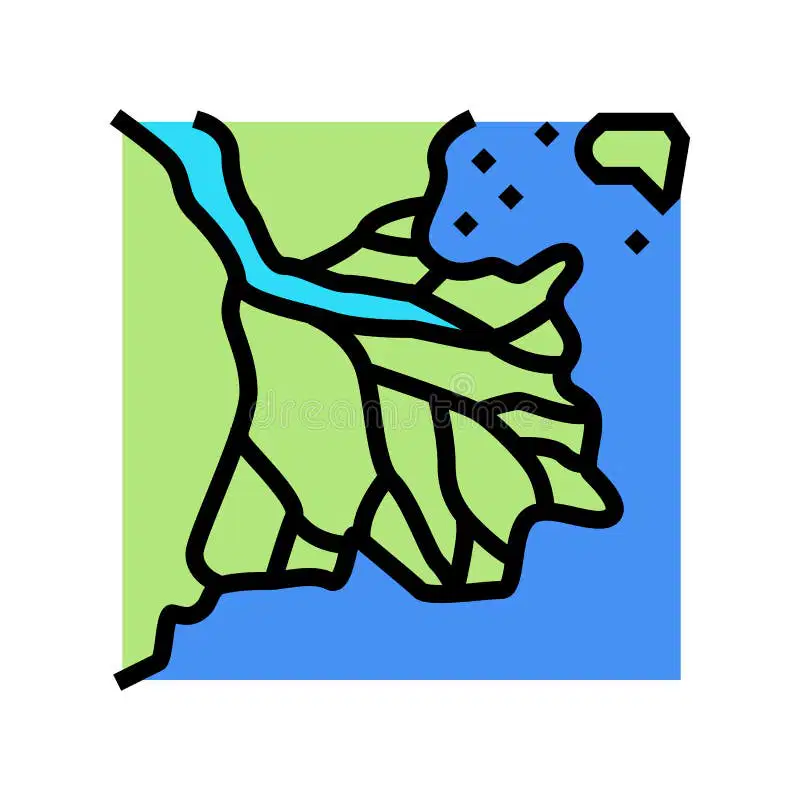
A diagram of a delta is shown. Which process best describes the formation of this delta?
The erosion of sediments carried by the river.
The weathering of rock by glaciers.
The deposition of sediments into the ocean.
The compaction of sediments in layers.

The picture shows a child standing in a swimming pool. Why does the lower part of the child appear so much different in size from the upper part? (5.6C)
The light rays that travel through water and then into air change direction.
The light rays that travel through water and then into air are enlarged.
The light rays that travel through air and then into water are reflected.
The light rays that travel through air and then into water are reduced.

When light travels through air into a prism, it bends and separates into many colors. In which other situation does light bend? (5.6C)
When light moves through air into water.
When light hits a wall.
When light passes through outer space.
When light hits a mirror.

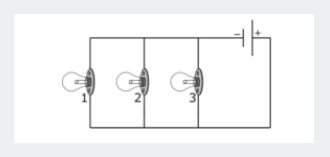
A group of students built the circuit shown here. The lightbulb does not glow. Which statement explains this observation? (5.6B)
The battery is not charged.
The lightbulb is not part of a complete circuit.
The circuit does not have a switch.
The bell uses most of the energy from the battery.

The picture shows a series circuit with three lit bulbs. How many of the bulbs will remain lit if the wire is cut at the point shown by the arrow? (5.6B)
0
1
2
3
A campfire, fireworks, and a burning candle all produce which forms of energy?
Select TWO correct answers.
Mechanical Energy
Thermal energy
Light energy
Solar energy
Electrical energy
A student plugs a hot plate into an outlet and turns on the hot plate to melt the ice. Complete the example to identify another object that used the same source of energy as the hot plate.
Drag and drop the correct answer in each box.
(a) using (b) energy.

A student reads the label on the bottle of salad dressing shown here. Why would the student shake the salad dressing well before using it? (5.5A)
Vinegar and oil have different densities.
Vinegar and oil easily form a solution.
Vinegar and oil both contain water.
Vinegar and oil are both liquids.
Which of these is a behavior that a person learns rather than inherited? (5.10B)

Having a pleasant dream

Digesting food in your stomach

Identifying the scent of a rose

Your eyes blinking

A student makes a sundial. The student takes a picture of the sundial at 3:30 P.M. Based on the student's sundial, which letter is closest to the position of the sun when the picture was taken?
W
X
Y
Z

A teacher uses an aquarium to make a habitat for a frog. A list of student observations of the frog is shown. Which student observation shows the frog interacting with non-living elements in its environment?
1 and 4
2 and 5
3 and 6
6 and 1

Students create a drawing of organisms in a garden. In their drawing, a bird eats a caterpillar. Another Caterpillar is eating the leaves on a parsley plant. Mushrooms grow in the shadow of the parsley. What is the role of the BIRD in this food web?
Producer
Consumer
Decomposer
Students create a drawing of organisms in a garden. In their drawing, a bird eats a caterpillar. Another Caterpillar is eating the leaves on a parsley plant. Mushrooms grow in the shadow of the parsley. What is the role of the MUSHROOM in this food web?
Producer
Consumer
Decomposer
Students create a drawing of organisms in a garden. In their drawing, a bird eats a caterpillar. Another Caterpillar is eating the leaves on a parsley plant. Mushrooms grow in the shadow of the parsley. What is the role of the PARSLEY in this food web?
Producer
Consumer
Decomposer
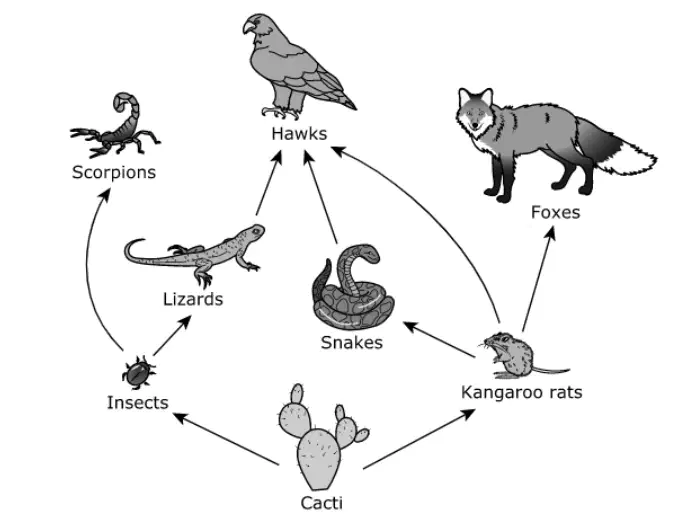
A desert food web is shown. How many carnivores are represented in the desert food web?
2
3
4
5

The table show characteristics of two different types of birds that live in similar forest environments. Which statement explains an advantage of a bone in the macaw's tongue that the hornbill does NOT need?
It helps macaw's catch and chew small mammals and crustaceans
It helps macaw's break open and eat tropical fruits and nuts
It helps macaws make large holes in trees to reach insects to eat.
It helps macaw's swallow whole prey
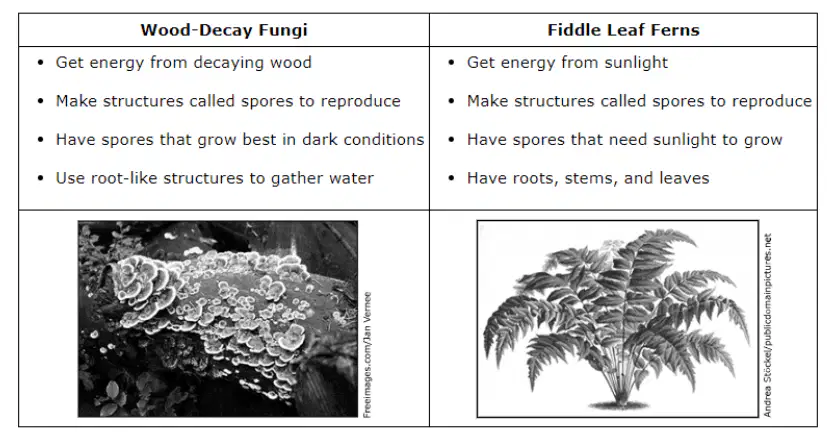
The tallest trees in a rain forest are removed for lumber. This increases the amount of light on the forest floor. The table shows information about fungi and ferns that grow on the forest floor. Which statement explains why one organism is better adapted to the removal of the tall trees?
The fungi are better adapted because they have spores that grow better in the dark
The ferns are better adapted because they have better root systems
The fungi are better adapted because they can get energy from decaying trees
The ferns are better adapted because they get energy from the sun.

A student pushes a ball along a hallway. A diagram shows the position of the ball every second for five seconds after it starts rolling. At one of the positions shown, an extra force is applied to the ball as it moves. Which diagram BEST represents the direction of the extra force and the position where the extra force was applied to the ball?


The diagram shows a light ray that is traveling toward a mirror that is tilted upward. Which drawing best shows how the light ray travels after it reaches the surface of the mirror?


Students use a circuit to investigate the properties of six objects. The buzzer makes a sound if an object completes the circuit. The circuit and observations are shown. Which objects are electrical insulators?
Eraser, toothpick, cotton ball
Eraser, paperclip, safety pin
Toothpick, paper clip, safety pin
Paper clip, safety pin, aluminum foil

The pictures show tools that can be used for separating mixtures. Which mixture is paired with the best tool for separating the materials?


Which two answer choices best complete the blanks.

Which of these adaptations most help the hawk keep other hawks out of its territory by warning them from far away?

Students placed four cubes of the same volume in a beaker of water. One cube floats on top of the water, one cube sinks to the bottom, and two cubs float in the middle of the water, beneath the surface. Click on the correct answer for Part A and Part B.

A partial food web is shown. Make a food chain that shows a complete pathway in which energy flows in this food web.
Grasses
Mice
Snakes
Hawks

A table classifying objects by physical properties is shown. What column heading should be used at the top of each column? Match the letter of the column heading to the correct answer.
Column A: (a)
Column B: (b)
Column C: (c)
Column D: (d)
Canyons are U-shaped valleys form differently. Choose the correct answer for Part A and Part B.

Three objects are shown. Based on their common properties, how should these objects be classified?


A student wants to change the circuit so only Bulb C is lit when one switch is closed. What does the student need to do?
Connect Bulb B to Bulb C and close Switch 2
Connect Bulb A to Bulb C and close Switch 3
Connect the battery to Bulb C and close Switch 1
Close Switch 2
A student has 3 spheres. Each sphere is made from copper, steel, or iron. The spheres each have a mass of 30 grams. Choose the correct answer for Part A and Part B.

A partial desert food web is shown. Which organism receives energy directly from a carnivore and an herbivore?
Agamid lizard
Fennec fox
Jerboa
Golden eagle

A beaker containing 3 liquids and 2 solids is shown. What two conclusions can be drawn based on this diagram?
Oil is soluble in water.
Steel is soluble in syrup.
A plastic ball is less dense than a steel ball.
Liquids are less dense than solids.
Oil is less dense than syrup.
Choose the correct answer for Part A and Part B.
Students listed 5 observations they made of organisms in terrariums and aquariums. Which observations describe interactions between two living things? Select TWO statements.
A fish eats aquatic plants.
A snake rests on a heated mat.
A turtle basks on a rock under a lamp.
A bearded dragon eats a cricket.
An anole runs across the dirt.
Students were asked to classify materials as good thermal conductors or good thermal insulators. Drag and drop the correct classification for each material.
Rubber - (a)
Copper - (b)
Steel - (c)
Foam - (d)
Wool - (e)
The horizon line, a lamppost, and its shadow are shown at 3:00 PM. Which circle best represents the position of the Sun at 3:00 PM? Select ONE circle.

Which processes belong in the blank boxes? Match the number of the box to the correct process.
Weathering
Deposition
Compaction
Cementation

Which diagram best represents the Sun-Earth-Moon system?
A
B
C
D
Sort the following materials into "Soluble in Water" or "Not Soluble in Water."
sugar

chocolate syrup

Kool-Aid powder

oil

plastic

Place the changing phases of matter in the correct chronological order starting with evaporation.
evaporation
condensation
precipitation
freezing
Select the item(s) that is
less dense than water.

Sort these objects based on their density.

sponge

wood block

quarter

marbles

cork

key

rubber ducky

metal ducky
Match the following scientific tools with what they measure.

volume

length

mass

time

force
Spinning of Earth on its (a) is called a (b) .
Label the Earth.

Match the following steps of the water cycle with their descriptions.
condensation
Water vapor cools and forms droplets.
runoff
Water flows over the ground surface.
precipitation
Water falls from clouds as rain, snow, etc.
evaporation
Water changes from liquid to vapor.
Kimberly is not sure what she should wear. Looking at these thermometers, which one indicates that she should dress for a hot day?


Match the physical properties.

texture

magnetic

density

length

color
Organize these facts into the correct STATE of MATTER.
definite volume, definite shape

definite volume, NO definite shape
molecultes are TIGHTLY packed

molecules are LOOSE
molecules take the shape of the container
NO definite volume or shape

molecules go EVERYWHERE

(a) is important because it returns (b) to other (c) .

The volume of the liquid in this graduated cylinder is (a)
Identify the different forces taking place in this tug-of-war.
Which of the following is an example of electrical energy being transformed into light energy?

A car engine running

A light bulb glowing

A windmill turning

A person running

When Gerardo and Tomas rub their hands together and they become warm, the type of energy transformation that occurs is (a) .
Electrical to thermal
Chemical to mechanical
Light to thermal
Match the following

ALL light passes through

SOME light passes through

NO light passes through
glass window
tissue paper
wax paper
water
wood block
aluminum foil
cardboard
notebook paper
cling wrap
Match the following
Which is a conductor and which is an insulator?
You are making a model using five balls below to show objects in our solar system. Compare the sizes of the balls and use the word bank to identify and label each one.

Name this moon phase
Waxing crescent
Waning gibbous
First quarter
Last quarter
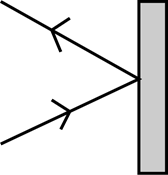
The illustration shows a light ray striking an object.
In the illustration, the light ray striking the object is (a) .
Rebecca's cousin visited from out of town. While she was in Laredo, it rained.
Why would it be INCORRECT for her to think that it rains a lot in Laredo?
Laredo's weather is normally hot, but the climate those days happened to be rainy.
Laredo's climate is normally hot, but the weather those days happened to be rainy.
Laredo experiences all types of climate throughout the year.
Gerardo is not sure how much he should water the garden.
Which weather tool will help him measure the amount of rain over time?


When Luis flipped over his bottles to create a tornado it did not work. Even though the water was on top, why did it not go down?
The water is less dense than the air in the bottom bottle.
Mr. Quezada placed the spell "wingarium leviosa" on the water.
The air on the bottom bottle had no place to escape.
Air has a higher density than water.

Using the ruler, which item can be approximately 9cm?


Yanela looked up at the sky and didn't see the moon. She got scared, but her parents told her it's still there.
Which moon phase are they referring to?
It is the full moon phase.
It is the first quarter moon phase.
It is the third quarter moon phase.
It is the new moon phase.

Nahyeli and Sebastian were using a telescope to make observations of the planets Mercury & Venus.
What are the positions of these planets in relation to the sun?
Mercury is closest to the sun, and Venus is the second planet from the sun.
Mercury is the second planet to the sun, and Venus is the third planet from the sun.
Venus is closest to the sun, and Mercury is the second planet from the sun.
Venus is closest to the sun, and Mercury is the third planet from the sun.

What looks to be the motion of the Sun in the sky is really caused by the _____ of Earth.
rotation
revolution
moon's orbit
Do you feel ready to take on your Science STAAR?


If you were a super hero, which power would you choose: magnetism or electricity?


What is your favorite type of precipitation?


Which picture below is the best example of a learned behavior in a dog?


Which food do you prefer to consume?


Do you recycle at home?
Yes
No

What grade were you in when you learned to ride a bicycle?
1st grade
2nd grade
3rd grade
4th grade
I don't know because bicycles are death traps.

