
 Worksheets
TEST-3
Total questions: 65
Worksheet time: 33mins
When water falls from clouds in liquid or solid form
accumulation
condensation
precipitation
evaporation
Water that flows downward on land
runoff
transpiration
evaporation
condensation
Water vapor given off by plants
condensation
transpiration
runoff
evaporation
When water turns from liquid form to a gas
evaporation
precipitation
transpiration
condensation
When water vapor turns into a liquid
transpiration
condensation
evaporation
runoff
What word do we give to water when it is in the form of a gas
water vapor
ice
snow
rain
Which of the following is associated with transpiration
rocks
animals
plants
humans
During what process in the water cycle is energy released?
Runoff
Transpiration
Infiltration
Condensation
__________ occurs when water flows over the surface of land
Condensation
Transpiration
Precipitation
Runoff
Evaporation is...
cloud formation
sun turns water to air
liquid to gas
water to solid
Condensation is...
water to gas
clouds to precipitation
vapor to liquid
sun heats water to gas
Precipitation is...
rain, snow, ice, hail
rain, snow, clouds
hail, snow, runoff
sand, mud, rain
What is the water cycle?
movement of water on Earth
water melts
cloud formation
3 forms of water
Plants give off water vapor as a waste product. This is called?
evaporation
condensation
sublimation
transpiration
What is the energy source for the water cycle?
Earth
Sun
Water
Moon
When clouds become too heavy, what occurs?
Runoff
Condensation
Precipitation
Evaporation
What are formed when water vapor condenses?
Transpiration
Clouds
Valleys
Mountains
Water is evaporating into the air from...
liquid to gas
liquid to solid
solid to gas
gas to liquid
What are minerals?
Both
Natural with definite comp.
Human-made
None
Which is NOT a characteristic of minerals?
Various colours
Renewable
Solid form
Not pure
Minerals are extracted from...
Metals
Ore
Rock
Soil
Ores are nonrenewable resources.
False
True
Sometimes
Unknown
Two iron ores with same name but different look?
Sphaelerite
Hematite
Limonite
Carnotite
Bauxite is rich in...
Copper
Aluminum
Iron
Titanium
What is used for making steel?
Gold
Bauxite
Iron
Copper
Which metal gives Magnetite magnetic properties?
Mg
Mn
Sn
Fe
Almost all aluminum is from...
Clay
Bauxite
Tungsten
Titanium
How many primary types of ores are there?
One
Two
Three
Four
Sodium is extracted from...
Hematite
Halides
Bauxite
Cinnabar
Cinnabar is a ______ ore.
Oxide
Carbonate
Sulfide
Nitrate
Mercury is extracted from...
Bauxite
Hematite
Rock salt
Cinnabar
Bauxite is an _______ ore.
Oxide
Sulfide
Carbonate
Chloride

Rocks formed from cooled volcanic activity on the surface or underground.
Igneous Rock
Metamorphic Rock
Sedimentary Rock
Lava

Rocks formed from sediment fragments that have been compressed and cemented over time.
Igneous Rock
Metamorphic Rock
Sedimentary Rock
Magma
Which of the following are the three layers of the Earth?
a. crust, mantle, core
b. crust, mantle, sphere
c. mantle, core, sphere
d. sphere, crust, core

The hottest layer at the center of the earth is called the __________.
magma
crust
outer core
inner core

All rocks are made of...
Stones
Oil
Minerals
Earth

Magnetite is a magnetic mineral with the formula Fe3O4. What kind of anion does it have?
Sulfide
Oxide
Carbonate
Hydroxide
What is the outermost physical layer of earth?
crust
outer core
mantle
lithosphere
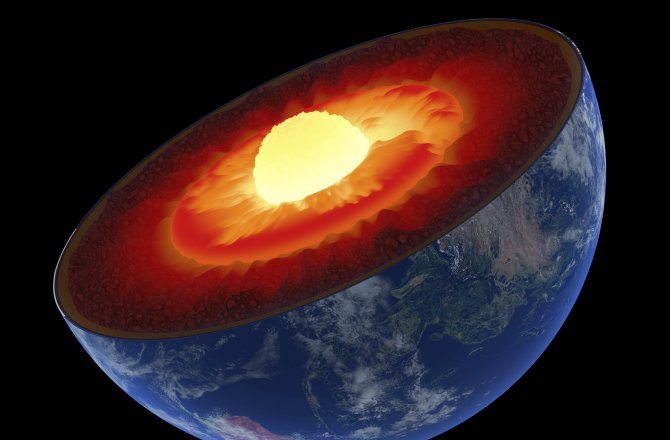
Which layer of the Earth is completely liquid?
crust
mantle
outer core
inner core
Which layer is the thinnest?
crust
mantle
outer core
inner core
Which layer is responsible for creating Earth's magnetic field?
crust
mantle
outer core
inner core

What is the name of the layer 4
inner core
outer core
Mantle
Crust

What is the name of the layer 1
inner core
outer core
crust
mantle

What is the name of the layer 2
Inner core
outer core
mantle
crust
Which of the following compounds are responsible for causing temporary hardness in water?
CaCl2
Ca(HCO3)2
CaSO4
Mg(HCO3)2
Complete the following sentence "Hard water is water that
forms a lather easily with water.
does not form a lather easily with water
The removal of temporary hardness in water that is heated, is represented by which of the following equations?
H2O + CO2 ➡️ H2CO3
H2CO3 + CaCO3 ➡️ Ca(HCO3)2
Ca(HCO3)2 ➡️ CaCO3 + CO2 + H2O
When carbon dioxide reacts with water in the air, a weak acid called carbonic acid is produced. What is the formula of carbonic acid?
(a)


This type of water lathers easily
soft
temporary hard
permanent hard
ice
Permanent hardness in water is caused by the presence of:
Calcium bicarbonate
Magnesium sulfate
Both of them
None of them
Water is hard when it contains:
Acid solution
Precipitate in suspension
Dissolved sodium salts
Dissolved Ca and Mg salts
What is hard water primarily characterized by?
High concentration of sodium and potassium ions
High concentration of magnesium and calcium ions
High concentration of iron and copper ions
Low concentration of any dissolved minerals

