
 Worksheets
Chapter 18: Aqueous Ionic Solutions
Total questions: 69
Worksheet time: 1hrs 27mins
Which of the following combinations creates a buffer solution?
Strong acid + Strong base
Weak acid + Conjugate base
Strong acid + Conjugate base
Weak acid + Strong base
What happens when HCl is added to a buffer made of HC₂H₃O₂ and NaC₂H₃O₂?
pH rises sharply
HCl is neutralized by the acetate ion
Buffer components are destroyed
The solution becomes neutral
Select all that apply to buffer systems:
Contain significant amounts of weak acid and conjugate base
Resist pH changes
Always have pH = 7
Work through neutralization reactions
Require strong acid and strong base
Match each term with its correct description:
Resists changes in pH
Buffer
Partially ionizes in wate
Weak acid
Formed when acid donates a proton
Conjugate base
-log of the acid dissociation constant
pKa
Reorder the steps for calculating the pH of a buffer using the equilibrium approach:
Write the balanced equation and set up an ICE table
Substitute equilibrium expressions into the Ka equation
Solve for [H₃O⁺] using Ka
Use pH = -log[H₃O⁺] to calculate pH
Write the steps for calculating the pH of a buffer using the equilibirum approach.
Calculate the pH of a buffer that is 0.100 M in HC₂H₃O₂ and 0.100 M in NaC₂H₃O₂.
Ka = 1.8 × 10⁻⁵
Use the Henderson-Hasselbalch equation:
pH = pKa + log([base]/[acid])
(a)
What makes a buffer most effective?
High concentrations of strong acids
Equal concentrations of weak acid and conjugate base
A very low pKa
Dilute buffer solutions
What happens if the ratio of base to acid in a buffer exceeds a factor of 10?
The pH drops to 1
The buffer is at peak performance
The buffer becomes ineffective
The solution neutralizes both acid and base equally
Which solution would best maintain a buffer at pH = 4.25?
HClO₂ (pKa = 1.95)
HNO₂ (pKa = 3.34)
HCHO₂ (pKa = 3.74)
HClO (pKa = 7.54)
Select all statements that are true about buffer capacity:
Increases with higher concentrations of acid and base
Increases when acid and base concentrations are more equal
Depends on the absolute and relative amounts of components
Only exists in solutions with pH = 7
Always remains the same regardless of concentrations
Match each term to its definition.
Amount of acid/base a buffer can absorb before pH changes
Buffer Capacity
The range of pH over which a buffer is effective
Buffer Range
pH = pKa + log [base]/[acid]
Henderson-Hasselbalch
The pH where [acid] = [conjugate base]
pKa
Choose the correct missing value to complete the Henderson-Hasselbalch equation:
If pKa = 4.25, [base] = 0.50 M, [acid] = 0.20 M, then pH = (a)
4.65
3.85
4.25
5.00
Put the steps in the correct order for preparing an effective buffer system.
Choose an acid with a pKa close to the desired pH
Use the Henderson-Hasselbalch equation to find ratio of base to acid
Measure appropriate moles of acid and conjugate base
Mix both components in solution
Write the steps in the correct order for preparing an effective buffer system.
True or False: A concentrated buffer has a higher buffer capacity than a dilute one.
True
False
True or False: Buffer solutions are always neutral.
True
False
A 1.0 L buffer contains 0.10 M HF and 0.050 M NaF. Which of the following will destroy the buffer?
Adding 0.050 mol of HCl
Adding 0.050 mol of NaOH
Adding 0.050 mol of NaF
None of the above
What is the correct value of pKa for ammonia (NH₃), given that pKb = 4.75?
4.75
7.00
9.25
14.75
Which solution shows a greater pH change after base addition: one with equal acid/base or one with a much greater amount of acid?
Equal acid and base
Greater amount of acid
Both have the same pH change
Neither changes pH
During the titration of a strong acid with a strong base, the equivalence point occurs when...
[OH⁻] = 0
moles of acid = moles of base
pH = 1.0
pOH = 0
What is the pH at the equivalence point for the titration of a strong acid with a strong base?
(a)
Match the term to its meaning.
Graph of pH versus volume of titrant added
Titration Curve
Amount of acid/base a buffer can absorb before pH changes
Buffer Capacity
Moles of acid = moles of base
Equivalence Point
-log(Ka), point of equal acid and conjugate base strength
pKa
The pH of a buffer made from 0.50 M NH₃ and 0.20 M NH₄Cl, given pKa = 9.25, is ______.
Select all that are true about titrations of weak acids with strong bases.
The starting pH is higher than a strong acid
The equivalence point pH is greater than 7
The curve is steeper than that of a strong acid
A buffer region appears before equivalence point
At the half-equivalence point in a titration of a weak acid with a strong base, the pH equals...
7.0
14 – pKa
pKa
pH of the base
What is the pH at the equivalence point when titrating 0.100 M HCHO₂ with 0.100 M NaOH?
7.00
< 7
> 7
Depends on volume
Which titration type results in an acidic equivalence point?
Strong acid + strong base
Weak acid + strong base
Weak base + strong acid
Strong base + strong base
In a titration of HNO₂ (weak acid) with KOH, what is the pH after adding 5.00 mL of 0.200 M KOH to 40.0 mL of 0.100 M HNO₂?
Which of the following describe indicators used in titration?
Weak acids or bases
Change color near the equivalence point
Neutralize strong acids
Help determine the endpoint
Only work in basic solutions
The equivalence point for the titration of a weak acid with a strong base is neutral (pH = 7.0).
True
False
True or False: At the equivalence point, the amount of acid equals the amount of base.
True
False
Match the titration point with its property.
Only weak acid/base is present
Initial point
[acid] = [base], pH = pKa
Half-equivalence
All acid/base is converted to its conjugate
Equivalence point
Excess strong base or strong acid present
Beyond equivalence
At the half-equivalence point, the pH equals the (a) of the acid.
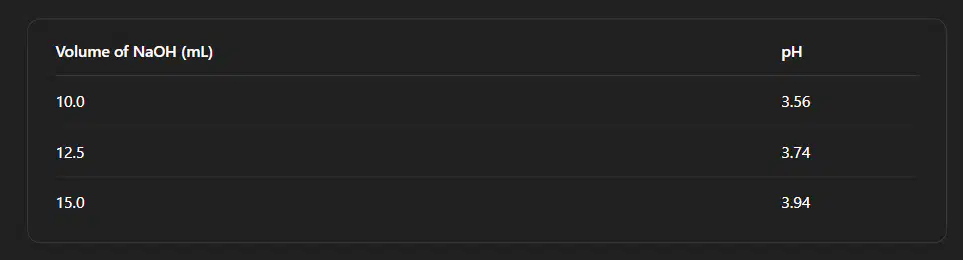
Use the data to determine when pH = pKa.
At which volume of NaOH is the half-equivalence point reached?
(a)
What is the Ksp expression for PbCl₂?
[Pb²⁺][Cl⁻]
[Pb²⁺][Cl⁻]²
[Pb⁺][Cl⁻]
[Pb²⁺]²[Cl⁻]
Which condition decreases the solubility of CaF₂ the most?
Adding Ca(NO₃)₂
Adding pure water
Heating the solution
Adding AgNO₃
Which compound is more soluble in an acidic solution than in a neutral one?
BaF₂
AgI
Ca(OH)₂
The value of Ksp changes with the presence of a common ion.
True
False
A compound with a lower Ksp always has a lower solubility.
True, only if the stoichiometry is the same.
Always true.
False
Select all that are true regarding the common ion effect:
It decreases solubility.
It increases the Ksp value.
It shifts equilibrium left.
It applies only to strong acids.
It follows Le Châtelier’s principle.
Match the compound to its solubility behavior in acid.
Mg(OH)₂
CaCO₃
AgI
The solubility product constant is abbreviated as (a) .
Choose the correct setup for calculating the molar solubility of CaF₂ in 0.100 M NaF
Ksp = 1.46 × 10⁻¹⁰: (a)
S = √Ksp
S = √(Ksp / 4)
S = Ksp / 0.100
S = Ksp / (0.100)²
What does it mean if Q < Ksp?
The solution is saturated.
Precipitation occurs.
The solution is unsaturated and more solid can dissolve.
The solution is at equilibrium.
If Q > Ksp for a solution, what will happen?
More solute will dissolve.
No change occurs.
Precipitation will occur.
The solution is unsaturated.
What does the solubility product constant (Ksp) represent?
The concentration of products minus reactants
The maximum amount of solid that can be dissolved at equilibrium
The minimum pH required for precipitation
The temperature at which a solution evaporates
A supersaturated solution is...
At equilibrium
Holding more solute than it can normally dissolve
Completely unsaturated
Always dilute
Which compound will precipitate first when adding OH⁻ to a solution of Mg²⁺ and Ca²⁺?
Ca(OH)₂
NaOH
Mg(OH)₂
KOH
Which statements are true about Ksp?
A smaller Ksp value means lower solubility
Ksp is used to predict precipitation
Ksp is the same as the reaction rate
Ksp only applies to gases
When Q = Ksp...
The system is at equilibrium
More precipitation occurs
The solution is unsaturated
No net change in solubility happens
Match the solution condition to its Q and behavior.
Q < Ksp
More solute can dissolve
Q = Ksp
Equilibrium; no net change
Q > Ksp
Precipitation occurs
In selective precipitation, the compound with the (a) Ksp precipitates first.
lowest
highest
Using your understanding of precipitation reactions, why might Mg(OH)₂ precipitate before Ca(OH)₂ in seawater?
What does a large value of the formation constant (Kf) indicate about the stability of a complex ion?
The complex ion is unstable
The formation of the complex ion is highly favored
The metal ion is weakly bound
Precipitation will occur
Which of the following will increase the solubility of AgCl(s) in water?
Adding NaCl
Adding HCl
Adding NH₃
Adding more Ag⁺
What species is formed when Ag⁺ reacts with 2 NH₃ molecules?
Ag(NH₃)₂⁺
AgNH₃⁺
Ag₂(NH₃)⁺
Ag(NH₃)₄²⁺
What is the effect of forming a complex ion on the solubility of a metal salt like AgCl?
It decreases solubility
It has no effect
It increases solubility by shifting equilibrium
It neutralizes the solution
Which of the following species are amphoteric and dissolve in both acid and base?
Zn(OH)₂
Al(OH)₃
Pb(OH)₂
Fe(OH)₃
What happens when Al(OH)₃ is added to a basic solution?
It dissolves
It precipitates
It acts as an acid
It neutralizes completely
In the titration of a strong acid with a strong base, how do you calculate these quantities?
initial pH
In the titration of a strong acid with a strong base, how do you calculate these quantities?
pH before the equivalence point
In the titration of a strong acid with a strong base, how do you calculate these quantities?
pH at the equivalence point
In the titration of a strong acid with a strong base, how do you calculate these quantities?
pH beyond the equivalence point
In the titration of a weak acid with a strong base, how do you calculate these quantities?
initial pH
In the titration of a weak acid with a strong base, how do you calculate these quantities?
pH before the equivalence point
In the titration of a weak acid with a strong base, how do you calculate these quantities?
pH at one-half the equivalence point
In the titration of a weak acid with a strong base, how do you calculate these quantities?
pH at the equivalence point
In the titration of a weak acid with a strong base, how do you calculate these quantities?
pH beyond the equivalence point

