
 Worksheets
Unit 3 Review Questions
Total questions: 71
Worksheet time: 2hrs 40mins
The mass of a proton is approximately equal to the mass of
an alpha particle
an electron
a beta particle
a neutron
Which atom in the ground state has an outermost electron with the most energy?
Li
Na
K
Cs
An orbital is defined as a region of the most probable location of
a proton
a nucleus
a neutron
an electron
Which represents the greatest mass of chlorine?
1 mole of chlorine
1 gram of chlorine
1 molecule of chlorine
1 atom of chlorine
In a sample of oxygen gas at STP, which represents the greatest number of molecules?
one molecule
one gram
one mole
one liter
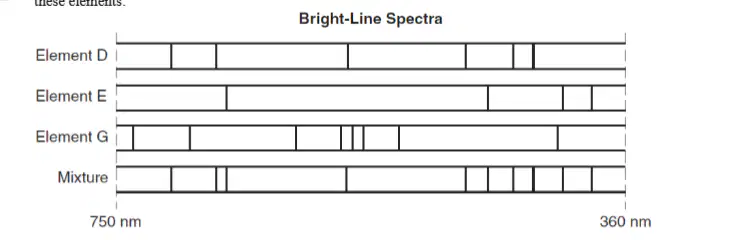
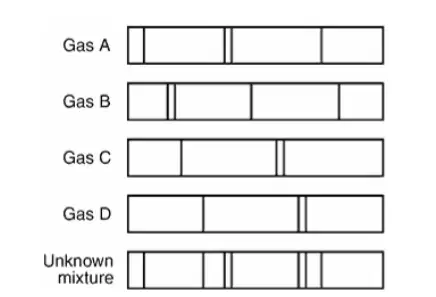
Given the bright-line spectra of three elements and the spectrum of a mixture formed from at least two of these elements: Which elements are present in this mixture?
D and G, only
E and D, only
E and G, only
D, E, and G
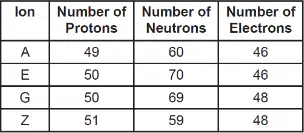
The numbers of protons, neutrons, and electrons in each of four different ions are shown in the table below. Which ion has the greatest mass?
Z
E
G
A
A sample of matter must be copper (Cu) if
the sample melts at 1768 K
atoms in the sample react with oxygen
each atom in the sample has 29 protons
the sample can conduct electricity
An atom that contains 8 protons, 8 electrons, and 9 neutrons has
an atomic number of 9
a mass number of 25
an atomic number of 16
a mass number of 17
The average isotopic mass of chlorine is 35.5. Which mixture of isotopes (shown as percents) produces this average mass?
50% 35Cl and 50% 37Cl
50% 12C and 50% 13C
75% 35Cl and 25% 37Cl
75% 12C and 25% 13C
What information is necessary to determine the atomic mass of the element chlorine?
The atomic mass and the relative abundance of each naturally occurring isotope of chlorine
the atomic mass of each artificially produced isotope of chlorine, only
the relative abundance of each naturally occurring isotope of chlorine, only
the atomic mass and the relative abundance of each naturally occurring and artificially produced isotope of chlorine
As an electron in an atom moves from the ground state to the excited state, the electron
loses energy as it moves to a higher energy level
loses energy as it moves to a lower energy level
gains energy as it moves to a lower energy level
gains energy as it moves to a higher energy level
Which sample contains a mole of atoms?
78 g K
42 g Kr
23 g Na
24 g C
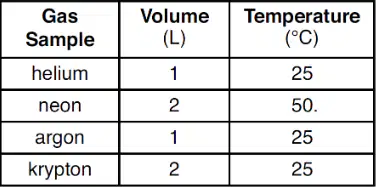
The table below shows the volume and temperature of four different gas samples at 100 kPa. Gas Sample | Volume (L) | Temperature (°C) helium | 1 | 25 helium | 2 | 50 argon | 1 | 25 krypton | 2 | 25 Which two gas samples contain equal numbers of atoms?
neon and argon
helium and argon
helium and neon
neon and krypton
A 1.0-mole sample of argon gas has a mass of
18 g
40 g
80 g
36 g
On the Periodic Table, the number of protons in an atom of an element is indicated by its
atomic number
selected oxidation states
number of valence electrons
atomic mass
Which particle has the least mass?
an electron
a hydrogen atom
a helium atom
a proton
What is the total number of neon atoms contained in 20.2 grams of neon gas?
3.01 × 10^23
6.02×10²³
1.01 × 10^24
2.02×1024
The atomic mass of an element is the weighted average of the atomic masses of
the artificially produced isotopes of the element
the naturally occurring isotopes of the element
the natural and artificial isotopes of the element
the least abundant isotopes of the element
An atom that has 13 protons and 15 neutrons is an isotope of the element
phosphorus
nickel
silicon
aluminum
What is the total number of atoms contained in 80. grams of neon?
2.4 × 10^24
6.0×10²³
4.8 × 10^24
1.2 × 10^24
The light emitted from a flame is produced when electrons in an excited state
absorb energy as they move to lower energy states
absorb energy as they move to higher energy states
release energy as they move to lower energy states
release energy as they move to higher energy states
Which change in electron location in an atom of calcium is accompanied by the greatest amount of energy emitted?
from shell 2 to shell 1
from shell 1 to shell 4
from shell 4 to shell 1
from shell 1 to shell 2
Which two particles make up most of the mass of a hydrogen-2 atom?
proton and positron
proton and neutron
electron and proton
electron and neutron
Which sample contains a total of 9.0×10²³ atoms?
0.50 mole of Cu
0.75 mole of Cu
3.0 moles of Cu
1.5 moles of Cu
An electron in a sodium atom gains enough energy to move from the second shell to the third shell. The sodium atom becomes
an atom in an excited state
a negative ion
an atom in the ground state
a positive ion
How do the energy and the most probable location of an electron in the third shell of an atom compare to the energy and the most probable location of an electron in the first shell of the same atom?
In the third shell, an electron has less energy and is closer to the nucleus.
In the third shell, an electron has more energy and is farther from the nucleus.
In the third shell, an electron has less energy and is farther from the nucleus.
In the third shell, an electron has more energy and is closer to the nucleus.
Which statement describes the distribution of charge in an atom?
A neutral nucleus is surrounded by one or more negatively charged electrons.
A positively charged nucleus is surrounded by one or more negatively charged electrons.
A neutral nucleus is surrounded by one or more positively charged electrons.
A positively charged nucleus is surrounded by one or more positively charged electrons.
What is the number of electrons in an atom that has 20 protons and 17 neutrons?
3
20
17
37
What is the number of electrons in an atom of scandium?
66
24
45
21
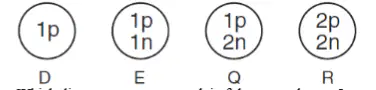
Each diagram below represents the nucleus of a different atom. Which diagrams represent nuclei of the same element?
D, E, and Q
Q and R, only
D and E, only
Q, R, and E
Which sample contains the same number of atoms as a gram of He?
4 g of O
7 g of Li
6 g of C
9 g of F
What will be the new volume of a 1.00-mole sample of a gas at STP if the pressure remains constant and the Kelvin temperature is halved?
11.2 L
22.4 L
44.8 L
33.6 L
What is the approximate total number of atoms in 1.0 mole of chromium?
1.0 × 10²³
3.0
6.0 × 10²³
6.9
Compared to an atom of carbon-14 (C-14), an atom of nitrogen-14 (N-14) contains fewer
neutrons
occupied principal energy levels
protons
occupied sublevels
Show an appropriate mathematical representation to determine the number of moles of each gas.
n=Mm
n = PV
n = RT
n=PV
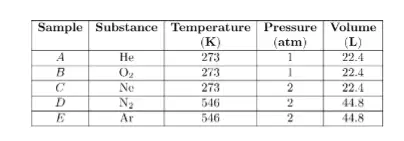
Which sample contains the same number of molecules as sample A?
E
B
C
D
State how bright-line spectra viewed through a spectroscope can be used to identify the metal ions in the salts used in the flame tests.
Each metal ion produces a unique pattern of bright lines, allowing identification.
All metal ions produce the same bright-line spectra, making identification impossible.
Bright-line spectra only show the color of the flame, not the metal ion.
Spectroscopes can only identify non-metal ions using bright-line spectra.
If 100.0 g of Mg is ignited, how many atoms of Mg are involved in the reaction? Show an appropriate mathematical representation and calculation.
2.48 × 1024 atoms
1.50 × 1024 atoms
6.02 × 10²³ atoms
4.17 × 1024 atoms

Atoms of H-1, H-2, and H-3 are each electrically neutral because, in terms of subatomic particles:
They have equal numbers of protons and electrons.
They have more neutrons than protons.
They have more electrons than protons.
They have no neutrons.
State the location and the total charge of the protons in a Ni-64 atom.
The protons are located in the nucleus and have a total charge of +28e.
The protons are located in the electron cloud and have a total charge of +64e.
The protons are located in the nucleus and have a total charge of +64e.
The protons are located in the electron cloud and have a total charge of +28e.
Explain, in terms of subatomic particles, why this excited atom is electrically neutral.
Because it has equal numbers of protons and electrons.
Because it has more neutrons than protons.
Because it has more electrons than protons.
Because it has no neutrons.
Explain, in terms of both electron movement and energy changes, how ions in the coating emit light.
Ions in the coating emit light when electrons move to a higher energy level and then fall back, releasing energy as photons.
Ions in the coating emit light when electrons are absorbed by the nucleus, causing a loss of energy.
Ions in the coating emit light when protons move between energy levels, releasing energy as sound.
Ions in the coating emit light when electrons stop moving, causing the ions to glow.
State one conclusion about atomic structure based on the observation that almost all alpha particles passed straight through the foil.
Most of the atom is empty space.
The atom is a solid sphere.
Electrons are found in the nucleus.
Alpha particles are attracted to the nucleus.
Explain, in terms of charged particles, why some of the alpha particles were deflected.
Some alpha particles were deflected because they encountered the positively charged nucleus, which repelled them.
Some alpha particles were deflected because they were attracted to the negatively charged electrons.
Some alpha particles were deflected because they lost energy and slowed down.
Some alpha particles were deflected because they collided with other alpha particles.
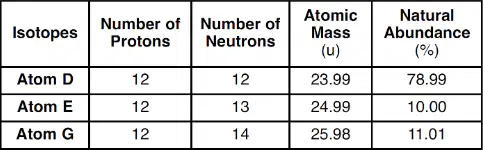
These three isotopes represent the same element because they have the same number of protons but different numbers of neutrons.
They have the same number of protons but different numbers of neutrons.
They have the same number of neutrons but different numbers of protons.
They have different numbers of protons and neutrons.
They have the same number of electrons but different numbers of protons.
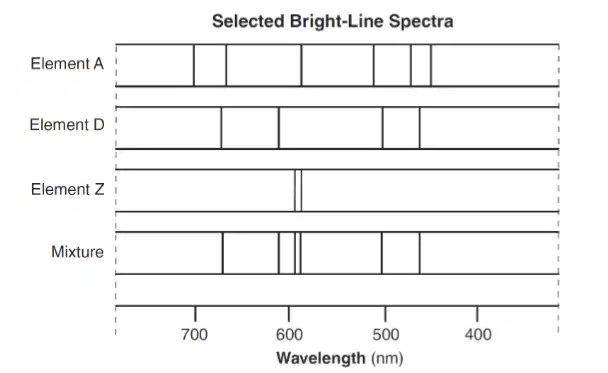
Evidence from the bright-line spectra that indicates element A is not present in the mixture is:
No lines in the mixture's spectrum match those of element A.
All lines in the mixture's spectrum match those of element A.
The mixture's spectrum is continuous with no bright lines.
Element A's lines are brighter than those in the mixture.
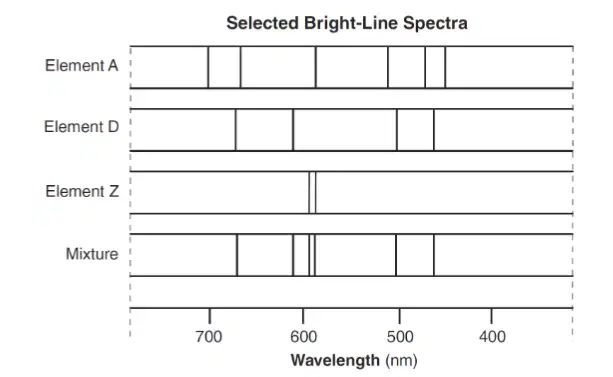
Explain why the spectrum produced by a 1-gram sample of element Z would have the same spectral lines at the same wavelengths as the spectrum produced by a 2-gram sample of element Z.
Because the spectral lines depend on the type of element, not the amount present.
Because doubling the mass changes the wavelengths of the spectral lines.
Because the spectrum depends on the temperature, not the element.
Because the spectrum is affected by the physical state of the sample.
State one way in which the Bohr model agrees with the Thomson model.
Both models describe the atom as containing electrons.
Both models describe the atom as having a nucleus.
Both models describe electrons orbiting the nucleus in fixed paths.
Both models describe the atom as mostly empty space.
Explain the production of an emission spectrum in terms of the energy states of an electron.
An emission spectrum is produced when electrons move from higher to lower energy states, releasing energy as light.
An emission spectrum is produced when electrons move from lower to higher energy states, absorbing energy as light.
An emission spectrum is produced when electrons remain in the same energy state without releasing or absorbing energy.
An emission spectrum is produced when electrons are removed from the atom entirely, causing the atom to emit light.
Atoms are mostly empty space.
True
False
Only in gases
Only in solids
Describe the structure of atoms, including the presence of electrons and small, negatively charged particles. How do atomic models show internal structure and neutrality?
Atoms consist of a nucleus containing protons and neutrons, surrounded by electrons, which are small, negatively charged particles; atomic models show internal structure and neutrality by balancing positive and negative charges.
Atoms are made only of electrons, which are positively charged, and atomic models show no internal structure.
Atoms have a nucleus with only neutrons, and electrons are large, positively charged particles; atomic models show only external features.
Atoms consist of a nucleus with protons and electrons, but atomic models do not show neutrality or internal structure.
Describe what happens when an electron falls from a high energy state to a low energy state. What is released during this process?
A photon is released.
A neutron is released.
An electron is absorbed.
A proton is released.
Label the electromagnetic Spectrum
Gamma
X-ray
Ultraviolet
Rainbow
Radio
Mircro
Infrared
Visible
What is the frequency of a sodium lamp that has a wavelength of 598.3 nanometres?
5.01 x 10¹⁴ Hz
179.49 Hz
1.994 x 10⁻¹⁵ Hz
5.01 x 10⁵ Hz
When an electron moves from n=2 (energy level 2) to n=4 (energy level 4)
MULTIPLE ANSWERS: CHECK ALL CORRECT ANSWERS
it must absorb light
it will release light
it will move farther from the nucleus
it will move closer to the nucleus
During a flame test, sodium chloride produces an intense yellow flame. This yellow color is produced when electrons in excited atoms
are gained by the atoms
are lost by the atoms
move to higher energy states within the atoms
move to lower energy states within the atoms
Fireworks that contain metallic salts such as sodium, strontium, and barium can
generate bright colors. A technician investigates what colors are produced by the metallic salts by performing flame tests. During a flame test, a metallic salt is heated in the flame of a gas burner. Each metallic salt emits a characteristic colored light in the flame.
Explain, in terms of electrons, how a strontium salt emits colored light.
(a)
Which electron transition in an atom results in the absorption of energy?
From the nucleus to the outer shell
Between two identical energy levels
From a higher energy level to a lower energy level
From a lower energy level to a higher energy level
What is the total number of neutrons in an atom of phosphorus-31?
16
15
31
46
Which statement best describes the electrons in an atom's ground state?
They have a positive charge.
They are always in the highest energy state.
They are found only in the nucleus.
They occupy the lowest available energy levels.
What is a cation's charge?
positive
negative
neutral
depends on the element
What is an anion's charge?
positive
negative
neutral
depends on the element's charge


An ion is an atom that has gained or lost _______.
protons
neutrons
electrons
How many electrons does a Ca2+ atom have?
2
22
20
18

