
 Worksheets
Simple & Compound Interest Calculations
Total questions: 23
Worksheet time: 12mins
What is Simple Interest?
Simple Interest is the amount of money charged on a loan or earned on an investment over time.
Simple Interest is a complex calculation involving multiple variables.
Simple Interest is the interest calculated on the initial principal and also on the accumulated interest of previous periods.
Simple Interest is a type of interest that compounds monthly.
What is the formula for Simple Interest?
I = P × R × T
I = P + R + T
I = (P × R) / T
I = P × R × T / 100
In the formula I = P × R × T, what does 'P' stand for?
Principal amount (initial loan or investment)
Power
Pressure
Perimeter
Jake borrows $5,000 at an 8% interest rate for 3 years. How much interest will he pay?
$1,200
$1,000
$1,500
$1,600
Calculate the simple interest using the formula I = P × R × T. If P = $1000, R = 5%, and T = 2 years, what is the interest?
$100
$90
$110
$120
What is the total amount to be paid if the principal is 1000andtheinterestis 100?
$1100
$1000
$1200
$1050
Rearrange the formula I = P × R × T to find P. What is the formula?
P = I / (R × T)
P = I × R × T
P = I / R × T
P = I × (R × T)
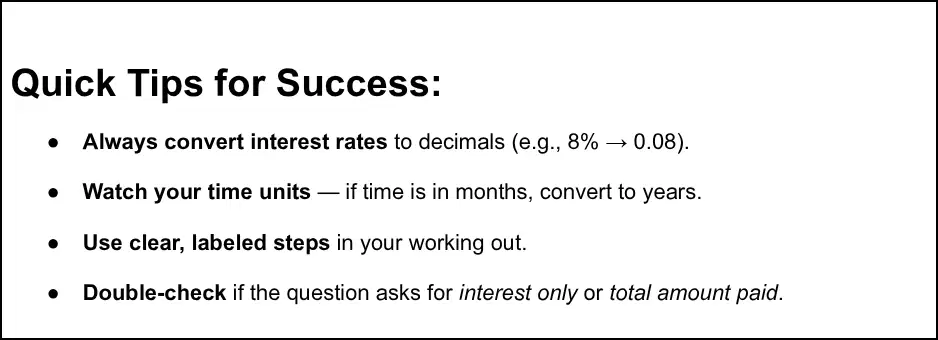
Which of the following is a quick tip for success when calculating interest?
Always convert interest rates to decimals.
Ignore time units.
Use unclear steps.
Explain how you would apply the formula I = P × R × T to a real-life business loan scenario.
By calculating the interest on a loan using the principal amount, interest rate, and time period.
By determining the total loan amount needed for a business.
By assessing the risk factors involved in a business loan.
By evaluating the creditworthiness of a business.

What is compound interest calculated on?
Only the original principal
Only the accumulated interest
Both the original principal and the accumulated interest
None of the above

Fill in the blank: Compound interest grows faster than simple interest because it earns interest on ________.
interest
principal
time
rate
What does 'A' represent in the compound interest formula?
Final amount after interest
Principal amount
Rate of interest
Time period
The significance of 'n' in the compound interest formula is:
The number of times interest is compounded per year
The principal amount
The rate of interest
The total time period
The formula for compound interest is:
A = P(1+r/n)(nt)
A = P + Prt
A = P(1 + rt)
A = P(1−r/n)(nt)
What is the formula for calculating the amount (A) in compound interest?
A) A=P(1+r/n)(nt)
B) A = P(1 + rt)
C) A = P(1−r/n)(nt)
Fill in the blank: The missing Rate (R) is (a) %.
Using the formula T = I / (P × R), calculate the time (T) if I = 6750, P = 25000, and R = 0.09.
2 years
3 years
4 years
What is the value of 'n' for annual compounding?
n = 1
n = 2
n = 4
n = 12
What is the value of 'n' for semi-annual compounding?
n = 2
n = 1
n = 4
n = 12
What is the value of 'n' for quarterly compounding?
n = 4
n = 2
n = 12
n = 1
What is the value of 'n' for monthly compounding?
n = 12
n = 4
n = 1
n = 365
What is the value of 'n' for daily compounding?
n = 365
n = 12
n = 52
n = 1
Which type of interest grows faster over time?
Simple interest
Compound interest

