
 Worksheets
Unit 5 Test - Light
Total questions: 28
Worksheet time: 17mins
Word Bank: Use each word once to complete the statements below RADIATION ELECTROMAGNETIC SPECTRUM FREQUENCY WAVELENGTH REFLECTION TRANSPARENT OPAQUE TRANSLUCENT ABSORPTION REFRACTION LED INCANDESCENT FLUORESCENT LASER OPTICAL FIBER SATELLITE MICROSCOPE TELESCOPE REFLECTING REFRACTING 1. The coating in a(n) ___________________________ light bulb emits light when it interacts with ultraviolet light.
FLUORESCENT
INCANDESCENT
LED
LASER
Word Bank: Use each word once to complete the statements below RADIATION ELECTROMAGNETIC SPECTRUM FREQUENCY WAVELENGTH REFLECTION TRANSPARENT OPAQUE TRANSLUCENT ABSORPTION REFRACTION LED INCANDESCENT FLUORESCENT LASER OPTICAL FIBER SATELLITE MICROSCOPE TELESCOPE REFLECTING REFRACTING 2. __________________ is defined as the transfer of energy as electromagnetic or EM waves. It is “light in motion.”
RADIATION
REFLECTION
ABSORPTION
REFRACTION
The scale used to show the full range of wavelengths of EM waves is called the __________________ __________________.
ELECTROMAGNETIC SPECTRUM
VISIBLE LIGHT RANGE
RADIO WAVE SCALE
INFRARED CHART
An instrument used to see tiny, nearby images is called a __________________.
MICROSCOPE
TELESCOPE
BINOCULARS
MAGNIFYING GLASS
A __________________ is a device that produces intense light of a very small range of wavelengths. It basically produces “concentrated” light.
LASER
BULB
LED
FLASHLIGHT
The bending, or changing in direction and speed of a wave, as it passes from one medium to another at an angle is known as __________________.
REFRACTION
REFLECTION
DIFFRACTION
ABSORPTION
____________________ refers to the distance between two consecutive waves.
Wavelength
Frequency
Amplitude
Velocity
The bouncing of light off a surface is called _____________________.
Reflection
Refraction
Diffusion
Absorption
When light is transmitted through an object clearly like water or clear glass, it is said to be ________________________.
Transparent
Opaque
Translucent
Reflective
A ______________________ is used to transmit data in the form of EM waves. Ex. GPS and weather systems.
Satellite
Router
Modem
Switch
____________________ is the number of waves per second, and is measured in hertz (Hz.)
Frequency
Amplitude
Wavelength
Velocity
______________________ materials do not let light pass through them.
Opaque
Transparent
Translucent
Reflective
____________________ is when light enters a material but does not leave it. Light energy is transferred to matter.
Absorption
Reflection
Refraction
Transmission
____________________ are used to see images of large, distant objects. They can be ______________________, using mirrors, or ______________________ using lenses.
Telescopes; reflecting; refracting
Microscopes; reflecting; refracting
Binoculars; reflecting; refracting
Cameras; reflecting; refracting
An ____________________ is a tiny indicator light on many electronic devices. It contains solid materials that emit light when energized by an electric current.
LED (Light Emitting Diode)
LCD (Liquid Crystal Display)
CFL (Compact Fluorescent Lamp)
Incandescent Bulb
________________________ light is created when electric current is passed through a thin wire called filament.
Incandescent
Fluorescent
LED
Halogen
________________________ materials scatter light, not letting it pass straight through.
Translucent
Opaque
Transparent
Reflective
Often found in bundles, ____________________ ____________________(s) are thin, transparent glass threads that transmit light over long distances.
Optical fibers
Copper wires
Plastic tubes
Metal rods
A Clear Window: Use a TP, TL, or O to describe its transparency.
TP
TL
O
none
A black T-shirt: Use a TP, TL, or O to describe its transparency.
O
TP
TL
T
Fog: Use a TP, TL, or O to describe its transparency.
TL
TP
O
None of the above
Tissue paper: Use a TP, TL, or O to describe its transparency.
TL
TP
O
None of the above
Use a TP, TL, or O to describe its transparency.
TP
TL
O
None of the above
Brick wall: Use a TP, TL, or O to describe its transparency.
O
TP
TL
N
Briefly explain the difference between candescent, fluorescent and LED lighting.
Candescent lighting uses a filament, fluorescent lighting uses gas, and LED lighting uses semiconductors.
Candescent lighting uses gas, fluorescent lighting uses semiconductors, and LED lighting uses a filament.
Candescent lighting uses semiconductors, fluorescent lighting uses a filament, and LED lighting uses gas.
Candescent lighting uses a filament, fluorescent lighting uses semiconductors, and LED lighting uses gas.
What is the speed of light in a vacuum?
299,792,458 m/s
150,000,000 m/s
3,000,000 m/s
30,000,000 m/s
The sky is blue because:
it reflects the ocean
of the scattering of sunlight by the atmosphere
it is a reflection of space
it absorbs all colors except blue
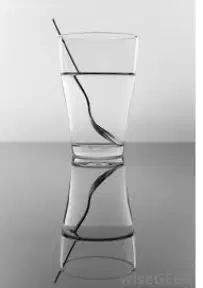
The spoon appears bent or broken in the picture because of:
Reflection of light
Refraction of light
Diffraction of light
Absorption of light

