
 Worksheets
Solar System Review
Total questions: 98
Worksheet time: 1hrs 1mins
The phase of the Moon that immediately precedes the new Moon is the ____.
third quarter
first quarter
full moon
waxing gibbous
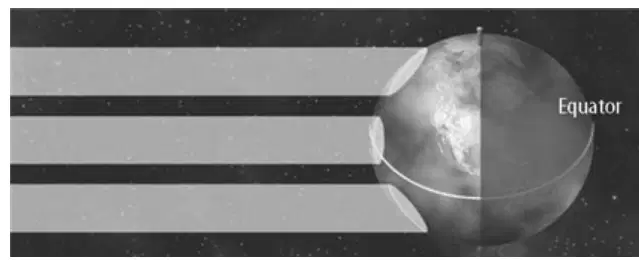
As shown below, sunlight is more spread out as you move ________ the equator.
toward
away from
around
across
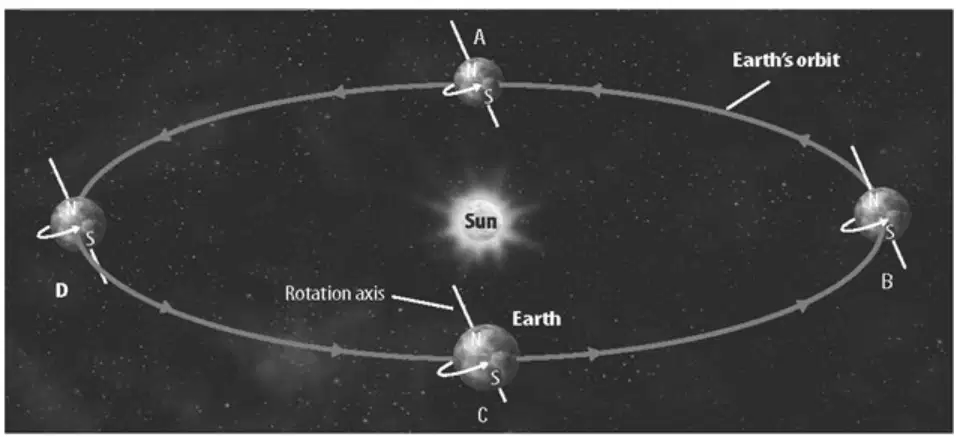
Which letter shows Earth’s position in the summer?
C
B
A
D
A lunar eclipse can only occur during which type of moon phase?
third quarter moon
full moon
first quarter moon
new moon
During ________ phases, more of the Moon is visible each night.
new
waxing
full
waning
When the north end of Earth’s rotation axis is pointing toward the Sun, which statement is true?
The southern hemisphere receives more energy from the Sun.
Temperatures increase in the southern hemisphere.
Temperatures decrease in the northern hemisphere.
The northern hemisphere receives more energy from the Sun.
The yearly orbit of Earth around the Sun is called its ____.
ellipse
revolution
tilt
rotation
The longest a total solar eclipse lasts is about how long?
1 minute
30 minutes
an hour
7 minutes
During which phase is just the western half of the Moon lit?
new moon
third quarter
full moon
first quarter
Earth rotates on its axis about once every year.
True
False

Which is the correct order for the pictures to explain the giant impact hypothesis for the Moon’s formation?
II, I, III
I, III, II
III, I, II
I, II, III
Match the description: first quarter
full moon
new moon
third quarter
solar eclipse
Match the description: full moon
first quarter
new moon
third quarter
solar eclipse
Match the description: third quarter
first quarter
full moon
new moon
solar eclipse
Match the description: lunar eclipse
first quarter
full moon
new moon
occurrence caused by Earth's coming between the Sun and the Moon and casting its shadow on the Moon
Match the description: maria
first quarter
full moon
new moon
lava flowing up through the Moon’s crust
Match the description: craters
impacts from objects in space
lava flowing up through the Moon’s crust
tectonic plate movement
volcanoes
Moon phase in which none of the lighted surface of the Moon can be seen from Earth
full moon
new moon
first quarter
third quarter
Occurrence caused by Earth's coming between the Sun and the Moon and casting its shadow on the Moon
solar eclipse
lunar eclipse
new moon
full moon
Since the Moon revolves once around Earth in the same amount of time that it takes to rotate on its axis the _______________ faces Earth.
same side
opposite side
top side
bottom side
The summer solstice occurs in June in the northern hemisphere and in December in the southern hemisphere.
True
False
Night and day on Earth are caused by Earth's revolution around the Sun.
True
False
The Sun's rays strike Earth at their northernmost and southernmost positions during ____.
spring and fall equinoxes
lunar eclipses
winter and summer solstices
solar eclipses
December 21 or 22 is known as the ____.
new Moon
equinox
December solstice
Moon phases
Moon phase in which none of the lighted surface of the Moon can be seen from Earth is called ____.
new Moon
waxing
full Moon
waning
Imaginary line extending between the poles around which Earth spins is called the ____.
waxing
axis
rotation
equinox
Turning of Earth on its axis is known as ____.
waxing
axis
rotation
equinox
Moon phases in which the amount of lighted surface seen on Earth increases are called ____.
waxing
axis
rotation
equinox
Spring tides--
occur at new and full moons, and have the lowest high tides and highest low tides.
occur at first- and third-quarter moons, and have the highest high tides and lowest low tides.
occur at new and full moons, and have the highest high tides and lowest low tides.
occur at first- and third-quarter moons, and have the lowest high tides and highest low tides.

Which phase of the Moon is shown if this is a picture of what the sky looks like at midnight?
new moon
third quarter
full moon
first quarter
What is the term for the path that the Moon takes as it revolves around Earth?
orbit
axis
rotation
equinox
Which phase of the Moon occurs when the entire face of the Moon is illuminated as seen from Earth?
third quarter
first quarter
new moon
full moon
What is the name of the phenomenon when the Moon passes directly between the Sun and Earth, blocking sunlight?
full moon
new moon
solar eclipse
lunar eclipse
What is the term for the Moon phase when more than half of the Moon is illuminated but not yet full?
new moon
first quarter
waxing gibbous
waning crescent
Which phenomenon occurs when the Earth is directly between the Sun and the Moon, casting a shadow on the Moon?
solar eclipse
full moon
new moon
lunar eclipse
What is the name of the line that divides the illuminated and dark sides of the Moon?
orbit
axis
terminator
equinox
What is the term for the Moon phase when less than half of the Moon is illuminated and it is decreasing?
new moon
waning crescent
waxing gibbous
first quarter
Which phase of the Moon occurs when the Moon is between the Earth and the Sun, and the side facing Earth is dark?
third quarter
first quarter
new moon
full moon
What is the name of the phenomenon when Earth passes directly between the Sun and the Moon, casting a shadow on the Moon?
solar eclipse
lunar eclipse
new moon
full moon
What is the term for the Moon phase when less than half of the Moon is illuminated and it is decreasing?
new moon
first quarter
waxing gibbous
waning crescent
During which phase of the Moon is the entire face of the Moon not visible from Earth?
first quarter
new moon
third quarter
full moon
Which phenomenon occurs when the Moon is directly between the Sun and Earth, blocking sunlight from reaching Earth?
lunar eclipse
solar eclipse
full moon
new moon
What is the correct order of the planets in the Solar System, starting closest to the Sun?
Mars, Mercury, Earth, Venus, Jupiter, Saturn, Uranus, Neptune,
Mercury, Venus, Earth, Mars, Jupiter, Saturn, Uranus, Neptune
Mercury, Mars, Venus, Earth, Jupiter, Saturn, Uranus, Neptune,
Mercury, Venus, Earth, Mars, Jupiter, Neptune, Uranus, Saturn

What is the name of this type of tide, spring or neap?
(a)
TRUE or FALSE: During a Spring tide, the earth, moon and sun are in a straight line.
True
False

Which locations show when the earth is experiencing a high tide?
1 & 2
1 & 3
1 & 4
2 & 4

Which locations show when the earth is experiencing a Spring tide?
1 & 2
1 & 3
1 & 4
2 & 4

The bulge in the ocean is showing
the gravitational pull of the moon
the gravitational pull of the sun
The gravitational pull of the moon and the sun
the lowest tide possible
What is the name of this type of tide, spring or neap?
(a)
TRUE or FALSE: During a Spring tide, the earth, moon and sun are in a straight line.
True
False
Which locations show when the earth is experiencing a high tide?
1 & 2
1 & 3
1 & 4
2 & 4
Which locations show when the earth is experiencing a Spring tide?
1 & 2
1 & 3
1 & 4
2 & 4

Which locations does earth experience a low tide?
1 & 2
1 & 3
1 & 4
2 & 4

When the sun and moon are both pulling on the earth's ocean, we experience
low tide
our lowest tide
average tide
our highest tide
Why is the moon's gravitational pull on our ocean greater than the sun's pull?
The sun is bigger
The sun is brighter
The moon is closer
The moon is brighter

We know the sun is larger than the moon. Why do they appear about the same size from earth?
We've been to the moon but not the sun.
The moon is much closer than the sun.
The sun is brighter than the moon.
The sun is warmer than the moon.
A spring tide happens during which phases of the moon?
1st and 3rd Quarter Moons
Full and New Moons
Only a Full Moon
It could happen any time

TRUE or FALSE: A Neap Tide happens during a Full Moon or a New Moon.
True
False

A Neap tide happens...
twice a month
only during a 1st quarter moon
every other lunar cycle
when the sun, earth and moon form a straight line

A solar eclipse happens
during a new moon
when the moon is between the sun and the earth
during daylight
All of these

This is an example of
a solar eclipse
a lunar eclipse
a full moon

The earth traveling around the sun is called
rotation
revolution
hemisphere
triangulation

What kind of eclipse is this... Solar or Lunar?
(a)

What kind of eclipse is this?
Solar
Lunar

Which eclipse makes the moon cast a shadow on the earth?
TOP PICTURE: Lunar
BOTTOM PICTURE: Solar

Which kind of eclipse can only happen during a full moon at night?
Solar Eclipse
Lunar Eclipse
Why don't we get a Solar Eclipse every time we pass through the New Moon Phase?
The moon's orbital plane is tilted.
Earth spins on its axis.
The sun is too bright.
The moon's gravity isn't strong enough.
What is the most widely accepted idea about how the Moon formed?
The volcanic eruption hypothesis
The giant impact hypothesis
The asteroid collision hypothesis
The solar wind hypothesis
What are the main features on the Moon's surface?
Rivers, lakes, and mountains
Craters, maria, and highlands
Forests, deserts, and valleys
Oceans, plains, and hills
What causes the Moon to move in an orbit around Earth?
The Moon's own gravity
The pull of Earth's gravity
The Sun's heat
The Moon's magnetic field
How long does it take for the Moon to make one complete revolution around Earth?
24 hours
7 days
27.3 days
365 days
What are maria on the Moon?
Large, dark, flat areas
Tall, bright mountains
Deep, narrow valleys
Small, round craters
How often does the Moon rotate as it revolves around Earth?
Once every 24 hours
Once every 7 days
Once every 27.3 days
Once every 365 days
What is the phase called when the Moon's near side is completely lit?
New Moon
First Quarter
Full Moon
Third Quarter
During which week of the lunar cycle does the first quarter phase occur?
Week 1
Week 2
Week 3
Week 4
In which week does the third quarter phase occur?
Week 1
Week 2
Week 3
Week 4
What is the phase called when the Moon's near side is completely dark?
Full Moon
First Quarter
New Moon
Third Quarter
The sun is ______ km from Earth.
15,000,000
150,000,000
50,000,000
5,500,000
The Sun's energy is from _________.
none of the answers are correct
atomic fission
nuclear fusion
light and heat
The Sun's core temperature is hotter than the surface temperature.
True
False
The motion of one object around another object
revolution
orbit
The path an object follows as it moves around another object
revolution
orbit
One complete Earth rotation is called a ________ and takes 24 hours.
seasonal cycle
annual cycle
day/night cycle
Earth's rotation makes object in the sky to __________ east to west across the sky.
move
cycle
center
tilted
The curved surface of the Earth's surface causes the sunlight to spread more at the __________ than at the _________.
poles; equator
equator; poles
east; west
west; east
The direction of the north end of Earth's rotation axis points towards the sun during __________ and _________.
summer; winter
winter; fall
fall; spring
spring; summer
The direction of the north end of Earth's rotation axis points away from the sun during __________ and _________.
summer; winter
winter; fall
fall; spring
spring; summer
A day when Earth's rotation axis is the most toward or away from the Sun
Solstice
Equinox
A day when Earth's rotation axis is leaning along Earth's orbit, neither toward or away from the Sun
Solstice
Equinox
Which two point in Earth's orbit is the solar energy increasing?
December Solstice and March Equinox
June Solstice and September Equinox
December Solstice and June Solstice
March Equinox and September Equinox
Which two point in Earth's orbit is the solar energy decreasing? Mark 2
December Solstice and March Equinox
June Solstice and September Equinox
December Solstice and June Solstice
March Equinox and September Equinox
The height of the apparent path of the sun through the sky in the northern hemisphere during December Solstice is ____________________.
Farthest from the sun
Closest to the sun
The height of the apparent path of the sun through the sky in the northern hemisphere during June Solstice is ____________________.
Farthest from the sun
Closest to the sun
An imaginary line that runs through the center on which an object rotates
rotation
rotation axis
revolution
revolution axis
Earth's _________ is always tilted in the same direction by the same amount (23.5 degrees).
rotation
rotation axis
revolution
revolution axis
The Sun's energy reaches Earth as ______________.
light and nuclear fusion
heat and nuclear fusion
light and thermal energy
nuclear fusion
How long is a year on Earth?
365 hours
24/7 days
365.24 days
27/7.24 hours

