
 Worksheets
Chapter 16/17
Total questions: 58
Worksheet time: 29mins
The largest source of federal revenue from taxes comes from
income taxes.
excise taxes.
estate taxes.
custom duties.
Taxes on the production, transportation, sale, or consumption of goods are _____ taxes.
income
corporation
excise
estate
Which of the following limits on the Federal Government's power to tax is implied but not stated in the Constitution?
No tax shall be levied on articles exported from any State.
All taxes must be used for public purposes, not private purposes.
States shall not be taxed for their governmental activities.
States shall pay direct taxes proportionately based on population.
The Federal Government can levy taxes on all of the following groups EXCEPT
manufacturers.
workers.
churches.
importers.
A gift tax must be paid if a person
receives money from the estate of a deceased relative.
receives gifts valuing more than $10,000 in any one year.
imports certain luxury items.
The Federal Government is able to borrow money at lower interest rates than private borrowers because
its securities are considered the safest possible investment.
interest rates are set by Congress.
it borrows over long periods of time.
it borrows mostly from State governments.
The Federal Government's practice of spending more than it takes in results in
greater dependence on regressive taxes than on progressive taxes.
deficit financing.
low interest rates.
longer fiscal years.
Today, more than one in every five dollars spent by the Federal Government pays for
interest on the national debt.
money allocated for military equipment.
money allocated to the various departments.
money needed to complete the federal budget.
Although only Congress can appropriate the money that the Federal Government uses to operate, it is the (a) who initiate(s) the spending process.
President
Supreme Court
Budget Committee
voters
Both corporate and individual income taxes are set at (a) rates.
high
progressive
regressive
low
The Federal Government can
use its taxing power in any manner it wishes.
tax an activity that Congress believes is harmful or dangerous to the public.
not levy taxes for any reason other than to raise money.
tax a State government on its public service activities.
Which of the following is NOT a source of nontax money in the United States?
interest on loans made by the Federal Government
personal payments to the 'conscience fund'
revenues collected as custom duties
profit from the manufacture of money
Public debt today is measured in of dollars.
millions
billions
Two of the largest categories of federal spending are
Social Security and interest on the public debt.
costs for operating the legislative and the judicial branches of government.
the Department of Energy and the Department of Defense.
costs for operating the Executive Office of the President and funds appropriated to the President.
The process of preparing the federal budget begins with
estimates from all agencies detailing yearly spending projections.
plans for spending determined by the President.
suggestions on spending from congressional committees.
spending plans submitted by the Office of Management and Budget.
A person with a low income from an importing business, who receives large gifts of money from friends and has no wealthy relatives, would prefer
a regressive income tax, low custom duties, high estate taxes, and low gift taxes.
a progressive income tax, high custom duties, low estate taxes, and low gift taxes.
a regressive income tax, high custom duties, low estate taxes, and high gift taxes.
a progressive income tax, low custom duties, high estate taxes, and low gift taxes.
Canal tolls and fees for passports and patents are categorized as
custom duties.
excise taxes.
seigniorage.
nontax revenues.
Entitlements fall into:
Capital budgets
Operations budgets
Discretionary spending
Mandatory spending
If the federal budget is not approved by October 1st, what usually happens.
Nothing
Congress will pass a continuing resolution
Canada will overtake the U.S.
none of the above
A key role of the secretary of state is
being the operating head of the Defense Department.
offering advice on foreign affairs to the President.
overseeing the issuing of patents and censuses.
dividing the State Department into its geographic components.
The secretary of defense is responsible for all of the following EXCEPT
advising the President in the carrying out of defense policy.
selecting the Joint Chiefs of Staff.
running the Defense Department.
advising the President in the formation of defense policy.
Which historic world event finally ended the United States' commitment to a policy of isolationism?
World War II
the Vietnam War
the Korean War
the Persian Gulf War
Sales tax in an example of a:
Progressive tax
Proportional tax
Gift tax
Events that take place in one's own country are called:
Right of legation
Diplomatic immunity
Foreign affairs
Domestic affairs
The first national draft was used in the United States during
the Revolutionary War.
the Vietnam War.
World War I.
none of the above.
The contrasting foreign policies of the United States that followed World War I and World War II can best be summarized as a shift from
isolationism to internationalism
an Open Door policy to a Good Neighbor policy
deterrence to détente
none of the above
For the first part of the country's history, American foreign policy could be described most accurately as
a. a continued involvement in all aspects of world affairs.
b. a pursuit of numerous economic and diplomatic ties abroad.
c. a desire for noninvolvement.
d. maintaining world leadership.
Refusal to become involved in the world's affairs is known as:
Internationalism
Isolationism
Right of legation
Diplomatic immunity
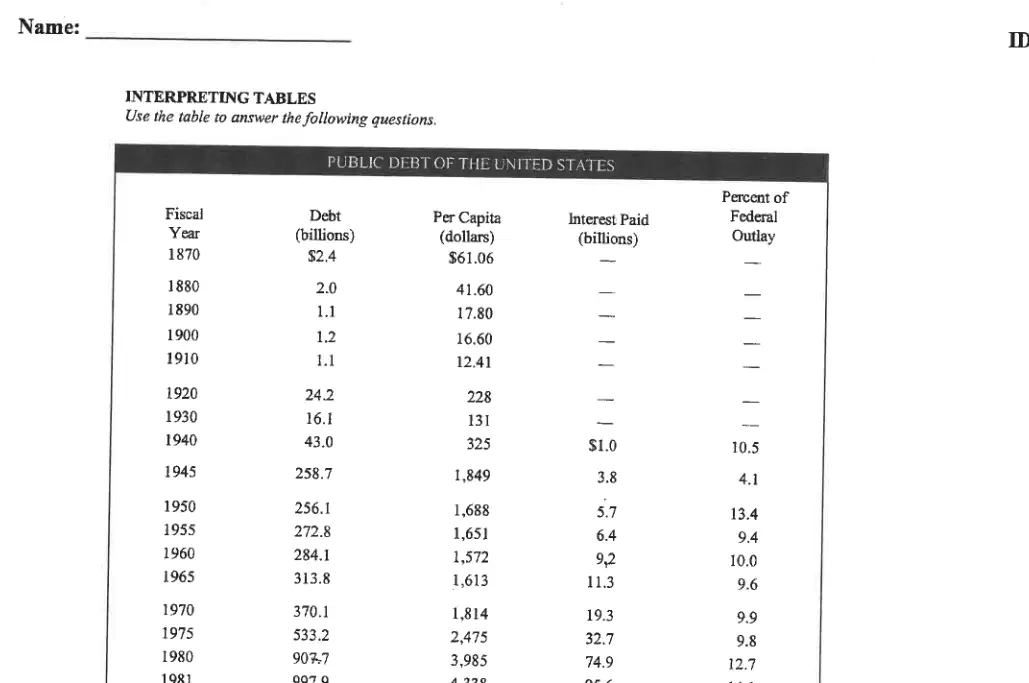
The total public debt first went over $900 billion in
1945
1960
1979
1980
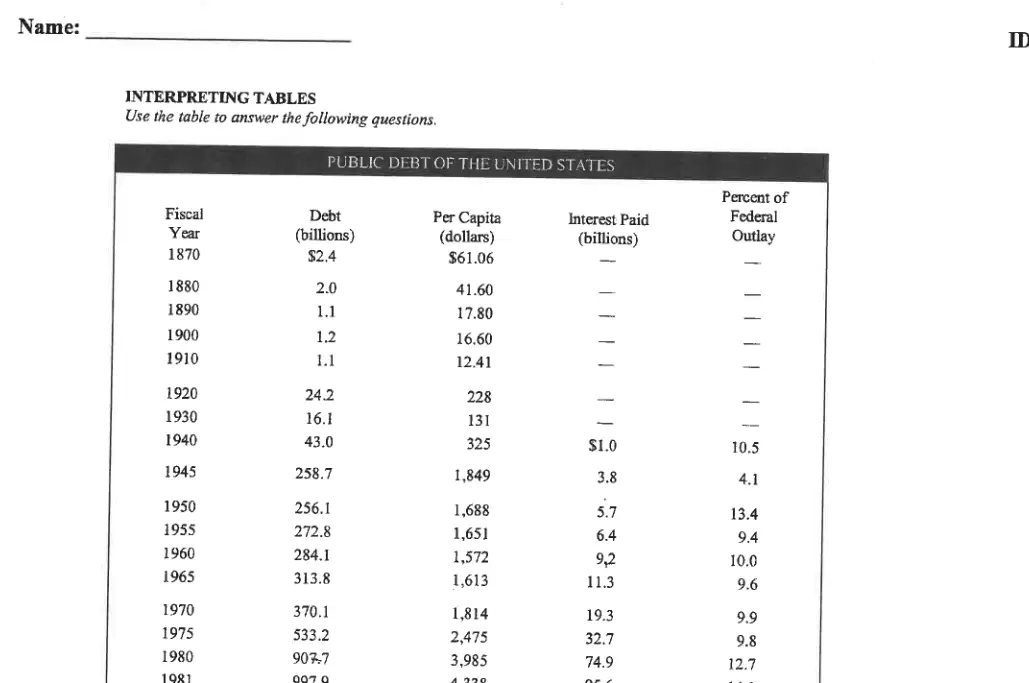
In what year did the public debt take the greatest percent of total federal outlay?
1970
1986
1991
1955
The Framers most likely placed high importance on the taxing power because
it was part of the Connecticut Compromise.
the lack of that power had been one of the shortcomings of the government under the Articles of Confederation.
they did not want the States to become too powerful.
they wanted to demonstrate their willingness to support the new Congress.
If Congress were permitted to tax exports, exporters would be forced to
halt all foreign commerce.
tax imports.
raise the cost of those goods or lower their profits.
lower the cost of the goods.
During the first fifty years of its existence, Congress raised money primarily through.
income taxes.
export taxes.
import taxes.
none of the above.
The congressional power to borrow money
was granted in the Constitution.
resulted from a constitutional amendment.
resulted from an act passed by Congress following World War I.
is implied by the taxing power.
Interest rates paid by the Federal Government are lower because the government is a low risk for investors. It can be inferred from this that interest rates are set by lenders based in part upon
the likelihood that the loan will be repaid.
the taxes that must be paid on the interest.
how much of their capital is invested in borrowers.
none of the above.
The power of the Federal Government to borrow money is
limited by what the American people are willing to finance.
limited by the President when it reaches a certain level.
unlimited.
constitutionally limited.
As with most of its other work, Congress relies heavily on _____ to do its budget work.
State governments
committees and subcommittees
the executive branch
the Senate
While establishing their new country and its government, it is only reasonable that Americans focused on
the conduct of other nations.
domestic affairs.
foreign affairs.
the global village.
The difference between a passport and a visa is that
a passport is issued by the United States while a visa is issued by the country one wishes to enter.
a passport is issued by the country one wishes to enter, while a visa is issued by the United States.
a citizen may not leave the country without a visa, but can without a passport.
passports are only valid for certain countries, while visas are universally valid.
By civilian control of the military, the Framers meant
control by military officers.
control by the Army.
control by the elected representatives of the people.
control by the civil service.
The draft was suspended largely because
American public opinion opposed it.
the President vetoed it.
the Supreme Court declared it unconstitutional.
World War II ended.
If you can cut the grass faster and clean the house quicker, you are said to have :
Absolute advantage
Comparative advantage
Dynamic advantage
Protective advantage
The U.S. currently has an embargo against :
Arctic Circle
France
Spain
Cuba
The U.S currently has a :
Trade surplus
Trade deficit
Balance of trade
None of the above
Trade agreement that consist of 27 European countries.
EU
NAFTA
WTO
GOTMILK
Tariffs, quotas, and embargos, are all:
Ways to improve trade between countries
Ways to restrict trade
Ways to hurt an economy
All of the above
When the U.S. economy is doing poorly, the U.S. dollar will lose its value because there is less demand for it, which is an example of:
Devaluation
Flexible exchange rates
Depreciation
An embargo
Japan producing jeans at a lower opportunity cost than the U.S., is an example of:
absolute advantage
comparative advantage
direct advantage
devaluation advantage
A tax on an imported good:
Surplus
Tariff
Quota
Deficit
A limit on the number of goods imported into a country is:
Quota
Tariff
Surplus
Something protectionist are against.
The U.S. used this to determine exchange rates until 1970.
Flexible exchange rates
Fixed exchange rates
Absolute exchange rates
None of the above
Proportional, progressive and regressive refers to:
Tax structure
Tax base
Tax incentive
None of the above
Where do State’s get most of their revenue?
Estate taxes
Property taxes
Sales taxes
Tariffs
Where do local governments such as cities, townships, and villages receive most of their revenue?
Income taxes
Property taxes
Excise taxes
Tariffs
The largest and most important trade organization is the:
WTO
NAFTA
EU
CAFTA
If a nation’s currency goes down in value, how will that affect that nation’s exports?
Exports will increase
Exports will decrease
Imports will increase
Imports will decrease while exports remain steady.
When a government orders the decrease in the value of its currency, this is called:
Depreciation
Devaluation
flexible exchange rate
Fixed exchange rate
If a nation’s currency increases in value, how will that affect that nation’s exports?
Exports will increase
Exports will decrease
Imports will increase
Imports will decrease, while exports stay the same.

