
Font size
 Worksheets
Unit 5 Ecosystem Dynamics
Total questions: 113
Worksheet time: 2hrs 8mins

Coyote populations have been increasing in recent years. Which would not be a reason for their increase?
More food is available
Less competition from other predators
Less available habitat to live in.
Less threat of being hunted by humans

According to the chart, which year had the smallest population of coyotes?
1990
2000
2007
2009

If the trend from 1990 to 2010 were to continue, how many sightings would we expect in 2020?
20 or more
between 10-15
between 5-10
less than 5

What might be a positive affect of Kentucky issuing hunting licenses and deer tags?
The state keeps track of the deer population each year
Only a limited number of licenses are issued based on the population of the deer.
Monies collected for licenses can be used on protecting deer and their habitat.
All of the above

If the populations of grasshoppers would decrease, what affect would that have on the population of lizards?
Increase
Stay the same
Decrease
Unable to determine

If the population of rattlesnakes were to decrease, why would that help to increase the population of hawks?
Rattlesnakes eat hawks
Hawks eat rattlesnakes
Rattlesnakes and hawks both eat kangaroo rats.
It would not help the hawk population.

What is a negative impact that the Asian Carp have on native species in our rivers
They eat the same food as some native species
They use the same space as native species
They out-compete some native species
All of these
Rats were introduced to Australia and the rat population exploded over several years. Which would not be a reason for their population growing?
Large amounts of available food
Increase in the number of predators.
More water available
Large habitats to live in
Which is an abiotic factor that influences the population of the rats?
The amount of food available
The amount of water available
The number of predators available
The amount of competition in the ecosystem
Eventually the rat population in Australia reached its carrying capacity. What does that mean?
The rat population continued to grow larger.
The rat population reached its maximum level.
The rat population went extinct.
The rat population no longer was affected by limiting factors
Which would be a limiting factor on the rats
The availability of food.
The number of predators
The availability of abiotic resources
All are limiting factors.

What is the original source of energy for this ecosystem?
Plants
Animals
Air
Sun

Both the lion and the cheetah eat some of the same prey in this ecosystem. Two organisms going after the same resource is known as
Mutualism
Parasitism
Competition
Commensalism

What niche do the bacteria have that return the nutrients of dead and decaying matter back to the ecosystem
Producer
Primary Consumer
Secondary Consumer
Decomposer

Pythons are not native to the Florida Everglades but have been released there. They are thriving and crowding out native species. That is why they are considered a/n
Keystone species
Producer
Invasive species
Parasite
Why might an invasive species be so successful in a certain nonnative habitats
They have no natural predators.
They are able to out-compete native species
They are generalist that eat many different types of food.
All of the above
Which of the following does not increase reaction time.
The time it takes for neurons to send messages to the brain.
The time it takes for the brain to interpret the signals
the time it takes for neurons to send messages from the brain to the muscles.
The time it takes for light to travel from to your eyes.
Every time a dog went outside to go to the bathroom and then came back inside, his master gave him a treat. The dog used his memory and continued this behavior because he wanted treats. This is an example of:
a learned behavior
an instinctual behavior
an innate behavior
a random behavior

The table shows typical temperatures in a gray wolf habitat.
Which of these best describes a way that gray wolves adapt to survive the changing temperatures?
Wolves develop a heavy coat in the fall and shed it in the spring.
Each wolf’s howl sounds different from the others.
A wolf pack works together to find food in the fall.
Wolves are most active at sunrise and sunset.
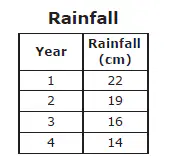
An area with many different types of plants is experiencing a drought. The table shows rainfall for four years.
Scientists predict that the rainfall pattern will continue during a fifth
year. Which two types of plants will have the best chance of surviving in
these conditions?
plants with stems that store water and plants with large colorful flowers
plants with large colorful flowers and plants with sharp thorns
plants with sharp thorns and plants with long root systems
plants with long root systems and plants with stems that store water
Most fox squirrels have a mixture of gray, red, and brown fur. However, some fox squirrels have entirely black fur. Which of the following statements most likely
describes a benefit of a squirrel having black fur?
Squirrels with black fur blend into their surroundings during
snowy winter months.
Squirrels with black fur have a slightly higher body
temperature during cold winter months.
Squirrels with black fur hibernate during winter months.
Squirrels with black fur attract more predators during winter
months.
Kudzu is a non native species that was introduced to the southeastern United States to help control erosion. However, it grew rapidly and covered large areas of land, including trees
and other plants, preventing them from receiving sunlight.
The non native species can outcompete the native species for
resources, causing the native species to decline.
The non native species can create a new food source for
native predators, helping to maintain balance.
The non native species can help native species to adapt to
changes in the environment.
The non native species can increase the biodiversity of the
ecosystem.
As the temperatures in an area increase, which of the
following plants is most likely to survive?
A plant with large, dark leaves that absorb and retain heat
A plant with delicate, thin leaves that requires frequent watering
A plant with small, light colored leaves that reflect heat and can
tolerate drought
A plant with large, broad leaves that lose heat by releasing
water
In the woodlands of New York, the whitetail deer population has greatly
increased in the past decade. Deer prefer to feed on plants that are native
to the region rather than invasive species of plants.
What effect does the growing deer population have on the ecosystem?
The number of native plants increases.
The amount of water increases.
The amount of plants considered
invasive species increases. The region receives more
precipitation.
How have humans had a positive impact on ecosystems?
By building highways
By cutting down forests
By using pesticides on farms
By creating nature preserves
The nine-banded armadillo is a small mammal with a scaled shell. They spend a lot
of time digging burrows to hide and for food. They are omnivores, but primarily feed on
insects.
Which of the following would most likely occur if armadillos were removed from an area?
The populations of armadillos’
predators would increase.
The number of burrows would
increase.
The populations of insects would
increase.
Other predators of insects would go
extinct.
Livestock, such as cows and goats, graze in pastures with grass. Which of the following is not an effect of overgrazing?
The number of plants in the
pasture decreases.
Soil loses nutrients that plants
need to grow.
The number of producers in the
pasture increases.
Soil erosion occurs.
An organism that eats other organisms to survive...
consumer
decomposer
producer
species
A collection of ecosystems that share similar characteristics...
population
community
biome
habitat
Where an organism lives in an ecosystem...
niche
habitat
population
A group of similar organisms that live in the same area...
biosphere
biome
species
population
A type of consumer that eats both plants and animals...
herbivore
carnivore
omnivore
An organism that breaks down decaying plants and animals...
consumer
decomposer
herbivore
omnivore
A group of organisms that share common characteristics and can breed...
species
community
biosphere
The role an organism plays in an ecosystem...
habitat
species
niche
producer
An organism that can make its own food...
producer
consumer
omnivore
decomposer
All of the biomes on Earth compose this...
population
ecosystem
biosphere
community
A population will increase when which of the following occurs?
emigration
resources decrease
immigration
organisms in the population die
Caterpillars eat vegetation. This makes them...
producers
decomposers
herbivores
consumers
Which of the following is NOT an abiotic factor of a terrestrial ecosystem?
water availability
temperature
fungi
oxygen
The flow of energy in an ecosystem can be seen in a...
species
food chain
biome
community
What is true about a population that has reached its carrying capacity?
it has reached the largest size that can be sustained by available resources
it begins to grow as resources become available
it decreases dramatically as resources are removed
its size is no longer dependent on the amount of resources present
Plants cannot survive without an a lot of nutrients in the soil. Which group adds nutrients to the soil?
producers
decomposers
herbivores
consumers
How does an ecosystem differ from a community?
an ecosystem includes biotic/abiotic factors while a community does not
an ecosystem includes all populations in an area while a community does not
A community includes biotic/abiotic factors while an ecosystem does not
A community includes all populations in an area while an ecosystem does not
Which of the following is NOT a consumer?
herbivore
omnivore
producer
carnivore
Under which of the following situations will a population decrease?
emigration
births
immigration
an increase in resources
Pollen in flowers is a source of food for bees. On the other hand, bees are a means of pollination for flowers. What type of interaction is this?
mutualism
predator-prey
interspecific competition
intraspecific competition
Which of the following is a biotic factor in a forest ecosystem?
temperature
precipitation
soil nutrients
trees
Decomposers are important because they...
break down dead animals tissues
break down dead plant tissues
recycle nutrients back into the soil
all of the above
Which one is this?
Shows one pathway of energy flow in an ecosystem?
food chain
food web
What is a herbivore?
An organism that primarily eats plants.
An organism that primarily eats meat.
An organism that can eat both plants and meat.
An organism that does not eat at all.
What energy role do wild pigs represent?
Carnivore, as they primarily eat meat.
Herbivore, as they primarily eat plants.
Omnivore, as they eat both plants and animals.
Detritivore, as they feed on decomposing organic matter.
What do omnivores eat?
Only plants.
Only meat.
Both meat and plants.
Only fruits.
What is a producer?
An organism that can make its own food, typically through photosynthesis.
An organism that consumes other organisms for energy.
A type of consumer that feeds on producers.
An organism that decomposes organic material.
How do food chains and food webs illustrate energy roles?
They show the flow of energy from producers to various levels of consumers in an ecosystem.
They depict the physical structure of an ecosystem without showing energy flow.
They illustrate the competition between different species for resources.
They represent the seasonal changes in an ecosystem's energy dynamics.
How do decomposers contribute to nutrient cycling?
They produce energy through photosynthesis.
They break down dead matter, returning nutrients to the soil for use by producers.
They compete with producers for sunlight and nutrients.
They store nutrients in their bodies for long periods.
What is a consumer?
An organism that can make its own food.
An organism that cannot make its own food and gets energy by eating other organisms.
An organism that only eats plants.
An organism that produces energy through photosynthesis.
What is the role of energy flow in an ecosystem?
Energy flows from producers to consumers and decomposers, maintaining ecosystem balance.
Energy is stored in the soil and used by plants only.
Energy is recycled within the ecosystem without any loss.
Energy flows only from consumers to producers.
Which of the following is NOT a consumer?
Producer
Customer
Client
User
What are decomposers?
Organisms that break down decaying biotic wastes and return materials to the ecosystem.
Organisms that produce energy through photosynthesis.
Organisms that consume primary producers for energy.
Organisms that compete for resources with other species.
What is the difference between a primary consumer and a secondary consumer?
Primary consumers eat producers (plants), while secondary consumers eat primary consumers.
Primary consumers are carnivores, while secondary consumers are herbivores.
Primary consumers are larger than secondary consumers.
Primary consumers produce energy, while secondary consumers consume energy.
What is an autotroph?
An organism that produces its own food from sunlight or chemical energy.
An organism that consumes other organisms for energy.
An organism that decomposes organic material for nutrients.
An organism that relies on external sources for food.
What is a carnivore?
An organism that primarily eats meat.
An organism that primarily eats plants.
An organism that can eat both plants and meat.
An organism that primarily feeds on fungi.
What is the significance of biodiversity in energy roles?
Biodiversity ensures a variety of energy roles, promoting ecosystem stability and resilience.
Biodiversity decreases the number of species, leading to more efficient energy use.
Biodiversity has no impact on energy roles within ecosystems.
Biodiversity only affects the aesthetic value of ecosystems.
What role do scavengers play in an ecosystem?
They produce energy through photosynthesis.
They consume dead organisms and help recycle nutrients.
They compete with predators for food resources.
They create habitats for other organisms.
What is the process called that producers use to make their own food?
cellular respiration
photosynthesis
cooking
hunting

Estimate the carrying capacity.
100 deer
80 deer
60 deer
40 deer
SELECT ALL of the density-dependent limiting factors.
Predation
Disease
Parasites
Competition
SELECT ALL of the density-independent limiting factors.
Unusual Weather
Natural Disasters
Human Activity
Water Availability
Which type of symbiosis involves both species benefitting? +/+
Mutualism
Commensalism
Parasitism
Which type of symbiosis involves one species benefitting while the other is harmed? +/-
Mutualism
Commensalism
Parasitism
Which type of symbiosis involves one species benefitting while the other is unaffected? +/0
Mutualism
Commensalism
Parasitism
Coyote populations have been increasing in recent years. Which would not be a reason for their increase?
More food is available
Less competition from other predators
Less available habitat to live in.
Less threat of being hunted by humans
According to the chart, which year had the smallest population of coyotes?
1990
2000
2007
2009
What might be a positive affect of Kentucky issuing hunting licenses and deer tags?
The state keeps track of the deer population each year
Only a limited number of licenses are issued based on the population of the deer.
Monies collected for licenses can be used on protecting deer and their habitat.
All of the above
If the populations of grasshoppers would decrease, what affect would that have on the population of lizards?
Increase
Stay the same
Decrease
Unable to determine
If the population of rattlesnakes were to decrease, why would that help to increase the population of hawks?
Rattlesnakes eat hawks
Hawks eat rattlesnakes
Rattlesnakes and hawks both eat kangaroo rats.
It would not help the hawk population.
What is a negative impact that the Asian Carp have on native species in our rivers
They eat the same food as some native species
They use the same space as native species
They out-compete some native species
All of these
Which is an abiotic factor that influences the population of the rats?
The amount of food available
The amount of water available
The number of predators available
The amount of competition in the ecosystem
Eventually the rat population in Australia reached its carrying capacity. What does that mean?
The rat population continued to grow larger.
The rat population reached its maximum level.
The rat population went extinct.
The rat population no longer was affected by limiting factors
What is the original source of energy for this ecosystem?
Plants
Animals
Air
Sun
Both the lion and the cheetah eat some of the same prey in this ecosystem. Two organisms going after the same resource is known as
Mutualism
Parasitism
Competition
Commensalism
What niche do the bacteria have that return the nutrients of dead and decaying matter back to the ecosystem
Producer
Primary Consumer
Secondary Consumer
Decomposer
Pythons are not native to the Florida Everglades but have been released there. They are thriving and crowding out native species. That is why they are considered a/n
Keystone species
Producer
Invasive species
Parasite
What are "apex predators?"
primary consumers
top predators
producers
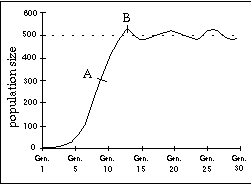
What is the carrying capacity of the graph?
around 500
more than 800
less than 300
around 700

Which of the following best describes the role of bacteria in the food web above?
Uses energy from light, to combine oxygen, carbon dioxide and water and converts it into energy in the form of sugar.
Uses energy from dead organisms or waste material to break down dead organisms and waste material into nutrients.
Controls the population by removing energy from living organisms
Uses energy from dead organisms or waste material to transfers energy

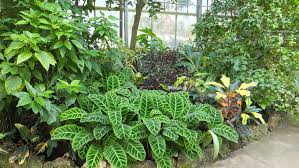

Barnacles are animals that cannot move. In order to get food, they attach to whales and catch any floating plankton in the water. The whale is neither helped nor harmed in the interaction. What type of symbiosis is this?
Mutualism
Commensalism
Parasitism
Neutralism

In the wild, some alligators gets their teeth cleaned by birds. The birds gets their food from the alligators' teeth.
What type of symbiosis is this?
Mutualism
Commensalism
Parasitism
Neutralism


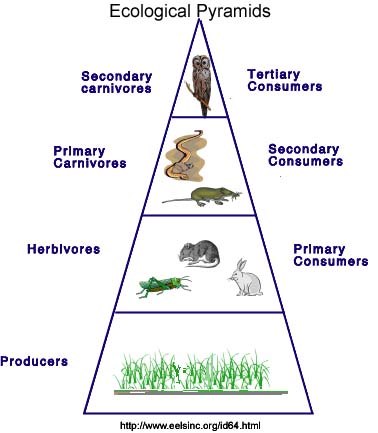

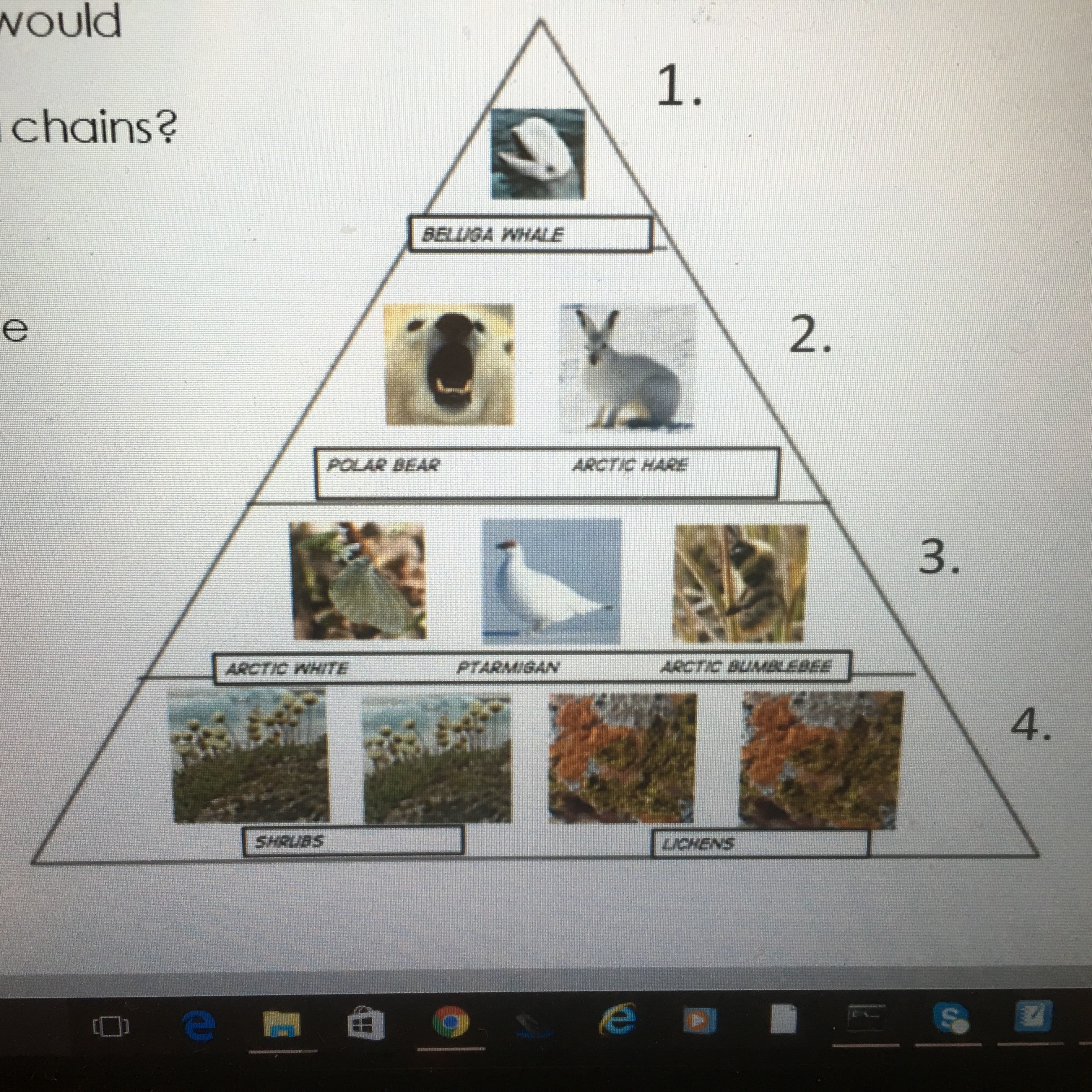
What amount of percentage does the energy decrease as it goes up the pyramid?
100%
1000%
10%
1%
How does the energy flow in an energy pyramids?
up the pyramid
down the pyramid
Photosynthesis is important because...
it makes carbon dioxide
it makes food for the food webs
it makes water
it's not important

