
 Worksheets
Marine Automation Midterm Exam
Total questions: 70
Worksheet time: 35mins
Which component removes moisture from compressed air in a pneumatic system?
Air dryer
Pressure regulator
Solenoid valve
Air receiver
What type of motion can a pneumatic actuator create?
Electrical motion
Hydraulic pressure motion
Thermal expansion motion
Linear or rotary motion
Assess the effectiveness of using redundant pneumatic systems versus single systems for critical shipboard applications. Which approach enhances safety and reliability?
Redundant systems provide backup in case of failure, enhancing safety
Single systems are simpler and easier to manage
Redundant systems are more expensive and complex
Single systems offer better performance under normal conditions
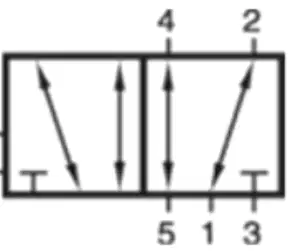
What type of a directional valve given on the image below with a number of ports and number switching position with a flow coming from port 3?
5/2-way valve, normally open position
5/2-way valve, normally closed position
5/2-way valve, normally open position
4/2-way valve, flow from 1-2 and from 4-3
Assess the importance of regular maintenance versus reactive maintenance for pneumatic systems onboard ships. Which approach ensures better long-term performance?
Regular maintenance is unnecessary if high-quality components are used
Reactive maintenance is more cost-effective and less time-consuming
Regular maintenance prevents unexpected failures and extends system life
Reactive maintenance allows for immediate response to issues
Evaluate the effectiveness of using automated pneumatic systems versus manual control systems for ballast water management on ships. Which system offers better operational efficiency?
Manual control systems are more reliable and easier to troubleshoot
Automated pneumatic systems provide consistent and precise control, reducing human error
Automated pneumatic systems are less efficient but easier to maintain
Manual control systems offer faster response times in emergencies
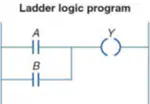
Which of the following describes the Ladder Logic Program?
AND Gate
NOR Gate
OR Gate
NAND Gate
This control element that has only two position, either it is fully closed or fully open. This control element does not operate at any intermediate position.
On / off control
Closed loop control
Open loop control
Sequence control
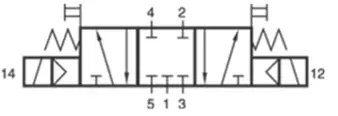
What type of a directional valve given on the image below with a number of ports and number switching position?
5/3-way valve, roller activated, spring returned center
5/3-way valve, solenoid pilot, 5/3-way valve, mechanical spring center
4/2-way valve, normally open position
5/3-way valve, pneumatically activated, spring returned center
What happens if a pneumatic system operates without a safety relief valve?
The system could become over-pressurized, potentially causing damage or hazards.
The flow of air would stop entirely.
The air pressure would decrease automatically.
The system would not generate enough air pressure to operate.
A ship's automated cargo handling system uses pneumatic actuators for movement. After operating for an extended period, the system begins to exhibit a significant loss of speed and force. Which evaluation suggests the most appropriate next step?
Check for air leaks in the pneumatic lines
Increase the air pressure in the system
Replace the pneumatic actuators
Inspect the moisture separator for clogging
In a pneumatic hoist system onboard, the hoist operates normally at first but then slows down and stalls. After inspecting the system, the crew observes excessive moisture in the air receiver tank. What action should they take to resolve the issue?
Replace the compressor's air filter
Drain and clean the moisture separator
Increase the system's pressure settings
Check for leaks in the pneumatic lines
Which of the following is a critical component to prevent over-pressurization in the system?
Safety relief valve
Air dryer
Flow control valve
Pressure gauge
What happens if the air in a control air distribution system contains excessive moisture?
Components may corrode, and system performance may degrade.
Air pressure will automatically stabilize.
The air flow direction will reverse.
The air compressor will shut down.
When assessing the reliability of a control air distribution system, which factor is most critical?
The size of the air receiver compared to the ship's total air demand.
The cost of the components used in the system.
The complexity of the system's layout.
The system's ability to maintain consistent pressure across all connected components.
When analyzing the efficiency of a control air distribution system, why is it important to evaluate air leakage?
Air leaks help identify high-pressure points in the system.
Air leaks cool the system and prevent overheating.
Air leaks waste energy, reduce system performance, and increase the load on compressors.
Air leaks are irrelevant as long as the pressure remains within acceptable limits.
A ship's control air system is prone to pressure drops during simultaneous operations of multiple valves. What is the best way to evaluate and resolve this issue?
Replace the control valves without investigating the underlying issue.
Assess the capacity of the compressor and air receiver to meet the system's demand during peak usage.
Reduce the number of connected components to the system.
Increase the system pressure beyond the recommended limits.
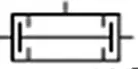
What type of component is shown on the image below?
Shuttle valve
Dual pressure valve
Quick exhaust valve
One-way flow control valve
What is a common cause of leaks in pneumatic lines onboard ships?
Deterioration of seals and connectors due to wear and tear.
Excessive use of lubricants in the system.
Incorrect sizing of the compressor.
Over-pressurization of the entire system.
Evaluate the trade-offs between using manual valves and automatic valves in pneumatic systems for shipboard applications. Which option provides greater operational efficiency, and why?
Manual valves are more reliable and require less maintenance
Automatic valves enhance efficiency through automation and precise control
Manual valves are better for high-pressure applications
Automatic valves are less reliable but easier to operate
Evaluate the importance of filter placement in pneumatic systems onboard ships. What is the most critical aspect to consider for ensuring system longevity?
Filters should be placed before actuators to prevent contamination
Filters are unnecessary in well-maintained systems
Filters should only be used in high-pressure applications
Filters should be installed after compressors to enhance air quality
It is a type of switch that actuates by the presence of a permanent magnet.
Limit switch
Proximity switch
Pressure sensor
Optical sensor
What does a flow control valve do in an electro-pneumatic circuit?
It regulates the flow of air to control the speed of an actuator.
It directs electrical signals to pneumatic components.
It compresses air for the circuit.
It filters out contaminants from the air supply.
Evaluate the impact of environmental factors, such as temperature and humidity, on the reliability of electro-pneumatic components. Which protective measures are most effective in ensuring long-term performance?
Using moisture-resistant materials and proper sealing techniques
Installing additional cooling systems to manage temperature
Regular maintenance and inspection of components
Using standard components without additional protection
Compare the use of limit switches and proximity sensors in detecting the position of moving parts in an electro-pneumatic system. Which option offers better accuracy and reliability, and why?
Limit switches provide better accuracy due to direct contact
Proximity sensors offer higher reliability and non-contact detection
Limit switches are more cost-effective and easier to install
Proximity sensors are less reliable but offer faster response times
Evaluate the effectiveness of using solenoid valves versus manual valves in an electro-pneumatic system for industrial automation. Which option offers better control and efficiency, and why?
Manual valves are more reliable and require less maintenance
Solenoid valves are less efficient but easier to operate
Manual valves provide better control in high-pressure applications
Solenoid valves offer better control and efficiency due to automated operation
What is an On-OFF switch that allows current to flow only when it is in the closed (ON) position?
Single pole, single throw
Single pole, double throw
Double pole, single throw
Double pole, double throw
What is a critical advantage of using solid-state relays over electromagnetic relays in onboard systems?
They generate more heat and require additional cooling systems.
They are harder to troubleshoot in case of a failure.
They have no moving parts, resulting in higher reliability and longer service life.
They are always more cost-effective.
When evaluating the reliability of a PLC system in a harsh industrial environment with extreme temperatures and high levels of dust, which factor is most critical to consider to ensure continuous and reliable operation?
The brand and reputation of the PLC hardware manufacturer.
The complexity and robustness of the PLC program.
The environmental conditions, such as temperature and dust levels, where the PLC is installed, and the PLC's ability to withstand these conditions.
The user interface and ease of use of the PLC software.
A relay is installed to switch the navigation lights on and off from the bridge. During a routine check, it is found that the relay's contacts are welded shut. What is the primary evaluation that should be carried out?
Whether the bridge wiring is up to date.
The load current on the relay compared to its rated capacity, as excessive current could cause welding.
Replace all relays onboard to ensure safety.
Switch to manual controls immediately without any evaluation.
A relay used in the auxiliary engine control circuit overheats frequently. What would be your evaluation to address this issue?
Reduce the engine's operating hours to avoid using the relay.
Replace the relay with the same type without further investigation.
Ignore the overheating as long as the relay continues to function.
Ensure that the relay is correctly rated for the current it handles and check for loose connections in the circuit.
This component of Programmable Logic Controller that provides a method for transferring information between internal storage and external devices.
Hard drives
I/O interface
Computer simulation
Internal memory transfer
It is an industrial-grade computer is tasked with automating industrial processes. It achieves this by overseeing inputs from sensors and various devices, employing programmed logic to make decisions, and managing outputs like motors, valves, and other actuators.
Distributed Control System
Programmable Logic Control
Central Processing Unit
Supervisory Control and Data Acquisition
In a ladder logic diagram, two normally open contacts in parallel lead to an output coil. What does this configuration achieve?
The output coil activates only when both conditions are true simultaneously.
The output coil activates if either one or both conditions are true.
The output coil remains deactivated regardless of the conditions.
The output coil activates when neither condition is true.
A PLC system is controlling the automated fire suppression system onboard a vessel. During a scheduled maintenance test, one section of the sprinklers fails to activate. What is the MOST comprehensive approach to evaluate this issue?
Replace the PLC outputs responsible for that section and retest.
Examine the wiring, PLC logic, and mechanical sprinkler components collectively.
Ignore it during testing since it's unlikely to occur in a real scenario.
Increase the threshold for activation in the PLC program and run the test again.
The main PLC used for deck crane operations suddenly stops responding during cargo handling. After rebooting, it works but sporadically malfunctions. How would you assess and address this issue?
Focus solely on the mechanical components of the crane for evaluation.
Inspect the PLC program, power supply, communication modules, and I/O wiring connections.
Replace the main PLC unit without conducting a detailed root-cause analysis.
Create a backup program and test it in parallel without changing the existing setup.
Is a high-level language that is used in Programmable Logic Controller (PLC) that is like Basic, Pascal and 'C'. It is a very powerful tool that can execute complex tasks utilizing algorithms and mathematical functions along with repetitive tasks.
Structured Text
Function Block Diagram
Ladder Logic Language
Sequential Function Chart
This part of the Ladder Diagram that is built in the form of horizontal line:
Redundancy
Rails
Rungs
Process control system
Evaluate the role of redundancy in PLC systems used in critical applications such as emergency shutdown systems in oil and gas platforms. Why is redundancy important?
Redundancy increases the complexity of the system
Redundancy reduces the overall cost of the system
Redundancy simplifies the programming process
Redundancy ensures continuous operation in case of a component failure
A PLC program written in Function Block Diagram (FBD) is not performing as expected. Assess the most effective approach to troubleshoot and optimize the program.
Rewrite the program in Ladder Logic for better visualization.
Analyze each function block individually and verify their inputs and outputs.
Convert the program to Structured Text for easier debugging.
Increase the scan time of the PLC to ensure all blocks are executed.
Which PLC programming language is best suited for representing control functions as interconnected blocks?
Ladder Diagram
Structured Text
Function Block Diagram
Sequential Function Chart
What is a 'rung' in Ladder Logic diagram?
A vertical line in a ladder logic diagram that connects inputs and outputs
A horizontal line in a ladder logic diagram that represents individual control logic
A block that represents a function in Function Block Diagram
A type of input module in a PLC
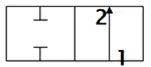
What type of a directional valve given on the image below with a number of ports and number switching position?
2/2-way valve, normally open position
3/2-way valve, normally closed position
3/2-way valve, normally open position
4/2-way valve, flow from 1-2 and from 4-3
If a PLC-controlled maritime system fails to isolate the faulty component during an onboard malfunction, assess the most appropriate action the crew should take to ensure operational safety.
Continue operation as usual until the next maintenance schedule
Ignore the malfunction, as the system will correct itself
Upgrade the PLC system immediately without troubleshooting
Manually isolate the faulty component to prevent further damage
Given the following scenario: A ship's PLC system triggers an alarm indicating overheating in the engine room. The operator silences the alarm without investigating the root cause. What could be the potential consequences of this action?
Improved system efficiency
Decreased engine maintenance frequency
Prolonged damage to the engine
Reduced chances of system failure
When evaluating the performance of a DCS, which factor is the most critical?
Aesthetic design of the interface
Speed of communication and data processing
Minimal use of sensors
Number of crew members trained to use it
What is an essential safety advantage provided by DCS in emergency situations?
Centralized control for better decision-making
Manual override for faster response
Removing redundant systems
Avoiding alarm signals
The following below statements are the advantages of DCS, except:
Monitoring and reporting of individual components and processes
Possible to control through dynamic graphic
Eliminating human error by Logging of data
Failure of one controller effects more than one loop
What type of computerized control system for a process or machinery that is usually with many control loops, in which autonomous controllers are distributed throughout the system, but there is no central operator supervisory control?
Central Processing Unit
Distributed Control System
Programmable Logic Control
Supervisory Control and Data Acquisition
A new SCADA system claims improved energy efficiency by optimizing data processing. What key performance indicator would you analyze to validate this claim?
The reduction in system maintenance costs.
The increase in the number of processed data points.
The reduction in operator workload.
The decrease in overall power consumption during operations.
When assessing the long-term sustainability of PLC, DCS, and SCADA systems, which factor is most important?
The initial setup cost.
The system's ability to adapt to future needs and technological advancements.
The number of features included.
The brand reputation.
When evaluating the user-friendliness of a SCADA system's interface, which metric provides the most valuable insight?
The time taken by operators to complete common tasks.
The number of clicks required to access system settings.
The aesthetic design of the HMI layout.
The variety of colors used in the interface.
It is a type of process control system architecture that uses computers, networked data communications and graphical Human Machine Interfaces (HMIs) to enable a high-level process supervisory management and control?
Central Processing Unit
Distributed Control System
Supervisory Control and Data Acquisition
Programmable Logic Control
What is the primary purpose of a SCADA system?
To control the speed of a vessel
To monitor and control industrial processes
To navigate ships
To communicate with other vessels
It is a device which emits a signal when the actuator is in the desired position or location.
Limit Switch
Proximity sensors
Pressure sensors
Optical Sensor
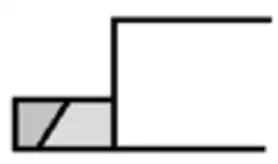
What type of operator is shown on the image below?
Spring operated
Pneumatic Operated
Push-Button Operated
Solenoid Valve Operated
This relay activates only when the preset number of rising edge signal is achieved.
Mini Relay
Counter Relay
Solid State Relay
Hybrid Relay
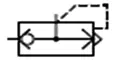
What type of component is shown on the image below?
Shuttle valve
Dual pressure valve
Quick exhaust valve
One-way flow control valve
It is system in which the mechanical function that operates through the force of liquid pressure.
Hydraulic System
Pneumatic system
Pneumatic system
Electro-Hydraulic System
It is a logic function used in different system that consists of at least two switching elements connected in series.
AND
OR
Pressure dependent
Stroke dependent
Which following below statement is incorrect:
A failed hydraulic hose is not dangerous compared to pneumatic systems
Hydraulic systems can become quite hot when working hard.
Hydraulic oil will burn when exposed to a flame.
Use caution an wear safety equipment around working hydraulic systems.
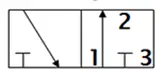
What type of a directional valve given on the image below with a number of ports and number switching position with a flow coming from port 1?
2/2-way valve, normally open position
3/2-way valve, normally closed position
3/2-way valve, normally open position
4/2-way valve, flow from 1-2 and from 4-3
This component of Programmable Logic Controller (PLC) that converts electrical distribution voltage, such as 230 VAC, 120 VAC or 125 VDC to signal level voltage used by the PLC processor and other modules.
Input/output Module
Power Supply Module
Redundant Module
CPU Module
This control system may trigger a series of mechanical actuators in the correct sequence to perform a task.
Closed loop control
PLC control
On / off control
Sequential control
The following component are examples of discrete outputs in PLC except:
Motor Starter
Push Button
LED light
Relays
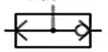
What type of component is shown on the image below?
Shuttle valve
Dual pressure valve
Quick exhaust valve
One-way flow control valve
It is a type of switch that is often used to switch mains electricity because it can isolate both the live and neutral connections.
Double Pole Single Throw Switches
Single Pole Double Throw Switches
Single Pole Double Throw Switches
Single Pole Single Throw Switches
It is a logic function used in different system that consists of at least two switching elements connected in parallel.
AND
OR
Pressure dependent
Stroke dependent
This device in which influence the path taken by an air stream predominantly start- stop direction of flow.
Non- return valves
Directional valves
Pressure control valves
Flow control valves
These are symbols drawn beside a component symbol of the directional valves to show how that component is controlled.
Operator
Communicator
Positioner
Power Supply

