
 Worksheets
AP Chem Unit 4 & 6 Quiziz Questions
Total questions: 53
Worksheet time: 53mins
Name
Class
Date
1.
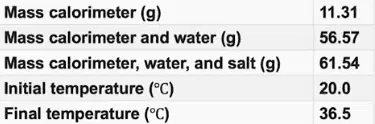
Calculate the molar heat of solution in J/mol.
a)
2076 J
b)
-2076 J
c)
3464 J
d)
-3464 J
2.
3 C2H2 (g) -> C6H6 (g). What is the standard change in H for the reaction represented. Delta H of C2H2 (g) is 230 kJ mol-1; Delta H of C6H6 (g) is 83 kJ mol
a)
-607 kJ
b)
-147 kJ
c)
-19 kJ
d)
19 kJ
3.
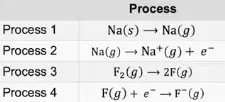
Which statement provides the best answer and justification for the energetics of these steps.
a)
Process 1 is endothermic because energy is releases when the attractions between sodium atoms are broken
b)
Process 2 is exothermic because sodium has a low electronegativity
c)
Process 3 is endothermic because energy is required to break the bond
d)
Process 4 is exothermic because fluorine has a high electronegativity
4.
Which of the following is/are true?
a)
Enthalpy change depends on the enthalpy of the products
b)
Enthalpy is a state function
c)
Enthalpy change depends on the enthalpy of the reactants
d)
All of the above
5.
When Urea, H2NCONH2, is dissolved in water a decrease in temperature is measured. Is the process exothermic or endothermic?
a)
Exothermic
b)
Endothermic
6.
True or false, ions that stay dissociated in water are included in the net ionic equations or the reaction?
a)
True
b)
False
7.
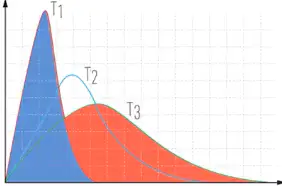
Which curve has the highest average kinetic energy?
a)
T1
b)
T2
c)
T3
8.
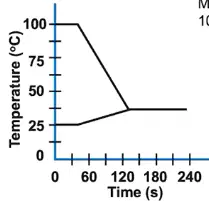
An experiment was designed to monitor the flow of heat from a hot piece of metal to water. What time is thermal equilibrium achieved?
a)
60 sec
b)
90 sec
c)
120 sec
d)
150 sec
9.
The net heat change in a chemical reaction is the same whether it is brought about in two or more different ways, in one or several steps. It is known as:
a)
Hess's law
b)
The law of conservation of energy
c)
Henry's law
d)
Joule's principle
10.
The limiting reagent in a chemical reaction is one that:
a)
has the largest molar mass (formula weight)
b)
is consumed completely
c)
has the smallest molar mass (formula weight)
d)
has the smallest coefficient
11.
To convert from mass of A to mass of B in a stoichiometry problem, the following steps are followed:
a)
Mass A --> Moles A --> Moles B --> Mass B
b)
Mass A --> Mass B
c)
Mass A --> Moles B --> Moles A --> Mass B
d)
Mass A --> Moles A --> Mass B
12.
C3H3(g) + 5O2(g) --> 3CO2(g) + 4H2O(g)
Assume if we combust 1.3 L of propane. How much CO2 will be produced?
a)
5.4 L
b)
4.5 L
c)
3.9 L
d)
2.7 L
13.
When the products of a reaction are at a different temperature than their surroundings, energy is exchanged to reach thermal equilibrium.
a)
True
b)
False
14.
What is the symbol for enthalpy?
a)
H
b)
S
c)
G
d)
E
15.
4 NH3 (g) + 3 O2 (g) -> 2 N2 (g) + 6 H2O(g). Is the standard molar heats of formation of ammonia, NH3(g), and gaseous water, H2O(g) are -46 kJ/mol and -242 kJ/mol, respectively, what is the value of delta H 298 for the reaction represented above.
a)
-190 kJ.mol rxn
b)
-290 kJ/mol rxn
c)
-580 kJ/mol rxn
d)
-1270 kJ/mol rxn
16.
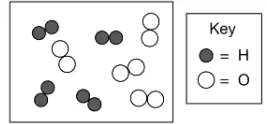
A mixture of H2 (g) and O2 (g) is placed in a container as represented above. The H2 (g) and O2 (g)react to form H2O(g).
Which of the following best represents the container after the reaction has gone to completion?
a)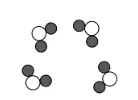
Option 1
b)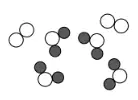
Option 2
c)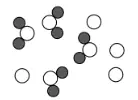
Option 3
d)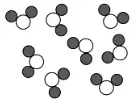
Option 4
17.
Potassium sorbate, KC6H7O2 (molar mass 150 g/mol) is commonly added to diet soft drinks as a preservative. A Stock Solution must be prepared. A student titrates 45.00 mL of stock solution with 1.25 M HCL (aq). A Total of 29.95 mL of 1.25 M (aq) is required to reach the equivalence point. Calculate [KC6H7O2] in the stock solution.
a)
0.832 M
b)
1.27 M
c)
0.783 M
d)
1.165 M
18.
A student dissolved a .139 g sample of acid, H2C2O4, in water in an Erlenmeyer flask.Then the student titrated the H2C2O4 solution in the flask with a solution of KMnO4. 26.20 mL of the KMnO4 was added, and it had a .0235 M, calculate the number of moles of MnO4- ions that completely reacted with the H2C2O4.
a)
5.23 x 10 -4 mol
b)
6.16 x 10⁻⁴ mol
c)
4.89 x 10 -5 mol
d)
8.34 x 10 -5 mol
19.
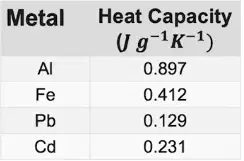
If equal masses were used, which metal can absorb the most heat before the temperature would increase by 1 degree C?
a)
Al
b)
Fe
c)
Pb
d)
Cd
20.
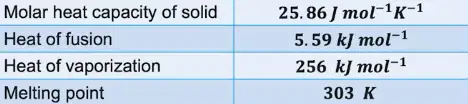
How much energy in kJ is required to melt 2 moles of gallium originally at 293 K?
a)
13.6 kJ
b)
16.4 kL
c)
11.2 kJ
d)
10.1 kJ
21.
Determine the amount of heat , in kJ involved when solidifying 12.0 moles of PET at its melting point. H fusion = 26.0 kJ mol -1.
a)
-312 kJ
b)
312 kJ
c)
-267 kJ
d)
267 kJ
22.
2H2(g)+O2(g)⟶2H2O(l)
You mix 4.0 g of H2 with 32.0 g of O2 and let them react to completion.
Which reactant is the limiting reactant, and which is the excess reactant?
a)
H2 is limiting. O2 is excess
b)
O2 is limiting. H2 is excess
c)
There is no excess reactant because they are in perfect proportion
d)
No reaction occurs
23.
45.0 grams of aluminum (Al) reacts with excess iron(III) oxide (Fe2O3).
2Al(s)+Fe2O3(s)→Al2O3(s)+2Fe(s) ΔH =−851.5 kJ/mol
How much heat (q) is released?
a)
-710 kJ
b)
-1420 kJ
c)
-256 kJ
d)
-511 kJ
24.
Which of these has a ΔH < 0.
a)
Melting ice
b)
Evaporation of ethanol
c)
Condensation of steam
d)
Boiling water at 100 °C
25.
Which is not a type of chemical change?
a)
Dissolving
b)
Rotting
c)
Digestion
d)
Titration
e)
Combustion
26.
In Chemical reaction and physical reaction, mass is conserved
a)
True
b)
False
27.
The oxidation number of Hydrogen is ___ with non metal, and ___with metal
a)
+1,+1
b)
+1, -1
c)
-1, -1
d)
+1, +1
28.
Find the oxidation number of Cu in the following equation respectively: Cu2O(aq) + H2SO4(aq) -->Cu(s) + CuSO4(aq) +H2O(l)
a)
0, 0, 10
b)
-2, 0, -4
c)
-1, 0, -2
d)
+1, 0, +2
e)
+2, 0, +4
29.
Which of the following are chemical reactions:
I. A wood plank burning
II. Someone chewing food
III. Baking Bread
a)
I and III
b)
I
c)
II
d)
III
e)
I, II, and III
30.
Find the net ionic equation of the precipitation reaction of silver chloride
a)
AgNO3(aq) + KCl(aq) -->AgCl(s) + KNO3(aq)
b)
Ag+ + NO3- + K+ Cl- --> AgCl +K+ NO3-
c)
Ag+ + Cl- --> AgCl
d)
Ag+(aq) + Cl-(aq) --> AgCl(s)
31.
Metal will ONLY be oxidized by metal _____ them in activity series
a)
Beneath
b)
Above
c)
Right
d)
Left
32.
Which one in the list is not insoluble: NH4, K, Rb, NO3-
a)
K only
b)
NH4 and K
c)
NH4, K, Rb
d)
NH4, K, Rb, NO3-
e)
None of the above
33.
A 1.53g piece of ice is in a freezer and initially at temperature o f-15.1C. The ice is removed from the freezer and melts completely after reaching a temperature of 0.0C. If the specific heat of ice is 2.03J/gC and its molar heat of fusion is 6.01kJ/mol, how much heat is required for the entire process to occur?(Hint: ice=solid H2O)
a)
46.9J
b)
510J
c)
557J
d)
543J
e)
463J
34.

Use the heating curve given. What is happening at the plateau section of the graph? Choose all true answer.
a)
Heat is being used to break intermolecular bonds
b)
Heat is being used to temperature
c)
There is increase in kinetic energy
d)
There is increase in potential energy
35.
Which of the following are indicators of a chemical reaction?
a)
Color change
b)
A gas is produced
c)
Ice melts
d)
Glass shatters
e)
Mixing salt in water
36.
Physical changes are reactions
a)
True
b)
False
37.
Which of the following salts will dissolve in water to form an alkaline solution?
a)
H2CO3
b)
K2CO3
c)
NaCl
d)
K2SO4
38.
Zn(s) + 2HCl(aq) → ZnCl2(aq) + H2 (g)
When the reaction represented above proceeds, heat is produced. Which of the following best describes the reaction?
a)
It is a combustion reaction because heat is produced by the reaction.
b)
It is a double replacement reaction because 2Cl atoms are added to Zn.
c)
It is an acid-base reaction because HCl is an acid that is capable of exchanging
d)
It is an oxidation-reduction reaction because zinc is oxidized and hydrogen is reduced.
39.
Which of the following reactions will have precipitation?
a)
NaCl(aq) + Mg(NO3)
b)
2AgNO3(aq) + BaCl2(aq)
c)
LiNO3(aq) + AgCl(aq)
d)
CuCl2(aq) + K2CO3(aq)
e)
K2SO4(aq) + Ca(NO3)2
40.
Mg + Br2 → MgBr2
How does the oxidation number of Mg change?
a)
0 → 2+
b)
0→2-
c)
0→1-
d)
0→1+
41.
What is an Arrehinius acid?
a)
A proton donor
b)
A producer of H+
c)
A producer of OH-
d)
NH3
42.
What is the Conjugate Base/acid of CH3COOH and NaOH (in that order)
a)
CH3COO-, H2O
b)
CH3COOH, NaOH
c)
CH3CO+, OH-
d)
CH3COO-, Na+
43.
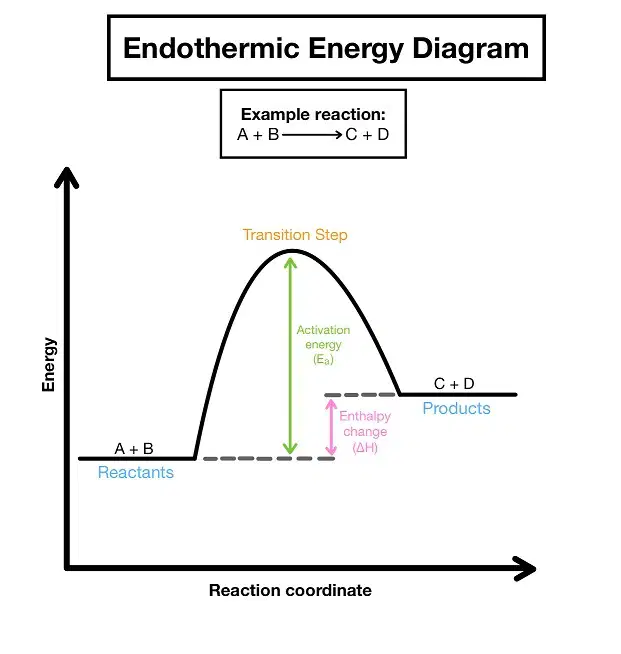
This reaction loses energy
a)
True
b)
False
44.
Oxidation is when atom ___ their electron, and reduction is when atom ___ their electron. A oxidized atom is called ____, and a reduced atom is called _____.
a)
loses, gains, cation, anion
b)
loses, gains, anion, cation
c)
gains, loses, cation, anion
d)
gains, loses, anion, cation
45.

This graph is exothermic
a)
True
b)
False
46.
Some average bond enthalpies, in kJ/mol, are as follows:
H-H = 436
Cl-Cl = 242
H-Cl = 431
What is the enthalpy change for the decomposition of hydrogen chloride?
2 HCl --> H2 + Cl2
a)
+184 kJ
b)
-184 kJ
c)
-247 kJ
d)
+247 kJ
47.
A compound consists only of Carbon, Hydrogen, and Oxygen. 8.272g of CO2 and 4.515g of H2O are produced during the complete combustion of 3.765g of the compound.
What is the empirical formula of the compound?
a)
C2H6O
b)
C2H4O2
c)
C3H6O
d)
C3H8O
48.
The enthalpy change for the reaction between hydrochloric acid and sodium hydroxide is −56 kJ/mol. Therefore ...
a)
the reaction is exothermic and the temperature rises
b)
the reaction is exothermic and the temperature falls
c)
the reaction is endothermic and the temperature rises
d)
the reaction is endothermic and the temperature falls
49.
2H2+O2 --> 2H2O
If 3.00 moles of O2 react completely, how many moles of H2O are produced?
a)
1.50 moles
b)
3.00 moles
c)
6.00 moles
d)
9.00 moles
50.
Balance this equation:
__ C3H8 + __ O2 --> __ CO2 + __ H2O
a)
1,4,3,4
b)
1,6,3,4
c)
1,5,3,4
d)
2,5,3,4
51.
Which of the following particulate diagrams best shows the formation of water vapor from hydrogen gas and oxygen in a rigid container at 125 C degrees.
a)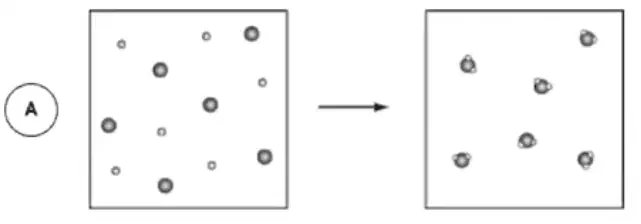
Option 1
b)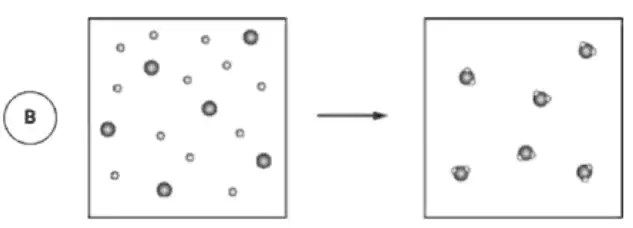
Option 2
c)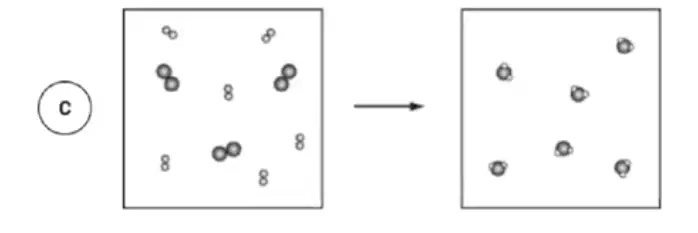
Option 3
d)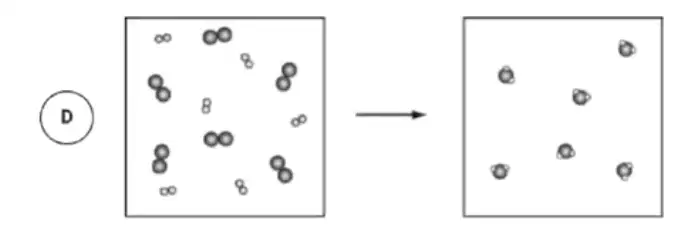
Option 4
52.
Enthalpy change for evaporation is + thus...
a)
the reaction is endothermic and there is intermolecular bond breaking
b)
the reaction is exothermic and there is intermolecular bond forming
c)
the reaction is exothermic and there is intermolecular bond breaking
d)
the reaction is endothermic and there is intermolecular bond forming
53.
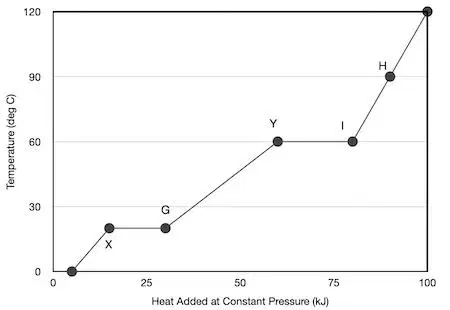
Which section of the heating curve does gas speed increase?
a)
Between X and G
b)
Between G and Y
c)
Between Y and I
d)
Between I and H
100 %

