
Font size
 Worksheets
MAC 6-10
Total questions: 89
Worksheet time: 45mins
In an economy that relies upon barter:
Trade does not require a double coincidence of wants
Scarce resources are allocated as easily as in non-barter economies
There is no item widely accepted in exchange for goods and services
All of the above are correct
Economists use the word "money" to refer to:
Income from goods and services
Assets regularly used to buy goods and services
A person's total assets
Value of stocks and bonds
Which type of money has intrinsic value?
Commodity money
Fiat money
Both
Neither
The Federal Reserve does NOT:
Control the money supply
Act as a lender of last resort
Make loans to large business firms
Ensure the health of the banking system
Which of the following does the Fed NOT do?
Conduct monetary policy
Act as lender of last resort
Convert Federal Reserve Notes into gold
Serve as a bank regulator
There is a:
Short-run tradeoff between inflation and unemployment
Short-run tradeoff between money supply and inflation
Long-run tradeoff between inflation and unemployment
Long-run tradeoff between money supply and inflation
Suppose that banks desire to hold no excess reserves, the reserve requirement is 5 percent, and a bank receives a new deposit of $1,000. This bank
will increase its required reserves by $50.
will initially see its total reserves increase by $1,000.
will be able to make a new loan of $950.
All of the above are correct
Suppose that banks desire to hold no excess reserves. With 15% reserve requirement and a $10 deposit then this bank
Must hold $10 in reserves
Sees reserves rise by $15
Will be able to make loan up to a maximun $8.50
All of the above
With a 10% reserve ratio, a $400 deposit yields:
$400 excess reserves
$400 required reserves
$360 excess, $40 required
$40 excess, $360 required
If reserve ratio is 12.5%, the money multiplier is:
6.25
8
12.5
25

.Refer to Scenario 29-2. Suppose that the Bank of Tazi changes the reserve requirement ratio to 3 percent. Assuming that the banks still want to hold the same percentage of excess reserves what is the value of the money supply after the change in the reserve requirement ratio?
9,375 million Tazes
10,000 million Tazes
12,500 million Tazes
None of the above is correct to the nearest million salidos.
Which of the following lists two things that both decrease the money supply?
make open market purchases, raise the reserve requirement
make open market purchases, lower the reserve requirement
make open market sales, raise the reserve requirement
make open market sales, lower the reserve requirement
Which of the following lists two things that both decrease the money supply?
lower the discount rate, raise the reserve requirement
lower the discount rate, lower the reserve requirement
raise the discount rate, raise the reserve requirement
raise the discount rate, lower the reserve requirement
Suppose banks decide to hold more excess reserves relative to deposits. Other things the same, this action will cause the
money supply to fall. To reduce the impact of this the Fed could lower the discount rate.
money supply to fall. To reduce the impact of this the Fed could raise the discount rate.
money supply to rise. To reduce the impact of this the Fed could lower the discount rate.
money supply to rise. To reduce the impact of this the Fed could raise the discount rate.
When the Fed conducts open-market sales,
it sells Treasury securities, which increases the money supply.
it sells Treasury securities, which decreases the money supply.
it borrows from member banks, which increases the money supply.
it lends money to member banks, which decreases the money supply.
The Fed's primary tool to change the money supply is
changing the discount rate.
changing the reserve requirement.
conducting open market operations.
redeeming Federal Reserve notes.
If the price level increased from 120 to 150, then what was the inflation rate?
30 percent
25 percent
20 percent
None of the above is correct.
If velocity = 5, the price level = 1.5, and the real value of output is 2,500, then the quantity of money is
333.33
750.00
1,050.00
8,333.33
When the money market is drawn with the value of money on the vertical axis, an increase in the money supply
increases the price level and increases the value of money.
increases the price level and decreases the value of money.
decreases the price level and increases the value of money.
decreases the price level and decreases the value of money.
Suppose the price level rises, but the number of dollars you are paid per hour stays the same. This means that your
nominal wage is higher.
nominal wage is lower.
real wage is higher.
real wage is lower.
The classical dichotomy refers to the idea that the supply of money
is irrelevant for understanding the determinants of nominal and real variables.
determines nominal variables, but not real variables.
determines real variables, but not nominal variables.
According to the classical dichotomy, which of the following increases when the money supply increases?
the real interest rate
real GDP
the real wage
None of the above increases.
According to the classical dichotomy, when the money supply doubles, which of the following doubles?
the price level and nominal GDP
the price level and real GDP
only real GDP
only the price level
The principle of monetary neutrality implies that an increase in the money supply will
increase real GDP and the price level.
increase real GDP, but not the price level.
increase the price level, but not real GDP.
increase neither the price level nor real GDP.
Based on the quantity equation, if M = 150, V = 4, and Y = 200, then P =
1/3
1/2
2
3
According to the assumptions of the quantity theory of money, if the money supply increases by 5 percent, then
nominal and real GDP would rise by 5 percent.
nominal GDP would rise by 5 percent; real GDP would be unchanged.
nominal GDP would be unchanged; real GDP would rise by 5 percent.
neither nominal GDP nor real GDP would change.
Suppose the money supply tripled, but at the same time velocity fell by half and real GDP was unchanged. According to the quantity equation, the price level
is 1.5 times its old value.
is 3 times its old value.
is 6 times its old value.
is the same as its old value.
The claim that increases in the growth rate of the money supply increase nominal interest rates but not real interest rates is known as the
Friedman Effect.
Hume Effect.
Fisher Effect.
None of the above is correct.
Shawn puts money into an account. One year later he sees that he has 5 percent more dollars and that his money will buy 6 percent more goods.
The nominal interest rate was 11 percent and the inflation rate was 5 percent.
The nominal interest rate was 6 percent and the inflation rate was 5 percent.
The nominal interest rate was 5 percent and the inflation rate was -1 percent.
None of the above is correct.
Banks advertise
the real interest rate, which is how fast the dollar value of savings grows.
the real interest rate, which is how fast the purchasing power of savings grows.
the nominal interest rate, which is how fast the dollar value of savings grows.
the nominal interest rate, which is how fast the purchasing power of savings grows.
Higher inflation makes relative prices
more variable, making it more likely that resources will be allocated to their best use.
more variable, making it less likely that resources will be allocated to their best use.
less variable, making it more likely that resources will be allocated to their best use.
less variable, making it less likely that resources will be allocated to their best use.
In the U.S., taxes on capital gains are computed using
nominal gains. This is one way by which higher inflation discourages saving.
nominal gains. This is one way by which higher inflation encourages saving.
real gains. This is one way by which higher inflation discourages saving.
real gains. This is one way by which higher inflation encourages saving.
Given a nominal interest rate of 6 percent, in which of the following cases would you earn the lowest after-tax real rate of interest?
Inflation is 4 percent; the tax rate is 5 percent.
Inflation is 3 percent; the tax rate is 20 percent.
Inflation is 2 percent; the tax rate is 30 percent.
The after-tax real interest rate is the same for all of the above.
You put money into an account that earns a 5 percent nominal interest rate. The inflation rate is 3 percent, and your marginal tax rate is 20 percent. What is your after-tax real rate of interest?
3.4 percent
1.6 percent
1.0 percent
None of the above is correct.
Suppose one year ago the price index was 120 and Mark purchased $20,000 worth of bonds. One year later the price index is 126. Mark redeems his bonds for $22,250 and is in a 40 percent tax bracket. What is Mark's real after-tax rate of interest to the nearest tenth of a percent?
4.3 percent
3.1 percent
1.8 percent
1.2 percent
High and unexpected inflation entails a greater cost
for those who borrow than for those who save.
for those who hold a little money than for those who hold a lot of money.
for those whose wages increase by as much as inflation, than for those who are paid a fixed nominal wage.
for savers in high income tax brackets than for savers in low income tax brackets.
Which of the following is correct?
Economic fluctuations are easily predicted by competent economists.
Recessions have never occurred very close together.
Other measures of spending, income, and production do not fluctuate closely with real GDP.
None of the above is correct.
The aggregate-demand curve shows the
quantity of labor and other inputs that firms want to buy at each price level.
quantity of labor and other inputs that firms want to buy at each inflation rate.
quantity of domestically produced goods and services that households want to buy at each price level.
quantity of domestically produced goods and services that households, firms, the government, and customers abroad want to buy at each price level.
Aggregate demand includes
the quantity of goods and services both the government and customers abroad want to buy.
the quantity of goods and services neither the government nor customers abroad want to buy.
the quantity of goods and services the government wants to buy, but not the quantity of goods and services customers abroad want to buy.
the quantity of goods and services customers abroad want to buy, but not the quantity of goods and services the government wants to buy.
When the price level falls the quantity of
consumption goods demanded rises, while the quantity of net exports demanded falls.
consumption goods demanded and the quantity of net exports demanded both rise.
consumption goods demanded and the quantity of net exports demanded both fall.
consumption goods demanded falls, while the quantity of net exports demand rises.
Other things the same, a decrease in the price level makes consumers feel
less wealthy, so the quantity of goods and services demanded falls.
less wealthy, so the quantity of goods and services demanded rises.
more wealthy, so the quantity of goods and services demanded rises.
more wealthy, so the quantity of goods and services demanded falls.
Part of the explanation for why the aggregate-demand curve slopes downward is that a decrease in the price level
decreases the real value of money.
increases the real value of the dollar in foreign exchange markets.
decreases the interest rate.
All of the above are correct.
When taxes increase, consumption
increases, so aggregate demand shifts right.
increases, so aggregate supply shifts right.
decreases, so aggregate demand shifts left.
decreases, so aggregate supply shifts left.
Which of the following both shift aggregate demand left?
a decrease in taxes and at a given price level consumers feel more wealthy
a decrease in taxes and at a given price level consumers feel less wealthy
an increase in taxes and at a given price level consumers feel more wealthy
an increase in taxes and at a given price level consumers feel less wealthy
The initial impact of the repeal of an investment tax credit is to shift
aggregate demand right.
aggregate demand left.
aggregate supply right.
aggregate supply left.
The misperceptions theory of the short-run aggregate supply curve says that the quantity of output supplied will increase if the price level
increases by less than expected so that firms believe the relative price of their output has increased.
increases by less than expected so that firms believe the relative price of their output has decreased.
increases by more than expected so that firms believe the relative price of their output has increased.
increases by more than expected so that firms believe the relative price of their output has decreased.
Other things the same, the aggregate quantity of output supplied will decrease if the price level
is lower than expected so that firms believe the relative price of their output has increased.
is lower than expected so that firms believe the relative price of their output has decreased.
is higher than expected so that firms believe the relative price of their output has increased.
is higher than expected so that firms believe the relative price of their output has decreased.
When the actual change in the price level differs from its expected change, which of the following can explain why firms might change their production?
both menu costs and mistaking a price level change for a change in relative prices
menu costs but not mistaking a price level change for a change in relative prices
mistaking a price level change for a change in relative price but not menu costs
neither menu costs nor mistaking a price level change for a change in relative prices
Which of the following would cause stagflation?
rising government expenditures
rising oil prices
a falling money supply
technical progress
Which of the following would cause prices to rise and real GDP to fall in the short run?
an increase in the expected price level
an increase in the capital stock
an increase in the quantity of labor available
All of the above are correct.
Suppose the economy is in long-run equilibrium. Senator A succeeds in getting taxes raised. At the same time, Senator B succeeds in getting major new restrictions on logging enacted. In the short run
real GDP will rise and the price level might rise, fall, or stay the same.
real GDP will fall and the price level might rise, fall, or stay the same.
the price level will rise, and real GDP might rise, fall, or stay the same.
the price level will fall, and real GDP might rise, fall, or stay the same.
According to classical macroeconomic theory,
the price level is sticky in the short run and it plays only a minor role in the short-run adjustment process.
for any given level of output, the interest rate adjusts to balance the supply of, and demand for, money.
output is determined by the supplies of capital and labor and the available production technology.
All of the above are correct.
Which of the following would not be an expected response from a decrease in the price level and so help to explain the slope of the aggregate-demand curve?
When interest rates fall, Sleepwell Hotels decides to build some new hotels.
The exchange rate falls, so French restaurants in Paris buy more Iowa pork.
Janet feels wealthier because of the price-level decrease and so she decides to remodel her bathroom.
With prices down and wages fixed by contract, Millio's Frozen Pizzas decides to lay off workers.
When the Fed buys government bonds, the reserves of the banking system
increase, so the money supply increases.
increase, so the money supply decreases.
decrease, so the money supply increases.
decrease, so the money supply decreases.
What does Y represent on the horizontal axis of the right-hand graph?
the quantity of money
the rate of inflation
real output
nominal output
Changes in the interest rate bring the money market into equilibrium according to
both liquidity preference theory and classical theory.
neither liquidity preference theory nor classical theory.
liquidity preference theory, but not classical theory.
classical theory, but not liquidity preference theory.
The short-run effects on the interest rate are
shown equally well using either liquidity preference theory or classical theory.
best shown using classical theory.
best shown using liquidity preference theory.
not shown well by either liquidity preference theory or classical theory.
People will want to hold more money if the price level
or if the interest rate increases.
or if the interest rate decreases.
increases or if the interest rate decreases.
decreases or if the interest rate increases.
Which of the following shifts aggregate demand to the right?
an increase in the price level
an increase in the money supply
a decrease in the price level
a decrease in the money supply
If the MPC = 3/5, then the government purchases multiplier is
5/3
5/2
5
15

What is the multiplier for this economy?
2.86
2.98
4.00
5.00

What is measured along the vertical axis of the graph?
the quantity of output
the amount of crowding out
the interest rate
the price level
Assume the MPC is 0.75. Assuming only the multiplier effect matters, a decrease in government purchases of $100 billion will shift the aggregate demand curve to the
left by $200 billion.
left by $400 billion.
right by $800 billion.
None of the above is correct.
When there is an increase in government expenditures, which of the following raises investment spending?
the investment accelerator and crowding out
the investment accelerator but not crowding out
crowding out but not the investment accelerator
neither the investment accelerator or crowding out
If a $1,000 increase in income leads to a $750 increase in consumption expenditures, then the marginal propensity to consume is
0.75 and the multiplier is 1 1/3
0.75 and the multiplier is 4
0.25 and the multiplier is 1 1/3
0.25 and the multiplier is 4
As income rises
money demand rises, so the interest rate rises.
money demand rises, so the interest rate falls
money demand falls, so the interest rate rises.
money demand falls, so the interest rate falls.
Critics of stabilization policy argue that
there is a lag between the time policy is passed and the time policy has an impact on the economy.
the impact of policy may last longer than the problem it was designed to offset.
policy can be a source of, instead of a cure for, economic fluctuations.
All of the above are correct.
During recessions, automatic stabilizers tend to make the government's budget
move toward deficit.
move toward surplus.
move toward balance.
not necessarily move the budget in any particular direction.
In the short run,
the price level alone adjusts to balance the supply and demand for money.
output responds to changes in the aggregate demand for goods and services.
changes in the money supply cause a proportional change in the price level.
increases in the money supply shift the aggregate supply curve causing output to rise.
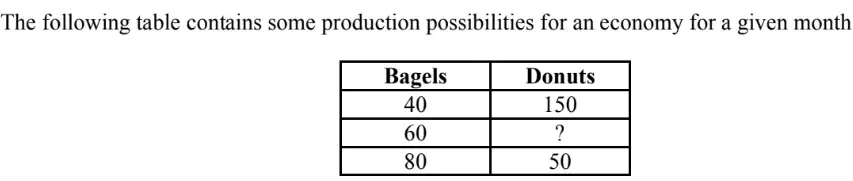
If the production possibilities frontier is a straight line, then "?" must be
50
75
100
125
Suppose Jim and Tom can both produce two goods: baseball bats and hockey sticks. Which of the following is not possible?
Jim has an absolute advantage in the production of baseball bats and in the production of hockey sticks.
Jim has an absolute advantage in the production of baseball bats and a comparative advantage in the production of hockey sticks.
Jim has an absolute advantage in the production of hockey sticks and a comparative advantage in the production of baseball bats.
Jim has a comparative advantage in the production of baseball bats and in the production of hockey sticks.
For two individuals who engage in the same two productive activities, it is impossible for one of the two individuals to
have a comparative advantage in both activities.
have an absolute advantage in both activities.
be more productive per unit of time in both activities.
gain from trade with each other.
The principle of comparative advantage does not provide answers to certain questions. One of those questions is
Do specialization and trade benefit more than one party to a trade?
Is it absolute advantage or comparative advantage that really matters?
How are the gains from trade shared among the parties to a trade?
Is it possible for specialization and trade to increase total output of traded goods?
Total output in an economy increases when each person specializes because
there is less competition for the same resources.
each person spends more time producing that product in which he or she has a comparative advantage.
a wider variety of products will be produced within each country due to specialization.
government necessarily plays a larger role in the economy due to specialization.
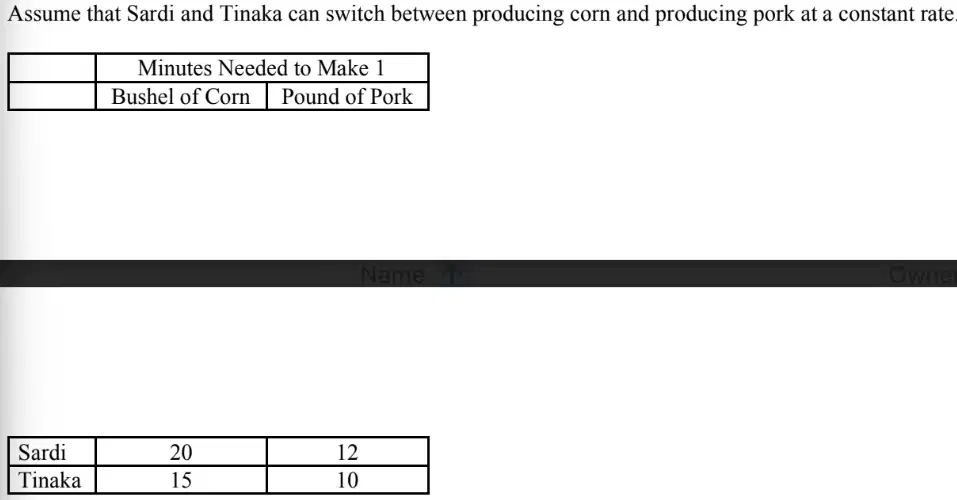
Refer to Table 3-1. Assume that Sardi and Tinaka each has 360 minutes available. If each person divides his time equally between the production of corn and pork, then total production is
10.5 bushels of corn and 16.5 pounds of pork
21 bushels of corn and 33 pounds of pork
35 bushels of corn and 22 pounds of pork
42 bushels of corn and 66 pounds of pork
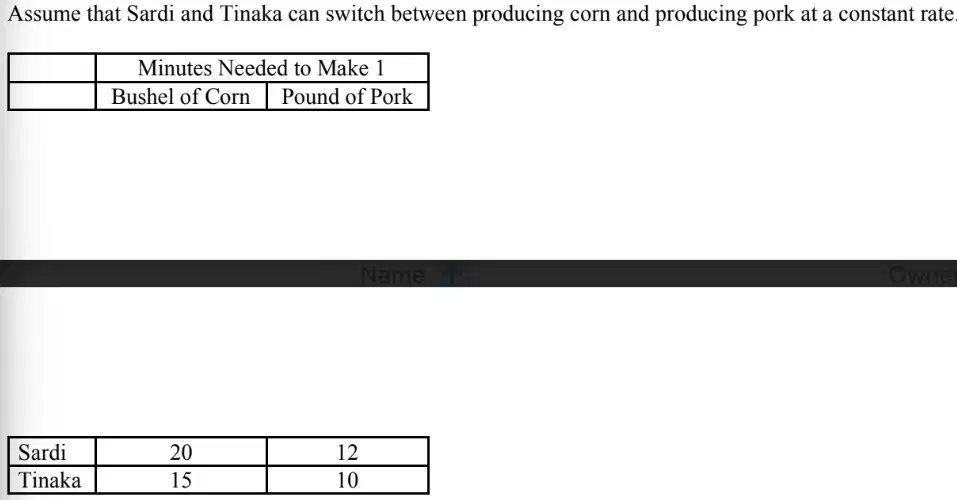
Refer to Table 3-1. At which of the following prices would both Sardi and Tinaka gain from trade with each other?
6 bushels of corn for 10.5 pounds of pork
12 bushels of corn for 19 pounds of pork
24 bushels of corn for 34 pounds of pork
Sardi and Tinaka could not both gain from trade with each other at any price.
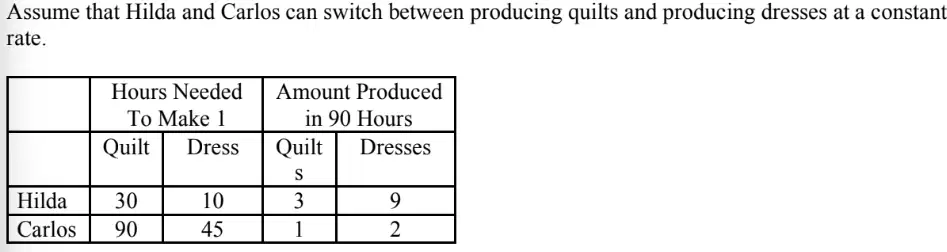
Hilda has an absolute advantage in the production of
both goods and a comparative advantage in the production of quilts.
both goods and a comparative advantage in the production of dresses.
neither good and a comparative advantage in the production of quilts.
neither good and a comparative advantage in the production of dresses.
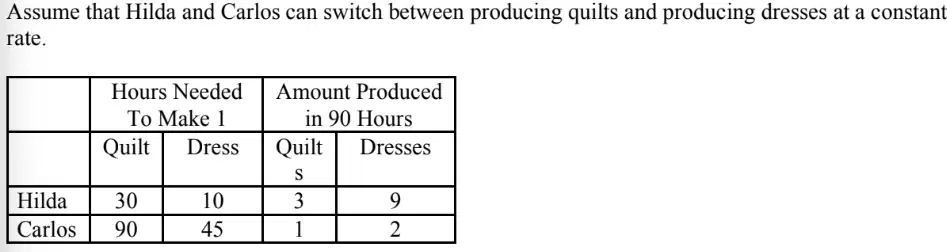
Carlos has an absolute advantage in the production of
both goods and a comparative advantage in the production of quilts.
both goods and a comparative advantage in the production of dresses.
neither good and a comparative advantage in the production of quilts.
neither good and a comparative advantage in the production of dresses.
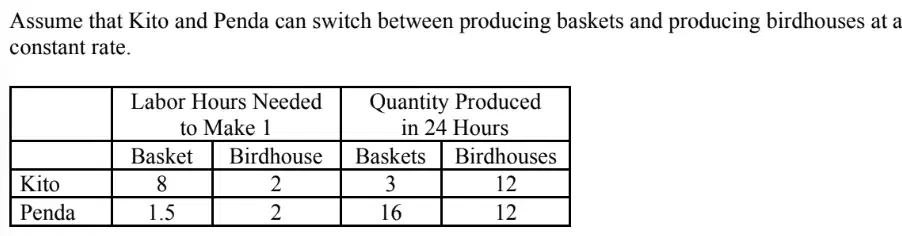
Refer to Table 3-8. Assume that Kito and Penda each has 24 labor hours available. If each person divides their time equally between the production of baskets and birdhouses, then total production is
4.75 baskets and 2 birdhouses
9.5 baskets and 12 birdhouses
16 baskets and 12 birdhouses
19 baskets and 24 birdhouses
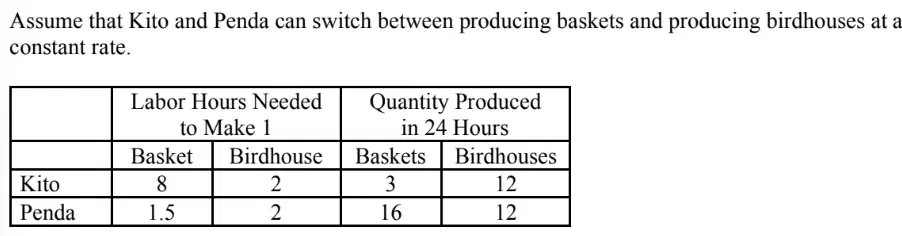
Refer to Table 3-8. As a result of specialization, the total output of baskets increased by
6.5
8
9.5
16
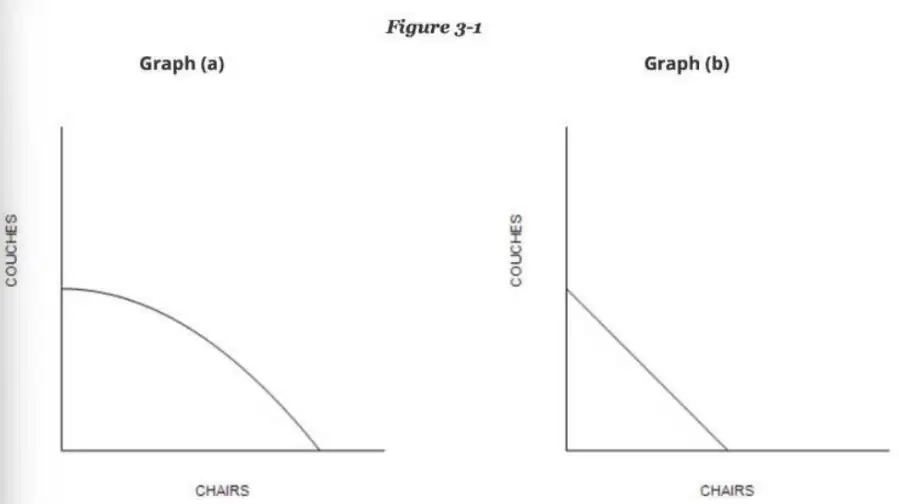
Refer to Figure 3-1. The rate of tradeoff between producing chairs and producing couches is constant in
Panel (a).
Panel (b).
both Panel (a) and Panel (b).
neither Panel (a) nor Panel (b).
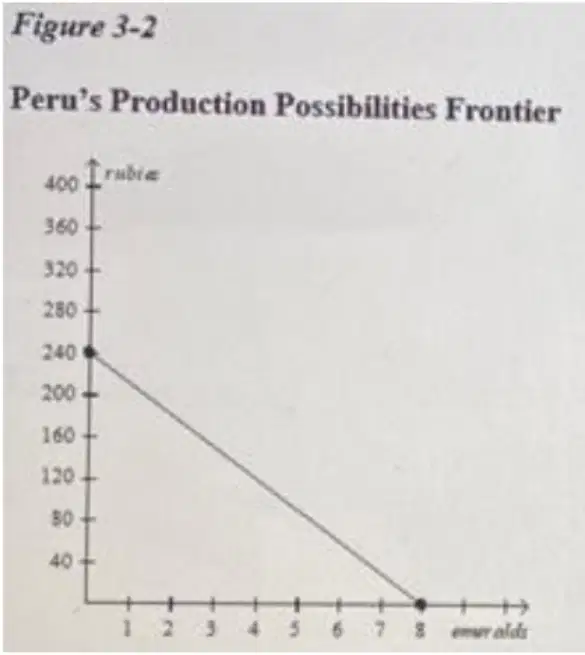
Refer to Figure 3-2. The fact that the line slopes downward reflects the fact that
for Peru, it is more costly to produce emeralds than it is to produce rubies.
Peru will produce more emeralds and fewer rubies as time goes by.
Peru faces a tradeoff between producing emeralds and producing rubies.
Peru should specialize in producing rubies.
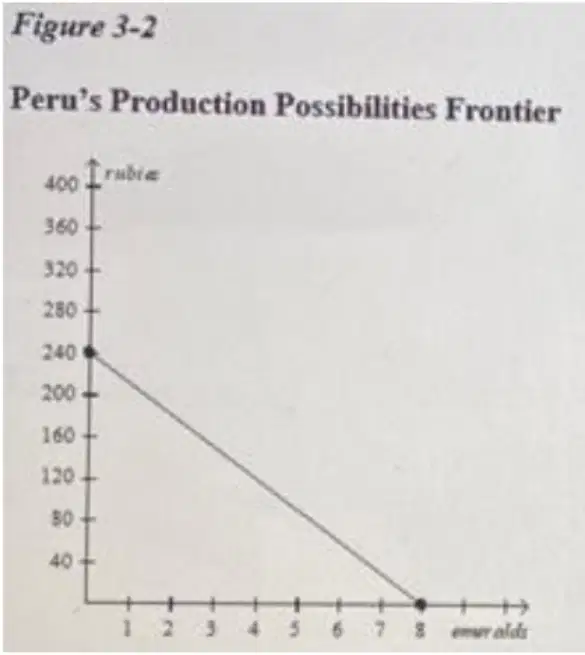
Refer to Figure 3-2. If the production possibilities frontier shown is for 40 hours of production, then how long does it take Peru to make one emerald?
1/6 hour
1/5 hour
5 hours
6 hours
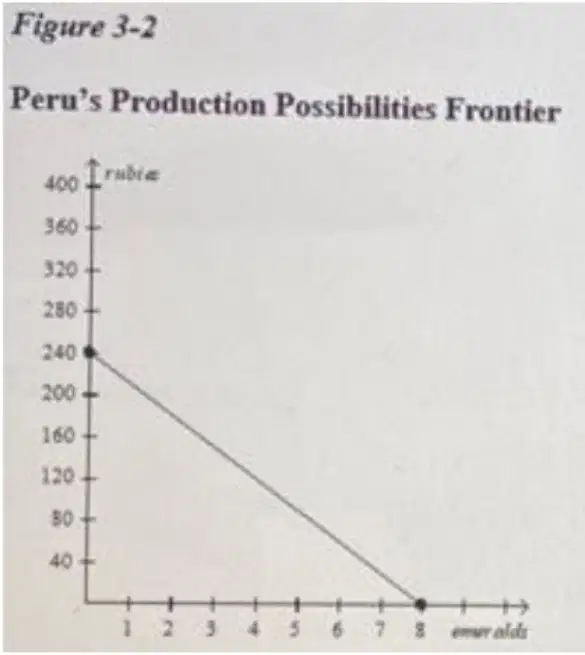
Refer to Figure 3-2. Suppose Peru decides to increase its production of rubies by 30. What is the opportunity cost of this decision?
1/8 emerald
1/3 emerald
1 emerald
3 emeralds
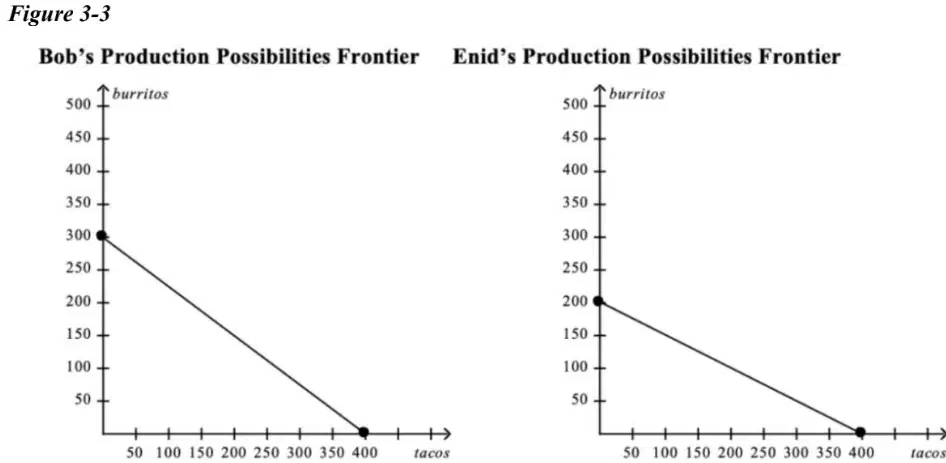
Refer to Figure 3-3. If the production possibilities frontiers shown are each for one day of production, then which of the following combinations of tacos and burritos could Bob and Enid together not produce in a given day?
200 tacos and 400 burritos
300 tacos and 350 burritos
400 tacos and 300 burritos
600 tacos and 250 burritos
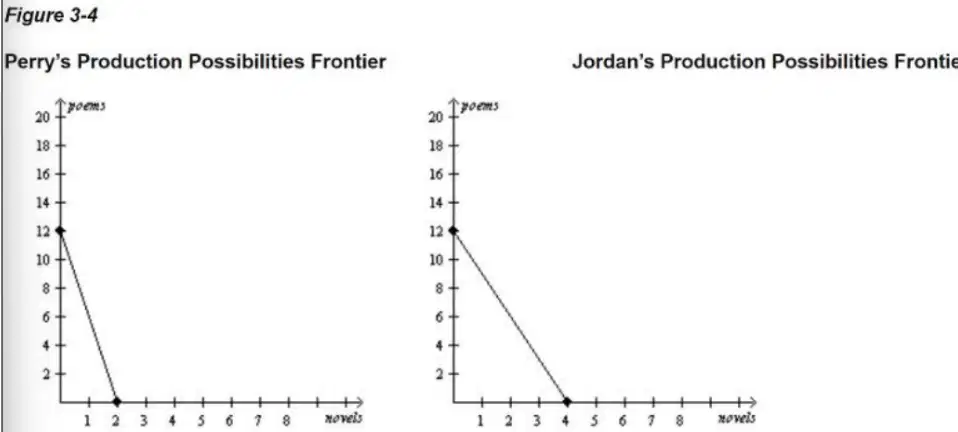
Refer to Figure 3-4. If Perry and Jordan both spend all of their time writing poems, then total production is
3 poems
6 poems
12 poems
24 poems
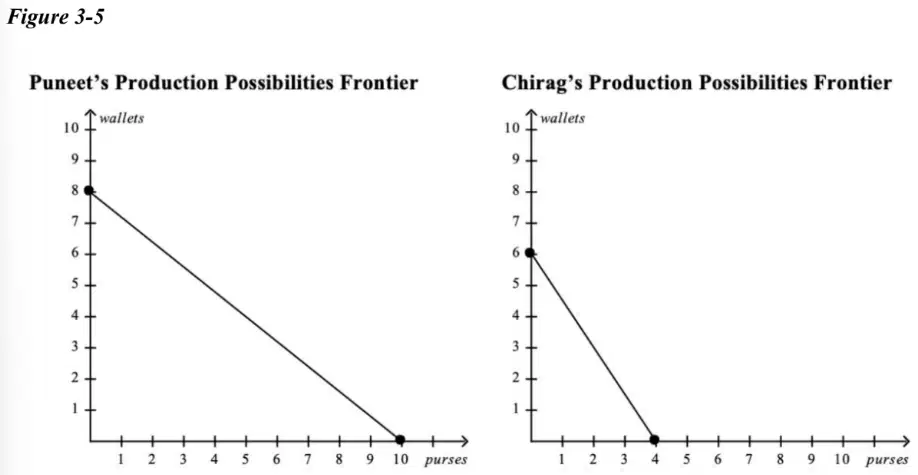
Refer to Figure 3-5. If the production possibilities frontier shown for Chirag is for 8 hours of work, then how long does it take Chirag to make one purse?
1/2 hour
2 hours
4 hours
8 hours
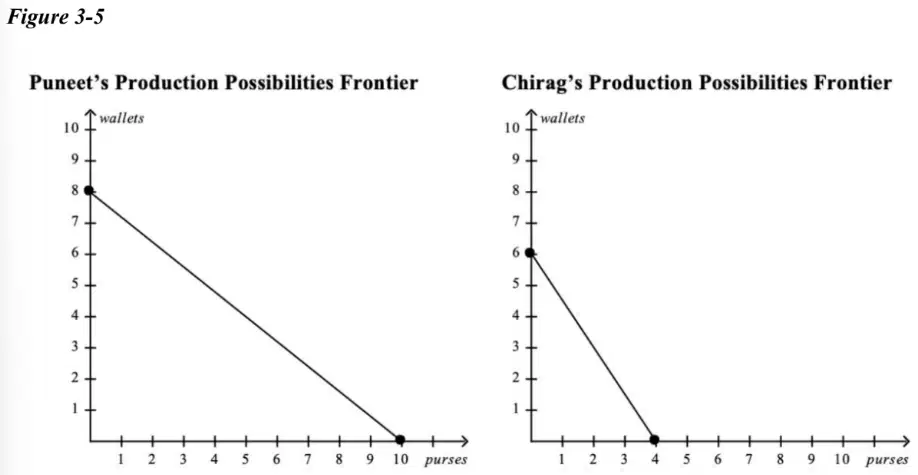
Refer to Figure 3-5. Puneet has a comparative advantage in the production of
purses and Chirag has a comparative advantage in the production of wallets.
wallets and Chirag has a comparative advantage in the production of purses.
both goods and Chirag has a comparative advantage in the production of neither good.
neither good and Chirag has a comparative advantage in the production of both goods.
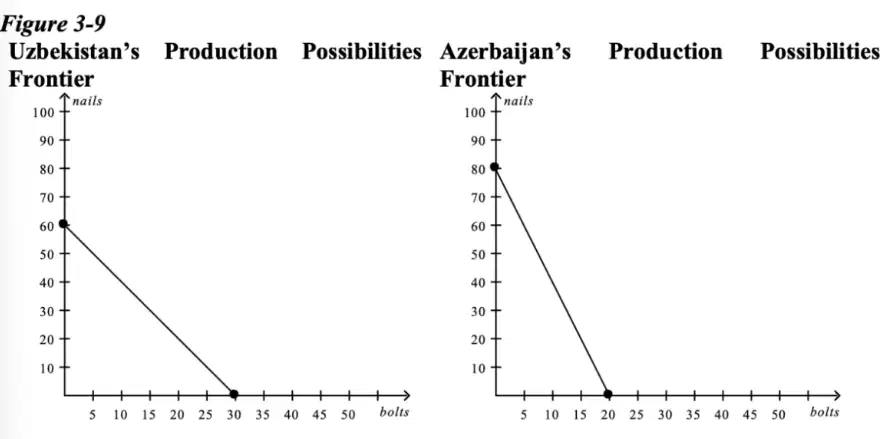
Refer to Figure 3-9. Suppose Uzbekistan decides to increase its production of bolts by 10. What is the opportunity cost of this decision?
1/2 nail
2 nails
5 nails
20 nails

