
 Worksheets
Optics
Total questions: 120
Worksheet time: 3hrs 21mins
What type of lens is wider in the middle than on the edges?
Concave
Convex
Objective
Ocular
When light passes through a convex lens, it does this.....
Diverge, or spread apart
Converge, or come together
Reflect, or bounce off
Create a rainbow
The point at which light rays converge after passing through a convex lens is called what.
The Horizon Point
The Point Break
The Focal Point
The Perspective
When light waves move from passing through air to passing through a glass lens when happens to them?
They slow down and change direction
They speed up and change direction
They maintain the same speed and change direction
They maintain their same speed and direction
What type of lens do you have in your eye?
Concave
Prismatic
Objective
Convex
The angle of the incoming rays of light are also called the.....
Angle of reflection
Angle of refraction
Angle of incidence
Wave angle
The distance between a convex lens and its focal point is called what?
The focus
The focal length
The wave length
The amplitude
The thicker the convex lens, the ___________________ its focal length.
Shorter
Longer
Thicker
Thinner
The thicker the convex lens, the ___________________ its focal length.
Shorter
Longer
Thicker
Thinner
As light passes from air into water it ________________________.
speeds up
continues at the same speed
slows down
forms a mirage

Which lens is concave?
a
b

Which lens can produce a real image?
a
b

Which lens always produces an image that is upright?
a
b

Which lens is the type of lens that is used in a hand lens?
a
b
The best definition of refraction is ____.
passing through a boundary
bouncing off a boundary
changing speed at a boundary
changing direction when crossing a boundary

We combine two lenses, one is convex and other is concave having focal lengths /, and f2 and their combined focal length is F. Combination of the lenses will behave like concave lens, if
f1 > f2
f1 = f2
f1 < f2.
f1 ≤ f2
A convex lens and a concave lens, each having the same focal length of 25 cm, are put in contact to form a combination of lenses. The power of the combination (in dioptres) is
zero
25
50
infinity
Which of the following statements is true ?
A convex lens has 4 dioptre power having a focal length 0.25 m
A convex lens has -4 dioptre power having a focal length 0.25 m
A concave lens has 4 dioptre power having a focal length 0.25 m
A concave lens has -4 dioptre power having a focal length 0.25 m.
A convex and a concave lens of equal focal length behaves as a regular glass slab receiving light normally.
True
False
A convex lens of refractive index 3/2 has a power of 2.5 D in air. If it is placed in a liquid of refractive index 2 then the new power of the lens is
– 1.25 D
– 1.5 D
1.25 D
1.5 D
The focal length of a biconvex lens of radii of each surface 50 cm and refractive index 1.5, is
40.4 cm
75 cm
50 cm
80 cm
If magnification is less than one (m<1) then the size of the image is
Enlarged
Diminished
Same size as object
The power of a lens is -5D. Find its focal length
20 cm
20 m
-20cm
-20mm
A 6cm tall object is placed perpendicular to the principal axis of a convex lens of focal length 25 cm. The object distance is 40 cm, find the image distance and magnification.
V= 200/3 cm
V= 400/13 cm
m= 10 cm
m= -10 cm
The image of a candle flame formed by a lens is obtained on a screen placed on the other side of the lens. If the image is three times the size of the flame and the distance between lens and image is 80 cm, at what distance should the candle be placed from the lens? What is the nature of the image at a distance of 80 cm and the lens?
f = 40 cm .
The lens is convex and image formed at 80 cm from the lens is real and inverted.
f = 20 cm .
The lens is concave and image formed at 80 cm from the lens is real and inverted.
f = 20 cm .
The lens is convex and image formed at 80 cm from the lens is real and inverted.
f = 40 cm .
The lens is concave and image formed at 80 cm from the lens is real and inverted.
The unit of Power of a lens
Dioptre
Meter
Kilogram
Newton
The power of a convex lens of focal length 50 cm is .
+ 2D
- 2D
50 D
- 5D
The ratio of height of image to height of the object is
Magnification
Power of a lens
Lateral displacement
Focal length
Power of the convex lens having a focal length 25cm is:
4D
0.2D
2.5D
40D
Where should an object be placed in front of a convex lens to get a real image of the size of the object?
At infinity
At twice the focal length
At principal focus of the lens
None
The distance between a convex lens and its focal point is called what?
The focus
The focal length
The wave length
The amplitude
The thicker the convex lens, the ___________________ its focal length.
Shorter
Longer
Thicker
Thinner
The power of a lens is positive for a ...
Concave (Diverging) Lens
Convex (Converging) Lens
Calculate the power of a concave lens of focal length 60 cm
−1.67 m−1
+1.67 m−1
−1.67 cm−1
+ 1.67 cm−1
A lens has a power of 12 m-1. Calculate its focal length
8.33 cm
12.45 cm
0.8 m
7.5 cm
A diverging lens has a power of
− 0.025 m−1 . Calculate its focal length.4 m
40 m
0.4 m
40 cm
Two convex lenses of power 6 m−1 and 10 m−1 are placed in contact. Calculate the combined power and the focal length of the combination.
P =16 m−1 , f = 6.25 cm
P = − 16 m−1 , f = 6.25 cm
P = 6 m−1 , f = 0.6 cm
P = −6 m−1 , f = 6 cm
A combination of two convex lenses has a focal length of 20 cm. If the focal length of one of the lenses is 60 cm, what is the focal length of the other?
30 cm
40 cm
20 cm
60 cm
A myopia patient has a far point of 10 m. What is the lens power to help him seeing distant objects clearly as normal people do?
1 D
0.5 D
0.25 D
0.2 D
0.1 D
A hyperopia patient's near point is 100 cm. What is the lens power needed to help him seeing objects clearly from 20 cm distance?
5 D
4 D
3 D
2 D
1 D
The normal eyes (emetrop) have the near point at .... and far point at ....
infinty and 25 cm
25 cm and infinty
25 cm and 250 cm
intinity and infinity
50 cm and infinity
The farthest point of an object that is still be seen clearly by our eyes without accommodation is called ....
myopia
punctum remotum
punctum proximum
punctum minimum
punctum maximum
Joe is making a headlamp for her motorcycle and needs a mirror that will reflect light from the headlamp's bulb in one direction.
Which of the following mirrors should Joe use in the headlamp?
Note: The smooth side is the reflecting part of the mirror, and the dotted side is the back.


Don is in charge of installing mirrors in a hospital hallway at all the corners so that nurses get a wide view of incoming people while moving patients.
Which of the following should Don use as a hallway safety mirror?
Note: The smooth side is the reflecting part of the mirror, and the dotted side is the back.


Rob wants to design a solar furnace that will focus sunlight at one spot to heat water.
Which of the following mirrors should Rob use in the solar furnace?
Note: The smooth side is the reflecting part of the mirror, and the dotted side is the back.


Miranda wants to design a powerful flashlight and needs a mirror that will reflect light from the flashlight bulb in one direction.
Which of the following mirrors should Miranda use in the flashlight?
Note: The smooth side is the reflecting part of the mirror, and the dotted side is the back.


Beth needs to install a parking mirror at the turn of a road for drivers to get a wide view of incoming traffic.
Which of the following should Beth use as a parking mirror?
Note: The smooth side is the reflecting part of the mirror, and the dotted side is the back.


Sarah has built a microscope but needs to design a mirror to illuminate her slides by focussing light from a distant bulb on the instrument.
Which of the following mirrors should Sarah use in the microscope?
Note: The smooth side is the reflecting part of the mirror, and the dotted side is the back.


Mike owns a shop and needs a security mirror to avoid shoplifters.
Which of the following should Don use as security mirror?
Note: The smooth side is the reflecting part of the mirror, and the dotted side is the back.
Amanda wants to see her own reflection in the morning before going to work.
Which of the following mirrors should Amanda use in her bedroom?
Note: The smooth side is the reflecting part of the mirror, and the dotted side is the back.


Lauren is a dentist and requires a mirror to see teeth and other areas in mouth of her patients. Consider that inside a patient's mouth, the objects are very close to the mirror.
Which of the following mirrors should Lauren use?
Note: The smooth side is the reflecting part of the mirror, and the dotted side is the back.


Robbie works in a shop where many items are sold, including sunglasses. Customers often want to try them on but cannot see how they look. Robbie needs to tell the manager to buy one.
Which of the following mirrors should Robbie recommend?
Note: The smooth side is the reflecting part of the mirror, and the dotted side is the back.


Image behind the mirror is
virtual
real
upside down
upright
Image behind the mirror is
virtual
real
upside down
upright
this type of mirror is used in supermarkets to see around bends
concave
convex
plane
window
A flat mirror is an example of a ___.
plane mirror
concave mirror
convex mirror
spherical mirror

What type of lens creates the image seen in the eyeglasses?
convex
concave
reflection
plane
A lens that is thicker in the middle than on the outside is called ___.
diverging
concave
convex
achromatic
A lens that is thinner in the middle than on the outside is called ___.
diverging
concave
convex
achromatic
What word means to bend light rays away from each other?
Converging light
Diverging light
Virtual Light
Real Light
What word means to bend light rays toward each other?
Converging light
Diverging light
Virtual Light
Real Light
A dentist uses a small dental mirror to help magnify teeth in your mouth. What type of mirror is this?
a convex mirror
a concave mirror
a convex lens
a concave lens
The side view mirrors on your car help shrink the image on both sides of the car, allowing you to see a larger field of view. What type of mirror is this?
a convex mirror
a concave mirror
a convex lens
a concave lens
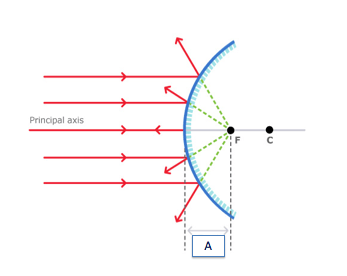
This image is showing a convex mirror because the image is (choose 2 answers)
rays meeting behind the mirror
rays meeting behind the mirror
image is real
image is virtual
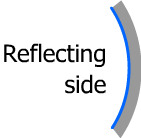

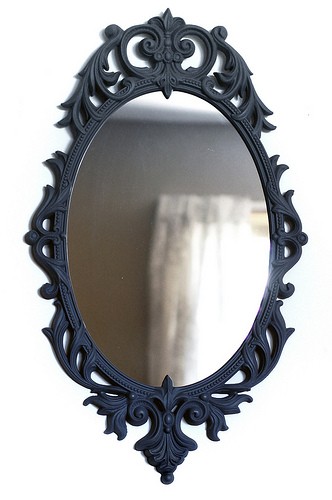

A student is conducting an experiment with four different types of mirrors. Which mirror in the experiment is a convex mirror?
mirror 1
mirror 2
mirror 3
mirror 4

Mirrors used for illuminating purposes such as headlights of cars, flashlights, and spotlights.
concave
convex
A mirror that always produces reduced and virtual image
concave
convex
A mirror that produces upright and enlarged image when the object is very near
concave
convex

Virtual, 5.45 cm behind mirror
Real, 5.45 cm in front of mirror
Virtual, 3.25 cm behind mirror
Real, 5 cm behind mirror

8.57 cm, virtual, m = 0.29
8.6 cm, real, m = 2
8.5 cm, virtual, m = 0.5
8.45 cm, virtual, m = 0.3

u = 20 cm, v = 9.5 cm
u = 30 cm, v = 10 cm
u = 25 cm, v = 8 cm
u = 30 cm, v = 7.5 cm

16.50 cm
16.42 cm
16.67 cm
16.30 cm

10 cm
13 cm
14 cm
12 cm

60 cm
40 cm
50 cm
30 cm

35 cm
40 cm
45 cm
50 cm

The object distance must equal:
The focal length
Half the focal length
Double the focal length
Not possible.
This image is showing a convex mirror because the image is (choose 2 answers)
rays meeting behind the mirror
rays meeting behind the mirror
image is real
image is virtual
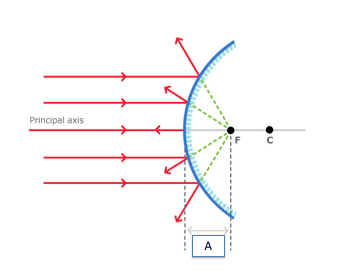
In the image, all the rays meet at F, What is F
focal length
focal point
center of curvature
reflection

what is A on the diagram?
center of curviture
focal length
reflected ray
focal point
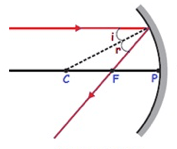
This ray diagram is for which mirror?
concave
convex
plane
window
image above the principal axis (PA) is
virtual
real
upright
upside down
The 2 reflected rays that meet.
ray of incident
reflected image is produced
focal point
image is not produced
A student is conducting an experiment with four different types of mirrors. Which mirror in the experiment is a convex mirror?
mirror 1
mirror 2
mirror 3
mirror 4

