
 Worksheets
PS Ch 17 Study Guide
Total questions: 40
Worksheet time: 25mins
The material through which a wave travels.
medium
vibration
crest
water
A repeating back-and-forth motion.
vibration
wave
medium
trough
Mechanical waves carry ____ from one place to another.
energy
matter
frequency
amplitude
A wave that causes the medium to vibrate at right angles to the direction in which the wave travels.
transverse wave
longitudinal wave
surface wave
ocean wave
A wave in which the vibration of the medium is parallel to the direction the wave travels.
transverse wave
longitudinal wave
surface wave
electromagnetic wave
An area where the particles in a medium are spaced close together.
compression
rarefaction
crest
trough
An ocean wave is an example of which kind of wave?
surface wave
transverse wave
longitudinal wave
complex wave
The highest point of the wave above the rest position.
crest
trough
amplitude
wavelength
The lowest point of the wave below the rest position.
trough
crest
compression
rarefaction
An area where the particles in a medium are spread out.
compression
crest
trough
rarefaction
A wave's (a) equals the frequency of the vibrating source producing the wave.
The time required for one cycle, a complete motion that returns to its starting point.
period
frequency
wavelength
amplitude
Frequency is measured in cycles per second, or _____.
hertz
meters
meters / sec
joules
The _____ of a transverse wave is the distance from one crest or trough to the next.
speed
wavelength
amplitude
frequency
The more energy a wave has, the greater its (a)
The maximum displacement of the medium from its rest position.
amplitude
wavelength
frequency
wave speed
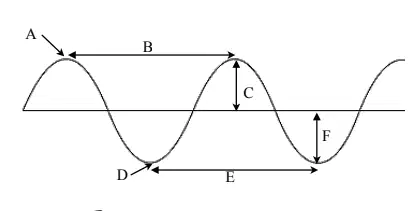
Which wave property is shown by letter B?
frequency
wavelength
amplitude
wave speed
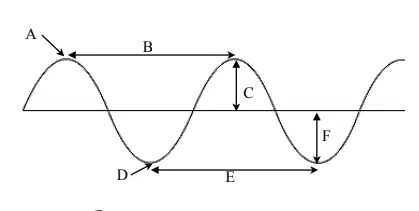
Which wave property is shown by letter C?
amplitude
wavelength
frequency
period
Which wave property is shown by letter A?
crest
wavelength
trough
period
Which wave property is shown by letter D?
crest
wavelength
trough
period
Occurs when a wave bounces off a surface that it cannot pass through.
reflection
refraction
diffraction
interference
The bending of a wave as it enters a new medium at an angle.
reflection
refraction
diffraction
interference
The bending of a wave as it moves around an obstacle or passes through a narrow opening.
reflection
refraction
diffraction
interference
Occurs when two or more waves overlap and combine together.
reflection
refraction
diffraction
interference
Occurs when two or more waves combine to produce a wave with a larger displacement.
constructive interference
destructive
interference
diffraction
refraction
When two or more waves combine to produce a wave with smaller displacement.
constructive interference
destructive
interference
diffraction
refraction
A wave that appears to stay in one place.
standing wave
node
antinode
diffracting wave
A point on a standing wave that has no displacement from the rest position.
node
antinode
standing node
constructive node
A point where a crest or trough occurs midway between two nodes.
mid-node
antinode
standing node
constructive node
When a wave enters a medium at an angle (a) occurs because one side of the wave moves more slowly than the other side.
Which type of wave are sound waves?
longitudinal waves
surface waves
transverse waves
The speed of sound is
20 m/s
342 m/s
5280 m/s
1600 m/s
Sound waves travel fastest in _____
solids
liquids
gases
a vacuum
Sound intensity is measured in
hertz
meters/second
decibels
seconds
The frequency of sound as you perceive it.
pitch
amplitude
intensity
speed

The change in sound frequency caused by the motion of the sound source, motion of the listener, or both.
Doppler effect
ultrasound effect
sonar effect
loudness effect
Match the parts of the ear to their function.
outer ear
gathers and focuses sound
middle ear
3 tiny bones sense vibrations
inner ear
sends impulses to the brain
eardrum
membrane that vibrates
The response of a standing wave to a wave of the same frequency, often producing a dramatic increase in amplitude.
resonance
ultrasound
sonar
pitch
A technique for determining the distance to an object underwater.
resonance
ultrasound
radar
sonar
As a source of sound approaches, an observer hears a (a) frequency. When the sound source moves away, the observer hears a (b) frequency.

