
Font size
 Worksheets
APES Unit 9: Global Change Quiz
Total questions: 75
Worksheet time: 1hrs 5mins

Which is NOT a way to reduce Ozone Depletion
Buy products with HCFCs
Get new appliances/products frequently
Recycle more products
Constantly get your appliances checked

What is one example of an increasing greenhouse gas?
Ethanol
Carbon Dioxide
Neon
Argon

Which accurately describes an invasive species?
A non-native species in that area
A native species to that area
An organism whose population is well under control
An organism that has many natural predators

Human population numbers, use of land, and their lifestyles, causing damage to habitats for species affect what?
Invasive Species
Biodiversity
Ocean Acidification
Global Warming

What happens during Ozone Depletion?
Ozone layer is simply diminishing
The Ozone Depletion gradually gets smaller
Has major effects on Ozone
One Chlorine Atom destroys less than 800 Ozone

What is the "Greenhouse Effect"
The growing of plants
Makes temperatures wonky on Earth
Trapping of the sun’s heat in the atmosphere
Gases that cause the atmosphere to trap necessary products in there

What is the correct definition for “Global Climate Change”?
Raising temperatures around the world
Unexpected weather affecting regions where it is not supposed to
A short-term change in the atmospheric conditions around the world
Change in the long-term weather patterns that are specific to different regions

Ocean acidification is the ongoing decrease in the pH of what?
Earth's Ocean
Earth's Rivers
Earth's Lakes
The Jersey Shore

What is an endangered species?
A species that is no longer alive
A species that lives in an environment they are supposed to be living in
A species dangerously close to extinction
A species that is being harmed by their surroundings
"Bad ozone" occurs in the
Lithosphere
Mesosphere
Stratosphere
Troposphere
The main elements in CFCs are
Carbon, Calcium, Francium
Carbon, Chlorine, Fluorine
Chromium, Chlorine, Fluorine
Chlorine, Fluorine, Calcium
Which of the following best exemplifies global collaboration for a sustainable environment? (Getting rid of CFCs)
The Antarctic Treaty of 1961
The Clean Air Act of 1972
CERCLA (Superfund)
The Montreal Protocol
Which of the following best describes the importance of ozone in the stratosphere to life on Earth?
Ozone reflects X-rays from the Sun back into space.
Ozone absorbs most of the ultraviolet radiation from the Sun.
Ozone helps to moderate surface temperature by absorbing CO2 and CH4.
Ozone increases mutation rates and accelerates evolution in a variety of species.
The second step of ozone formation involves atomic oxygen combining with what molecule?
CO2
O2
NO2
2H2O
The breakdown of CFCs in the atmosphere is caused by UV rays.
True
False
Which of the following is a greenhouse gas that comes only from human sources?
Nitrous oxide
Carbon dioxide
Methane
Chlorofluorocarbons
Although levels of CFCs in the atmosphere are much lower than those of CO2 , CFCs are still potent greenhouse gases because they
remain in the atmosphere for only a brief time
lack natural sources
are much more efficient at absorbing thermal radiation
are more difficult to remove from smokestacks and tailpipes
Which of the following best describes the mechanism of the greenhouse effect in Earth's atmosphere?
Infrared radiation from Earth's surface is absorbed by gases in the atmosphere.
Cosmic radiation from deep space is absorbed by gases in the atmosphere.
Alpha radiation from the Sun is absorbed by water vapor in the atmosphere.
Ultraviolet radiation from the Sun is absorbed by ozone gas in the stratosphere.
All of the following gases have been implicated in contributing to the increase in global temperature via the greenhouse effect EXCEPT
CFC's
O2
N2O
CO2
Why is water vapor not considered a significant contributor to global climate change?
The concentration of water vapor is very low compared to the other gases.
Water vapor is inefficient at absorbing heat and does not absorb much of the infrared spectrum.
Trees and other organisms naturally release water vapor during the process of decomposition.
Water vapor has a relatively short residence time in the atmosphere.
A greenhouse gas that, in the lower troposphere, is formed by photochemical reactions
H2O
CO2
CH4
O3

Layer of Earth's atmosphere the contains "good" O3
Troposphere
Hydrosphere
Mesosphere
Asthenosphere
Stratosphere

The ocean becomes this with the absorption of excess CO2
alkaline
acidic
neutral
shallower
none of these

A species who is very close to extinction
threatened
endangered
invasive
least concern
alien
committing industrialized countries and economies in transition to limit and reduce greenhouse gases (GHG) emissions in accordance with agreed individual targets
Kyoto Protocol
CITES
Montreal Protocol
Endangered Species Act
NEPA

Which is NOT a part of HIPPCO?
Human population
Income (affluence)
Climate change
Pollution
Overharvesting

Organisms that are successful in a new environment due to access to abundant resources and no predators
threatened
keystone
endangered
least concern
invasive

This had the goal of decrease production of CFCs by the year 2000
Montreal Protocol
Kyoto Protocol
Paris Agreement
NEPA
CITES

The international agreement between governments to ensure that international trade in specimens of wild animals and plants does not threaten the survival of the species
CITES
Endangered Species Act
Montreal Protocol
Kyoto Protocol
Sioux Falls Animal Act

Where there is a lot of mixing of air, weather, and "bad" ozone
Troposphere
Hydrosphere
Mesosphere
Asthenosphere
Stratosphere

Which is NOT true about ocean warming?
The distribution of heat in the oceans is not uniform
Coral bleaching rates are decreasing
Warm water holds less dissolved oxygen than colder water
Sea levels are rising due to thermal expansion
Many species are relocating further from the equator

Evidence for climate change on Earth includes
Global temperature decline
Warming oceans
Increasing glaciers
Lowering sea levels
None of these

Which of the following anthropogenic activities is most closely associated with depletion of the stratospheric ozone layer?
Flooded cropland
Garbage incineration
Mining of talc
Disposal of refrigerators and air conditioners
None of these

A source of heat to warm up oceans is
sunlight
water vapor
carbon dioxide
all of these
none of these
As greenhouse gasses increase, what happens to Earth's temperature?
Increase
Decrease
Stays the Same
No Trend
What evidence is there to support that Global Warming is occurring?
Rising ocean temperatures
Declining arctic sea glacers
Sea levels rising
Increase in carbon dioxide in the atmosphere
Which of the following could increase the amount of greenhouse gasses in our atmosphere?
Burning fossil fuels
Planting trees
Walking to school and work
Cutting down trees
Why do we need greenhouse gasses?
We don't! All greenhouse gasses are bad
They help regulate Earth's climate
They decrease Earth's temperature
None of the above

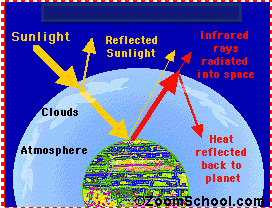
On the picture, the heat out is decreasing. What can we assume if this is happening?
There is no change in the graph
We don't have any greenhouse gasses
Greenhouse gasses are decreasing
Greenhouse gasses are increasing

How does ocean acidification impact marine calcifiers?
It weakens their shells and bodies
It makes their food die
It makes the water too warm for them
It adds too much weight to their shells

How are humans adding CO2 to the air?
Building houses
Using fossil fuels
Causing chemical spills
Growing trees

Earth's average temperature has increased 1°C in the past century. Which reason best explains this increase in temperature?
lower levels of ozone in the atmosphere
lower levels of nitrogen in the atmosphere
higher levels of carbon dioxide in the atmosphere
higher levels of oxygen in the atmosphere
Which of the following gases is NOT a greenhouse gas?
carbon dioxide (CO2)
nitrogen (N2)
water vapor (H20)
methane (CH4)
Which of the following are evidence of climate change?
extreme weather events
increase in the average global temperature
melting of polar ice caps
all of the above
Which of the following is contributing to an increase in carbon dioxide (CO2) in the atmosphere?
deforestation
burning fossil fuels
burning down trees
all of the above
an area's climate changes and it gets LESS rainfall. what can happen?
more hurricanes
more forest fires
floods
more diseases
what human activities lead to an increase in the amount of greenhouse gases and therefore lead to climate change?
burning fossil fuels for energy
transportation (cars, planes, trains)
farming
all of the above
Warming seas will...
Increase the number of storms
Decrease the number of storms
The number if storms will stay the same
An example of a climate change mitigation strategy is
mandating more fuel efficient vehicles
building structures to protect from rising sea levels
species migration
using drought resistant crops

What is the main cause of coral bleaching?
Higher ocean temperatures
Not enough carbon dioxide is dissolved in ocean water
Whales chewing on coral reefs
Too much sunlight
Which law regulates and protects endangered species within the US?
CITES
Endangered Species Act
Kyoto Protocol
Montreal Protocol
Which law regulates the trade in endangered species between countries?
CITES
Endangered Species Act
Kyoto Protocol
Montreal Protocol
Which of these attempts to reduce the rate of Global Warming by reducing greenhouse gas emissions?
CITES
Endangered Species Act
Kyoto Protocol
Montreal Protocol
Pick all of the following traits that make a species LESS likely to go extinct:
Ability to move to a new habitat
Inability to move to a new habitat
Being a specialist
Being a generalist
Pick all of the following traits that make a species More likely to go extinct:
Ability to move to a new habitat
Inability to move to a new habitat
Being a specialist
Being a generalist
Which of the following traits are most likely to be present in an invasive species?
Generalist
Specialist
r-selected species
K-selected species
What is an endangered species?
A species that is no longer alive
A species that lives in an environment they are supposed to be living in
A species dangerously close to extinction
A species that is being harmed by their surroundings
What are the greatest problems facing plants, animals, and people?
introducing invasive species
habitat destruction
illegal hunting
all of the above
How does the government help restore species that are threatened or endangered?
Prohibit "Take"
Conserve habitat lands
Captive breeding programs (zoos)
All of the above
Invasive species alter the ecosystem by reproducing in number _____. This leads to ______ food for the native species.
Quickly, less
Quickly, more
Slowly, less
Slowly, more
What do invasive species do to the biodiversity of their ecosystem?
They increase biodiversity by adding to the population
They decrease biodiversity because they deprive other organisms, which will cause them to die out
They increase biodiversity by taking away niches of other organisms
They decrease biodiversity by adding new niches to the ecosystem
Reproducing quickly
too many predators
What is one major concern about the spread of zebra mussels, an invasive species, in Tennessee waterways?
Zebra mussels only grow in shallow ponds, so they have minimal impact on larger rivers and lakes in Tennessee.
Zebra mussels are beneficial because they compete with larger fish species, helping smaller native fish to survive.
Zebra mussels improve water clarity, which leads to an increase in fish populations that benefit from clearer water.
Zebra mussels attach to boats and other surfaces, clogging water intake pipes and harming water quality, which negatively affects native fish and plant species.

