wayground logo

Free Printable Worksheets

Font size

S
M
L
XL
Worksheets

Food Webs Practice

Total questions: 66

Worksheet time: 3hrs 48mins

Name
Class
Date
1.
All energy transformations in an ecosystem begin with
a)
a scavenger
b)
the sun
c)
a decomposer
d)
a herbivore
2.
__________ is an organism that only eats plants for energy.
a)
Carnivore
b)
Herbivore
c)
Omnivore
d)
Terivore
3.

Using food web which of the following is a secondary consumer?

a)

snake

b)

worm

c)

butterfy

d)

squirrel

4.
__________ is an organism that only eats meat for energy.
a)
Omnivore
b)
Borivore
c)
Herbivore
d)
Carnivore
5.

Using the food web what would happen if the eagle became extinct?

a)

The frog population would decrease.

b)

The frog population would increase.

c)

The butterfly population would increase.

d)

The snake population would decrease.

6.

Which is the primary source of energy for plants?

a)

producer

b)

consumer

c)

decomposer

d)

sun

7.

Which of the following would be the most likely effect, if there were a sudden increase in the cricket population?

a)

There would be a decrease in the small bird population.

b)

There would be a decrease in the grass/flowers population.

c)

There would be a decrease in the mice population.

d)

There would be an increase in the grass/flowers population.

8.
What are the organisms that break down dead stuff?
a)
Producers
b)
Consumers
c)
Decomposers
d)
Organisms
9.

Using the food web which of the following is a primary consumer?

a)

butterfy

b)

snake

c)

fox

d)

frog

10.
The arrows in a food chain or web represents what?
a)
They point to the organism that is being eaten.
b)
It shows how sunlight flows within an ecosystem.
c)
They show what direction the energy is flowing between organisms. 
d)
They represent how water is transferred within a habitat.
11.
In this food chain, what will happen if the frogs become extinct?
a)
The snakes will increase.
b)
The grasshoppers will decrease.
c)
The eagles will remain the same.
d)
The grasshoppers will increase.
12.

Using the food web which of the following is a tertiary consumer?

a)

frog

b)

bird

c)

eagle

d)

worm

13.
A food web can be broken down into several seperate
a)
food chains
b)
food pyramids
c)
producers
d)
consumers
14.

Decomposers get energy from...

a)

the sun

b)

eating plants

c)

eating animals

d)

dead things and waste

15.

Arrows in a food web represent...

a)

eating

b)

sunlight

c)

energy

d)

matter

16.

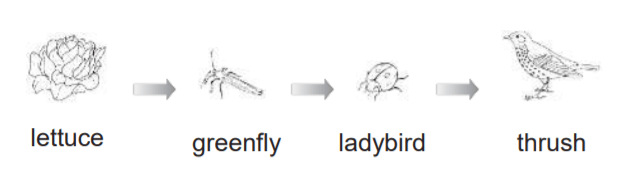
Who is the producer?

a)

lettuce

b)

greenfly

c)

ladybird

d)

thrush

17.

Which type of organism should replace the X in the food web?

a)

an omnivore

b)

an herbivore

c)

a carnivore

d)

a producer

18.
The relationship between ALL the organisms in a community showing who eats whom is called a ___________________________.
a)
Food Web
b)
Food Chain
c)
Abiotic Factors
d)
Biotic Factors
19.
One path that energy could take through an ecosystem is called a ________________________.
a)
Food Web
b)
Food Chain
c)
Abiotic Factors
d)
Biotic Factors
20.
Where does the energy that travels through an ecosystem originally come from?
a)
Earth's Core
b)
Water
c)
Plants
d)
The Sun
21.
An organism that lives by breaking down dead organic matter into simpler parts is a _______________________.
a)
scavenger
b)
consumer
c)
decomposer
d)
carnivore
22.
A second-level (secondary) consumer CANNOT be which type of consumer?
a)
Carnivore.
b)
Decomposer.
c)
Omnivore
d)
Herbivore.
23.
An animal that only eats other animals is a _______________.
a)
carnivore
b)
omnivore
c)
herbivore
d)
decomposer
24.
A living thing that makes its own food is called a __________________________.
a)
consumer
b)
producer
c)
carnivore
d)
herbivore
25.
If you connect all the food chains in an ecosystem you get a __________________________.
a)
food web
b)
food chain
c)
niche
d)
symbiosis
26.
Which shows a complete picture of the flow of energy through an ecosystem.
a)
Food Chain
b)
Food Web
27.
Recently, a family of bobcats moved into an area with a large rabbit population. What changes may occur in the ecosystem?
a)
The rabbit population may increase
b)
The rabbit population may decrease
c)
The rabbit population may increase first, then decrease
d)
The rabbit population will remain the same
28.
A population of mice lives in a barn community. A cat population has just joined the community. What will happen?
a)
Mouse and cat populations both go up?
b)
Mouse and cat populations both go down
c)
Mouse population goes down as cat population goes up
d)
Mouse population goes up as cat population goes down
29.
An animal that eats only plants is a ______________________.
a)
carnivore
b)
omnivore
c)
herbivore
d)
decomposer
30.
In the food web shown, the snail would be considered...
a)
primary consumer
b)
secondary consumer
c)
tertiary consumer
d)
producer
31.
Which best describes what a food chain shows you?
a)
Energy flowing through an ecosystem
b)
Food flowing through an ecosystem
c)
Consumers eating other organisms
32.
What is the role of decomposers in a food chain?
a)
Use sunlight to make food
b)
Eat other organisms to gain energy
c)
Make the food for the whole food chain
d)
Break down dead organisms and add nutrients to the soil
33.
What's the role of consumers in a food chain?
a)
Use sunlight to make food 
b)
Eat other species and keep them from overpopulating
c)
Break down dead stuff
d)
Add nutrients to the soil
34.
Which of these is true about this food web?
a)
The Owl gets its energy from the producer.
b)
The Lion gets its energy only from a wild cat.
c)
The Kite gets its energy from the goat.
d)
The Mouse is most likely to die, several ways.
35.
Which organism do the owl and the weasel compete for in the food web?
a)
Hawk
b)
Spider
c)
Grasshopper
d)
Shrew
36.
What might happen if you remove a primary consumer from the ecosystem?
a)
There would be more food for secondary consumers.
b)
The number of primary consumers would increase.
c)
The number of plants would increase.
d)
The number of secondary consumers would increase.
37.
Identify the correct food chain that demonstrates the energy flow of this food web
a)
Plant > Caterpillar > Bluebird > Eagle
b)
Plant > Lizard > Snail
c)
Plant >Lizard > Snail >Eagle
d)
Eagle >Lizard>Caterpillar>Plant
38.

What role do bobcats play in a forest food web?

a)

Bobcats break down dead plants and animals and return nutrients to the soil

b)

Bobcats are consumers of marmots and grouses

c)

Bobcats produce their own energy

d)

Bobcats are predators of grasses and berries

39.

A wetlands food chain is shown, which table show the correct role of each organism?

a)
b)
c)
d)
40.

Which type of organism is missing from this food web?

a)

Decomposer

b)

Predator

c)

Consumer

d)

Producer

41.

How many types of organisms in this food web obtain energy directly from producers?

a)

One

b)

Two

c)

Three

d)

Four

42.

What role do turkeys play in this food web?

a)

Decomposer

b)

Predator

c)

Consumer

d)

Producer

43.

Which table shows the correct role of organisms in the food web?

a)
b)
c)
d)
44.

In this food web, energy is transferred directly between--

a)

mosquitoes and mudskippers

b)

kingfishers and mangrove crabs

c)

prawns and mosquito larvae

d)

kingfishers and mangrove trees

45.

Based on the information in the food web, which of the following food chains shows one way energy flows in this ecosystem?

a)
b)
c)
d)
46.

which statement correctly describes the transfer of energy in a food chain in this ecosystem?

a)

energy is transferred from berries to bears to elk

b)

energy is transferred from grasses to marmots to bobcats

c)

energy is transferred from bobcats to grouses to grasses

d)

energy is transferred from grasses to elk to grouses

47.

Based on the information in the table, which of the following food chains shows one way energy flows in this ecosystem?

a)
b)
c)
d)
48.

Which organisms in this food web only eats producers?

a)

Fruit bats and bandicoots only

b)

insects and fruit bats

c)

rufous owls, bandicoots and pythons only

d)

insects only

49.

Which organisms in this food web eat only consumers?

a)

spider monkey and butterfly only

b)

spider, poison dart frog and butterfly only

c)

jaguar, carcara, spider and poison dart frog only

d)

poison dart frog and jaguar only

50.

Which change would most likely occur if all the producers in this ecosystem were removed?

a)

The populations of consumers would increase

b)

the producers would move to a new location

c)

to populations of consumers would decrease

d)

Pacus would become producers.

51.

Which organisms do not directly consume another organism for energy?

a)

Ravens and Quails

b)

Kangaroo rats and crickets

c)

cacti and seeds

d)

gila monsters and desert tortoises

52.
What is a producer?
a)
an organism that gets energy from eating other organisms
b)
an organisms that uses sunlight to make its own food
c)
an organism that gets energy from eating dead organisms, non-living material or waste
d)
an organism that uses chemical energy to make its own food
53.
What is a producer?
a)
an organism that gets energy from eating other organisms
b)
an organisms that uses sunlight to make its own food
c)
an organism that gets energy from eating dead organisms, non-living material or waste
d)
an organism that uses chemical energy to make its own food
54.
A community of living and nonliving things in their natural environment makes up a 
a)
food web
b)
ecosystem
c)
food chain
d)
population
55.
What is a herbivore?
a)
an animal that gets energy from eating other animals
b)
an organism that gets energy from eating only plants
c)
an animal that gets energy by eating both plants and other animals
d)
an animal that eats only herbs
56.
An organism that gets energy from eating other organisms is a ______________.
a)
producer
b)
consumer
c)
decomposer
d)
prey
57.
An organism that gets energy from breaking down dead organisms, non-living material or waste is a(an) ___________.
a)
producer
b)
consumer
c)
decomposer
d)
autotroph
58.
What is a carnivore?
a)
an animal that gets energy by eating other animals
b)
An animal that gets energy by eating only plants
c)
an animal that gets energy by eating both plants and animals
d)
an animal that makes its own energy through photosynthesis
59.
A connection of food chains with many food energy paths in an ecosystem is a ____________.
a)
ecosystem
b)
food web
c)
environment
d)
population
60.
Which of the following is NOT a consumer?
a)
grass
b)
dog
c)
shark
d)
fish
61.
Which of the following is a herbivore?
a)
cricket
b)
frog
c)
hawk
d)
shrew
62.
Where do all life forms get their energy?
a)
Earth's Core
b)
Water
c)
Plants
d)
The Sun
63.
In the energy pyramid here, how much of the energy in each level gets lost as heat or used by the organism for survival?
a)
80%
b)
90%
c)
10%
d)
20%
64.
What percentage of energy is passed on to each tropic level?
a)
10%
b)
50%
c)
90%
d)
100%
65.
The arrows in a food chain or web represents what?
a)
They point to the organism that is being eaten.
b)
It shows how sunlight flows within an ecosystem.
c)
They show what direction the energy is flowing between organisms. 
d)
They represent how water is transferred within a habitat.
66.

If there is 2000 kcal of energy in this particular ecosystem, how many kcal of energy will be available for hawk?

(a)