
 Worksheets
Unit 5 and 6 Review
Total questions: 78
Worksheet time: 59mins
Which type of matter is a compound?
Pure Substance
Mixture
Which type of matter cannot be broken down, decomposed, or separated by physical or chemical means?
Element
Compound
Mixture
Which type of matter can be separated by physical means?
Element
Compound
Mixture
Which type of matter can be separated by chemical means?
Element
Compound
Mixture
Which type of matter contains 2 or more elements chemically combined in a fixed proportion?
Element
Compound
Mixture
Which type of matter contains physically combined substances that has proportions that can vary?
Element
Compound
Mixture
Which type of matter is an element?
Pure Substance
Mixture
When reactants are chemically combined to create a product, the product's properties:
are the same as the reactant's properties
are different from the reactant's properties
Which type of matter is an aqueous solution?
Element
Compound
Mixture
Which type of mixture has an even distribution of particles? (You cannot see the different parts)
Heterogeneous Mixture
Homogeneous Mixture
Which type of mixture is an aqueous solution?
Heterogeneous Mixture
Homogeneous Mixture
Which type of mixture doesn't have an even distribution of particles? (You cannot see the different parts)
Heterogeneous Mixture
Homogeneous Mixture
Which type of matter is this:
Na
Element
Compound
Mixture
Which type of matter is this:
NaCl (s)
Element
Compound
Mixture
Which type of matter is this:
NaCl (aq)
Element
Compound
Mixture
Which type of matter is this:
N2
Element
Compound
Mixture
Matter is classified as:
Substances only
Mixtures only
Substances and Mixtures
Homogeneous and Heterogeneous Mixtures
Which substance cannot be broken down by a chemical change? (Is this an element or a compound?)
ammonia
magnesium
methane
water
Which substance cannot be broken down by a chemical change? (Is this an element or a compound?)
aluminum
ammonia
aluminum oxide
ammonium chloride
Which substance CAN be broken down by a chemical change? (Is this an element or a compound?)
Carbon
Chlorine
Calcium
Calcium Chloride
What are the two types of substances?
elements
compounds
homogeneous
heterogeneous
What are the two types of mixtures?
elements
compounds
homogeneous
heterogeneous
Which separation technique uses a porous barrier to separate a liquid and a solid?
(a)
Which method is best for separating a mixture of sand and water?
Evaporation
Filtration
Magnetism
Distillation
Which method is best for separating salt and water?
Evaporation
Filtration
Magnetism
Distillation
Which separation technique uses boiling points to separate a homogeneous mixture of liquids?
(a)
Which separation technique uses molecular polarity and the tendencies of how far something will travel along the surface of another material?
(a)
What property does distillation use to separate different parts of a mixture?
particle size
boiling point
polarity
tendency to travel on a surfrace
What property does filtration use to separate different parts of a mixture?
particle size
boiling point
polarity
tendency to travel on a surfrace
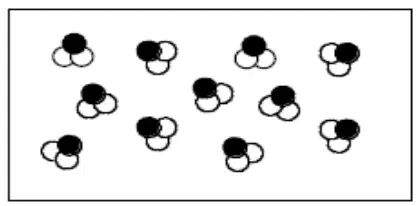
What type of particle diagram is this?
Element
Compound
Mixture of Elements
Mixture of Compounds
Mixture of Elements and Compounds
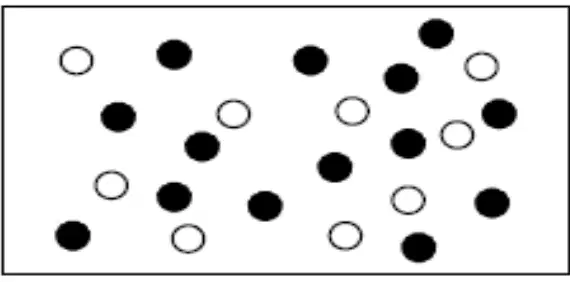
What type of particle diagram is this?
Element
Compound
Mixture of Elements
Mixture of Compounds
Mixture of Elements and Compounds
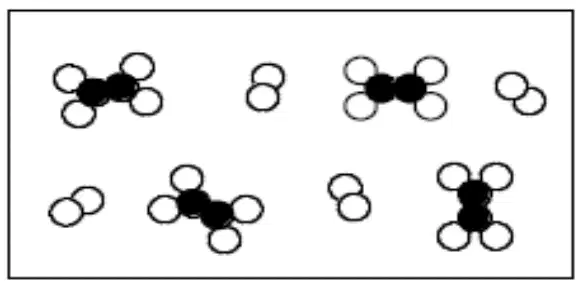
What type of particle diagram is this?
Element
Compound
Mixture of Elements
Mixture of Compounds
Mixture of Elements and Compounds
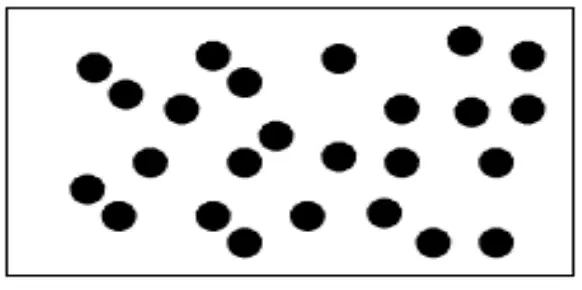
What type of particle diagram is this?
Element
Compound
Mixture of Elements
Mixture of Compounds
Mixture of Elements and Compounds
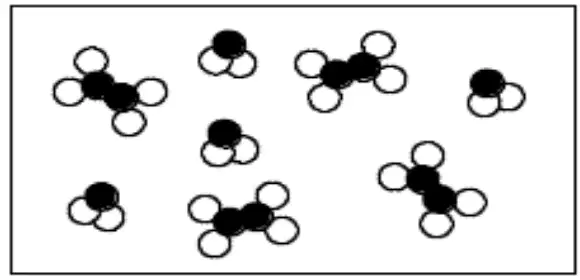
What type of particle diagram is this?
Element
Compound
Mixture of Elements
Mixture of Compounds
Mixture of Elements and Compounds
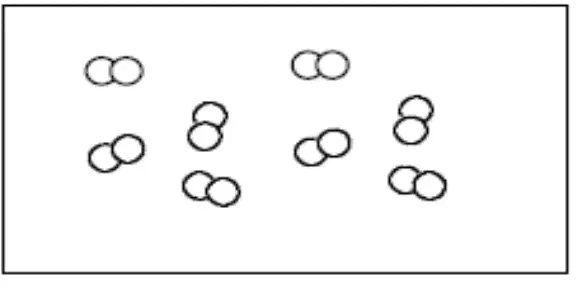
What type of particle diagram is this?
Element
Compound
Mixture of Elements
Mixture of Compounds
Mixture of Elements and Compounds
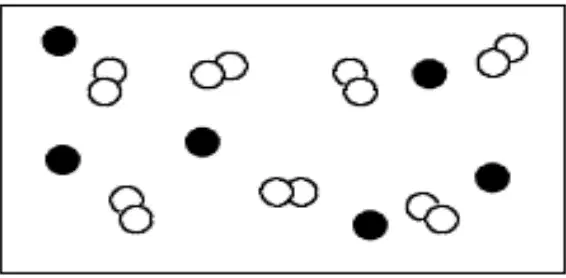
What type of particle diagram is this?
Element
Compound
Mixture of Elements
Mixture of Compounds
Mixture of Elements and Compounds

What type of particle diagram is this?
Element
Compound
Mixture of Elements
Mixture of Compounds
Mixture of Elements and Compounds
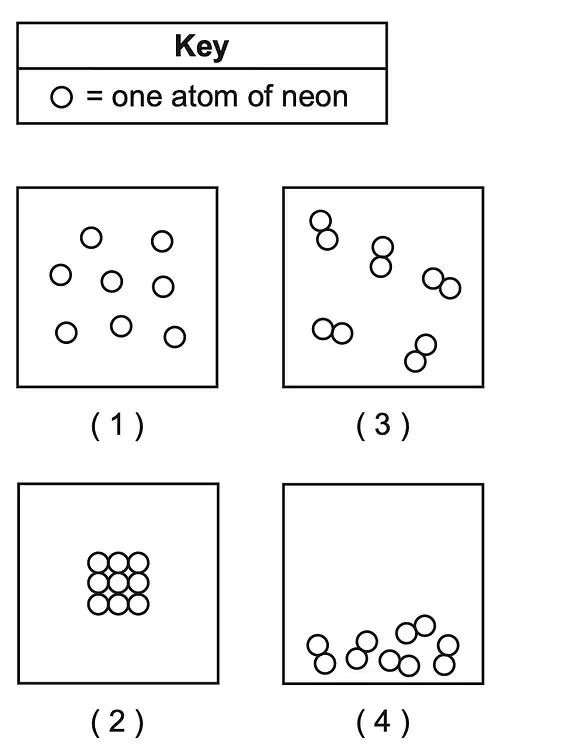
Which particle diagram best represents neon?
(think about the phase of neon at room temperature and
whether it's diatomic or not)
1
2
3
4
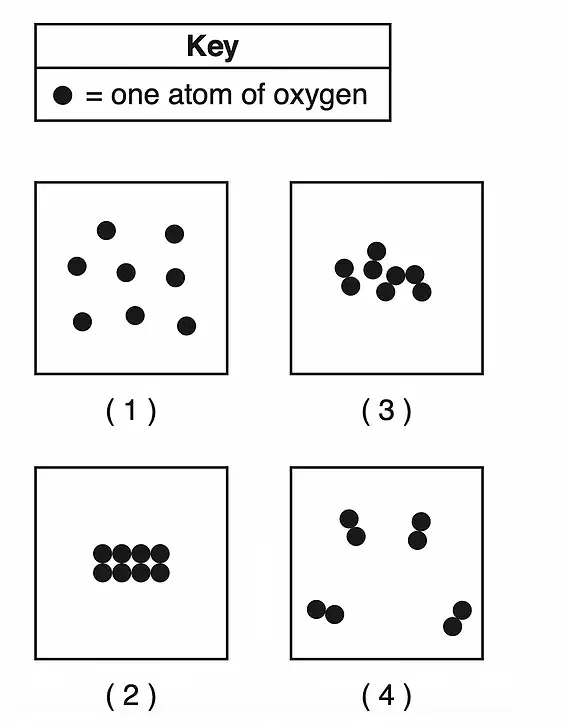
Which particle diagram best represents oxygen?
(think about the phase of oxygen at room temperature and
whether it's diatomic or not)
1
2
3
4
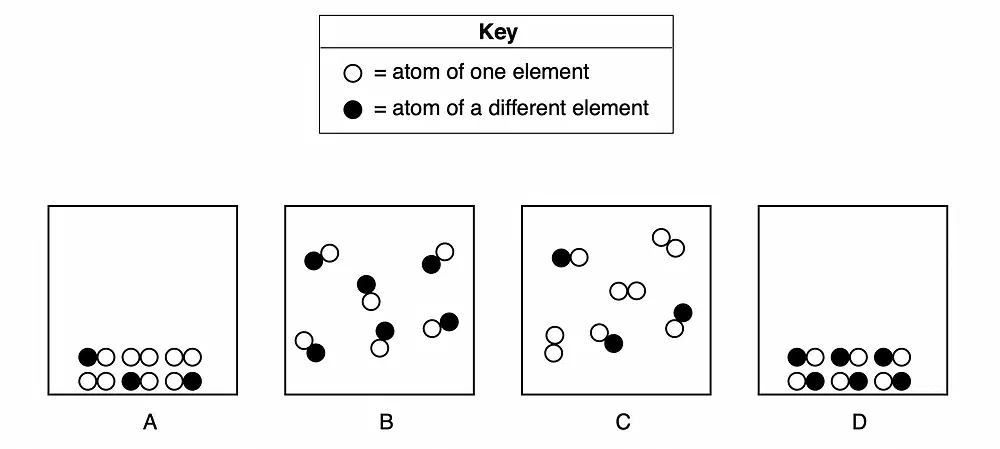
Which diagram represents a compound that is in the solid phase?
A
B
C
D
Which diagram represents a compound that is in the gas phase?
A
B
C
D
In a heating curve: when kinetic energy is constant, what happens to potential energy?
increases
decreases
constant
In a heating curve: when kinetic energy is increasing, what happens to potential energy?
increases
decreases
constant
In a cooling curve: when kinetic energy is decreases, what happens to potential energy?
increases
decreases
constant
In a cooling curve: when kinetic energy is constant, what happens to potential energy?
increases
decreases
constant
What is kinetic energy also known as?
Temperature
Heat
What is the word for absorbing energy?
Endothermic
Exothermic
What is the word for releasing energy?
Endothermic
Exothermic
Which curve is exothermic?
Heating Curve
Cooling Curve
Which curve is endothermic?
Heating Curve
Cooling Curve
Which phase changes are exothermic (releasing energy)?
You have to pick multiple answers
melting
freezing
boiling
condensing
deposition
Which phase changes are endothermic (absorbing energy)?
You have to pick multiple answers
melting
freezing
boiling
condensing
sublimation
Heat energy is always going from _____ to _____
Hot to Cold
Cold to Hot
Which phrase describes the motion and attractive forces of ideal gas particles?
Random straight-line motion and no attractive forces
random straight-line motion and strong attractive forces
random curved-line motion and no attractive forces
random curved-line motion and strong attractive forces.
Which statement describes the particles of an ideal gas, based on the kinetic molecular theory?
there are attractive forces between the particles
the particles move in circular paths
the collisions between the particles reduce the total energy of the gas
the volume of the gas particles is negligible compared with the total volume of the gas
Which statement describes particles of an ideal gas, based on the kinetic molecular theory?
Gas particles are separated by distances smaller than the size of the gas particles
Gas particles do not transfer energy to each other when they collide
Gas particles have no attractive forces between them
Gas particles move in predictable, circular motion.
According the the kinetic molecular theory, collisions between gas particles in a sample of an ideal gas
increase the energy content of the gas sample
produce strong attractive forces between gas particles
result in a net loss of energy by the gas sample
transfer energy between the gas particles
A real gas behaves most like an ideal gas at
low pressure and high temperature
low pressure and low temperature
high pressure and high temperature
high pressure and low temperature
At which temperature and pressure will a sample of neon gas behave most like an ideal gas?
300 K and 2.0 atm
300 K and 4.0 atm
500 K and 2.0 atm
500 K and 4.0 atm
At which temperature and pressure would a sample of helium behave most like an ideal gas?
75 K and 500 kPa
150 K and 500 kPa
300 K and 50 kPa
600 K and 50 kPa
A sample of hydrogen gas will behave most like an ideal gas under the conditions of
low pressure and low temperature
low pressure and high temperature
high pressure and low temperature
high pressure and high temperature
Which is the strongest type of intermolecular force?
Hydrogen Bonding
Dipole-Dipole
Dispersion
Hydrogen Bonding occurs between Hydrogen and any of these three elements:
Cl,C,O
C,O,N
F,O,I
F,O,N
The higher the boiling point, the ___________ the intermolecular force
stronger
weaker
The lower the boiling point, the ___________ the intermolecular force
stronger
weaker
Which substance has the strongest intermolecular force?
Boiling point of CO2 = 195K
Boiling point of NH3 = 240K
Boiling point of CH4 = 111K
Avogadro's law states that if two gases have the same temperature, pressure, and volume;
the two gases have:
same number of molecules
different number of molecules
Avogadro's law states that if two gases have the same temperature, pressure, and volume;
the two gases have:
same number of molecules
different number of molecules
Which substance has the same number of molecules as 2.0 L of He at STP?
3.0 L of CO2
4.0 L of H2O
2.O L of H2
1.5 L of N2
Which substance has the same number of molecules as 2.0 L of O2 at 300K and at 200 kPa?
2.0 L of N2 at 200 K and 200 kPa
4.0 L of H2O at 300 K and 300 kPa
2.O L of H2 at 300 K and 200 kPa
1.5 L of N2 at 400 K and 150 kPa
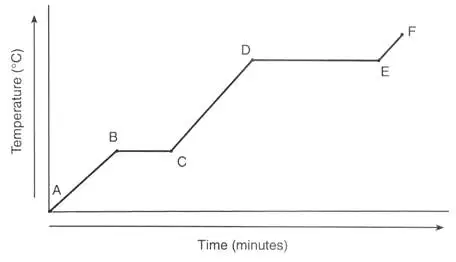
In a heating curve, what is happening to interval AB in terms of
kinetic energy?
potential energy?
KE increases
PE constant
KE constant
PE increases
KE constant
PE constant
KE increases
PE increases
In a heating curve, what is happening to interval BC in terms of
kinetic energy?
potential energy?
KE increases
PE constant
KE constant
PE increases
KE constant
PE constant
KE increases
PE increases
In a heating curve, what is happening to interval CD in terms of
kinetic energy?
potential energy?
KE increases
PE constant
KE constant
PE increases
KE constant
PE constant
KE increases
PE increases
In a heating curve, what is happening to interval DE in terms of
kinetic energy?
potential energy?
KE increases
PE constant
KE constant
PE increases
KE constant
PE constant
KE increases
PE increases
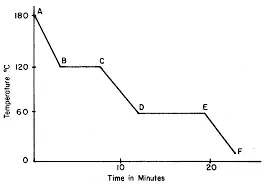
In a cooling curve, what is happening to interval AB in terms of
kinetic energy?
potential energy?
KE decreases
PE constant
KE constant
PE decreases
KE constant
PE constant
KE decreases
PE decreases
In a cooling curve, what is happening to interval BC in terms of
kinetic energy?
potential energy?
KE decreases
PE constant
KE constant
PE decreases
KE constant
PE constant
KE decreases
PE decreases
In a cooling curve, what is happening to interval CD in terms of
kinetic energy?
potential energy?
KE decreases
PE constant
KE constant
PE decreases
KE constant
PE constant
KE decreases
PE decreases
In a cooling curve, what is happening to interval DE in terms of
kinetic energy?
potential energy?
KE decreases
PE constant
KE constant
PE decreases
KE constant
PE constant
KE decreases
PE decreases

