
 Worksheets
U3L6 HW Econ: Economies of Scale
Total questions: 24
Worksheet time: 6hrs 0mins
Which of the following best defines fixed costs and variable costs, and provides correct examples?
Fixed costs remain constant regardless of output (e.g., rent); variable costs change with output (e.g., raw materials).
Fixed costs change with output (e.g., raw materials); variable costs remain constant (e.g., rent).
Fixed costs and variable costs both change with output (e.g., wages and rent).
Fixed costs and variable costs both remain constant regardless of output (e.g., rent and utilities).
Marginal cost is defined as:
The additional cost incurred by producing one more unit of a good.
The total cost of producing all units of a good.
The average cost per unit of output.
The fixed cost of production.
Calculate total revenue and profit.
Total revenue and profit are calculated by subtracting total cost from total sales.
Total revenue and profit are calculated by adding total cost to total sales.
Total revenue and profit are calculated by multiplying total cost by total sales.
Total revenue and profit are calculated by dividing total sales by total cost.
Apply the profit maximizing rule and explain how and why it works.
A firm maximizes profit where marginal cost equals marginal revenue because producing beyond this point would increase costs more than revenue.
A firm maximizes profit where total cost equals total revenue because this is the break-even point.
A firm maximizes profit where average cost equals average revenue because this ensures efficiency.
A firm maximizes profit where fixed costs are minimized because this reduces overall expenses.
Economies of scale refer to:
The cost advantages that enterprises obtain due to their scale of operation, with cost per unit of output generally decreasing with increasing scale.
The increase in average costs as production increases.
The process of reducing production to lower costs.
The disadvantages faced by large producers.

What happens to long-run average costs as output increases in the 'Economies of Scale' region?
They increase
They decrease
They stay the same
They fluctuate
What is economies of scale? Fill in the blank: Firms that produce more can better use _______ and _______.
mass production techniques; specialization
limited resources; outsourcing
manual labor; advertising
small-scale production; diversification
Using mass production techniques, like robots, will cause total cost to be higher but the average cost for each car would be significantly lower. This is due to:
economies of scale
diseconomies of scale
opportunity cost
law of diminishing returns
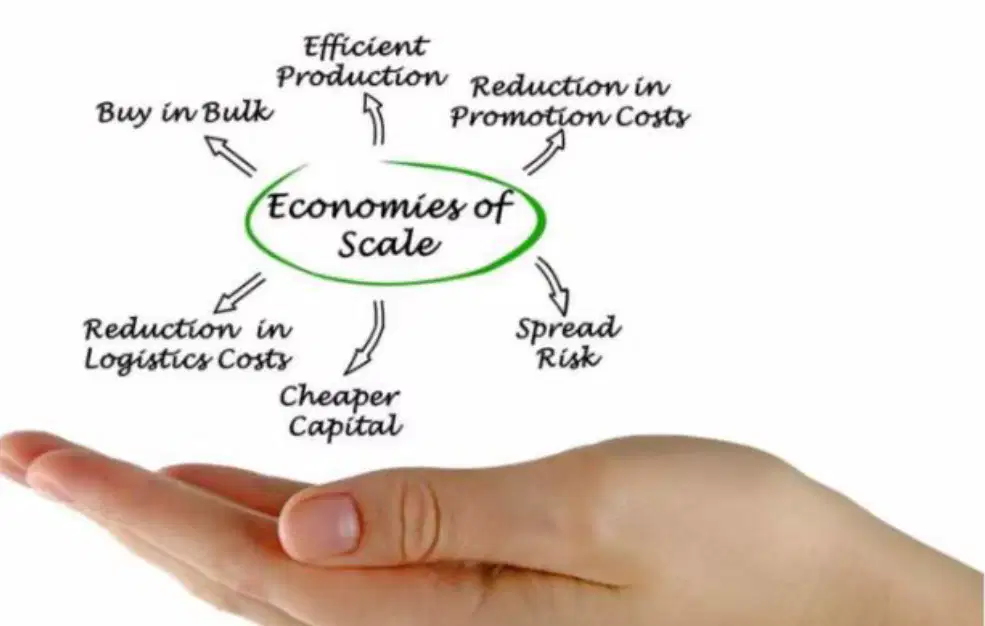
Which of the following is a benefit of economies of scale?
A) Efficient Production
B) Increased Taxes
C) Higher Interest Rates
D) Decreased Output
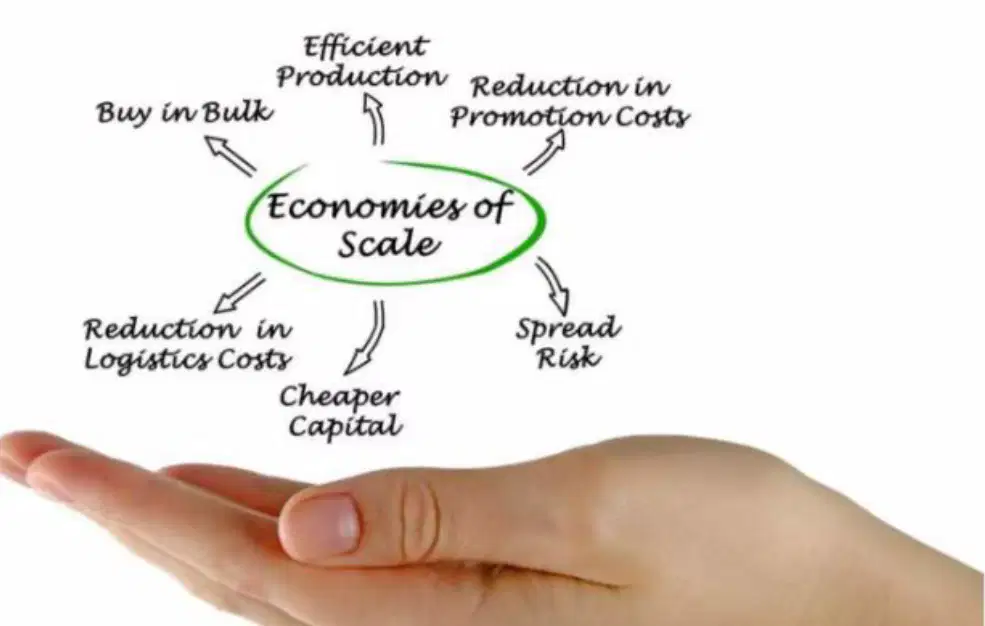
Fill in the blank: Economies of scale can help a business by allowing it to ________ in bulk.
Buy
Sell
Advertise
Transport
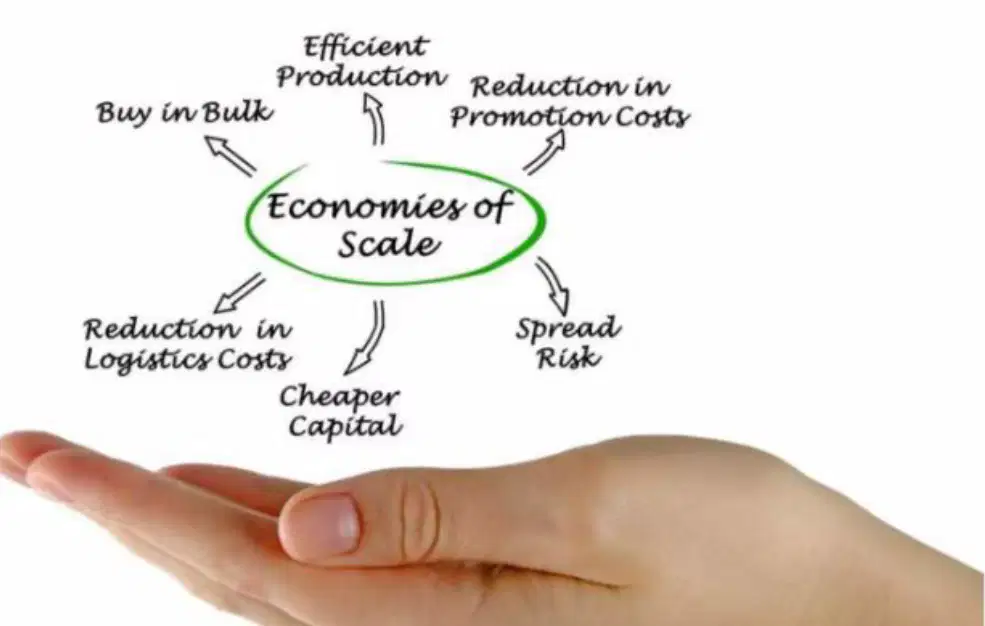
Fill in the blank: A reduction in ________ cost is a benefit of economies of scale.
Logistics
Advertising
Interest
Legal
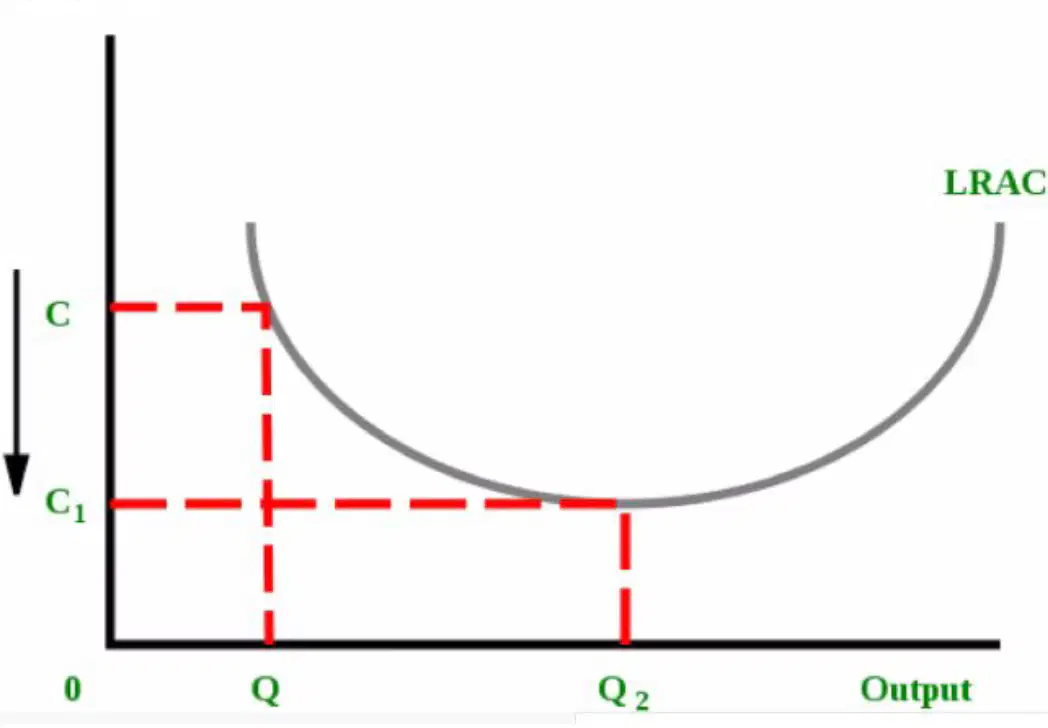
At which output level does the average cost reach its minimum?
0
Q
Q2
Q1
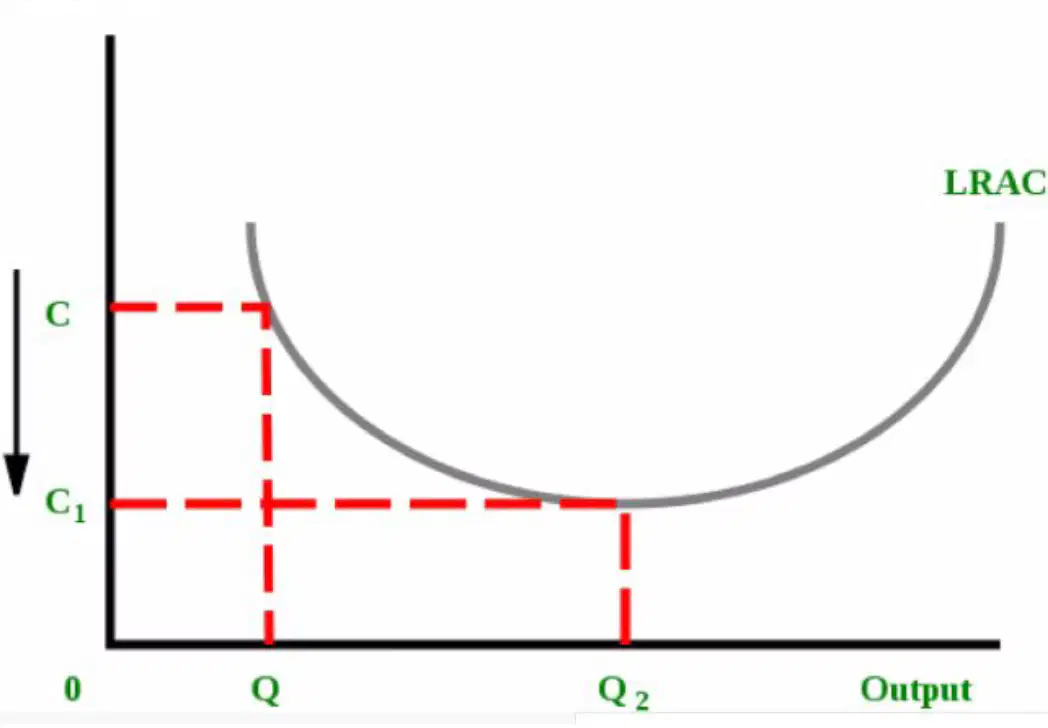
Refer to the diagram of the Long Run Average Cost (LRAC) curve. Fill in the blank: As output increases from 0 to Q2, the average cost _______.
decreases
increases
remains constant
fluctuates
A firm that increases its scale of operation to a point where it encounters rising long run average costs is said to be experiencing what?
Internal diseconomies of scale.
External economies of scale.
Constant returns to scale.
Internal economies of scale.
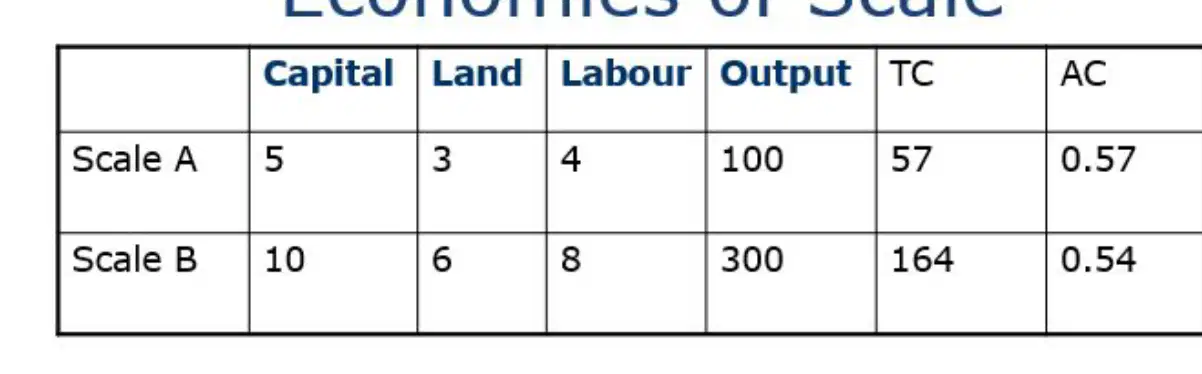
Refer to the table on Economies of Scale. What is the output for Scale B?
100
300
57
0.54
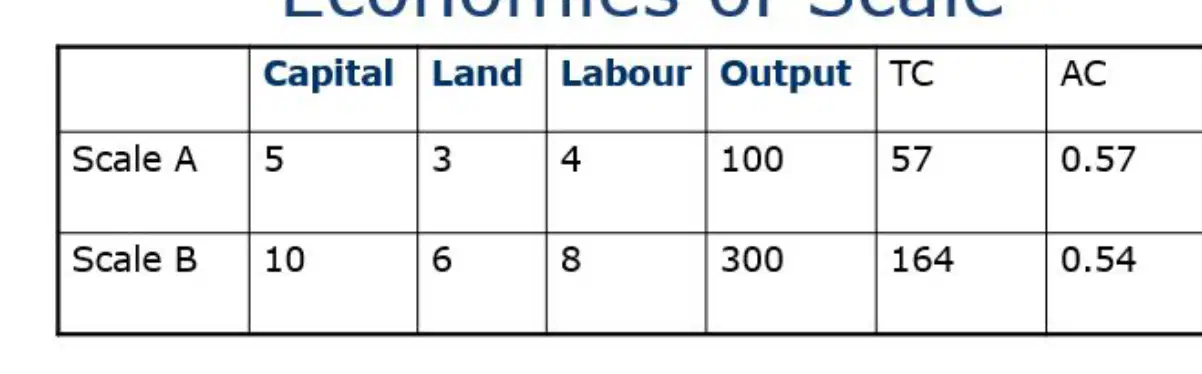
What is the Average Cost (AC) for Scale A?
0.54
0.57
57
164
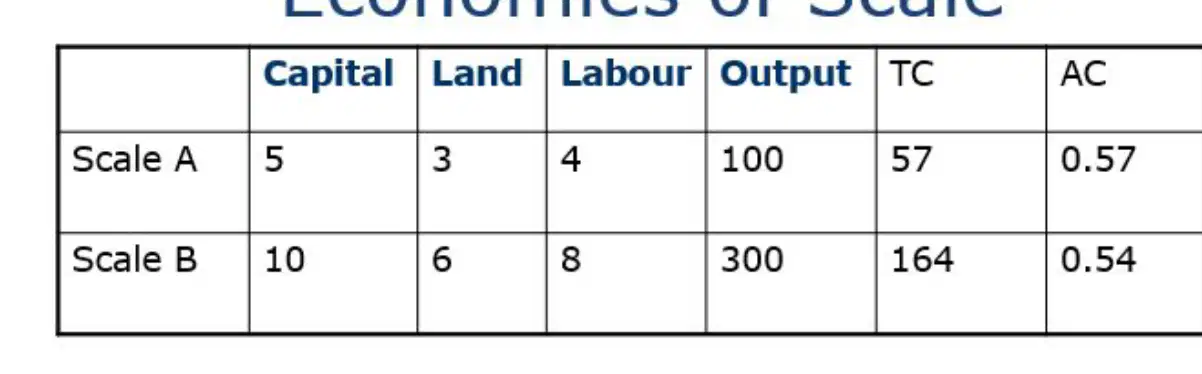
Refer to the table on Economies of Scale. Fill in the blank: The Total Cost (TC) for Scale B is _____
164
142
180
200
Why do overall 'costs' rise but unit costs can fall when the scale of production increases?
Because fixed costs are spread over more units, reducing unit cost, while total costs increase with higher output.
Because both total and unit costs always increase with scale.
Because unit costs rise due to inefficiency at higher scales.
Because overall costs and unit costs are unrelated.
Fill in the blank: Sunk costs are all costs incurred or committed in the past that cannot be changed by any decision made now or in the future. Sunk costs should not be ________ in decisions.
considered
ignored
included
analyzed
Sunk costs should be considered in decisions.
True
False
Sunk costs are:
costs that cannot be recovered once incurred.
costs that are yet to be paid.
costs that are variable in nature.
costs that are directly related to production.
Which of the following statements is true about sunk cost?
A) Sunk cost affects future costs and can be changed by future actions.
B) Sunk cost does not affect future costs and cannot be changed by any current or future action.
C) Sunk cost is always relevant in decision making.
D) Sunk cost is the same as opportunity cost.
Fill in the blank: Spending on advertising during product launching is considered a _______ cost when taking a decision on continuance of product.
sunk
variable
fixed
incremental
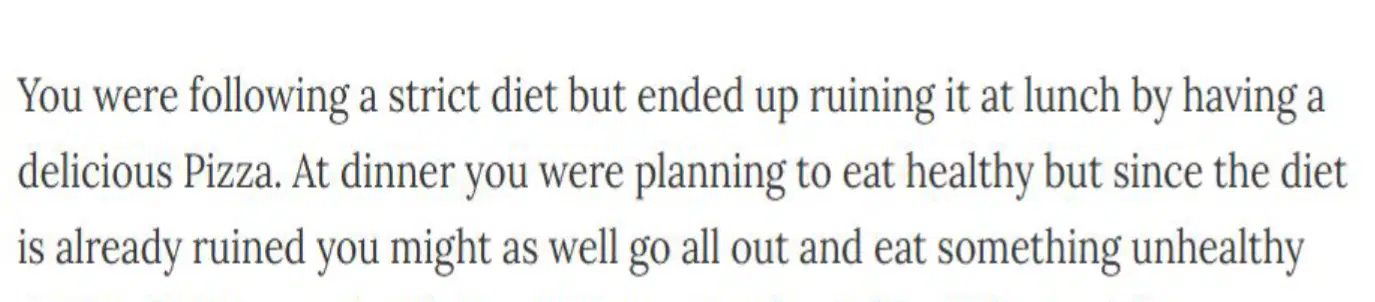
What is the main psychological concept illustrated in this passage?
Confirmation bias
Sunk cost fallacy
Placebo effect
Anchoring bias

