
Font size
 Worksheets
AP Biology Unit 1.1-1.4 Review Questions
Total questions: 70
Worksheet time: 1hrs 1mins

Water is composed of these 2 elements, ____ and ____, in a 2 to 1 ratio
Helium, Gold
Hydrogen, Oxygen
Hydrogen, Fluorine
Helium, Oxygen

A covalent bond is the term used to describe the bond type in which atoms _____ electrons.
share
transfer
steal
lose
Why is water polar? Identify the element that is more electronegative and explain why that causes the molecule to become polar.
True or False: A hydrogen bond is a weak bond interaction between the positive and negative regions of two separate molecules
True
False
When two of SAME molecules form hydrogen bonds with each other this is called (a) .
When 2 DIFFERENT molecules for hydrogen bonds with one another this is known as ADHESION
True
False

What allows this Water Strider to walk on water?
Collusion
Van der Waals forces
Magnetism
Surface Tension

Why does ice float in a drink of water?
Hydrogen Bonds typically occur between atoms of hydrogen involved in this type of bond:
Ionic
Nonpolar Covalent
Polar Covalent
Nonpolar AND Polar Covalent

The Oxygen atoms in the molecule shown have this charge:
Positive
Partial Positive
Negative
Partial Negative
The Hydrogen atoms in the molecule shown have this charge:
Positive
Partial Positive
Negative
Partial Negative
Evaporative cooling
Cools down an animal's body
Cools down the environment
Cools down both an animal's body and the environment


Which of the following statements is true about buffer solutions?
They maintain a constant pH when bases are added to them but not when acids are added to them.
They maintain a constant pH when acids are added to them but not when bases are added to them.
They maintain a constant pH of exactly 7 in all living cells and biological fluids
They maintain a relatively constant pH when either acids or bases are added to them.
They are found only in living systems and biological fluids.
Hydrophobic substances such as vegetable oil are
nonpolar substances that repel water molecules.
nonpolar substances that have an attraction for water molecules
polar substances that repel water molecules
ar substances that have an affinity for water.
charged molecules that hydrogen-bond with water molecules.
Water's high specific heat is mainly a consequence of the
small size of the water molecules.
high specific heat of oxygen and hydrogen atoms.
absorption and release of heat when hydrogen bonds break and form.
fact that water is a poor heat conductor.
inability of water to dissipate heat into dry air.
Water is an excellent solvent. Select the property that justifies this statement.
as a polar molecule, it can surround and dissolve ionic and polar molecules
it forms ionic bonds with ions, hydrogen bonds with polar molecules, and hydrophobic interactions with non polar molecules
it forms hydrogen bonds with itself so cohesion is possible
it is liquid and will adhere to many substances
Which macromolecule is primarily responsible for enzyme catalysis, cell structure, and immune response?
Carbohydrates
Proteins
Lipids
Nucleic acids
Which macromolecule serves as a long-term energy storage molecule, insulation, and component of cell membranes?
Proteins
Carbohydrates
Nucleic acids
Lipids
Nucleic acids play a crucial role in:
Enzyme function
Energy storage
Hereditary information
Lipid synthesis
How does the R group of an amino acid affect the folding of a protein?
It determines the protein's color.
It affects the protein's solubility.
It determines the protein's pH.
It influences the protein's 3D structure and function.
Which elements are commonly found in carbohydrates?
Carbon, hydrogen, oxygen
Carbon, hydrogen, nitrogen
Carbon, oxygen, phosphorus
Carbon, sulfur, nitrogen
Which elements are present in nucleic acids?
Carbon, hydrogen, oxygen, nitrogen, phosphorus
Carbon, oxygen, nitrogen, phosphorus
Carbon, sulfur, phosphorus
Carbon, hydrogen, oxygen
Lipids are characterized by their high content of which elements?
Carbon and hydrogen
Carbon, nitrogen, and oxygen
Carbon, oxygen, and sulfur
Carbon, hydrogen, and phosphorus
What process breaks down macromolecules into their smaller subunits?
Dehydration synthesis
Hydrolysis
Transcription
Translation
Which macromolecule commonly contains phosphorus?
Carbohydrates
Proteins
Nucleic acids
Lipids
The building blocks of proteins are:
Amino acids
Nucleotides
Monosaccharides
Fatty acids
The building blocks of nucleic acids are:
Amino acids
Nucleotides
Monosaccharides
Fatty acids
What are the four main types of macromolecules required by living organisms?
Sugars, fats, minerals, water
Proteins, lipids, carbohydrates, nucleic acids
Vitamins, enzymes, water, sugars
Amino acids, minerals, vitamins, nucleotides
What is the main function of carbohydrates in living organisms?
Storing genetic information
Providing energy
Catalyzing chemical reactions
Building cell membranes
Proteins are composed of which elements?
Carbon, hydrogen, oxygen, nitrogen
Carbon, hydrogen, nitrogen, sulfur
Carbon, nitrogen, phosphorus, hydrogen
Carbon, sulfur, oxygen, hydrogen
How are macromolecules formed?
Through dehydration synthesis (condensation) reactions
Through hydrolysis reactions
Through nucleotide base pairing
Through oxidation-reduction reactions
Which macromolecules typically contain nitrogen?
Carbohydrates
Proteins
Nucleic acids
Lipids
Which macromolecule often contains sulfur?
Carbohydrates
Proteins
Nucleic acids
Lipids
What are the primary functions of proteins in living organisms?
Long-term energy storage
Transmitting genetic information
Catalyzing chemical reactions
Providing structural support
What significant role do lipids play in?
Storing and transmitting genetic information
Acting as enzymes in metabolic reactions
Providing immediate energy
Forming cell membranes and insulation
Which of the following is a function of nucleic acids in living organisms?
Storing and transmitting genetic information
Catalyzing metabolic reactions
Providing immediate energy
Forming cell membranes
Match the following monomers with the correct polymer as stated in the 1.3 video.
Monosaccharide
Carbohydrate
Amino acid
Protein
fatty acid
lipids
Nucleotide
nucleic acid
Match the following:

A dehydration synthesis creates proteins

Proteins can undergo hydrolysis reaction

Dehydration synthesis makes carbohydrate

Catabolism

Which of the following is common feature of the illustrated reactions showing the linking of monomers to form macromolecules?
A. Two identical monomers are joined by a covalent bond.
B. Two different monomers are joined by a covalent bond.
C. Monomers are joined by a covalent bond, and a water molecule is produced.
D. Monomers are joined by ionic bonds, and a water molecule is produced.

Which of the following is an accurate description of the process shown in Figure 1 ?
A. The linking of amino acids with an ionic bond as an initial step in the protein synthesis process.
B. The formation of a more complex carbohydrate with the covalent bonding of two simple sugars.
C. The hydrolysis of amino acids with the breaking of covalent bonds with the release of water.
D. The formation of a covalent peptide bond in a dehydration synthesis reaction.

Which statement is the most accurate description of the reaction shown in Figure 1?
A. It represents monomers linked by dehydration synthesis.
B. It represents a polypeptide chain that folds to form the tertiary structure.
C. It represents a polypeptide chain that is denatured into the primary structure.
D. It represents a polypeptide chain that is broken down through a hydrolysis reaction.
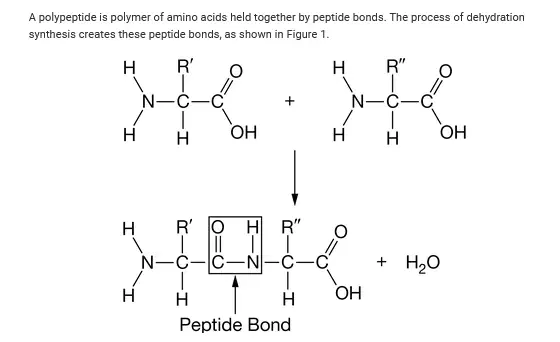
Figure 1. Amino acids are linked through the formation of peptide bonds.
As shown in Figure 1, an amino acid must have which of the following properties in order to be incorporated into a polypeptide?
A. The ability to remain stable in the presence of water molecules.
B. An R-group
that is compatible with the R-group of the last amino acid incorporated.
C. A central carbon atom that reacts with a nitrogen atom to form the peptide bond
D. The ability to form a covalent bond with both its NH2
group and its COOH
group.
Dehydration with nucleotides form what?
Carbohydrate
Nucleic Acid
Protein
Triglyceride
Process of forming bonds by removing water molecules
Dehydration
Hydrolysis
What is formed from hydrolysis of proteins?
Amino acids
Glycerol & fatty acids
Monosaccharides
Nucleotides
The process of breaking bonds by splitting water
Dehydration
Hydrolysis
What are the building blocks (or monomers) of proteins?
Nucleotides
Monosaccharides
Amino Acids
Glycerols
What are the building blocks (or monomers) of proteins?
Nucleotides
Monosaccharides
Amino Acids
Glycerols
Which of the structures below shows a protein?


Which of the structures below shows a nucleic acid?
Which of the structures below shows a lipid?
Which of the structures below shows a carbohydrate?

