
 Worksheets
Animal Senses
Total questions: 57
Worksheet time: 36mins
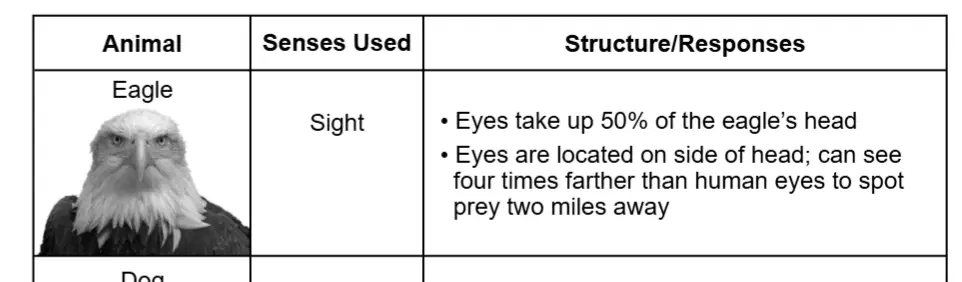
Based on the Animal Senses Model, which sense does the eagle primarily use to spot prey from a distance?
Smell
Hearing
Sight
Touch
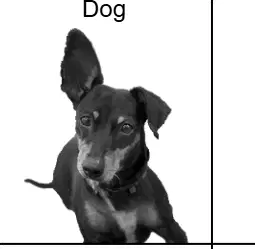
According to the Animal Senses Model, how does a dog use its sense of hearing?
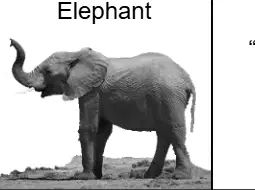
According to the Animal Senses Model, what are two ways elephants use their senses to survive in their environment?
Elephants receive sound vibrations from other elephants through their feet to find mates and use scent clues to tell the difference between two human tribes, to avoid tribes that hunt them.
Elephants use their eyesight to spot predators from miles away and use their tails to communicate with each other.
Elephants use their sense of taste to find the sweetest fruits and use their trunks to dig for water underground.
Elephants use their sense of balance to climb trees and use their sense of touch to identify different types of soil.
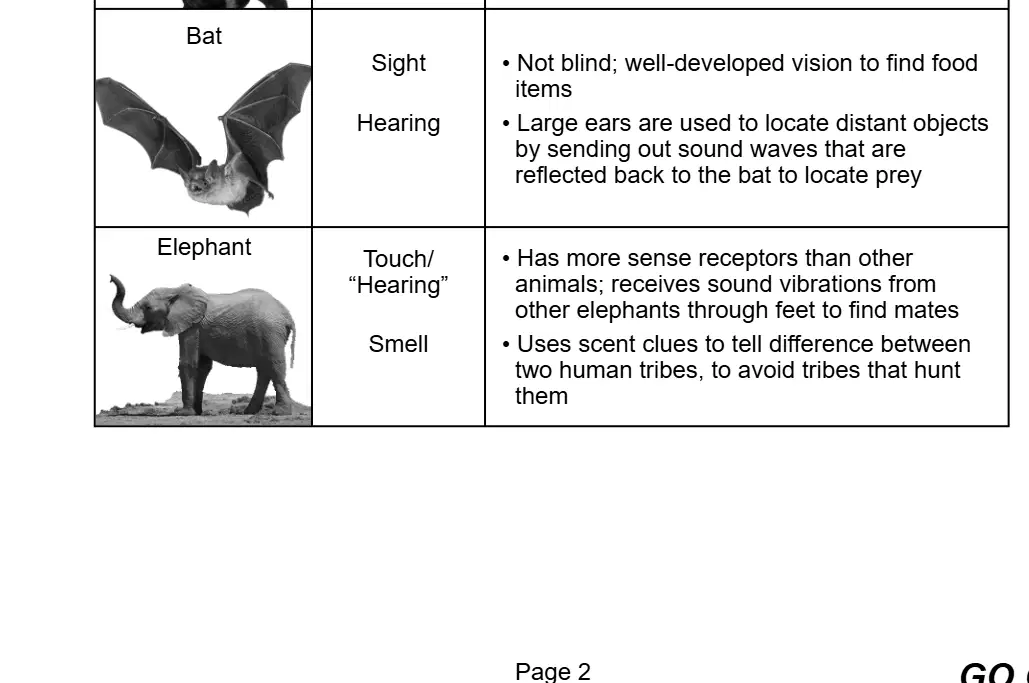
Based on the Animal Senses Model, which animal uses both sight and hearing to locate prey?
Eagle
Dog
Bat
Elephant
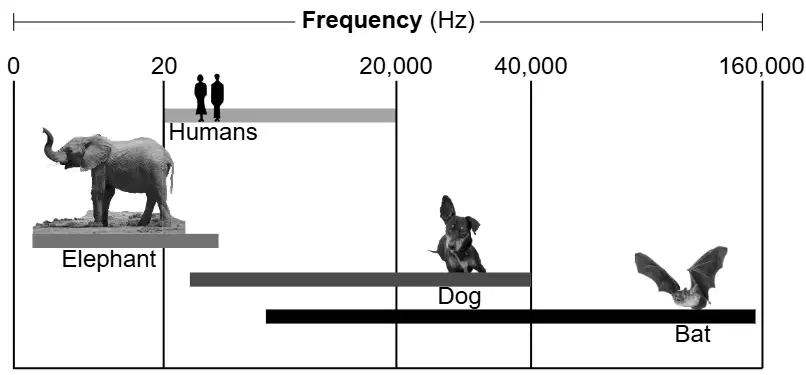
A student claimed that elephants and bats both receive sound information, but respond to the sounds differently. Which statement best supports this claim using information from the Animal Senses Model?
Elephants and bats both use sound to find food in the same way.
Elephants use low-frequency sounds to communicate over long distances, while bats use high-frequency sounds for echolocation.
Both elephants and bats ignore sound information in their environment.
Elephants and bats both respond to sound by flying.
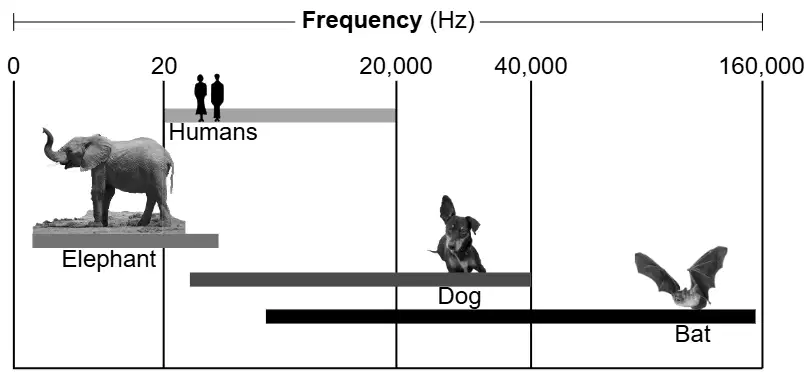
Organisms respond to information in different ways. Which statement describes how two organisms could respond to a warning sound at 35,000 Hz?
Humans cannot hear the sound to respond and elephants might stamp their feet.
Humans can hear the sound and respond and the dog might bark.
Humans cannot hear the sound to respond and the dog might bark.
Humans can hear the sound and respond and the bat might fly away from the sound. groov
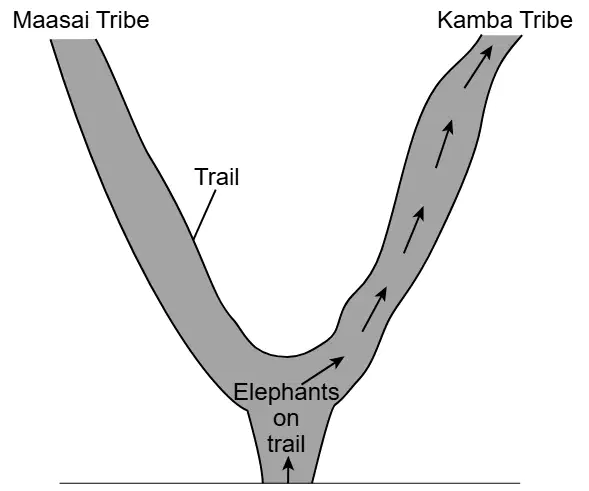
The model below represents the path that a herd of elephants would take if given the choice when encountering the scents of two different tribes. Which type of information processing allows the herd of elephants to make this choice?
Use memories stored in the brain to recall the Kamba tribe, which has hunted them in the past.
Use memories stored in the brain to recall the Maasai tribe, which has hunted them in the past.
Use memories stored in the trunk to recall the Kamba tribe, which has hunted them in the past.
Use memories stored in the trunk to recall the Maasai tribe, which has hunted them in the past.
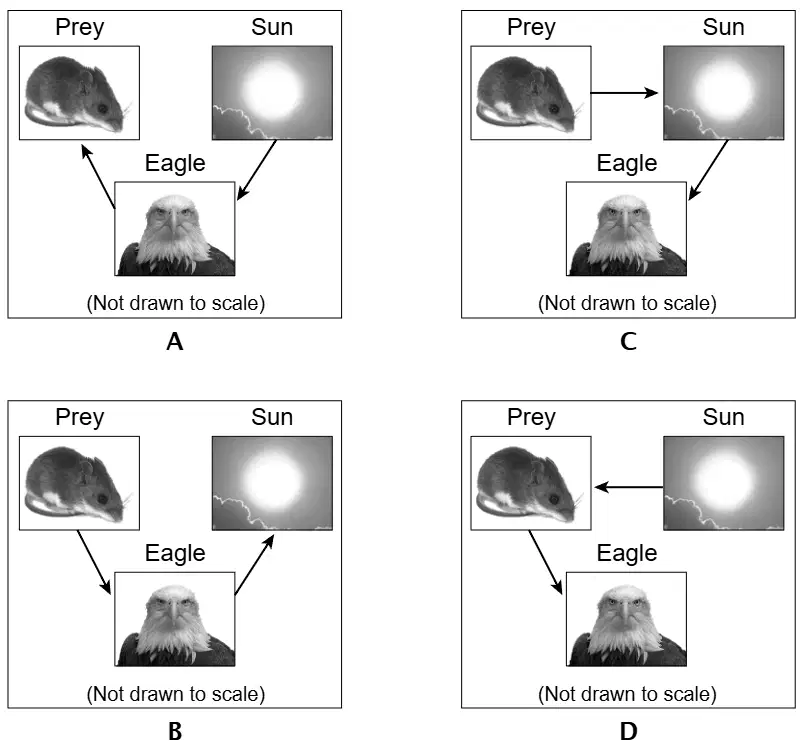
In the models below, arrows represent the path of light. Which model correctly represents the path of light that occurs between the eagle, its prey (mouse), and the Sun that allows the eagle to see its prey?
Diagram A
Diagram B
Diagram C
Diagram D
Explain, using evidence from Data Table 1, how the speed of the golf ball affects the energy of the golf ball.
As the speed of the golf ball increases, its energy increases.
As the speed of the golf ball increases, its energy decreases.
The speed of the golf ball does not affect its energy.
The energy of the golf ball is always constant regardless of speed.
Which statement about forces acting on the golf ball is supported by the evidence in Data Table 1?
Balanced forces cause the golf ball’s speed to increase as height of the bounce increases.
Unbalanced forces cause the golf ball’s speed to increase as the ball falls.
Forces on the ball are balanced when the golf ball hits the floor and bounces up.
Unbalanced forces cause the golf ball’s speed to decrease as the ball falls.
A student claims that the energy of the golf ball was converted from one form to another when the ball hit the floor. Which table accurately describes an energy conversion that occurred when the ball hit the floor and the supporting evidence?
Energy Conversion: heat energy into motion energy | Evidence: the ball got faster when it hit the floor
Energy Conversion: sound energy into motion energy | Evidence: the ball made a noise when it hit the floor
Energy Conversion: motion energy into heat energy | Evidence: the temperature of the ball decreased when the ball hit the floor
Energy Conversion: motion energy into sound energy | Evidence: the ball made a noise when it hit the floor
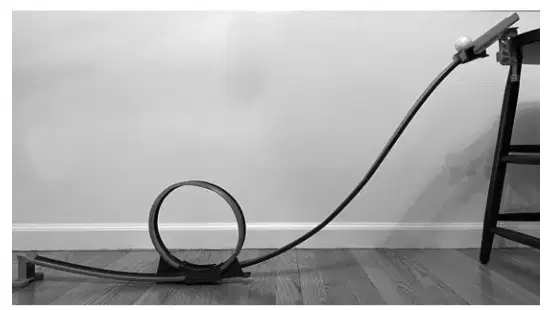
After completing the golf ball investigation, a student decided to investigate how to get a golf ball to travel from the beginning of a toy car track to the end of the toy car track. The student placed a golf ball at the top of the ramp and observed that the ball rolled down the track, began to go up the loop, then fell off the track. What problem did the student observe with the original setup?
The ball did not roll down the ramp
The ball did not go up the loop
The ball fell off the track before reaching the end
The ball reached the end of the track
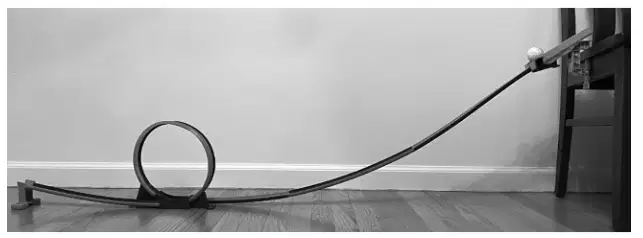
In order to solve the problem of the golf ball not reaching the end of the track, the student came up with two solutions. What is Solution 1?
Increase the height of the ramp
Decrease the length of the track
Increase the length of the track between the ramp and the loop, keeping the height the same
Decrease the height of the ramp
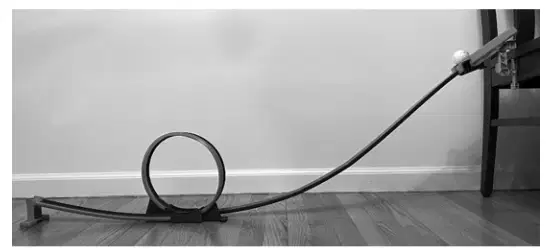
Solution 2 to the problem is to increase the _______ of the ramp, keeping the length of the track the same as the original setup.
height
width
color
material
Identify the solution that best solves the problem and allows the golf ball to travel around the loop to the end of the track. Using scientific reasoning, explain why this solution will best solve the problem.
Increase the height of the starting ramp to give the ball more speed.
Decrease the height of the starting ramp to slow the ball down.
Add obstacles before the loop to slow the ball.
Make the loop larger so the ball can go around more easily.
The student asks the question, “What will happen to the energy and motion of the two golf balls when Ball 1 is released down the toy car track?” Which table correctly predicts the changes in energy and motion that will occur when the two golf balls collide?
Change in Energy: Ball 1 will transfer no energy to Ball 2. Change in Motion: Ball 1 will push Ball 2 until they both come to a stop.
Change in Energy: Ball 1 will transfer no energy to Ball 2. Change in Motion: Ball 1 will come to a stop while Ball 2 will move at the same speed that Ball 1 moved before the collision.
Change in Energy: Ball 1 will transfer some of its energy to Ball 2. Change in Motion: Ball 1 will lose speed, while Ball 2 will gain speed.
Change in Energy: Ball 1 will transfer some of its energy to Ball 2. Change in Motion: Ball 1 will move at its original speed, while Ball 2 will gain speed.

Which bar graph represents the highest average daily air temperature that could occur in Atlanta in January and July?
[Bar graph A: January ~30°F, July ~80°F]
[Bar graph B: January ~50°F, July ~70°F]
[Bar graph C: January ~60°F, July ~70°F]
[Bar graph D: January ~70°F, July ~40°F]
Describe how the average daily air temperature changes as a person travels directly north from Houston.
The average daily air temperature increases.
The average daily air temperature decreases.
The average daily air temperature remains the same.
The average daily air temperature fluctuates randomly.
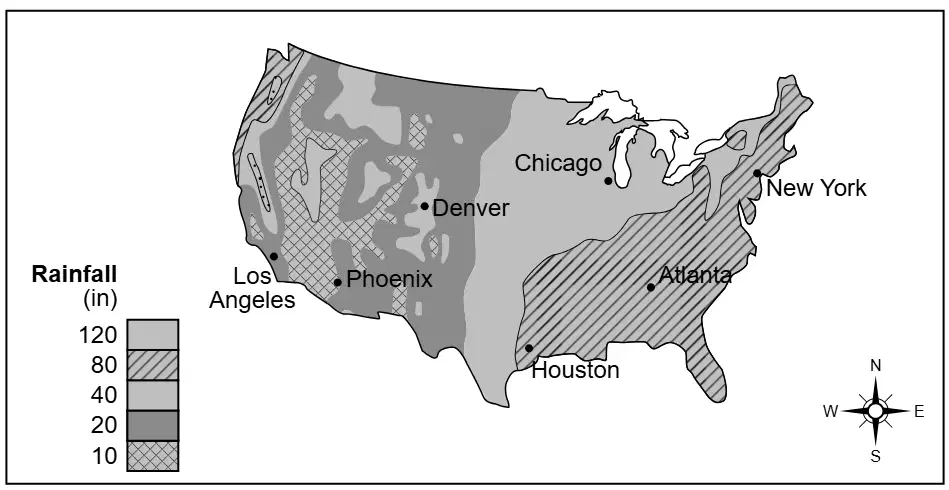
Using data from the maps, which of the following best supports the claim that, even though Los Angeles and Atlanta are located at about the same latitude, Los Angeles has a different climate than Atlanta?
Los Angeles has less rainfall and milder temperatures than Atlanta.
Los Angeles and Atlanta have the same amount of rainfall and similar temperatures.
Los Angeles has more rainfall and colder temperatures than Atlanta.
Los Angeles and Atlanta both have dry climates with little temperature variation.
Catastrophic flooding impacted Atlanta in September 2009. An estimated 10 to 20 inches of rain fell in less than 24 hours and historic flash flooding occurred. Over 20,000 homes and businesses had major damage. Which design solution would require the fewest steps to reduce future impacts of heavy rains on the residents of Atlanta?
Build new roads that redirect rainwater to a single water treatment plant.
Provide free sandbags to every resident in Atlanta to place around the outside of their homes to keep the water out.
Keep existing overflow water pipes in sewer systems open to redirect water away from the city.
Create large open fields in many parts of the city to allow rainwater to soak into the soil.
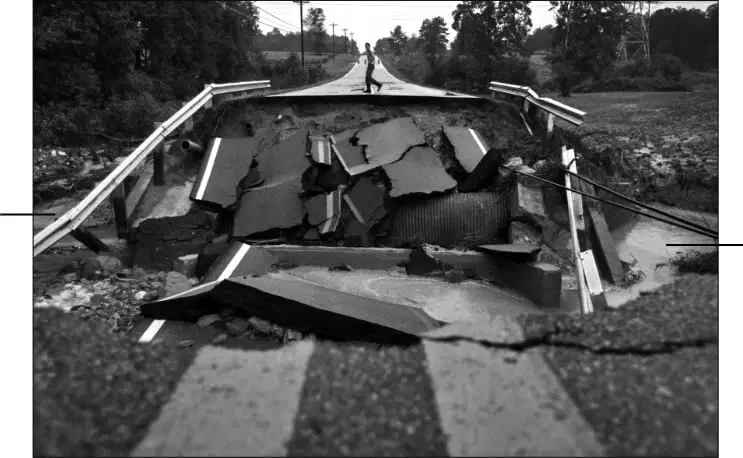
How did the heavy rainfall in 2009 most likely cause damage to this roadway?
Heavy floodwater ran over and crushed the roadway into pieces.
Lightning during the storm struck the roadway, breaking it up.
Running water under the road caused an earthquake.
Water eroded soils from under the road, causing it to collapse.
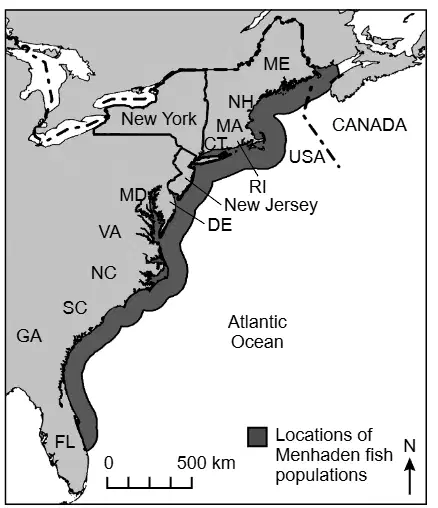
According to the map, which states are included in the range of menhaden populations along the east coast?
Maine (ME), New Hampshire (NH), Massachusetts (MA), Rhode Island (RI), Connecticut (CT), New York, New Jersey, Delaware (DE), Maryland (MD), Virginia (VA), North Carolina (NC), South Carolina (SC), Georgia (GA), Florida (FL)
California (CA), Oregon (OR), Washington (WA), Alaska (AK), Hawaii (HI)
Texas (TX), Louisiana (LA), Mississippi (MS), Alabama (AL), Florida (FL)
Illinois (IL), Indiana (IN), Ohio (OH), Michigan (MI), Wisconsin (WI)

According to the bar graph, which coastal region had the highest number of fish factories in 1955?
South Atlantic (FL-NC)
Mid-Atlantic (DE-NY)
Chesapeake Bay (VA-MD)
North Atlantic (CT-ME)
Which coastal region has shown the greatest decrease in the number of processing factories for menhaden fish from 1955 to 2015?
North Atlantic
Mid-Atlantic
Chesapeake Bay
South Atlantic
One method that the Long Island community of scientists, fishermen, and recreational boaters have used to protect the menhaden fish population is:
Implementing fishing limits on menhaden
Introducing invasive species
Increasing pollution in coastal waters
Removing all predators of menhaden

Identify the type of fishery (Industrial or Commercial Bait) that most likely had the greatest impact on the menhaden population and the health of the ocean ecosystem during the time period 1986-2010. Provide the numerical evidence from the graphs that supports your choice.
Industrial fishery
Commercial Bait fishery
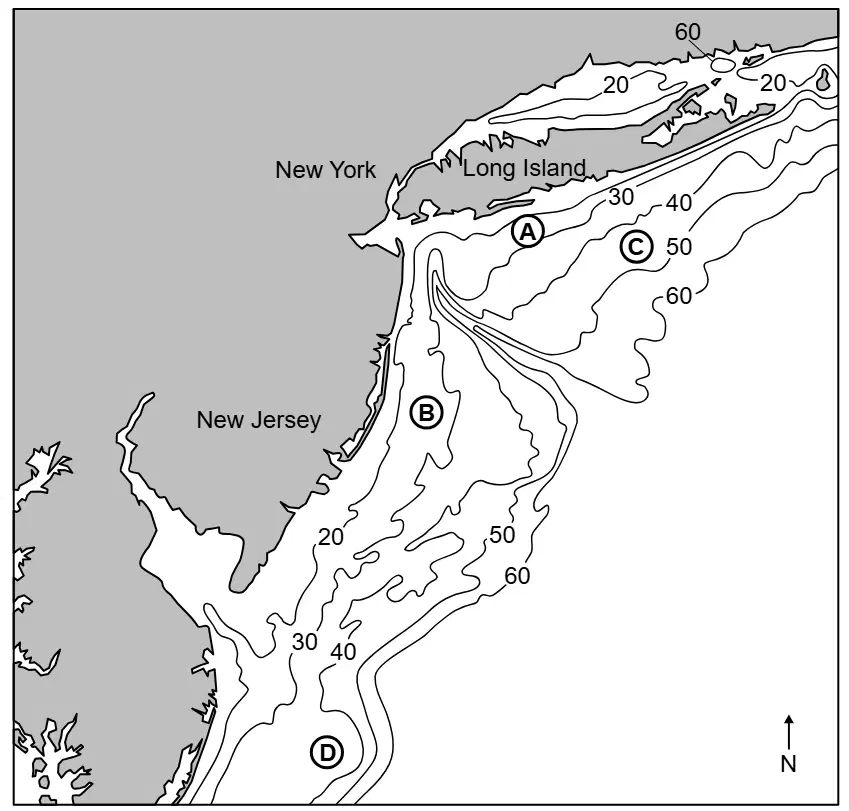
Refer to the topographic map showing ocean depth (in meters) off the coast of New York and New Jersey. What is the approximate ocean depth at location A?
20 meters
30 meters
40 meters
60 meters
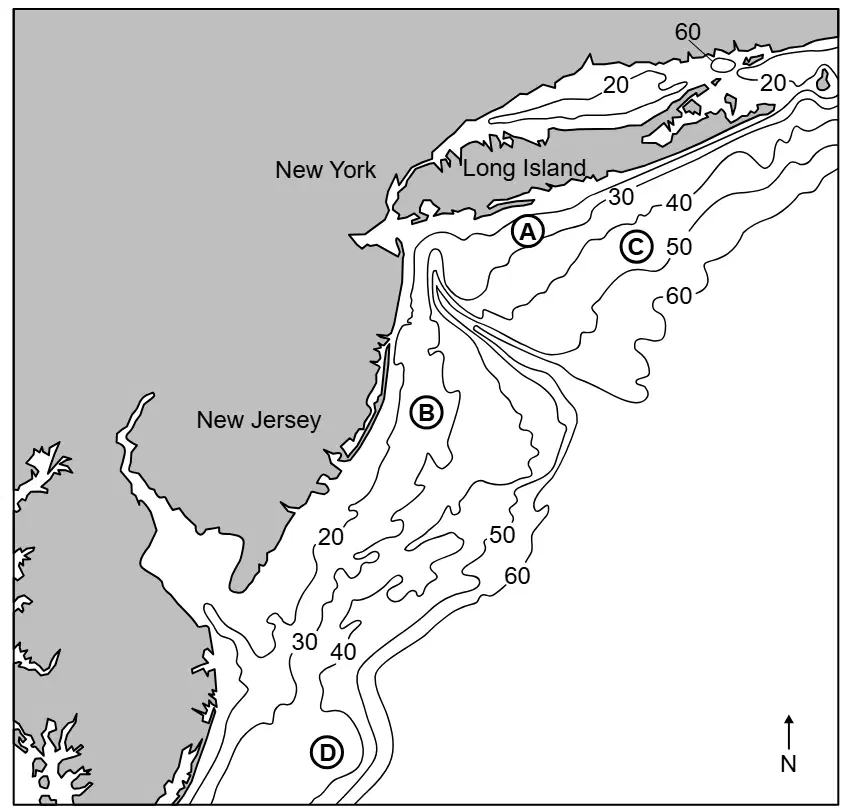
Refer to the topographic map showing ocean depth (in meters) off the coast of New York and New Jersey. The depth at location B is (a) meters.
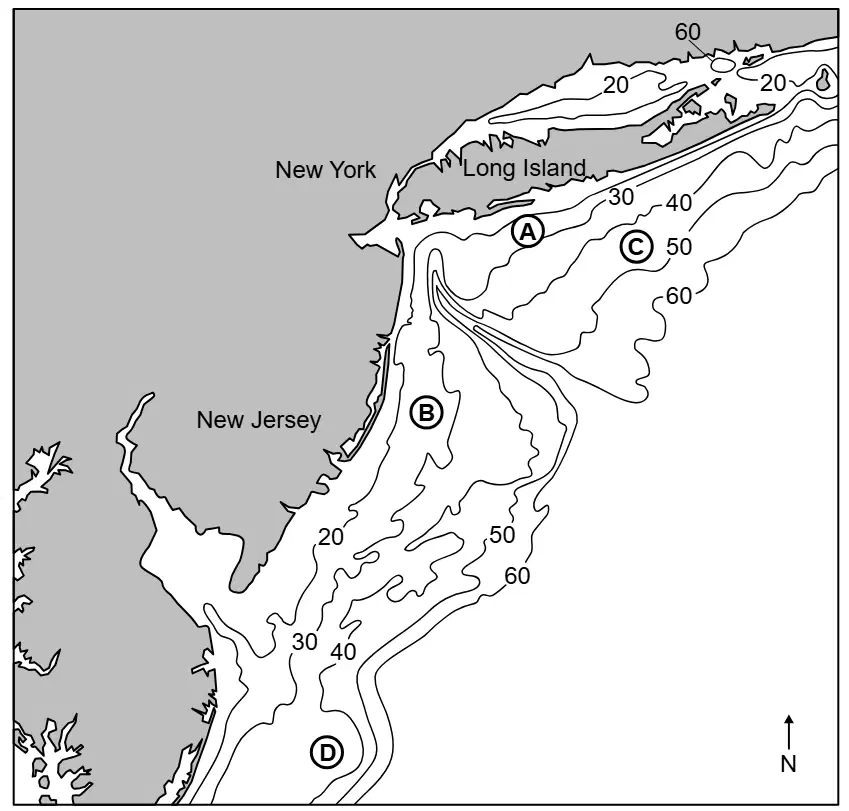
Refer to the topographic map showing ocean depth (in meters) off the coast of New York and New Jersey. Which location is at the greatest ocean depth?
A
B
C
D

Using the ocean depth data from the map and your knowledge of topographic maps, which table correctly summarizes the ocean features and evidence for one of the lettered locations?
Location A
Location B
Location C
Location D

Place a checkmark (✓) in the table below to indicate the identity of the unknown substance.
Baking Soda
Table Salt
Sugar
Cornstarch
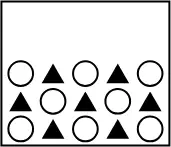
The models below represent the number and arrangement of particles in a sample of water and a sample of sugar. Key: ○ Water particle ▲ Sugar particle Which model best represents the number and arrangement of the water and sugar particles after the sample of sugar was poured into the sample of water and mixed?
Water and sugar particles mixed together
Water and sugar particles separated
Only sugar particles
Water and sugar particles mixed together
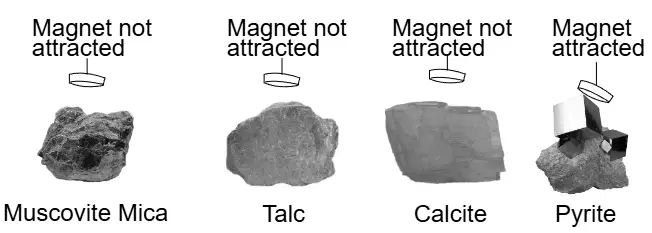
Indicate if each mineral is magnetic by writing Yes or No in Student Data Table 1.
Muscovite Mica: No, Talc: No, Calcite: No, Pyrite: Yes
Muscovite Mica: Yes, Talc: No, Calcite: Yes, Pyrite: No
Muscovite Mica: No, Talc: Yes, Calcite: No, Pyrite: No
Muscovite Mica: Yes, Talc: Yes, Calcite: Yes, Pyrite: Yes

A student makes a claim that a new substance was formed when vinegar was added to calcite. Which statement can be used as evidence to support this student’s claim?
The calcite changed color after the vinegar was added.
The vinegar droplets caused the calcite sample to melt and lose mass.
Bubbles formed after the vinegar was added to the calcite.
The surface texture of the entire calcite sample changed after the vinegar was added.

Based on the results shown in Student Data Table 2, rock A is most likely made of the mineral calcite because:
It reacts with acid and fizzes.
It is harder than glass.
It is magnetic.
It is made of large crystals.

Based on the passage about meerkats, what is the main reason the mother meerkat stands on her back legs?
To look for food
To keep lookout for predators
To dig burrows
To play with pups
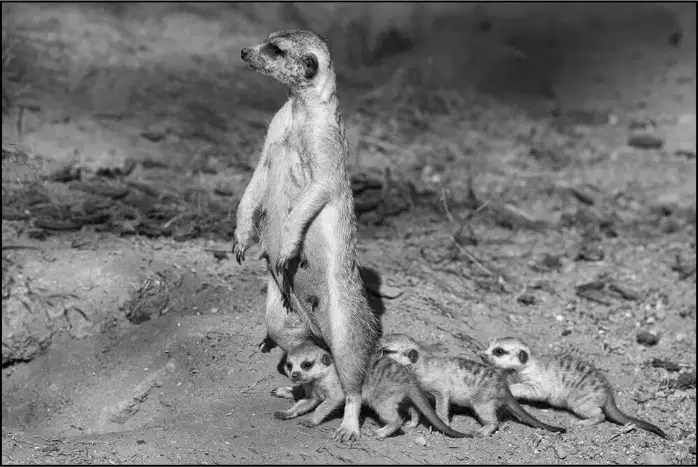
According to the passage, what are young meerkats called?
pups
cubs
calves
kits
Where do meerkats live?
South America
Southern Africa's Kalahari and Namib deserts
North America
Australia
Meerkats get all the water they need from the food they eat.
True
False
What do meerkats eat? List at least two types of food mentioned in the passage.
Insects and small mammals
Fish and seaweed
Leaves and tree bark
Fruits and flowers
What is a group of meerkats called?
mob
herd
flock
pack
Meerkats use their eyes, ears, and noses to help them survive. A student recorded some facts about meerkat senses. Fact 1: Good vision allows meerkat guards to spot predators. Fact 2: Meerkats can close their ears to prevent sand from getting into them when they dig for food and shelter. Fact 3: An excellent sense of smell helps meerkats find prey that is hiding underground. Fact 4: While searching for food and caring for pups, meerkats listen for alarm whistles. Which facts could be used to provide evidence that meerkats use sense organs in order to detect threats from other organisms?
facts 1 and 2
facts 2 and 3
facts 3 and 4
facts 4 and 1

Write the words in the boxes below in the correct order to complete the model to show the correct movement of matter among the organisms in Africa’s Kalahari Desert.
Grasses → Insects → Meerkats → Eagles
Eagles → Meerkats → Insects → Grasses
Meerkats → Grasses → Eagles → Insects
Insects → Eagles → Grasses → Meerkats
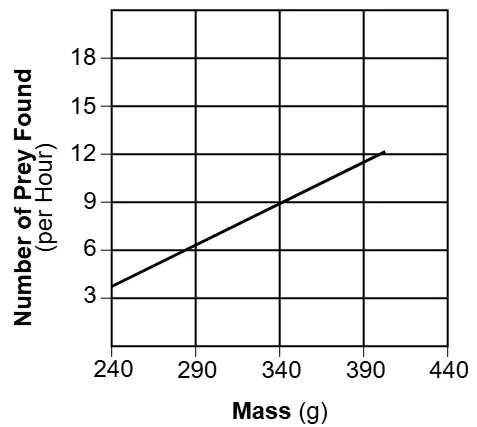
The graph below shows the relationship between the mass of a meerkat and the number of prey found per hour. What does the graph provide evidence for regarding variation in a physical characteristic in the meerkat population?
It provides evidence that variation in mass can provide an advantage for survival.
It shows that all meerkats have the same survival rate regardless of mass.
It suggests that mass has no effect on the number of prey found.
It indicates that meerkats with lower mass always find more prey.
Being a part of a mob helps meerkat pups survive because:
It provides protection from predators and increases their chances of survival, as shown in both graphs.
It makes it harder for pups to find food, decreasing their survival chances.
It causes more competition among pups, lowering their survival rate.
It leads to more injuries among pups, reducing their survival.

Traits can be influenced by the environment. Use evidence from Graph A and Graph B to support this claim.
True
False
Which animal has super sense of smell?
Dog
Cow
Goat
Cat
Which part of tiger is very sensitive?
Whiskers
Tail
Head
Legs
Name the bird who has eyes in front of his head.
Sparrow
Parrot
Peacock
Owl
How do the guard ant recognize his ants?
By smell
By seeing
By touching
By tasting
Which sense organ allows animals to receive vibrations and detect sound?
skin
nose
ears
mouth
What do bats use to sense the world around them at night?
echolocation
camouflage
touch
migration
What type of senses do sharks and rays use?
Echolocation
Magnetic Senses
Electric Senses
Touch
Which animal has a heightened sense of electroreception?
eagle
platypus
elephant
bat
snake
Which statements are true about animal senses? Choose all that apply.
Flies taste with their legs.
Snakes and spiders use echolocation.
Bats and dolphins use echolocation.
Birds and cats have a good sense of sight.
Bats use echolocation to find their way. Which of the senses do they use for this?
sight
sound
taste
touch
Bats use echolocation to find their way. Which of the senses do they use for this?
sight
sound
taste
touch

