
 Worksheets
Final Exam
Total questions: 109
Worksheet time: 1hrs 3mins
Which of the following example research questions can be used for a Chi Square goodness of fit test?
There are bags of candy with five flavors of candy in each bag. The bags should contain an equal number of pieces of each flavor. Are the proportions of the five flavors in each bag the same?
We want children with a lot of experience, some experience, and no experience shared evenly across the team. Suppose we know that 20 percent of the players in the league have a lot of experience, 65% have some experience and 15 percent are new players with no experience. Do these percentages match desired proportions?
You are studying mental health conditions. Does the proportion of your sample who report have various mental health conditions match those of the general population?
What is the Chi square test of independence?
Checks whether different variables are likely to be related or not.
Determines whether different a categorical variable follows a hypothesized distribution.
Determines if the variables are multicollinear.
Determines if the variables need to be transformed.
What is a Chi square goodness of fit test?
Determines whether a categorical variable follows a hypothesized distribution.
Checks whether different variables are likely to be related or not.
Examines if the mean scores of two groups are significantly different.
Controls for Type 1 error by reducing the p level.
Which of the following adjust for inflated type 1 error (false positive)?
Bonferroni
Holm
Tukey
Scheffe
Aikake
Which of the following is the correct procedure when sphericity is violated?
Follow the lowest epsilon
When epsilon is less than 0.75, use Greenhouse Geisser
When epsilon is more than 0.75, use Huynd Feldt
Follow the highest epsilon
What is the non-parametric equivalent of a repeated measures ANOVA?
Friedman test
Mauchly’s test
Bonferroni test
Kruskall Wallis
What does the VIF (Variance Inflation Factor) do?
Detects multicollinearity when there’s a correlation between predictors (IVs)
Estimates how much the variance is inflated due to multicollinearity of the model.
1 = not correlated; between 1 and 5 moderately correlated; greater than 5 highly correlated
Determines if the variable scores fit the model
When would you use a standardized regression coefficient (B)?
When variables are on fundamentally different scales.
When you don't get statistical significance with unstandardized coefficients
Never
When you need to run a power analysis after checking for effect size.
What are the assumptions of a linear regression?
Homogeneity of variance
Independence of observations
No multicollinearity (need uncorrelated predictors)
Normality
Linearity between predictor and residuals
What does a balanced cell design mean in Factorial ANOVA?
The sample size of all possible combinations of conditions is equal.
The sample size of all possible combinations is large.
The ANOVA cells are appropriate given the IV labels.
The main effects are equal.
How many main effects do you have for a 2 x 2 factorial ANOVA?
2
4
8
1
What is bootstrapping used for?
To resample from the collected data to re-estimate parameters and effects
To develop better research approaches
To form a normal distribution when assumptions are violated
To ensure that power is maximized
What is another term for an outside influence that can affect the outcome or explain a relationship?
Confound
Outlier
3rd variable
What can you do when homogeneity of variance is violated in a one-way between groups ANOVA?
Conduct a Welch one-way test
Conduct a Kruskal-Walls Test
Conduct a Freidman test
Use a Yates test
The following central tendency scores for exam scores are below. How would you describe this distribution and the type of effect?
mean: 78
median: 90
mode: 99
Negative skew, ceiling effect
Negative skew, floor effect
Positive skew, ceiling effect
Positive skew, floor effect
The number of standard deviations a score is above or below the mean is indicated by a(n) __________.
Z score
raw score
outlier
interval
A study indicates that in general the more fruit students eat before a test, the better they do on the test. However, beyond a certain point, the more fruit students eat, the worse they do on the test. Thus, the relation between amount of fruit eaten and test performance is an example of
a positive linear correlation.
a curvilinear correlation.
a negative linear correlation.
no correlation.
When do we use a Yate’s correction in a Chi Square test?
When the degree of freedom is 1
When the expected frequency is 5 or less
When there are repeated observations
When we use continuous variables as IVs
What are the assumptions of a Repeated Measures ANOVA?
No outliers
Normality
Linearity
Sphericity
Which of the following estimates are used for evaluation when there is a violation of sphericity?
Greenhouse-Geisser
Cox Test
Huynd Feldt
Bartlett test
What does sphericity mean?
Equal variances among the differences between all possible pairs of within-subject conditions (level of the IV)
Equal variances among the differences between all possible pairs of between-subject conditions (between IVs)
Linearity of scores between 2 group means
Normality between 2 group means
What is true of linear regression?
Forecasts an effect
Identifies the strength of a relationship between a predictor and a response variable.
How much the dependent variable changes with a change in one or more independent variables.
Determines the strength (weight) of predictors
What term is used when the difference between predicted and observed scores is large?
outlier
leverage
influence
extreme
Which of the following can be tested using a logistic regression?
Do body weight, calorie intake, fat intake and age have an influence on heart attacks? (Yes v. No)
What is the strength of the relationship between dose (low, medium, high) and effect (mild, moderate, and severe)?
What type of drink (coffee, soft drink, tea and water) is preferred based on location in U.S. and Age?
Do several measures of personality differentiate those who pursue different majors in college?
Which of the following statement(s) are true about ANOVA?
ANOVA tests group differences
ANOVA and regression rely on SS and F tests
ANOVA computes correlations and predictions.
ANOVA is used when the DV is categorical.
What is eta in a factorial ANOVA?
Sum of squares for the effect over the total sum of squares (represents the proportion of variance in the outcome that can be explained by the effect of the factor of interest).
Sum of squares for the effect over the sum of squares of the effect. Does include variance accounted by the other factors in the model.
The sum of squares divided by the degrees of freedom.
The sum of all p levels that would inflate Type 1 error.
What can you do when a between-subjects ANOVA violates the assumption of normality?
Conduct a Welch one-way test
Conduct a Kruskal-Walls Test
Conduct a Freidman test
Use a Yates test
If a study finds that the scarier the movie a person is watching, the more popcorn the person will eat, the relationship between scariness and popcorn is an example of a(n) __________ correlation.
positive linear
negative linear
curvilinear
no correlation
With Sign: N = 4; df = 3; M = 79; S2 = 18.67
No Sign: N = 4; df = 3; M = 85; S2 = 12.00
dftotal = 6; S2pooled = [(3/6)(18.67)] + [(3/6)(12)] = 9.34 + 6 = 15.34
S2M1 = S2M2 = 15.34/4 = 3.84
S2difference = 3.84 + 3.84 = 7.68; Sdifference = 2.77
t needed (df = 6, p < .05, one-tailed) = –1.943
t = (79 – 85) / 2.77 = –2.17
What is the correct statistical notation for the results?
t(6) = -2.17, p < 5%
t(6) = -2.17, p > 5%
t(6) = -1.943, p < 5%
t(6) = -1.943, p > 5%
Contingency tables in Chi Square tests
Show number of observations in groups or combinations of groups.
Are used to estimate the critical value of a given statistic.
Used to determine statistical power in a T test.
Estimates Type 1 error in an ANOVA.
Which of the following example research questions can be used for a Chi Square test of independence?
A veterinary clinic records a list of dog breeds they see as patients. The 2nd variable is whether owners feed dry food, canned food, or a mixture. Can the clinic order food based only on the total number of dogs, without consideration of their breeds?
Does the proportion of ethnicity in Las Vegas match the proportions in New York City?
Does watching violent tv shows relate to religious affiliations (Catholic, Protestant, etc.)
Is there a relation between mentorship experiences and ethnicity?
What is another name for a repeated measures ANOVA with one factor (IV)?
One way within subjects ANOVA
One way between subjects ANOVA
Mixed design ANOVA
Random effects ANOVA
Which of the following statements are true for a linear regression?
The effect size of a simple regression (R2) is equivalent to the squared correlation (r2) when dealing with one predictor and one response variable.
The effect size of a simple regression is equivalent to the squared t value of the predictors.
The effect size of a simple regression is equivalent to the estimated residuals.
The t statistic of each of the predictors sums to the effect size
To test homogeneity of variance in a linear regression
Run a Kolmogorov–Smirnov test
Create a histogram
Plot fitted values against standard residuals (want a straight horizontal line)
Run a non-constant variance test. If p > .05, there is no relationship, and therefore homogeneity of variance.
Which of the following will improve (R squared) in regression by chance?
More predictors
More dependent variables
Less dependent variables
More residuals
What does variance of scores within a treatment group indicate?
Spread of scores
Consistency of measurement
Reliability
Width of the distribution
Select all options that can test for normality of distributions.
QQ plot
Krukall Wallis Test
Kurtosis, Skew
Histogram
Welch test
When figuring out the range of scores in 95% of the population, the cut off point on the z score number line is
+1.96, -1.96
+1.96
-1.96
+2.5, -2.5
The Fisher’s test is used in Chi Square when
expected frequency is 5 or less
expected frequency is more than 5
there are repeated observations
we use continuous variables as IVs
How do you increase power in Chi Square tests?
Use simple contingency tables (less categories) and large sample sizes.
Use complex contingency tables (more categories) and small sample sizes.
Use repeated measures
Use linear approximations
How do we test for the degree for sphericity?
Epsilon
Mu
Sigma
Eta
R squared in a linear of regression is also called the
Criterion of determination
Coefficient of determination
Proportion of variance in the outcome variable that can be accounted for by the predictors
Regression error
Which of the following is true about F in a regression analysis:
Is equal to the variance not explained by the model.
Is equal to the variance explained by the extra parameters (predictors) divided by the variation not explained by the extra parameters.
Determines the indirect effects of the predictors
Indicates a mismatch between observed and expected proportions.
In the regression line equation: y = b0 + b1x1
The predictor coefficient is b1
The score of the predictor is x
Y is the predicted score
b1 is the intercept
What is partial eta in a factorial ANOVA?
Sum of squares for the effect over the sum of squares of the effect and residuals as opposed to total variance.
Sum of squares for the effect over the total sum of squares (represents the proportion of variance in the outcome that can be explained by the effect of the factor of interest).
The sum of squares divided by the degrees of freedom.
The sum of all p levels that would inflate Type 1 error.
What kind of Factorial ANOVA is this? A study looking at the effect of gender and athlete type on mental health scores.
Between group factorial ANOVA
Within group factorial ANOVA
Mixed factorial ANOVA
Combined Factorial ANOVA
If a research article presented the results of an analysis of variance as, "F (5, 64) = 3.60, p < .05," then how many groups were there in the study?
7
6
64
63
In which of the following situations would a t test for independent means be conducted?
a comparison of the SAT scores of a group of 10 students who completed a special SAT preparation course compared to the scores of students in general on the SAT
a comparison of scores of participants in a memory study where one group is assigned
to learn the words in alphabetical order and another group is assigned
to learn the words in order of length of the word
a comparison of participants' scores on a skills test before and after attending a training session intended to improve the skill
a comparison of participants' logical reasoning skills with the general population
Which of the following about epsilon is true?
The lower the number, the greater the violation.
If the epsilons are different, choose the higher number (more conservative)
F statistics does not change
Greenhouse-Geisser and Huynd-Felt corrects the degrees of freedom for the F distribution
Multiply epsilon by the degrees of freedom numerator (k-1) and the degrees of freedom denominator (k-1) (n-1).
What kind of Factorial ANOVA? A study comparing the altruism scores of different class grades (freshmen, sophomore, junior, and senior) before and after watching a documentary about poverty.
Between groups
Within groups
Mixed factorial ANOVA
Factorial ANCOVA
Tukey HSD (Honestly Significant Difference) in Factorial ANOVA
Examines all relevant pairwise comparisons between groups
Constructs confidence intervals for all comparisons
Calculates adjusted p value for any specific comparison
Is a post hoc test
Which of the following is an ideal ANOVA F ratio in an analysis?
1
0
100
-100
Joe conducts an analysis of variance. If he rejected the null hypothesis, the most likely F value is
0.64
1.01
3.57
–5.12
What is the symbol for z score cross products?
ZxZy
xy
Zxy
ZY
Interaction effect between degree attained and major studied on income. Which statement(s) are true?
The effect of degree on income depends on major studied
The effect of major studied on degree depends on income
The effect of major studied on income depends on degree
The effect of degree on major depends on income
How many interaction effects are there in a 3x2 factorial ANOVA
3
1
2
24
What is the intercept in a linear regression?
The effect size
Error
The number of units predicted variables increases after adding predictors
The mean of the predicted variable (y), if the other IVs are set to zero
If homogeneity of variance is violated in a regression analysis, you can
Use heteroscedasticity correlated covariance matrix (sandwich estimators)
Run a Holm test to check equivalence of p values
Bootstrap to find out if it is still violated
Use a Bartlett test to test against the median
How do you deal with multicollinearity in a regression analysis?
Take a composite of the IVs that are correlated
Check if interaction between the IV and its log is significant
Drop the IV(s) that are correlated
Divide the original p level by the number of possible comparisons
In an ANOVA with a between-groups population variance of 30 and a within-groups estimate of 25, the F ratio is
30/25 = 1.20
(30-25)/30 = 0.17
25/(30-25) = 5.00
25/30 = 0.83
The coefficient of determination (r^2) is .72 between temperature (x) and ice cream sales (y). Which statement is true?
Effect of type of ice cream on sales depends on temperature 72% of the time
72% of changes in temperature depends on how much people pay for ice cream
72% of the variance in sales of ice cream can be explained by temperature
72% of ice cream is affected by temperature
The probability of making a Type 1 error is ____
equal to 1 - beta
equal to beta
equal to the critical value level (p level)
never known
Which of the following is the largest effect size?
-.90
+.80
+.50
-.30
Estimated population variances for each group are 12.8, 16.3, 15.1, and 19.9. Estimated within group population variance
(12.82 + 16.32 + 15.12 + 19.92)/ (4-1) = 351.18
(12.82 + 16.32 + 15.12 + 19.92)/ 4 = 263.39
(12.8 + 16.3 + 15.1 + 19.9) / (4-1) = 21.37
(12.8 + 16.3 + 15.1 + 19.9)/4 =16.03
How would you describe this distribution and the type of effect? Mean: 78, Median: 60, Mode: 56.
Negative skew, ceiling effect
Negative skew, floor effect
Positive skew, ceiling effect
Positive skew, floor effect
How would you describe this distribution and the type of effect? Mean: 78, Median: 78, Mode: 78
Positive skew, ceiling effect
Negative skew, ceiling effect
Negative skew, floor effect
Normal
What is the definition of a main effect?
Compares only 2 specific cells
difference between
two groups (conditions) in one
grouping variable (IV)
pattern of
differences across one row will not
be the same of patterns of
differences across another row
effect of one IV within one
level of the second IV

What type of effect is this?
Main effect contrasts
Simple effects (simple main effects)
Interaction effect
Simple contrasts

What type of effect is this?
Main effect contrasts
Simple effects (simple main effects)
Interaction effect
Simple contrasts

What kind of effect is this?
Main effect contrasts
Interaction effect
Simple effects (simple main effects)
Main effect

What type of contrast is this?
Main effects contrast
Interaction effect
Simple effects (simple main effects)
Simple contrasts
What type analysis is this? Are there differences in stress scores (ratio) across 3 different occupations and 2 different cities?
factorial ANOVA: between group design
factorial ANOVA: mixed design
factorial ANOVA: within group design
ANOVA
What kind of analysis is this? Are there differences in stress scores (ratio) across 3 different occupations and 2 times points (early. mid career)?
factorial ANOVA: between group design
factorial ANOVA: mixed design
factorial ANOVA: within group design
ANOVA
How many IVs in a 2 x 2 x 3 x 5 Factorial ANOVA?
5
4
60
None of the above
What is true of a repeated measures design?
Error variance is smaller
Reduces individual differences not associated to conditions
Participants serve as their own control, more power, lower sample size needed
Error variance is higher
Variance of the paired differences between conditions (e.g., time) is the same for all comparison levels of a factor
Normality
Homogeneity of variance
Linearity
Sphericity
If Mauchly's test is violated, the F ratio becomes inflated
True
False
Which choices are true about epsilon?
epsilon is 1, sphericity is met
epsilon is <1, sphericity is not met
epsilon is >1, sphericity is not met
none of the above
Which of the following is the least conservative estimate of epsilon?
Lower bound
Wilcoxon estimate
Huynh-Feldt estimate
Greenhouse-Geisser estimate
Which of the following is the most conservative estimate of epsilon, which is typically not used?
Lower bound
Wilcoxon estimate
Huynh-Feldt estimate
Greenhouse-Geisser estimate
When should you use Greenhouse-Geisser?
If GGe < .75
If GGe > .75
When GGe is 0
None of the above
When sphericity is violated, the new degrees of freedom is (k = groups, n = # of scores)
df(num) = k - 1; df(error) = (k - 1)(n - 1)
df(num) = k + 1; df(error) = (k + 1)(n + 1)
df(num) = epsilon(k - 1); df(error) = epsilon(k - 1)(n - 1)
None of the above
Which of the following are post hoc tests?
Scheffe
Tukey
Holm
Wilcoxon signed rank test
Kendall's W
effect size for chi square
effect size for Friedman's test
effect size for dependent t test
effect size for repeated measures ANOVA
What type of analysis would you use?
1 DV (nominal w/ multiple categories), 1+ IV(s) (continuous, normally distributed)
Dichotomous logistic regression
Ordinal logistic regression
Multinominal logistic regression
Linear discriminant analysis
1 DV (nominal, multiple categories), 1+ IV(s) (nominal, ordinal, continuous; no assumptions about data)
Dichotomous logistic regression
Ordinal logistic regression
Multinomial logistic regression
Linear discriminant analysis
When is degrees of freedom 1 in a Chi Square test?
In a 1x1 design
When there is one IV being analyzed in a goodness of fit test
In a 2x2 design
Never
What best describes a Brown-Forsythe test in an ANOVA?
determines the absolute deviation from the outcome variable and the mean
determines the deviation from the outcome variable and the mean
determines the absolute deviation from the outcome variable and the median
determines the deviation from the outcome variable and the median
What is the null hypothesis of the Levene's test?
Spread of scores is identical for all groups
The scores follow a normal distribution
The spread of scores is equal to 0 for all groups
The slope of the regression line is 0
What is the difference between an ANOVA and a Kruskal Wallis test?
An ANOVA compares group standard deviations; whereas Kruskal Wallis compares group means
An ANOVA uses Bonferroni for post hoc comparisons; whereas Kruskal Wallis cannot apply post hoc tests
An ANOVA compares group means; whereas Kruskal Wallis compares rank totals
An ANOVA compares within group variance; whereas Kruskal Wallis compares between group variance
Multiple R squared
Will decrease when you add more predictors
Proportion of variance in outcome variable explained by the regression
Influences sphericity
Reflects the proportions in chi square analysis
Which of the following is an ideal Kruskal Wallis H for an analysis?
1
100
0
-100
Which of the following is the most popular post hoc test following a significant Kruskal-Wallis test?
Nemenyi test
Dunn's test
Leverage helps identify
the "extreme" H values
the "extreme" mean values
"extreme" predictor x values
"extreme" predicted y values
You have 4 different age groups you need to compare: 5yrs, 10yrs, 15yrs, 20yrs. If you want to compare pre-teens & younger with the older groups, what would be the contrasts?
-1, 0, 0, +1
0, +1, -1, 0
-1, -1, +1, +1
0, 0, +1, -1
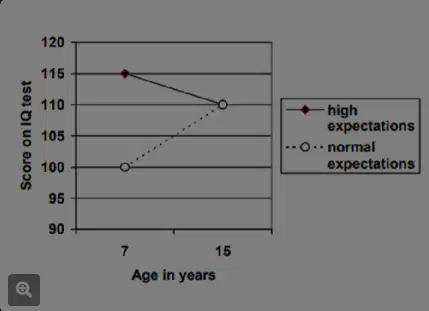
Click all statements that may apply
main effect for age
main effect for expectations
Interaction effects between years and expectations on IQ test
main effect for IQ
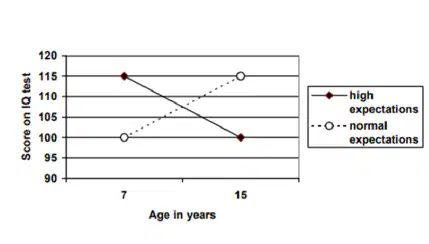
Select all statements that may apply
Interaction effect between age and expectations on IQ scores
main effect for age
main effect for expectations
main effect for IQ scores
Education administrators are trying to determine if the performance on 5 different achievement tests (numerical/continuous) can predict the program that high schoolers select: general, academic, vo/tech)
chi square
factorial ANOVA
logistic regression
repeated measures ANOVA
What is true about Type 1 error?
equal to p
equal to alpha
inflated due to violation of sphericity
inflated due to multiple comparisons
In a correlation analysis, the results were: t(50) = 2.776, p < .05
Which of the following statements is true?
sample size is 52
the results are not statistically significant
sample size is 50
the correlation coefficient is 2.776
What is a correlation coefficient?
sum of squares of ZxZy
the sum of ZxZy
the mean of the sum of squares of ZxZy
the mean of ZxZy
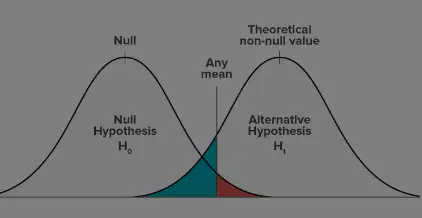
What is the red area called?
power
type 1 error
type 2 error
McNemar test
Do the proportion of participants who felt safe (yes or no) differ when before wearing a cycling helmet as opposed after putting the cycling helmet on?
Factorial ANOVA
McNemar test
Chi Square Goodness of Fit
Chi Square Test of Independence
If you are choosing to run an independent t-test, and normality is not met, what test would you run?
Wilcoxon's Rank Sum Test (Mann Whitney U)
Mauchly's test
Levene's test
If you're choosing to run a paired-samples t-test and it violates the normality assumption, what test would you run?
Wilcoxon Signed Rank Sum test
Wald's test
Welch's t test
Wilcoxon Paired Signed Rank test
When do you run a Welch's test?
Levene's test, p < .05
Shapiro Wilk's, p < .05
Levene' test, p > .05
Kruskall Wallis, p > .05
What is SS/df?
estimated variance of a distribution of scores
estimated standard deviation of a distribution of scores
standard deviation of mean scores
variance of mean scores
Shapiro Wilk's test is better than QQ plot when sample size is less than 50.
True
False
What is the effect size for Chi Square?
Epsilon
Cramer's V
Cohen's d
Eta Squared

