
 Worksheets
Q4 Benchmark Review Quizizz
Total questions: 58
Worksheet time: 41mins
What is the Big Bang Theory?
The idea that the universe has always existed in its current state
The theory that the universe began from a single point and has been expanding ever since
The belief that the Earth is at the center of the universe
The process by which stars are formed
Which model places the Sun at the center of the solar system?
Geocentric model
Heliocentric model
Asteroid model
Lunar model
What type of galaxy is the Milky Way?
Elliptical
Irregular
Spiral
Lenticular
Which of the following is a characteristic of inner planets?
They are made mostly of gas
They have many rings
They are small and rocky
They are far from the Sun
What is gravity?
The force that keeps objects moving in a straight line
The force that pulls objects toward each other
The process of planets orbiting the Sun
The spinning of Earth on its axis
Where is the asteroid belt located?
Between Earth and Mars
Between Mars and Jupiter
Beyond Neptune
Between Venus and Earth
Which of the following best describes a galaxy?
A large group of stars, gas, and dust held together by gravity
A single star and its planets
A rocky object orbiting the Sun
A moon orbiting a planet
Which of the following best describes a solar system?
A group of galaxies
A star and all the objects that orbit it
A collection of asteroids
A planet and its moons
Compare the geocentric and heliocentric models. Which statement is true?
Both models place the Sun at the center of the universe
The geocentric model places Earth at the center, while the heliocentric model places the Sun at the center
Both models place Earth at the center of the universe
The heliocentric model places the Moon at the center
Which of the following lists the correct order from smallest to largest: planet, galaxy, solar system, universe?
Planet, solar system, galaxy, universe
Solar system, planet, galaxy, universe
Galaxy, planet, solar system, universe
Universe, galaxy, solar system, planet
Why are the outer planets also called "gas giants"?
They are made mostly of rock
They are smaller than inner planets
They are made mostly of gases and are very large
They are closer to the Sun
How does gravity affect the structure of the solar system?
It causes planets to spin on their axes
It keeps planets in orbit around the Sun
It makes planets change size
It causes the Sun to move around Earth
Explain why inner planets have fewer moons compared to outer planets.
Inner planets are closer to the Sun and have less gravity to capture moons
Inner planets are made of gas and cannot hold moons
Outer planets are smaller and have less gravity
Inner planets are farther from the Sun
Given the definitions of gravity and inertia, explain how both work together to keep planets in orbit around the Sun.
Gravity pulls planets toward the Sun, while inertia keeps them moving forward, resulting in an orbit
Inertia pulls planets toward the Sun, while gravity keeps them moving forward
Both gravity and inertia push planets away from the Sun
Gravity and inertia have no effect on planetary orbits
What is the primary reason for the seasons on Earth?
The speed of Earth's rotation
The tilt of Earth's axis relative to its orbit around the Sun
The gravitational pull of the Moon
The distance of Earth from the Sun changes
Which of the following best explains why the Moon has phases?
The Moon's distance from Earth changes
The Moon's surface temperature varies
The Moon rotates on its axis
The relative positions of the Earth, Moon, and Sun
What causes a solar eclipse?
The Moon passes between the Sun and the Earth
The Earth and Moon are on opposite sides of the Sun
The Earth passes between the Sun and the Moon
The Sun passes between the Earth and the Moon
What is the primary reason for tides on Earth?
The distance of Earth from the Sun
The rotation of Earth on its axis
The gravitational pull of the Moon
The gravitational pull of the Sun
What causes a lunar eclipse?
The Moon passes between the Sun and the Earth
The Earth passes between the Sun and the Moon
The Earth and Moon are on opposite sides of the Sun
The Sun passes between the Earth and the Moon
The spinning of the earth on its axis that causes day and night is called
orbit.
axis.
rotation.
revolution.
The path of an object in space around another object is a(n)
orbit.
axis.
rotation.
tilt

What event does the diagram show?
planet eclipse
solar eclipse
lunar eclipse
red eclipse

The diagram shows the relative positions of earth, the moon, and the sun. The moon is shown at four possible positions around earth. Which position of the moon could result in a solar eclipse?
1
2
3
4
Earth has seasons because:
earth rotates on its axis
the distance between the earth and the sun changes
earth's axis is tilted as it revolves around the sun
the temperature of the sun changes
The average temperature in Atlanta in June is 25 degrees Celsius, but the average temperature in December is 7 degrees Celsius. Why is the average temperature in Atlanta higher in June than in December?
The sun is hotter during June than it is during December
Earth is closer to the sun in June than it is during December
Earth's axis is tilted so that Atlanta gets more direct sunlight in June than in December
The atmosphere in Atlanta absorbs more heat from sunlight in June than in December
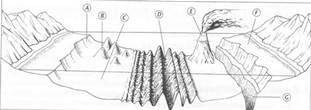
Seamounts that reach the surface of the ocean.
guyot
continental slope
abyssal plain
volcanic island

Name the feature for G
seamount
trench
mid-ocean ridge
continental shelf
What is the primary cause of global wind patterns?
Uneven heating of the Earth's surface by the sun.
The gravitational pull of the moon
The movement of tectonic plates
What causes warm air to rise?
Warm air is less dense than cold air.
Warm air weighs more than cold air.
Warm air has higher pressure than cold air.
Warm air is more dense than cold air.
What is the Coriolis Effect primarily caused by?
The Earth's gravity
The Earth's rotation
The Earth's magnetic field
The Earth's atmosphere
______________is created by unequal heating of the Earth's surface.
conduction
radiation
wind
river movement
What is the source of all energy in our atmosphere?
Water
Sun
Moon
Stars
Which layer of the atmosphere do we live in?
Troposphere
Mesosphere
Thermosphere
Stratosphere

Which atmosphere layer contains the Aurora Borealis?
Troposphere
Mesosphere
Thermosphere
Stratosphere
What happens in the Mesosphere?
Man can fly in this layer.
There are just a few clouds in this layer.
Meteors can be seen.
Satellites revolve around the Earth in this layer.

What type of heat transfer is illustrated here?
conduction
convection
radiation

What type of heat transfer is illustrated here?
conduction
convection
radiation
This type of rock forms when small particles of rocks or the remains of plants and animals are pressed and cemented together.
Igneous rocks
Metamorphic rocks
Sedimentary rocks
Intrusive rocks
What type of rock will you only see fossils in?
Igneous
Sedimentary
Metamorphic
Intrusive
A substance that forms in nature, is a solid, has a definite chemical makeup, and has a crystal structure
Rock
Mineral
Element
Mohs
This process creates beaches, barrier islands, and sand bars
chemical weathering
physical weathering
deposition
erosion
What is the breaking down of rocks?
weathering
erosion
deposition
What is the movement of sediments from one place to another?
weathering
erosion
deposition
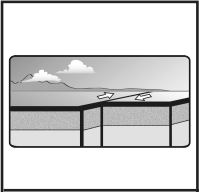
What type of boundary is this?
convergent
divergent
transform

What type of boundary is this?
convergent
divergent
transform

Energy source that cannot be replaced in our lifetime
Nonrenewable Energy
Renewable Energy
Geothermal
Alternative Energy
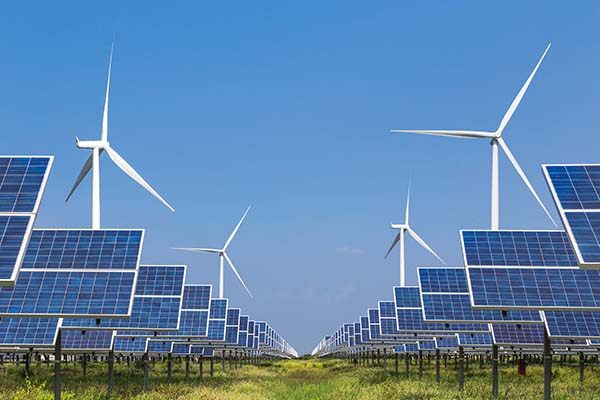
What are renewable resources?
A limited amount and cannot be replaced in a human life time.
Plastic bags
Coal, oil, and natural gas
Can be replaced in our lifetime through natural processes
How can we conserve energy?
use less coal, oil, and natural gas.
use reusable fabric bags instead of disposable plastic.
use public transportation instead of driving a car.
All of the above


What type of weather could be expected where the H's are located?
fair
rainy
stormy


