
 Worksheets
4NA MA2 revision Reactivity Series and Organic Chem
Total questions: 54
Worksheet time: 35mins
Arrange the following metals from most reactive to least reactive.
most reactive -----> least reactive
sodium
magnesium
zinc
silver
Which metal can react with cold water?
copper
lead
potassium
zinc
Which metal cannot react with water, steam or acid?
magnesium
tin
silver
sodium


The diagrams show what happens when three different metals are added to water. What are X, Y and Z?
X - Calcium
Y - Copper
Z - Potassium
X - Copper
Y - Calcium
Z - Potassium
X - Potassium
Y - Calcium
Z - Copper
X - Potassium
Y - Copper
Z - Calcium

The table shows the reactions of four different metals with water.
What is the correct order of reactivity, from most reactive to least reactive?
W→X→Y→Z
W→Z→Y→X
Z→W→X→Y
Z→W→Y→X

Most reactive
K
Mg
Carbon
Zn
Hydrogen
X
Cu
Which row correctly shows the properties of metal X?
A
B
C
D
Which of the following metals is the least reactive according to the reactivity series?
Gold
Iron
Aluminium
Potassium
How can you prevent corrosion? (more than one answer)
painting
oiling
plastic coating
cannot be prevented
Which of the following items will rust?
A plastic bottle
A gold ring
An iron bridge
A cardboard box

The picture shows an investigation into the conditions required for rusting. What is the purpose of the layer of oil in test tube B?
To absorb moisture
To prevent oxygen getting into the water
To prevent carbon dioxide from being released
To keep the water in the test tube

Look at the picture. From what you see, choose which things are needed for rusting to occur.
water only
oxygen only
oil and water
water and oxygen
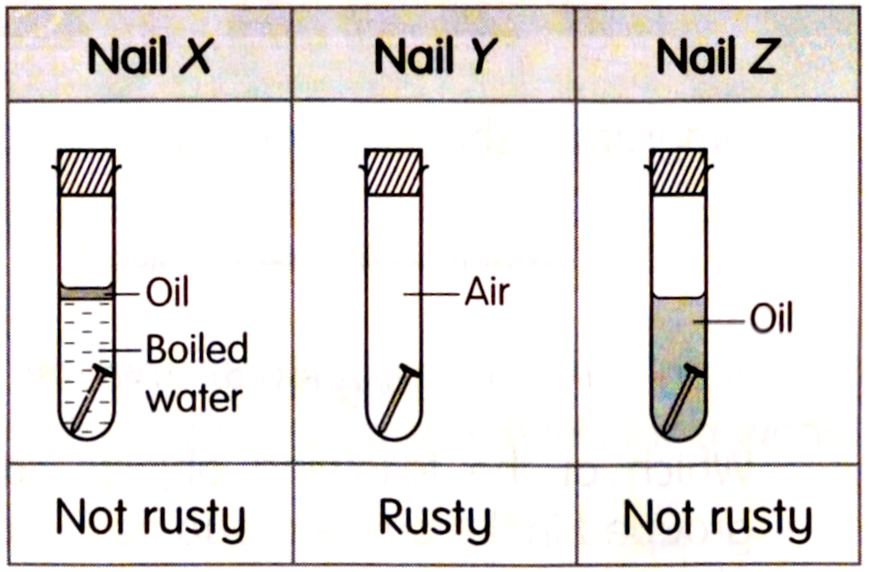
An experiment has been carried out by a group of pupils. The results of the experiment are recorded in Table 2.
What can be concluded from this experiment?
Nail X did not rust because exposed to the air and water.
Nail Y rust because exposed to the air and water.
Nail X did not rust because exposed to the oil layer.
Nail Z did not rust because exposed to water.

Which nails will rust after one week?
A
B
C
D
What is the main component in natural gas?
carbon dioxide
methane
nitrogen
oxygen
What is the gas required in the combustion of fossil fuels to produce energy?
carbon dioxide
chlorine
nitrogen
oxygen
Why can crude oil be separated into different fractions?
The fractions have different colours.
The fractions have different boiling points.
The fractions have different solubilities in water.
The fractions are in different physical states at room temperature.
Which sentence about fractional distillation of crude oil is true?
Natural gas is collected at the bottom of the fractionating column.
The hydrocarbon with the lowest boiling point remains in the furnace.
The fractions are collected one after the other during the process.
Shorter hydrocarbons are collected near the top of the fractionating column.
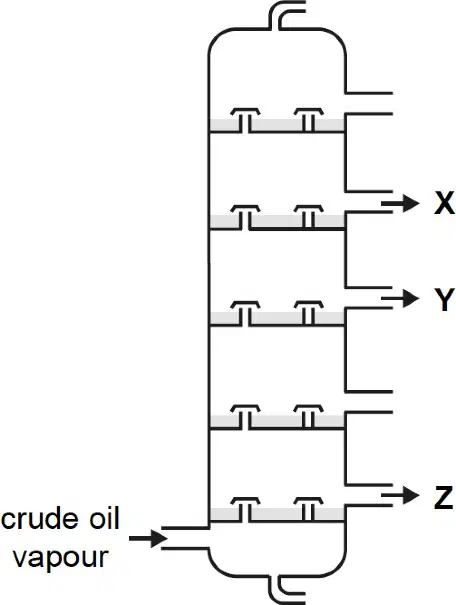
The diagram shows a fractionating column used to separate crude oil. Which of the following statements is correct?
Fraction X is more viscous than fraction Z.
Fraction X is less flammable than fraction Y.
Fraction Y has a lower boiling point than fraction Z.
Fraction Y contains molecules of larger molecular masses than fraction Z.
Biofuels are fuels made from plants and animals. One example is bioethanol, which can be produced by fermenting sugarcane. Carbon dioxide gas is given off during the production of bioethanol, as well as when it is burnt as a fuel. However, this may not result in an overall increase in the amount of carbon dioxide in the atmosphere.
Which statement explains this advantage of bioethanol as a fuel?
A similar amount of carbon dioxide is removed from the atmosphere due to photosynthesis in the sugarcane plants.
A similar amount of carbon dioxide is used up by the sugarcane plants during respiration.
Bioethanol is a renewable resource.
The combustion of bioethanol produces less carbon dioxide per carbon atom.
What is a hydrocarbon?
a mixture of hydrogen and carbon
a compound made up of hydrogen, carbon and oxygen atoms
a compound made up of hydrogen and carbon atoms only
a mixture of hydrogen, carbon and oxygen atoms
Which gas is produced during incomplete combustion?
carbon monoxide
carbon dioxide
nitrogen
oxygen
When there is insufficient supply of oxygen, which of the following reaction occurs?
Complete combustion
Incomplete combustion
Neutralisation
Displacement

Where do short chain hydrocarbons collect?
At the top
In the middle
At the bottom
What is natural gas mainly made up of?
(a)
Which of the following shows the structure of ethene?


The general formula of Alkene is
CnH2n+2
CnH2n
CnH2n+1OH
CnH2n+1COOH
The first member of the alkene series is ethene
Which of the following are unsaturated hydrocarbons?
ethane
propene
methane
ethene
Methane reacts with chlorine in substitution reaction. Which of these is an essential condition?
An acid catalyst
A low temperature
UV light
A low pressure
Alkanes react with excess oxygen to form
carbon dioxide and water
salt and water
carbon monoxide and soot
metal hydroxide and hydrogen
Which of the following is not a chemical reaction of alkenes?
combustion
substitution
addition reaction
polymerisation

What is the name of this molecule?
methane
ethene
butene
butane
Ethene (C2H6) reacts with hydrogen gas (H2). What is the product formed?


When aqueous bromine is added to an alkene, bromination occurs.
What is the expected observation?
Reddish-brown solution turns colourless
Reddish-brown solution remains reddish-brown
Brown solution turns blue black
Reddish-brown solution turns lighter brown
C10H22 is an alkane. It is cracked to yield two products. What is X? (hint: some math is required)
C10H22 --> C2H4 + X
C2H4
C6H12
C8H22
C8H18
A homologous series is a family of organic compounds with
similar chemical properties and same general formula
similar chemical properties and different general formula
different chemical properties and same general formula
similar physical properties and same general formula
Each member of a homologous series differs from the next by a
–CH2 group
–CH group
–CO2 group
–CH4 group
Which of the following can be used to distinguish between alkanes and alkenes?
add a few drops of aqueous bromine
add a few drops of Universal indicator
add a piece of blue litmus paper
add a piece of red litmus paper
State the general formula for alkane
CnH2n+2
CnH2n
CnH2n+1
CnH2n-2
Which are the following are all alkanes?
methane, ethane, propane
methane, ethene, propene
methene, ethene, propene
ethene, propene, butene
The formula for propane is
C2H4
C2H6
C3H8
C3H6
Both alkanes and alkenes are
hydrocarbons
alcohols
saturated
unsaturated
An alkane is
polyunsaturated
polysaturated
saturated
unsaturated
Which of the following reactions apply to alkenes only
cracking
substitution
addition
combustion
Polyunsaturated means having many
C=C bonds
C-C bonds
C=O bonds
C-O bonds
Which of the following shows the structure of propene?
Vegetable oil can be converted into margarine by adding…
chlorine
bromine
hydrogen
oxygen

