
 Worksheets
Review PH 506 Environmental Determinants of Health - Hybrid
Total questions: 22
Worksheet time: 16mins
In one sentence, describe something new you learned in the Environmental Determinants of Health course.
Which invited speakers talk did you like more?

Planetary health (Dr. Renzo Guinto)

Microplastics (Dr. Adriana Alvarez)

Environmental health pathways (DEHQ)

Pesticides (Dr. Briana Chronister)
Which are the three elements of One Health?
Animal health
Human health
Green technology
Environmental health
Occupational health
What are some environmental challenges faced by low- and middle-income countries?
Contaminated drinking water
Water shortages
Chemical releases
Climate change
What are the three main routes of exposure to toxins in humans?
Dermal
Inhalation
Ingestion
Exhalation
What is the main source of water for California (and Baja California)?
Desalinated water from the Pacific Ocean
The Colorado River
Underground water
The Tijuana River
Mosquitoes, ticks, fleas, and flies can transmit what type of diseases?
Zoonosis
Rabies
Vector-borne diseases
Intoxication
Which of the following are characteristics of hazardous waste?
Biodegradable
Non-toxic
Ignitable, corrosive, reactive, toxic
Stable
What was the COP21 - Paris Agreement about?
To develop research about climate change
To make international alliances to promote economic growth
To prevent the extinction of species
To limit global warming to well below 2 degrees Celsius compared to pre-industrial levels
The following are some factors that influence toxicological damage: dose and route of exposure.
True
False
The burning of fossil fuels creates: carbon monoxide, sulfur dioxide, and nitrogen oxides.
False
True
Which type of radiation damages DNA?
Thermal radiation
Ultraviolet radiation
Non-ionizing radiation
Ionizing radiation
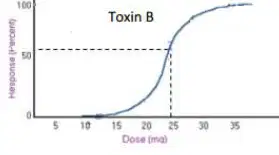
What is the LD-50 (lethal dose for 50% of the population) for Toxin B?
10 mg
25 mg
50 mg
13 mg
Self-harm is the most common type of injury in the US.
True
False
What is the difference between a toxin and a toxicant?
There is not difference
Both are toxic substances, toxicants are man-made and toxins are made by living organisms
A toxin is created in laboratories and a toxicant in the environment
Both are toxic substances, a toxin came from a toxicant
Which of the following is NOT a natural component of the air?
Nitrogen
Sulfur dioxide
Oxigen
Water vapor
Which of the following are examples of occupational diseases?
Common cold due to weather changes
Food allergies
Asbestosis, carpal tunnel syndrome, noise-induced hearing loss
Flu, caused by a virus
Which are the three most hazardous metals/metalloids for human health?
Bismuth, selenium, chromium
Copper, zinc, aluminum
Lead, mercury, arsenic
Iron, nickel, titanium
How can we prevent foodborne diseases?
Clean once a week
Practice proper food handling techniques
Use unprocessed ingredients in cooking
Store food at room temperature
Which of the following is NOT a principle for environmental policy development?
Environmental justice
Environmental sustainability
The polluter-pays principle
Prioritizing economic growth
Which is the most important environmental regulatory agency in the US?
Environmental Protection Agency (EPA)
Occupational Safety and Health Administration (OSHA)
National Oceanic and Atmospheric Administration (NOAA)
Department of Energy (DOE)
Please share your comments about the PH506 class

