NEW
Font size
 Worksheets
Physical Science Final Exam
Total questions: 70
Worksheet time: 1hrs 13mins
Matter that has a definite volume and a definite shape is a ____________.
solid
liquid
gas
plasma
When two or more substances are physically combined, the result is a(n) ____________.
chemical change
element
compound
mixture
A type of matter formed by chemically joining two or more elements is known as a
compound
solution
colloid
suspension
The color of ink is a ____________.
physical change
physical property
chemical change
chemical property
Three examples of physical changes are
sawing wood, crushing a can, and burning a marshmallow
burning of gasoline, rotting an egg, and exploding fireworks
freezing of water, evaporation of gasoline, and rusting of a nail
boiling of water, blowing up a balloon, and melting a candle
In a solution, the substance that is being dissolved is the ____________.
solute
solvent
liquid
gas
A solution that contains more of the solute than it can normally hold at a given temperature is ____________.
saturated
supersaturated
unsaturated
mega-saturated
Which part of the periodic table indicates the number of energy levels in the electron cloud?
Group
Family
Valence electrons
Period
What is an atom’s nucleus made of?
protons and electrons
protons only
protons and neutrons
neutrons only
Atoms of the same element that have different numbers of neutrons are called
molecules
ions
protons
isotopes
Which particles determine the atomic number of an element?
protons only
neutrons and protons
neutrons only
protons and electrons
At room temperature, most metals are ____________.
Solids
Liquids
Gases
Plasma
Hydrogen is in group 1 with lithium, sodium, potassium, rubidium, cesium, and francium because it ____________
Is a metal
Is a gas
Has 1 valence electron
Has 1 energy level
Which statement about the arrangement of the periodic table is not true?
Noble gases are in the group farthest to the right
Metals are found on the left side of the periodic table
Rare earth elements are in the first column on the left
Transition metals are in the center of the periodic table
The chemical bond formed when two atoms share electrons is called a(n)
Covalent bond
Ionic bond
Metallic bond
Electron bond
Which pair of atoms will combine with each other and form an ionic bond?
C and O
C and H
Ca and Mg
Ca and Br
Which element is most likely to gain electrons in a chemical reaction?
Kr
K
Br
Ca
How does an atom of aluminum become an ion?
It gains 3 electrons
It gains 3 protons
It loses 3 electrons
It loses 3 neutrons
Which of the following is a similarity between ionic and covalent bonds?
Both include the gaining and losing of electrons
Both include the sharing of electrons
Both make the elements more stable
Both are typically found as solids at room temperature.
Why does an increase in temperature result in an increase in reaction rate?
It raises the activation energy
It causes the molecules to increase in size
It decreases the concentration of reactants
It causes an increase in the number of particle collisions
The Law of Conservation of Mass states
Mass never stays constant
Mass is always added during a chemical change
Mass is always lost during a chemical change
Mass is not lost or created during a chemical change
Which of the following observations does NOT indicate that a chemical reaction has occurred?
formation of a precipitate
production of a gas
state of matter change
heat and light released
What type of mixture is Salad dressing?
Heterogeneous
Homogeneous
Colloid
Solution
What type of mixture is trail mix?
Heterogeneous
Homogeneous
Colloid
Solution
What type of a mixture is lemonade?
Homogeneous
Heterogeneous
Colloidal
Suspension
What kind of change is burning popcorn?
Chemical change (C)
Physical change (P)
Both are physical changes (P)
Both are chemical changes (C)
What kind of change is the rusting of a fishing pole?
Chemical change (C)
Physical change (P)
Melting change (M)
Nuclear change (N)
What kind of change happens when you boil water?
Physical change (P)
Chemical change (C)
Nuclear change (N)
No change (N)
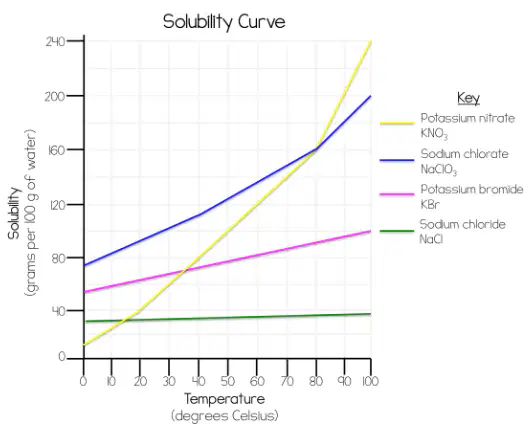
At what temperature is the solubility of KBr the same as that of KNO3?
About 70°C
About 20°C
About 50°C
About 90°C

Which salt’s solubility is the least affected by temperature?
NaCl (Sodium chloride)
KNO₃ (Potassium nitrate)
CuSO₄ (Copper(II) sulfate)
KCl (Potassium chloride)
A piece of wood that measures 3 cm by 6 cm by 4 cm has a mass of 80 g. What is the density of the wood?
Density = 1.11 g/cm³
Density = 2.22 g/cm³
Density = 0.89 g/cm³
Density = 3.33 g/cm³
A graduated cylinder has 33.5 mL of water. A piece of metal is added to the water and the new volume is now 46.2 mL. If the metal has a mass of 16.25 g, what is its density?
1.43 g/mL
0.78 g/mL
2.10 g/mL
0.52 g/mL
Which of the following must be labeled in the Bohr Model of an atom?
Only protons and neutrons
Only electrons
Protons, neutrons, and electrons
Only protons and electrons
Why do elements form compounds? What elements never form compounds and why?
Elements form compounds to achieve a stable electron configuration; noble gases never form compounds because they already have a stable configuration.
Elements form compounds to increase their atomic mass; alkali metals never form compounds because they are too reactive.
Elements form compounds to decrease their reactivity; halogens never form compounds because they are already stable.
Elements form compounds to lose energy; transition metals never form compounds because they have incomplete shells.
Name the following ionic compound: MgO.
Magnesium oxide
Magnesium hydroxide
Magnesium peroxide
Magnesium carbonate
Name the following ionic compound: Be₃P₂.
Beryllium phosphide
Beryllium diphosphide
Triberyllium diphosphide
Beryllium phosphate
Give the correct chemical formula for the following name: Ammonium fluoride.
NH4F
NH3F
NH4Cl
NH3Cl
Give the correct chemical formula for the following name: Iron (II) chloride.
FeCl2
FeCl3
Fe2Cl3
Fe2Cl
Name the following compound: P₄O₆.
Phosphorus trioxide
Phosphorus pentoxide
Tetraphosphorus hexoxide
Phosphoric acid
Name the following compound: N₂S.
Dinitrogen sulfide
Nitrogen disulfide
Nitrogen monosulfide
Dinitrogen monosulfide
Give the correct chemical formula for the following name: Tetracarbon decahydride.
C4H10
C10H4
C4H12
C2H10
Give the correct chemical formula for the following name: Triboron heptabromide.
B3Br7
B2Br7
B3Br6
BBr3
Choose the chemical reaction that is balanced and classified correctly.
4 PBr₃ → P₄ + 6 Br₂ (Balanced equation; classification: decomposition)
2 PBr₃ → P₂ + 3 Br₂ (Balanced equation; classification: synthesis)
PBr₃ → P + Br₂ (Balanced equation; classification: single replacement)
4 PBr₃ → 2 P₂Br₄ (Balanced equation; classification: decomposition)
Balance the following chemical equation: ____N₂ + ____O₂ → ____N₂O₅
1 N₂ + 5 O₂ → 2 N₂O₅
2 N₂ + 5 O₂ → 2 N₂O₅
1 N₂ + 2.5 O₂ → 1 N₂O₅
2 N₂ + 2.5 O₂ → 2 N₂O₅
Balance the following chemical equation: ____CH₄ + ____O₂ → ____CO₂ + ____H₂O
1 CH₄ + 2 O₂ → 1 CO₂ + 2 H₂O
1 CH₄ + 1 O₂ → 1 CO₂ + 2 H₂O
2 CH₄ + 2 O₂ → 1 CO₂ + 2 H₂O
1 CH₄ + 2 O₂ → 2 CO₂ + 1 H₂O
Balance the following chemical equation: ____HBr + ____Mg(OH)₂ → ____MgBr₂ + ____H₂O
2 HBr + 1 Mg(OH)₂ → 1 MgBr₂ + 2 H₂O
1 HBr + 2 Mg(OH)₂ → 2 MgBr₂ + 1 H₂O
2 HBr + 2 Mg(OH)₂ → 1 MgBr₂ + 1 H₂O
1 HBr + 1 Mg(OH)₂ → 2 MgBr₂ + 2 H₂O
Complete and balance the following combustion reaction: ____C₈H₁₈ + ____O₂ →
2 C₈H₁₈ + 25 O₂ → 16 CO₂ + 18 H₂O
2 C₈H₁₈ + 18 O₂ → 8 CO₂ + 16 H₂O
C₈H₁₈ + 12 O₂ → 8 CO₂ + 9 H₂O
C₈H₁₈ + 8 O₂ → 8 CO + 9 H₂O
What does malleable mean?
able to be flattened
will break easily
able to be pulled into a wire
is shiny

This is a correct dot diagram for nitrogen (N)
true
false
Which of these is correct?


If I have 100 grams of reactants, how many grams of products should I have?
0g
100g
50g
75g
The _______ are on the left side of the equation and the _______ are on the right.
products; reactants
reactants; solutions
solvents; products
reactants; products
Choose the answer that shows this equation Balanced
N2 + O2 ----> N2O5
3N2 + O2 ----> 3N2O5
5N2 + 2O2 ----> 5N2O5
2N2 + 5O2 ----> 2N2O5
Cannot be balanced
H2 + O2 -> H2O
H2 + O2 -> H2O

Amplitude is the distance between
the crest and the trough
each wave
the middle point of a wave and the clouds
the crest or trough and the middle point of the wave
True or False: Sound needs a medium to travel through
True
False

Areas of increased pressure on a sound wave are known as a ----
Rarefaction
Compression
Frequency
Amplitude

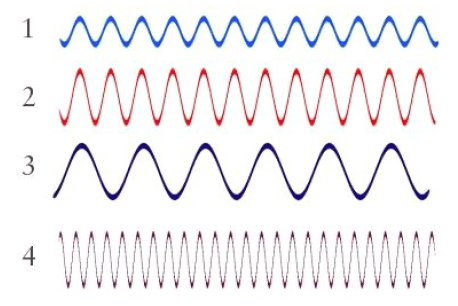
Which wave has the longest wavelegth?
1
2
3
they are all of the same