
 Worksheets
5na fa2 revision
Total questions: 47
Worksheet time: 2hrs 20mins


What happens when you turn off the electric current used to produce a magnetic field (an electromagnet)?
The magnet's strength will increase.
The magnet's strength will decrease.
The magnet's strength will remain the same.
The poles of the magnet will switch.

Two nickel bars are placed close to the N-pole of a bar magnet. The nickel bars become magnetised.
Which row states the pole induced at P, the pole induced at Q, and the type of magnetic force between P and Q?
pole induced at P = N
pole induced at Q = S
force between P and Q = attraction
pole induced at P = N
pole induced at Q = S
force between P and Q = repulsion
pole induced at P = S
pole induced at Q = N
force between P and Q = attraction
pole induced at P = S
pole induced at Q = N
force between P and Q = repulsion

The diagram shows apparatus that can be used to make a magnet.
Which metal and which power supply are used to make a permanent magnet?
metal = iron
power supply = 6 V a.c.
metal = iron
power supply = 6 V d.c.
metal = steel
power supply = 6 V a.c.
metal = steel
power supply = 6 V d.c.

Looking at the diagram of a simple electric motor, what would be a way to increase the speed of the fan?
decrease the number of turns of the coil
decrease the size of the permanent magnet
increase the fan size
increase the e.m.f. of the battery

A positive charge is moving to the left through a magnetic field that is going into the page. What is the direction of the force on the charge?
Up
Down
Into the page
Out of the page
There is no force on the charge.

A positive charge is stationary in a magnetic field that is coming out of the page. What is the direction of the force on the charge?
Up
Down
Into the page
Out of the page
There is no force on the charge.

A current (I) is moving through a wire in the upward direction through a magnetic field directed to the right. What is the direction of the force on the wire?
Up
Down
Into the page
Out of the page
There is no force on the charge.

A wire perpendicular to the page carries an electric current in a direction out of the page. There are four compasses near the wire.
Which compass shows the direction of the magnetic field caused by the current?
A
B
C
D
A current (I) is moving through a wire in the upward direction through a magnetic field directed to the right. What is the direction of the force on the wire?
Up
Down
Into the page
Out of the page
There is no force on the charge.


What does the direction of the pointing fingers mean in this picture?
the direction of the voltage
the rotation of the wire
the direction of the magnetic field
the direction of the current

A wire carries a current, creating a magnetic field around itself as shown. The current in the wire is:
Directed to the right
Directed to the left
Equal to the magnetic field
In the same direction as the magnetic field
How can the force on a wire in a magnetic field be increased?
By using a weaker magnet
By using a smaller wire
By decreasing the current
By using more current or a stronger magnet
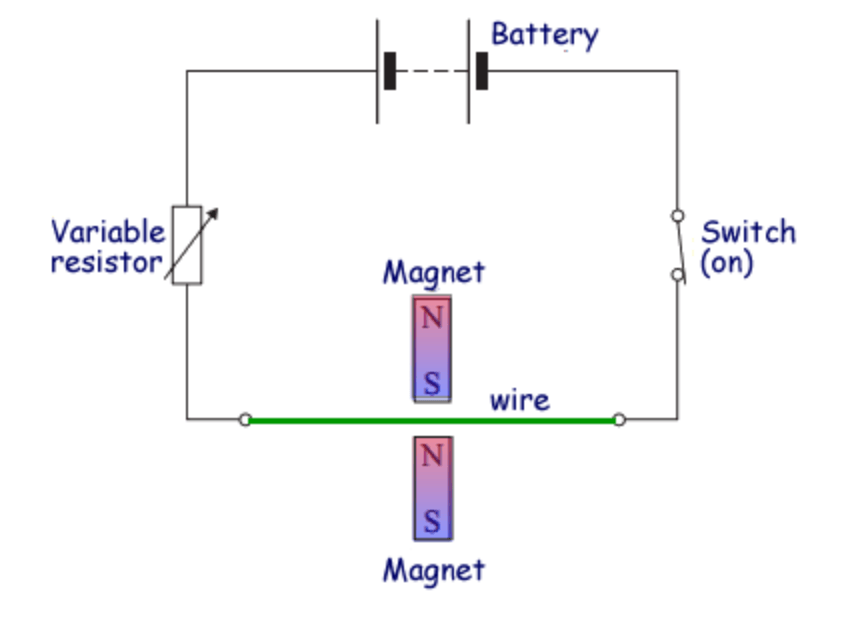

In which direction will the force act on this current-carrying wire?
up
down
left
right
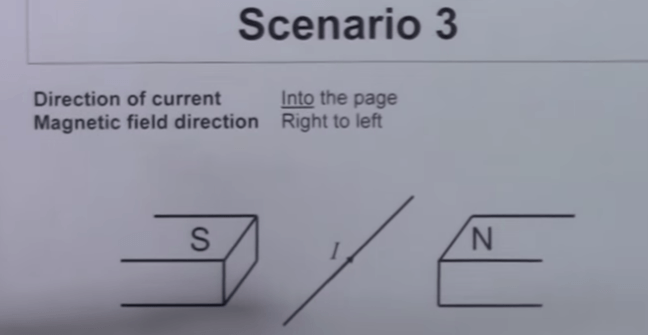
What direction would the wire move?
Up
Down
Left
Right
Match the definition: The transfer of energy from a vibrating object in waves that travel through matter.
Sound
Light
Music
Particles
True or False: Sound waves can travel through space
True
False

Which of the instrument has a higher frequency?
Piccolo (top)
Tuba (bottom)
All objects ___________ when they make sound.
Decrease in temperature
Vibrate
Increase in mass
Lose particles
Sound travels fastest through _____.
Solid
Liquid
Gas
What is the unit of frequency?
Pascal
Newton
Decibel
Hertz
Farah is doing an experiment that involves calculating the speed of a longitudinal wave. What will most likely happen if she increases the temperature in the room?
The amplitude of the wave will increase.
The amplitude of the wave will decrease.
The speed of the wave will increase.
The speed of the wave will decrease.
A tuning fork is struck and produces a sound wave. Which of the following statements is true about the wave?
A) It is a transverse wave.
B) It is a longitudinal wave.
C) It does not require a medium to travel.
D) It travels faster in a vacuum.
What is the speed of sound in air at room temperature?
343 m/s
299,792,458 m/s
1,500 m/s
1,234 m/s
A boat is using echo-sounding equipment to measure the depth of the water underneath.
The equipment in the boat sends a short pulse of sound downwards and detect the echo 4.0s later. The speed of sound in water is 1500 m/s. What is the depth of the water?
1500 m
3000 m
6000 m
12000 m
What is the range of frequencies audible to the human ear?
lower than 20 Hz
20 Hz - 20,000 Hz
higher than 20,000 Hz
0 Hz - infinite Hz

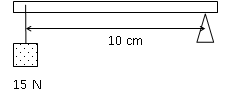
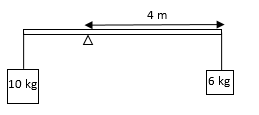
Two masses of mass 10.0 and 6.0 kg are hung from massless strings at the end of a light rod. The rod is virtually weightless. A pivot (fulcrum) is placed off center and the system is free to rotate. If the 6.0 kg mass is 4.0 m away from the pivot, how far away is the 10.0 kg mass if the system is not rotating?
0.42 m
2.4 m
4.8 m
4.2 m
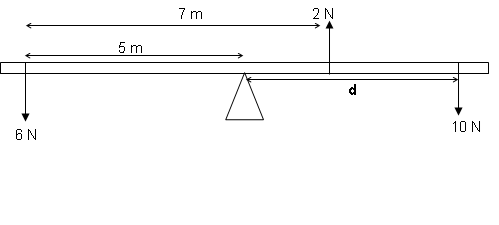
Assuming the system is in equilibrium, calculate the missing distance d
3.4 m
2.8 m
4.4 m
1.6 m
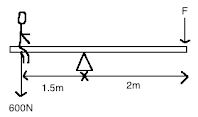
A boy of weight 600N sits on the see-saw as shown at a distance of 1.5m from the pivot. What is the force F required at the other end to balance the see-saw?
450 N
350 N
4.5 N
200 N
Moment (Nm) =
Force (N) x distance (m)
Angular Force (N°) x distance (m)
Work done (J)
Force (N) x distance (s)
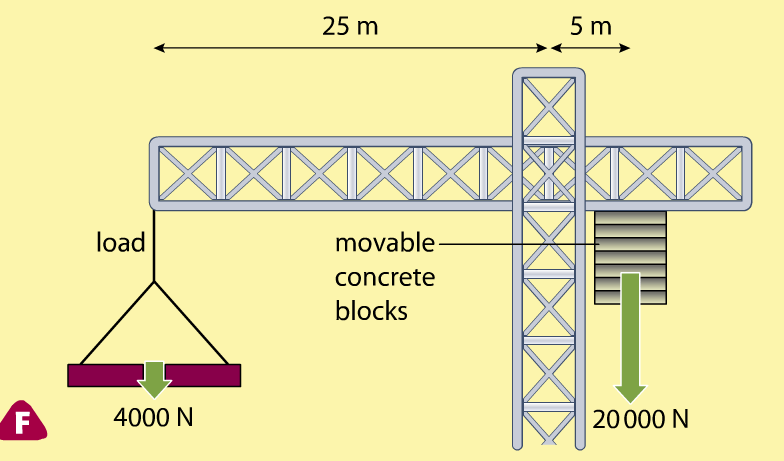
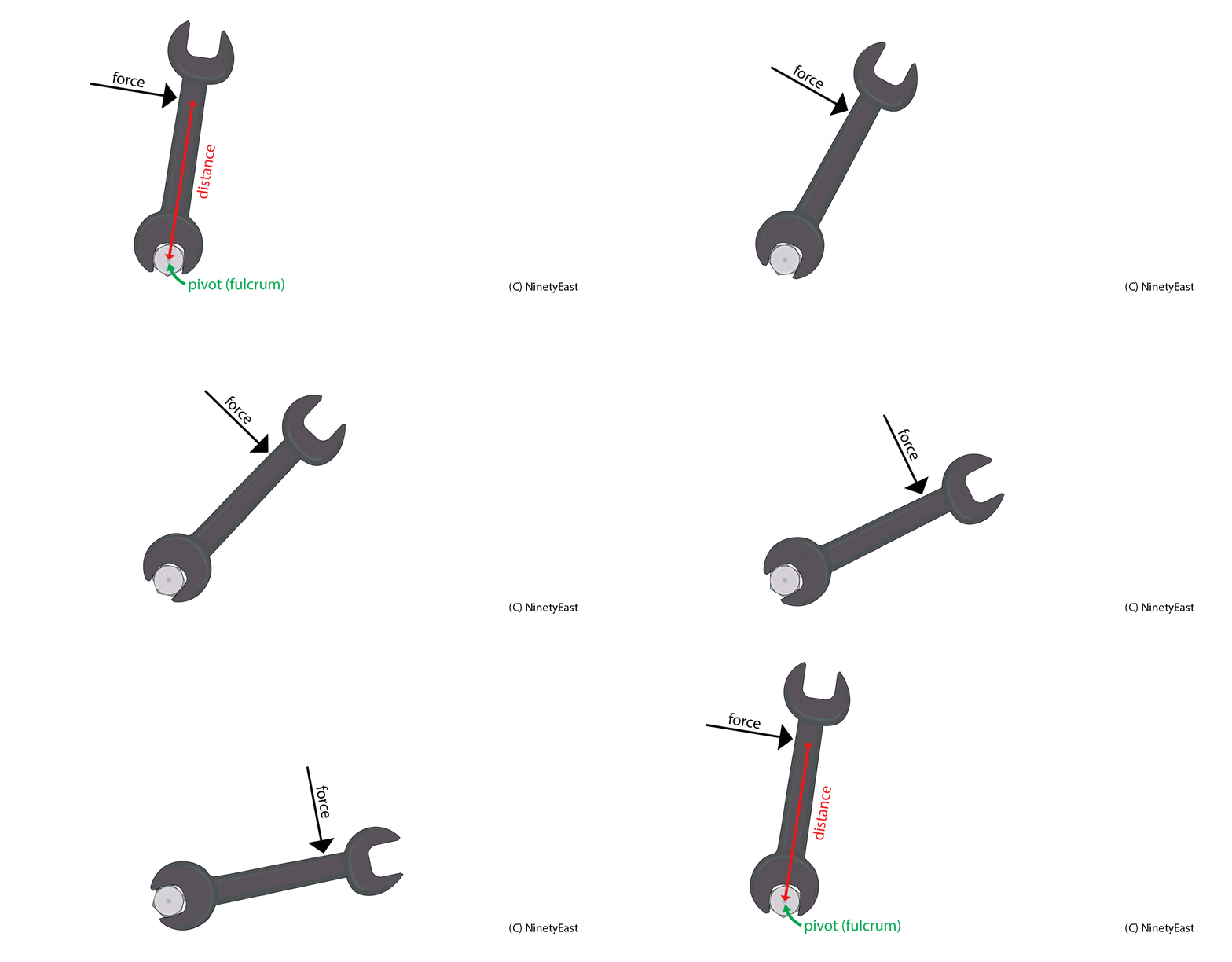
What to we call forces applied to anything that turns?
Minute
Moment
Minimum
Monument

A
B
C
D
E
To calculate a turning effect of a spanner the force is multiplied by the length of the spanner
always - if the length of the spanner is equal to the distance from the fulcrum to the applied force
never - the length must be equal to the distance from the pivot to the fulcrum
if the length of the spanner is equal to the parallel distance from the pivot to the applied force
if the length of the spanner is equal to the perpendicular distance from the pivot to the applied force

