
 Worksheets
Weather and Heat Transfer
Total questions: 65
Worksheet time: 3hrs 57mins
The sun heats the Earth________
when it feels like it
differently
unevenly

What is the direction of the cool sea breeze during a land breeze?
From the land towards the sea
From the sea towards the land
From the sea upwards
From the land downwards

During a land breeze, what causes the air to rise?
The cool air from the sea
The warm land surface
The sun heating the sea
The moon's gravitational pull

What time of day does a land breeze typically occur?
Noon
Evening
Morning
Night

What is the dew point?
The temperature at which rain begins to fall
The temperature at which the air is saturated with water
The temperature at which water begins to evaporate
The temperature at which snow starts to form

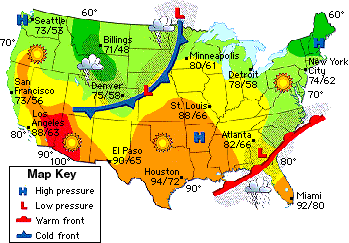
What type of weather front is depicted in the diagram?
Warm front
Cold front
Stationary front
Occluded front

What do high-pressure systems normally associate with?
Clouds and frequent precipitation
Smaller diurnal temperature changes
Dry weather and mostly clear and sunny skies
Minimized temperature changes throughout the day

What are low-pressure systems typically associated with?
Dry weather and clear skies
Clouds and precipitation that minimize temperature changes
Greater radiation at night and less sunshine during the day

What is a warm front defined as?
The transition zone where a cold air mass is replacing a warm air mass.
The transition zone where a warm air mass advances and is replacing a cold air mass.
The area where two warm air masses meet.
The boundary where air temperature does not change.

What is a cold front?
The trailing edge of a cooler mass of air at ground level that replaces a warmer mass of air
The leading edge of a cooler mass of air at ground level that replaces a warmer mass of air
A warm air mass that replaces a cooler air mass at a high-pressure system
The boundary of an anticyclone where warm air is pushed upwards
Atlanta is experiencing severe thunderstorms. What weather front is likely in Atlanta?
warm front
cold front
stationary front
occluded front
How is heat spread through the air in our atmosphere? (Warmer currents rise, cooler currents sink)
convection
radiation
conduction
friction
How is energy from the Sun transferred to Earth’s surface?
convection
radiation
conduction
friction
How is energy from Earth’s surface transferred to the air molecules that are touching it?
convection
radiation
conduction
friction
Dahlonega has been experiencing a week of lingering rain showers and cloud cover that isn’t clearing up. What weather front is likely in Dahlonega?
warm front
cold front
stationary front
occluded front
Heat can only transfer from a ______ substance to a ______ substance.
warmer, cooler
cooler, warmer
warm, warm
cool, cool
What is primarily responsible for creating wind?
Pollution in the atmosphere
The Greenhouse Effect
Uneven heating of Earth’s surface
Layers of the atmosphere
All clouds and weather activity occur in which layer of the atmosphere?
troposphere
stratosphere
mesosphere
thermosphere
Dawsonville is experiencing clear, sunny skies. Which pressure system must be in Dawsonville?
low pressure
high pressure
cold front
warm front
The temperature around the equator stay the same throughout the year. This is because the area around the equator…
Has a greater tilt than other parts of Earth
Receives less direct sunlight throughout the year
Receives more indirect sunlight than other areas
Receives similar amounts of direct sunlight all year
During the day, the land warms up faster than the ocean water and a sea breeze forms because…
Cool sea air flows toward land to replace the rising, warm air
Warm ocean air moves toward land
Cool land air flows to the ocean to replace rising warm air over the sea
Cool ocean air moves out to replace warm ocean air
At night, the land cools off faster than the ocean water and a land breeze forms because…
Cool sea air flows toward land to replace the rising, warm air
Warm ocean air moves toward the ocean
Cool ocean air replaces warm ocean air
Cool land air flows to the ocean to replace rising warm air over the sea

Explain which air mass affects the weather in Georgia.
Air mass #1 brings warm, moist weather to Georgia, because it is a continental polar air mass.
Air mass #2 brings warm, moist weather to Georgia, because it is a maritime tropical air mass.
Air mass #1 brings cold, dry weather to Georgia, because it is a maritime tropical air mass.
Air mass #2 brings cold, dry weather to Georgia, because it is a continental polar air mass.

When a warm air mass takes over a cold air mass and causes drizzly rain, what type of front occurs?
Warm Front
Stationary Front
Cold Front
Occluded Front

Which of the following are the effects of an occluded front?
Cooler weather and rain or snow
Drizzly rain and warm weather
Clear skies followed by rain
Clear, sunny weather

A city near the ocean experiences thunderstorms on a frequent basis. Which of these is the BEST explanation for this?
The cold fronts that only form over coastal areas cause thunderstorms.
The tidal variations in coastal areas causes thunderstorms.
The uneven heating of land and water in coastal areas creates fronts that cause thunderstorms.
The interactions of the waves with the landmass change the air pressure to cause thunderstorms.

Cold air is denser than warm air, so it sinks. What kind of pressure area does this create?
Dense pressure
High pressure
Low pressure
No pressure

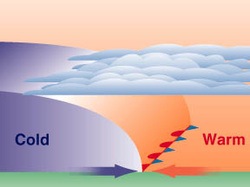
The front pictured above would bring what kind of weather?
Clear and warm followed by rain
Warm and cloudy followed by clear skies
Stormy weather followed by cool, clear skies
Rainy weather followed by warm, cloudy skies

When the air has reached 100% humidity, what will most likely follow?
Fog
Lightning
Rain showers
Wind

Most water vapor in the atmosphere comes from __________________________.
Evaporation from oceans
Evaporation from soil
Transpiration from plants
The burning of fossil fuels

What happens when a warm moist air mass and a cooler dry air mass meet at Earth’s surface?
The sky becomes clear
Winds die down
There are fewer clouds
Stormy weather builds up
Fill in the blank: At higher elevations, you have less air pressing down on you, and therefore, air pressure _________.
decreases
increases
remains the same
fluctuates

What front does this symbol represent?
warm front
cold front
stationary front
occluded front

What type of front does this symbol represent?
warm front
cold front
stationary front
occluded front

Which type of front would most likely produce thunderstorms?
Warm
Cold
Stationary
Which characteristics would you associate with a continental tropical air mass?
Dry and Cold
Dry and Warm
Wet and Cold
Wet and Warm

Which cities are probably experiencing stormy or rainy weather?
Los Angeles and Charleston
Seattle and Chicago
Chicago and Little Rock

A ________________ is an intense storm with strong winds, heavy rain, lightning, and thunder.
tornado
hurricane
thunderstorm
A _________ can from when a rapidly spinning column of low pressure air, called a funnel cloud touches the ground.
thunderstorm
hurricane
tornado
A _____________ is a large, rotating low-pressure system that forms over the warm waters of oceans near the equator.
tornado
hurricane
thunderstorm
flooding
Most hurricanes
cannot be seen from space
cross exposed land
become dangerous category 5 storms
lose their power when they move into cooler waters or moves over land
What is a front?
when four air masses meet
when three air masses meet
when two air masses meet

What type of front is shown?
Warm Front
Cold Front
Occluded Front
Stationary Front

This is the symbol for a _____________ weather front.
Cold
Warm
Stationary
Occluded

A _____________ weather front occurs two cold air masses meet and push/force the warm air in the middle upwards.
Cold
Warm
Stationary
Occluded
What type of front is stalled or still?
Cold Front
Warm Front
Occluded Front
Stationary Front
Most of the energy needed for all the processes on earth comes directly or indirectly from the sun. There is no medium or material connecting the sun to the earth. Therefore, the only type of heat transfer possible to transfer energy from the sun to the earth is
condensation
conduction
convection
radiation
At the beach, differences in temperatures create wind which transfers heat between the land and the water. The same process is also seen in the ocean as the gulf stream carries heat from the tropics northward. Heat transfer through any intermediate fluid is known as
condensation
conduction
convection
radiation
The transfer of heat by currents through liquids or gases is called
Convection
Radiation
Conduction
Which best explains how the Earth’s atmosphere is warmed?
Radiation from the sun warms the surface and the atmosphere is heated through conduction and convection.
Radiation from the sun warms the surface and the atmosphere is heated through evaporation and convection.
Convection from the sun warms the surface and the atmosphere is heated through conduction and radiation.
Convection from the sun warms the surface and the atmosphere is heated through evaporation and conduction.
What type of energy transfer occurs when two things are in direct contact (touching)?
Condensation
Conduction
Convection
Radiation
What is the main source of energy that drives all weather patterns?
Sun
Moon
Oceans
Mountains

If an object has particles that are moving very quickly, the object 's temperature is probably _____.
What is another name for Heat energy?
Conductor
Radiation
Convection
Thermal

