wayground logo

Free Printable Worksheets

Font size

S
M
L
XL
Worksheets

Chemistry Final Exam Review

Total questions: 79

Worksheet time: 3hrs 49mins

Name
Class
Date
1.

How does oxygen become an oxide ion?

a)

it loses 2 electrons

b)

it gains 2 electrons

c)

it shares electrons

d)

it releases energy

2.

What part of the atom does bonding involve?

a)

protons

b)

neutrons

c)

all electrons

d)

valence electrons

3.

How many valence electrons do MOST atoms need to be stable?

a)

2

b)

8

c)

electrons equal to number of protons

d)

electrons equal to number of neutrons

4.

Aluminum will react spontaneously with oxygen in the air to form aluminum oxide. Write the formula for the compound that is produced in this reaction.

a)

AlO

b)

Al2O3

c)

O3Al2

d)

Al6O3

5.

In order to have a stable arrangement of 8 valence electrons, metal atoms are likely to _________electrons.

a)

gain electrons.

b)

lose electrons

c)

gain protons

d)

lose protons

6.
In an ionic compound, the total positive charge of all the positive ions ___________ the total negative charge of all the negative ions.
a)
equals
b)
is more than
7.

Valence electrons are found

a)

in the innermost energy level of an atom

b)

in the middle energy levels of an atom

c)

in the outermost energy levels of an atom

8.

When an atom loses an electron, it becomes a

a)

positive ion

b)

negative ion

c)

neutral ion

d)

neutral atom

9.
How are ionic bonds formed?
a)
Transfer of electrons
b)
Sharing of electrons
10.
Why do elements bond?
a)
To be friends
b)
To create a new element
c)
To become stable
11.
Elements in the same _________ have the same number of valence electrons
a)
Row
b)
Group
c)
Metals
d)
Nonmetals
12.

How do covalent bonds form?

a)

Donating & receiving valence electrons between atoms

b)

Oppositely charged ions attract each other & form bonds

c)

Scientists are still not sure how they form

d)

Sharing valence electrons between atoms

13.

What does this picture illustrate? (Select all that apply)

a)

Sharing valence electrons

b)

Covalent bonding

c)

transferring valence electrons

d)

ionic bonding

e)

two nonmetals

14.
How many sig figs are there?
100.00
a)
1
b)
3
c)
4
d)
5
15.
How many sig figs are there?
4004
a)
1
b)
2
c)
3
d)
4
16.
How many sig figs are there?
0.000008
a)
1
b)
2
c)
6
d)
7
17.
How many sig. fig. are in the number below:
350.540
a)
4
b)
5
c)
6
d)
7
18.
86.04 + 4.04
a)
9.044
b)
9044
c)
90.08
d)
90.44
19.

33 g - 2.1 g = ?

a)

31.9 g

b)

31 g

c)

30.9 g

d)

30 g

20.
Solve & Round to Correct Sig Figs.
4.5 x 2.34 = 
a)
11
b)
10.52
c)
10.5
d)
10
21.

What is the formula for Chromium (VI) phosphate?

a)

   Cr6PO4Cr_6PO_4  

b)

Cr(PO3)2Cr\left(PO_3\right)_2  

c)

Cr(PO4)2Cr\left(PO_4\right)_2  

d)

Cr2PO3Cr_2PO_3  

22.

What is the ionic charge of the anion in the following compound K2SK_2S  

a)

+1

b)

-1

c)

+2

d)

-2

23.

How do you name this base NaOH

a)

Sodium (I) hydroxide

b)

Sodium hydro oxogen

c)

Sodium hydroxide

d)

Sodium monohydroxide

24.

How do you write the formula for this compound Diphosphorous tetrachloride

a)

2P4Cl

b)

PCl2PCl_2  

c)

P2Cl4P_2Cl_4  

d)

P2Cl5P_2Cl_5  

25.

Which type of chemical reaction has the following configuration?


Substance + Substance --> Compound


A + B --> AB

a)

Composition/Synthesis

b)

Decomposition

c)

Single Replacement

d)

Double Replacement

e)

Combustion

26.

Which type of chemical reaction has the following configuration?


Element + Compound --> Element + Compound


A + BC --> B + AC

a)

Composition/Synthesis

b)

Decomposition

c)

Single Replacement

d)

Double Replacement

e)

Combustion

27.

Which type of chemical reaction has the following configuration?


Hydrocarbon + Oxygen --> Carbon Dioxide + Water


CxHy + O2 --> CO2 + H2O

a)

Composition/Synthesis

b)

Decomposition

c)

Single Replacement

d)

Double Replacement

e)

Combustion

28.

What type of chemical reaction has the following configuration?


Ionic Compound(aq) + Ionic Compound(aq) --> Compound + Compound


AB(aq) + CD(aq) --> AD + BC

a)

Composition/Synthesis

b)

Decomposition

c)

Single Replacement

d)

Double Replacement

e)

Combustion

29.

What type of chemical reaction has the following configuration?


Compound --> Substance + Substance


AB --> A + B

a)

Composition/Synthesis

b)

Decomposition

c)

Single Replacement

d)

Double Replacement

e)

Combustion

30.
The smallest possible unit matter can be divided into while still maintaining its properties.
a)
Proton
b)
Atom
c)
Element
31.
Most of the mass in an atom is made up of _____________________?
a)
protons and electrons
b)
protons and neutrons
c)
neutrons and electrons
d)
electrons and quarks
32.

What does the 6 represent?

a)

Atomic mass

b)

atomic number

c)

chemical symbol

d)

element name

33.
If an atom has 12 positively charged subatomic particles, which of the following must it also have to be considered a neutral atom?
a)
12 neutrons
b)
12 electrons
c)
12 protons
d)
24 protons and neutrons
34.

Subatomic particles with a negative charge

a)

Electrons

b)

Neutrons

c)

Protons

d)

Quarks

35.
Subatomic particles with a positive charge
a)
neutrons
b)
atomic mass
c)
protons
d)
isotopes
36.

The smallest particle of an element.

a)

Element

b)

Molecule

c)

Atom

37.

These are found in the nucleus and have a neutral charge.

a)

proton

b)

electron

c)

neutron

38.
An atom of the element with atomic number 6 always has _____.
a)
six protons in its nucleus
b)
an atomic mass of six
c)
more than six neutrons
d)
six electron clouds
39.
How many protons are in Beryllium?
a)
4
b)
9
c)
5
d)
2
40.
What is atomic number?
a)
Number of protons in an atoms 
b)
Number of neutrons in an atom
c)
Mass of an atom
d)
Charge on an atom
41.
Which subatomic particles are found in the nucleus of an atom?
a)
Protons and Electrons
b)
Protons and Neutrons
c)
Neutrons and Electrons
d)
Protons, Neutrons and Electrons
42.
2NaClO3 (s)  2NaCl (s) + 3O2 (g)  
12.00 moles of NaClO3 will produce how many grams of O2?
a)
256 g of O2
b)
576 g of O2
c)
288 g O2
43.
Cl2 + 2KBr → Br2 + 2KCl
How many grams of potassium chloride (KCl) can be produced from 356 g of potassium bromide (KBr)?
a)
749 g
b)
223 g
c)
479 g
d)
814 g
44.
Fe2O3 + 3H2 → 2Fe + 3H2O
About how many grams of H2O will be produced from 150 grams of Fe2O3
a)
50 grams H2O
b)
60 grams H2O
c)
5000 grams H2O
d)
6000 grams H2O
45.
Given the following reaction, 2 NaClO3 (s) --> 2NaCl (s) +3 O2 (g)  12.00 moles of NaClO3 will produce how many grams of O2?
a)
256 g of O2
b)
576 g of O2
c)
288 g O2
46.
N2 +  3H2 −->  2NH3 
How many moles of hydrogen are needed to react with 2 moles of nitrogen?
a)
6
b)
2
c)
3
d)
1
47.
How do I move from grams to moles
a)
multiply by molar mass
b)
divide by molar mass
c)
multiply by Avo number
d)
divided by Avo number
48.
How many particles are in a mole?
a)
602
b)
602 million
c)
602 moles
d)
6.02 x 10²³
49.
CH4 + 2 O2 → CO2 + 2 H2O
How many moles of carbon dioxide are produced from the combustion of 110 g of CH4?
a)
13.7 mol
b)
2.75 mol
c)
6.11 mol
d)
6.85 mol
50.
B2H6 + 3O2 -->2 HBO2 + 2 H2O
 What mass of O2 will be needed to burn 36.1 g of B2H6?
a)
13.8 g O2
b)
3.86 mol of O2
c)
125.2 g O2
51.

What is the pH range of an acid?

a)

4-6

b)

1-7

c)

1-6

d)

8-14

52.

The strongest bases have pH values close to

a)

0

b)

14

c)

7

d)

5

53.

Which process involves the reaction between an acid and a base to form water and a salt?

a)

A. Saponification

b)

B. Esterification

c)

C. Neutralization

d)

D. Fermentation

e)

E. Hydrolysis

54.

One sign that neutralization has occurred is _____

a)

A blue indicator

b)

A slippery feel

c)

The presence of anthocyanins

d)

The presence of water

e)

All of the above

55.

A base in solution____

a)

A. Neutralizes the solution

b)

B. Produces hydrogen ions

c)

C. Produces hydroxide ions

d)

D. Lowers the solution's ions

e)

E. Is where the hydrogen army stays

56.

Isotopes of an element have a different number of...

a)

Protons

b)

Neutrons

c)

Electrons

d)

Mass

57.

Potassium-39 has how many neutrons?

a)

19

b)

18

c)

20

d)

21

58.

Nickel-59 has how many neutrons?

a)

30

b)

31

c)

32

d)

33

59.

Rubidium has two common isotopes, 85Rb and 87Rb. If the abundance of 85Rb is 72.2% and the abundance of 87Rb is 27.8%, what is the average atomic mass of rubidium?

a)

85.468 amu

b)

37 amu

c)

85.6 amu

d)

86.4 amu

60.

Which of these determines the identity of an atom?

a)

proton

b)

neutron

c)

valence electron

d)

protons and neutrons

61.

Gaining or losing protons in an atom changes its...

a)

isotope type.

b)

charge.

c)

identity. It becomes a different element.
62.

Gaining or losing neutrons in an atom changes its...

a)

isotope type.

b)

charge.

c)

identity. It becomes a different element.

63.
Four isotopes of lead include lead-204, lead-206, lead-207, and lead-208.  The average atomic mass of lead is 207.2.  Which isotope of lead is likely to be the most abundant.
a)
204
b)
206
c)
207
d)
208
64.
An element has two naturally occurring isotopes. One is 10.013 amu and is 19.9% abundant. The other is 11.01 amu and is 80.1% abundant. What is the average atomic mass? What element is it?
a)
9.012, Beryllium
b)
12.011, Carbon
c)
6.941, Lithium
d)
10.812, Boron
65.
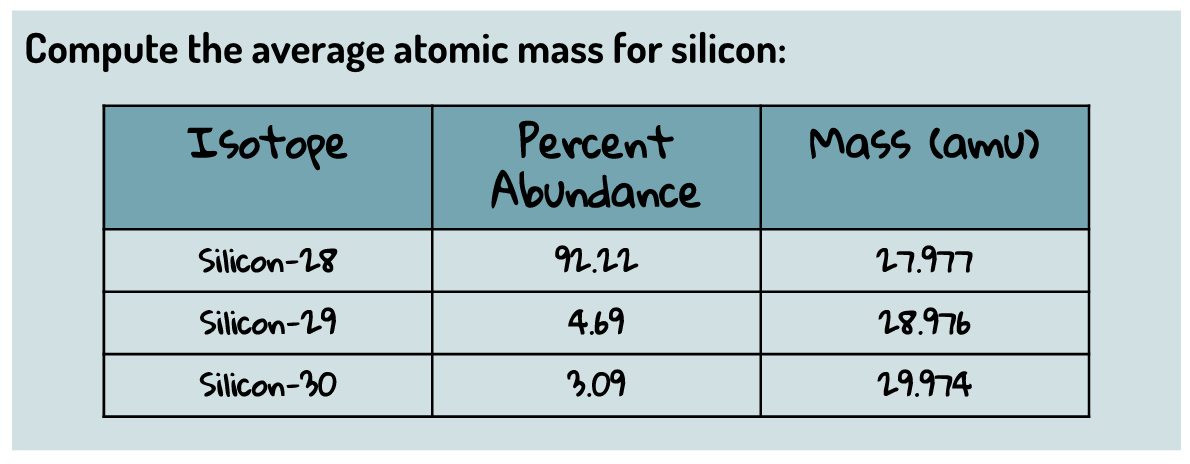
Compute the average atomic mass for silicon:
a)
27.977
b)
28.09
c)
28.976
d)
The average mass cannot be determined from provided information.
66.
What atom matches this electron configuration?
1s2s2p3s2
a)
Neon
b)
Magnesium
c)
Aluminum
d)
Potassium
67.
Which is the electron configuration for an oxygen atom?
a)
1s22s22p63s23p64s2
b)
1s22s22p4
c)
1s22s22p6
d)
1s22s22p63s23p6
68.
What is the maximum number of electrons that an orbital can have?
a)
1 electron
b)
2 electrons
c)
3 electrons
d)
4 electrons
69.
What atom matches this electron configuration?
[Xe] 6s2 4f14 5d9
a)
Mercury
b)
Gold
c)
Platinum
d)
Thallium
70.
How many electrons can the first energy level hold?
a)
1
b)
2
c)
8
d)
0
71.
Which element is pictured?
a)
neon
b)
fluorine
c)
magnesium
d)
argon
72.
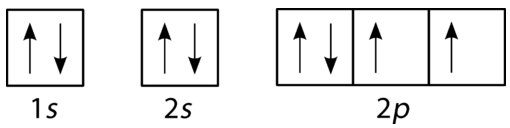
Which element is depicted from this orbital diagram
a)
Fluorine
b)
Neon
c)
Chlorine
d)
Argon
73.
This orbital diagram represents:  
a)
C
b)
B
c)
N
d)
O
74.
This orbital diagram represents:  
a)
C
b)
B
c)
N
d)
O
75.
Which orbital shows a violation of Hund's Rule?
a)
A
b)
B
c)
C
d)
D
76.
Which orbital shows a violation of the Aufbau Principle?
a)
A
b)
B
c)
C
d)
D
77.
Which orbital shows a violation of the Pauli Exclusion Principle?
a)
A
b)
B
c)
C
d)
D
78.

The measurement 0.035550 g rounded off to two significant figures would be

a)

0.03

b)

0.35

c)

0.036

d)

3.5 x 10²

79.

What is the formula for the compound formed by calcium ions and chloride ions?

a)

CaCl

b)

Ca2Cl

c)

CaCl3

d)

CaCl2